Driving the Accord
Uses the speech voice supplied by your browser or device.
Acronyms used in this post: US means United States, the country where I studied and worked for many years. UTSA means University of Texas at San Antonio, the university where I studied in Texas. PhD means Doctor of Philosophy, the long academic apprenticeship where one learns, among other things, how slowly hope can be institutionalized. AI means Artificial Intelligence, the new machine intelligence now peering into every phone, office, drawing room, political slogan, and poor man’s job anxiety.

The water bottle gives a small hollow knock when I set it down on the floor. Plastic on tile. Tok. A sound so ordinary that most days it would vanish into the great municipal dustbin of life, along with the ceiling fan’s tired whirr, the pressure cooker’s whistle from the next flat, and the cough of a scooter downstairs being persuaded to remain alive.
But today I hear it.
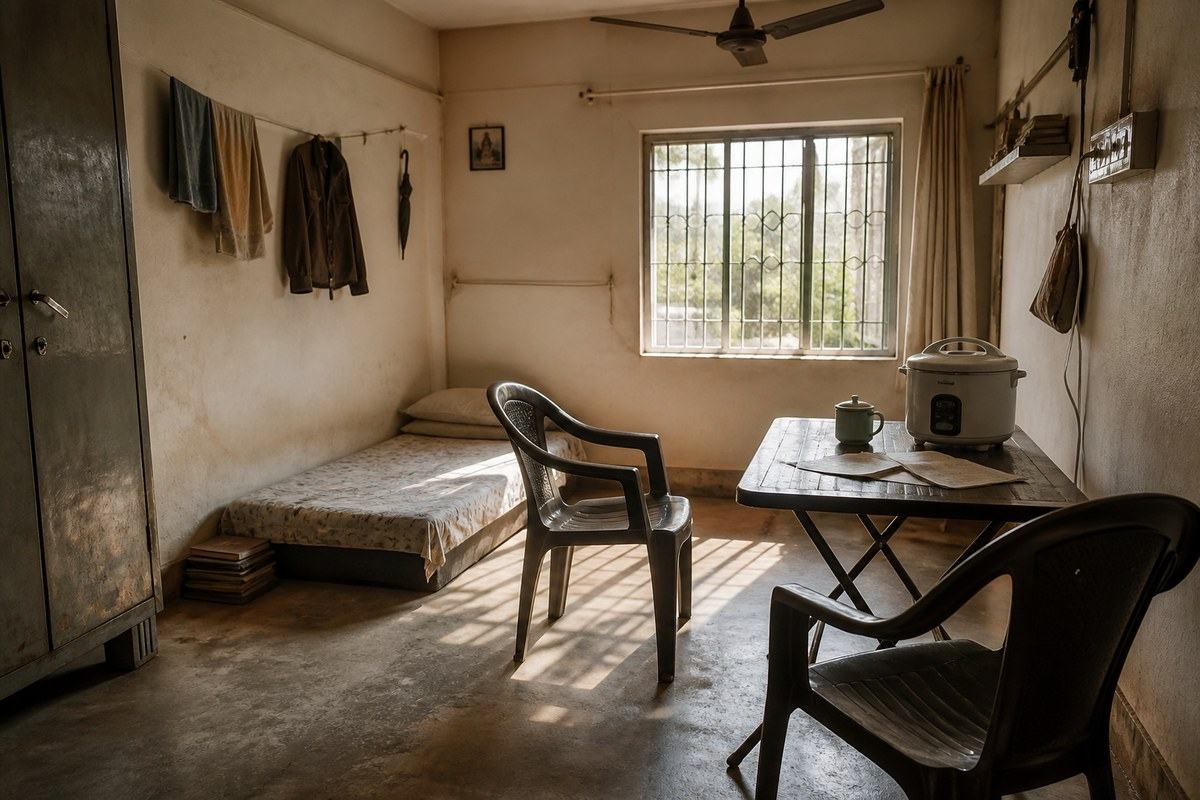
This is how a year begins when you are not rich, not young, not married, not properly employed, and not in possession of one of those glossy lives where people photograph croissants from above. It begins with a bottle, a mattress, a rice cooker, an old laptop, a phone, a tablet, and books leaning against the wall like slightly drunk witnesses.
It is January 1, 2026. Physics does not care. Marketing cares deeply. Every app, shop, bank, news channel, and gym poster is suddenly drunk on renewal. New year, new you. As if the old you had been returned under warranty.
My brain, regrettably, also notices. Not because I have become spiritual. No conch shell. No cosmic sitar. No divine accountant opening a fresh ledger. Just the small click of a mind trained to notice calendar edges, like a laboratory rat who has learned that sometimes a bell means food and sometimes it means another electric shock from reality.
The mattress is on the floor, doing what mattresses do best: accepting collapse without comment. Beside it sits the water bottle. Then the rice cooker, that little priest of starch. Then a pot for tea. Then the Samsung phone, hot with world events, spam, family silence, AI miracles, political shouting, and delivery notifications. Then the tablet, smooth and smug. Then the laptop, old enough to need encouragement before opening Chrome.
And books.
Books everywhere. Books stacked with the moral seriousness of people waiting outside a ration shop.
This is my present.
The past had wheels.
I miss zipping past things. Now everything zips past me.
That old photograph is from the years when I drove my Honda Accord roughly 260 kilometers between Austin and San Antonio three times a week. I did this for years. At the time it felt tiring, expensive, mildly mad, and somehow normal. Youth is a dangerous editor. It takes absurdity and labels it routine.
The Accord made distance feel negotiable. Press the pedal, hold the lane, and Texas opened like a long hot sentence. The road shimmered. Trucks wobbled in the heat like they had been painted in water. Small towns appeared with one main street, one church, one gas station, and one water tower standing proudly like a man in a cheap suit at a wedding.
There were detours too. Country roads. Construction exits. Confusing Austin downtown one-way streets where I would suddenly find myself trapped in civic geometry, muttering like a Bengali uncle trying to assemble Swedish furniture without glasses. Then I would escape toward San Antonio, Houston, Dallas, Amarillo. The names themselves had scale. They sounded like chapters in a sunburnt American epic.
Here in South Calcutta, my world is smaller.
Not poetically smaller. Actually smaller.
I have no car, no house, no mate. I am a man in a room with a few reliable objects and several unreliable thoughts. If you are comfortably off, objects are background. If you are near the bread line, objects become biography. The bottle says: he drinks water. The rice cooker says: he still feeds himself. The laptop says: he is still trying. The books say: he has not entirely surrendered to the great Indian national hobby of becoming mentally dead while remaining socially active.
My first car in America was not the Accord. It was a burgundy Toyota Tercel, bought second-hand from a Japanese man. There was something almost ceremonial about it. I did not feel I had bought transportation. I felt I had been adopted by a reliable family.
That first weekend I drove into downtown San Antonio with two Japanese girls from Oak View Apartments near UTSA. I was then technically a PhD student, before life quietly took out a red pen and corrected me into a master’s student. This was 1998 to 2000, when I still believed the future was a large American supermarket aisle and I merely had to choose the correct cereal.
A PhD, at that age, sounded noble from outside and slightly deranged from inside. It was the academic version of standing at a bus stop after the last bus had gone, insisting that public transport was a philosophical problem.
The Tercel died later in Austin after I pushed it too hard on the highway. US 183 South, I think, though memory has melted the road signs into one Texas soup. It did not die politely. It gave up with drama, like a minor actor determined to be noticed in the final scene.
Then came the Honda Accord.
Silver. Calm. Adult. Sensible.
Silver is a peculiar color. It wants to look futuristic but is actually the compromise candidate of the paint world. Not white, too pure. Not black, too final. Not gray, too defeated. Silver says: I have a job, but I still own sunglasses.
The Accord had dignity. It did not flirt. It did not boast. It did not make German-car noises about power and destiny. It simply started when asked. That is an underrated quality in machines and a miraculous quality in people.
The word “accord” means agreement, harmony, hearts brought together. I doubt Honda’s naming committee sat around chanting Latin like monks in a boardroom, but it still amuses me. The car had accord in its name while my own life was slowly becoming a committee meeting where every participant hated the agenda.
It lasted almost as long as the legal dissolution of my domestic peace.
That sentence looks simple. It is not.
It sits there like a dead mosquito on a white wall. Tiny, ugly, impossible to ignore.
People love saying cars are like relationships. They need maintenance. They break down. They must be cared for. This is usually said by someone who has either never owned a truly bad car or has been overgenerous to a truly bad relationship.
The better comparison is not romantic.
It is mechanical.
Objects betray you legibly. A battery dies. A belt cracks. A tire punctures. A hinge loosens. A phone battery swells into private resentment. You can inspect the damage. You can replace the part. Even when the object fails, it usually has the decency to fail according to physics.
Humans fail according to interpretation.
That is where the trouble begins.
A person can leave, change, withdraw, lie, reinterpret the past, weaponize kindness, forget your best years, remember your worst five minutes, and then explain the whole thing in language so polished you almost apologize for bleeding on the carpet. A machine may be cruel, but it is rarely theatrical. A toaster does not say, “I need space.”
This is why, in my reduced state, I have become absurdly tender toward objects.
My slippers have been more loyal than many relatives. They do not ask me to grow, which often means become useful to someone else. They do not ask about my income. They do not evaluate my social standing. They take the shape of my feet and continue until one day a strap breaks. Even then, the betrayal is modest.
The Samsung phone is more complicated. It is both tool and parasite. It wakes me, distracts me, feeds me news, poison, weather, war, cricket, stock photos of happiness, and videos of men explaining how to become rich by selling courses on becoming rich. It contains AI now, or claims to. Everything claims to contain AI now. Soon the neighborhood tea stall will advertise AI-assisted muri.
But the phone shows up. It keeps time. It vibrates. It glows in the dark like a small private shrine. It has been in my hand more often than any human hand in years, which is either a technological achievement or a social indictment. Possibly both.
The rice cooker is better. The rice cooker is honest.
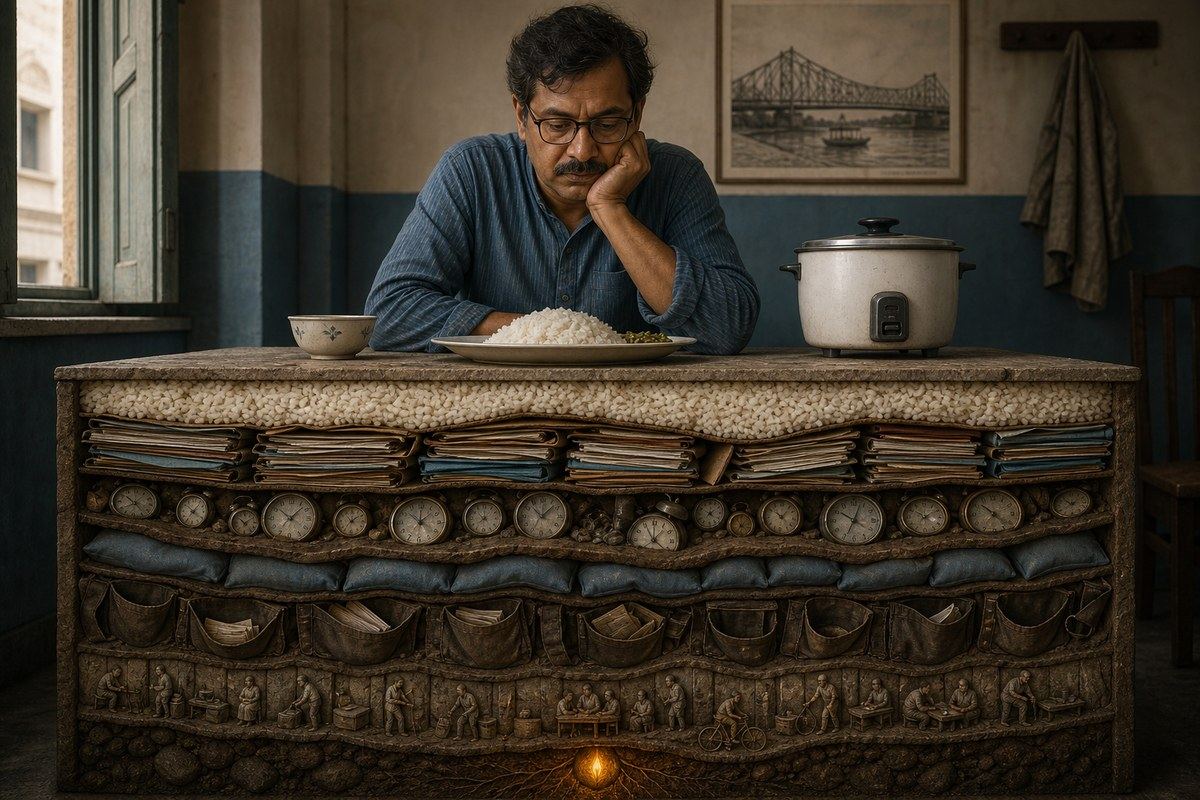
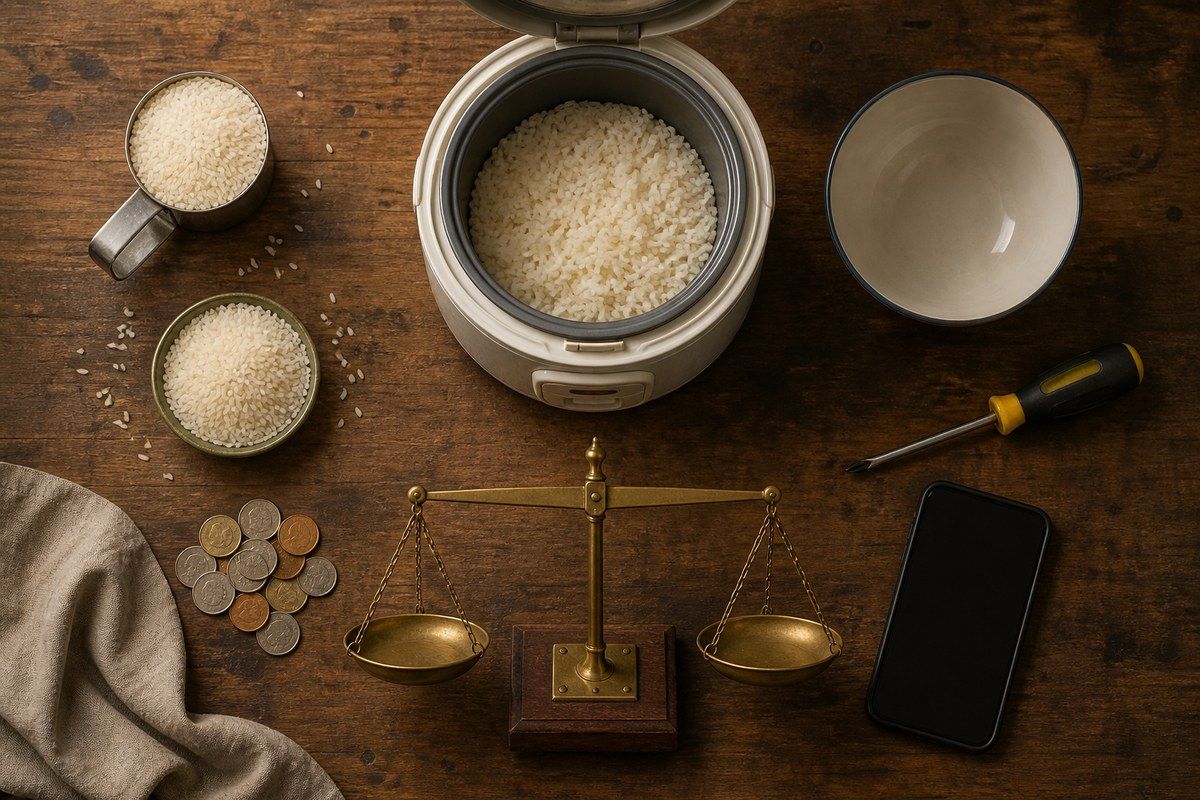
A rice cooker is a miracle so ordinary that we refuse to be amazed by it. In another century it would have been witchcraft. In my childhood it would have been a luxury. Now it sits in my room like a squat white monk and performs thermodynamics for lunch.
Water goes in. Rice goes in. Electricity enters like invisible labor. Steam rises. Then, at the proper moment, it clicks.
That click is civilization.
No slogan. No manifesto. No minister cutting a ribbon. Just heat, water, starch, and a small mechanical decision. In a country where drains overflow, bridges crack, files vanish, and everyone has a cousin who knows someone in an office, the rice cooker’s click feels almost Scandinavian in its moral clarity.
This is the point where some well-fed person might say, “But simplicity is beautiful.”
Careful.
There is chosen simplicity, and there is economic constriction wearing a clean shirt.
A monk owns little because he has renounced. A poor man owns little because the market has renounced him first. These are not the same, though society enjoys confusing them because it makes poverty look like character development.
If I were truly an ascetic, I would have serenity. What I have is inventory.
Bottle. Cooker. Laptop. Books. Charger. Medicine strip. Tea. Mattress. Phone. Repeat.
Outside, Calcutta continues its daily opera. The lane is narrow. Someone is shouting into a phone as if the microphone is in Bangladesh. A vegetable seller sings the price of potatoes with more melodic authority than most playback singers. A bus honks like a wounded rhinoceros. Somewhere, a political poster is peeling from a wall, revealing last year’s political poster underneath, which is probably the most honest history textbook we have.
The air has that burnt, dusty taste which makes your lungs feel like they have been lightly sandpapered. Men stand at tea stalls discussing world affairs with the confidence of generals and the budget of unemployed philosophers. Every few minutes someone says the country is rising. Usually while standing in front of a broken pavement.
I am not mocking them. I am one of them, only with a laptop and worse sleep.
The great problem with returning from America to India is not that one country is heaven and the other hell. That is childish. America has loneliness with central heating. India has community with sewage surprises. Pick your poison.
The problem is systems.
In Austin, if a road existed, it generally behaved like a road. If a bill arrived, it usually made some procedural sense. If you had to drive 260 kilometers, the journey had boredom, not mythology. A working system is not love. It is not kindness. But it is mercy. It leaves some part of your brain free for living.
In a broken system, every errand becomes an exam.
Will the electricity go? Will the app fail? Will the delivery man call from the wrong lane? Will the bank demand a document that proves another document that proves your existence to a person who does not look up from his phone? Will the road be dug up because some department remembered water after building asphalt over it?
A man has only so much mental petrol.
Mine leaks.
The Accord belonged to the years when petrol still became motion. Fuel in, distance out. There was something beautifully crude about it. Combustion is not affectionate, but it is dependable in the old blunt way: burn something, move forward, pay entropy, repeat.
I remember the steering wheel texture. The smell of warm plastic. The slight vibration when the car idled. The afternoon light on the dashboard. The quiet arrogance of being able to decide, at 5:30 in the evening, that I would drive to another city and arrive there.
That freedom was not only personal. It was infrastructural. Roads, salary, legal status, fuel stations, functioning maps, predictable danger. Freedom often looks like philosophy from a distance. Up close it looks like a full tank and no immediate fear.
Then came the deer.
There is no grand metaphor here, though the mind always tries to manufacture one. A deer came out. The car struck it. Or it struck the car. Memory has blurred the assignment of blame. What I remember is the shock of the planned life meeting the unplanned animal.
America has many such lessons. You can have insurance, a Japanese car, a legal job, a mapped road, and still a deer can arrive from the side of the universe.
At that time I was also medicated heavily enough to distrust myself behind a wheel. Xanax, Ambien, other tablets, the whole pharmaceutical panchayat sitting inside my skull. I began to fear sleep-driving, that terrifying possibility of movement without memory. Imagine waking not in bed but in the middle of your own life, engine warm, brain missing a few pages.
After that, distance lost its innocence.
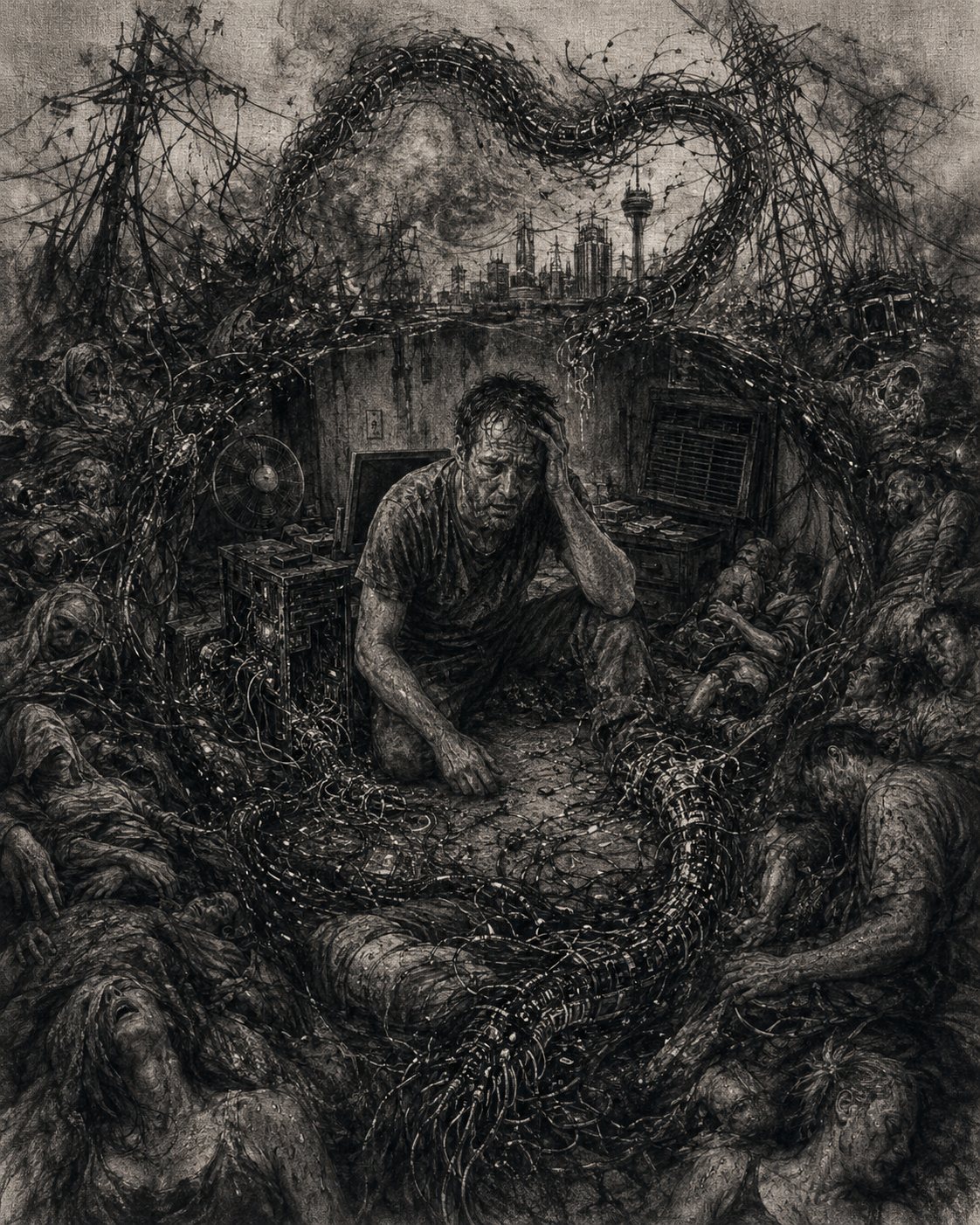
Later, in India, movement became harder for different reasons. The fear here is not only accident. It is air, crowd, humiliation, theft, random aggression, the little social electricity of a place where too many people are pressed into too little fairness. I have been roughed up before. Once violence has shaken your body, it rents a room inside you. It does not always live there loudly. But it keeps the key.
So here I am, in a room, on the first day of 2026, surrounded by things that do not ask questions.
And the strangest thing is this: they comfort me.
Not always. Not enough. But somewhat.
Books especially.
Books are dangerous because they make alternatives visible. A hungry person can be controlled. A busy person can be distracted. A frightened person can be managed. But a person who reads widely becomes difficult in a special way. He starts comparing the given world to other possible worlds. This is why every small tyrant, from the household bully to the national loudspeaker, dislikes reading unless it is the approved kind.
In India, we often prefer memory to inquiry, mythology to maintenance, spectacle to drainage. We will argue ancient glory with foam at the mouth and step over a broken manhole without noticing. Pride is cheap. Competence is expensive. Therefore we buy pride wholesale.
Meanwhile my books sit quietly, committing treason against despair.
A book does not ask whether I am successful. It does not ask why I am not earning more. It does not say, “At your age you should have settled.” It waits. Patient as sediment. Open me, it says, and for a few pages you may become larger than your room.
That is no small gift.
The old laptop does something similar, though with more wheezing. Its fan starts like an elderly tram. The keys shine with grease and long use. The screen flickers occasionally, perhaps from age, perhaps from moral fatigue. Yet it still opens a door. I can write. I can think. I can send one more proposal into the void. I can edit one more paragraph until it stops smelling of wet cardboard.
For a man who has lost many forms of social legitimacy, a working keyboard is not a gadget. It is a rope.
There is a cruel comedy in middle age. When you are young, people ask what you will become. When you are old, people ask how you are keeping. In the middle, especially if money is thin, they ask nothing. You become socially transparent, like one of those plastic folders in which old bills are kept.
And yet one remains alive. Annoyingly. Stubbornly.
Tea helps.
Tea is not a solution, but it is a negotiator. You put water on the boil, add leaves, milk, maybe ginger if the stomach permits optimism, and for five minutes the day becomes manageable. Not good. Manageable. There is a difference, and lower middle class life teaches it early.
A good cup of tea does not solve unemployment, aging, loneliness, air pollution, political decay, or the private circus of mood. But it creates a small table inside the mind where panic is asked to sit down and lower its voice.
That is worth something.
I sometimes think the Accord is not a car in my memory anymore. It has become a measurement instrument. It measures the distance between then and now. Then: a silver car, Texas highways, work, fuel, speed, a body that trusted motion. Now: a room in Calcutta, a bottle on the floor, a rice cooker click, and a man doing arithmetic with hope.
But even that is not the whole truth.
Because then also had fear, medication, divorce, exhaustion, immigration uncertainty, and the foolishness of believing motion meant progress. And now, for all its smallness, has clarity. Not happiness. Let us not become vulgar. Clarity.
The Accord moved me through space. The room forces me through thought.
I would still prefer the car.
Let us not over-philosophize poverty into a yoga retreat.
The Accord is gone now. Sold, scrapped, dissolved into the metal economy. Perhaps part of it is a bracket somewhere. Perhaps a piece of it sleeps in a junkyard. Perhaps its atoms are in another machine, another city, another life. Matter is wonderfully unsentimental. It does not hold reunions.
I remain.
On January 1, 2026, I sit with my inventory.
The phone says the world is burning, innovating, voting, collapsing, streaming, rebranding, and offering fifty percent off. The rice cooker waits for rice. The water bottle stands by like a dull transparent saint. The books lean in their private parliament. The laptop wheezes. The mattress accepts me without asking for rent, though of course the landlord does.
Outside, Calcutta coughs and argues and fries something in oil old enough to vote.
Inside, I pick up the bottle again.
Tok.
There it is.
A small sound. A cheap sound. A faithful sound.
The year does not begin with fireworks. Not for everyone. Sometimes it begins with plastic on tile, tea in a stained pot, a vanished Honda on a Texas highway, and the discovery that the things which keep you alive may not love you, but they do not leave before morning.
That will have to do for now.
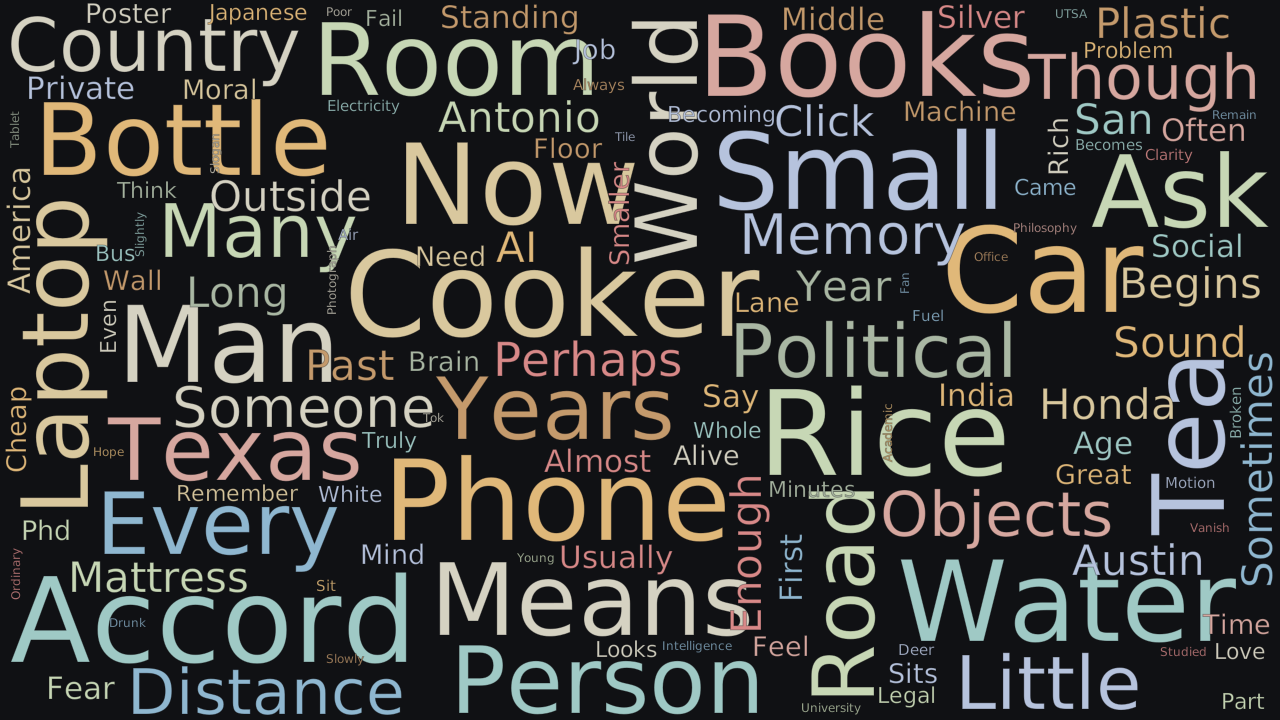
Word Cloud
Related reading
Selected by shared topics and section, with closer publication dates breaking ties.