Mindfulness?
Acronyms and Terms
DMN — Default Mode Network. A network in the brain associated with self-talk, rumination, memory wandering, and the endless mental commentary that shows up especially when you are lying awake at 3:47 a.m. remembering embarrassing things from 1998.
Uses the speech voice supplied by your browser or device.

When people talk about mindfulness meditation these days, they usually speak in the tone of someone recommending an expensive air fryer. Very calm. Very certain. Very suspiciously moisturized. Somewhere there is always bamboo furniture involved.
But when I hear the word mindfulness, I think of writing.
Because writing is the only time my head sometimes stops behaving like Sealdah station during Puja rush hour.
Otherwise the mind is chaos. Absolute municipal chaos. Thoughts crossing each other without signals. One memory reversing into another. Anxiety honking from behind. Regret hanging from the footboard. Some half-dead ambition lying on the tracks smoking a bidi. The whole thing held together with frayed electrical wires and optimism.
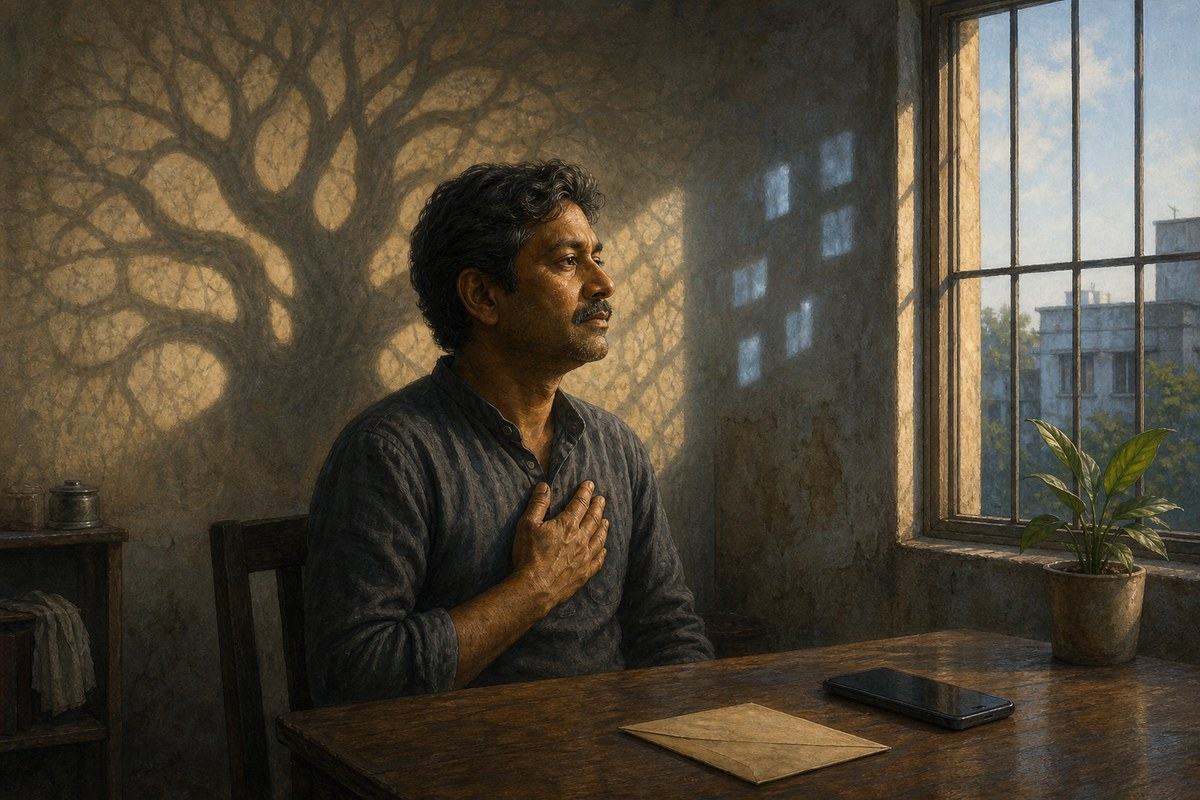
And then I sit down to write.
Not because I think I am a writer. God forbid. Calcutta already has enough unemployed intellectuals with jhola bags and opinions about cinema from 1963. But writing does something strange. It slows the traffic down just enough for me to inspect the wreckage.
You notice things.
A fear that looked gigantic becomes small and shabby under a sentence. Anger loses some steam once words trap it like mosquitoes under a glass tumbler. Not always. Sometimes writing makes things worse. Sometimes it is like poking a drain with a stick and discovering the drain had ambitions.
But at least the thoughts become visible.
That matters.
Most people, I think, walk around carrying entire thunderstorms inside them while discussing coriander prices or mobile recharge plans.
Anyway, it is around 4 a.m. now while I write this. I just came back from the bathroom after producing something biologically impressive enough that some poor downstream septic pipe may require counseling later. The tea beside me is getting cold already. Outside, somewhere in the lane, two dogs are having a philosophical disagreement. One auto passed a minute ago sounding like it was assembled from old pressure cookers.
The city is still mostly dark.
This is the best time in Calcutta. Before the humidity wakes up.
Because once the sun properly arrives, the atmosphere here becomes like somebody draped a warm wet towel over the face of existence. You step outside and immediately feel marinated. February is ending now. These are the last few mornings where the air still remembers kindness.
Then comes summer.
Then comes suffering.
Then comes mango.
Civilization continues somehow.
Now the funny thing about meditation is that it is actually absurdly simple. The whole industry around it is complicated. The thing itself is not. Sit quietly. Focus on your breathing. Your mind wanders. Bring it back.
That’s all.
You do not need a guru from Rishikesh who speaks like he swallowed a poetry calendar. You do not need a bald Scandinavian man renamed “Shantidev” after a three-week retreat in Dharamshala. You do not need incense costing more than fish curry ingredients.
Just breathe.
That’s the irritating part. The thing actually works.
Not magically. Not spiritually perhaps. But mechanically.
Your attention behaves a bit like an untrained puppy. Meditation teaches it to sit for five seconds without chewing the sofa. The mind wanders. You bring it back. Wanders again. Bring it back again. Thousands of repetitions. Very boring.
Especially the boring part.
People underestimate boredom. Boredom is why modern civilization exists. Human beings will invent cryptocurrency, colonize Mars, destroy democracies, and watch fourteen hours of conspiracy videos simply to avoid sitting quietly with their own thoughts for ten minutes.
Meditation forces the confrontation.
And after a while you begin noticing odd little things. You become slightly better at listening during boring conversations. Slightly less reactive. Slightly less likely to mentally stab somebody because they are chewing loudly near you.
Not enlightened.
Just marginally less unbearable.
Though in my case the machinery underneath is probably too damaged for breathing alone to fix. Bipolarity is not sadness. People confuse these things. Sadness is weather. Bipolarity is climate. Sometimes the brain behaves like a ceiling fan with only two settings: hurricane and dead goat.
You adapt.
Or pretend to.
That is another reason I dislike the wellness industry around mindfulness. It often sells meditation like deodorant. As though every mental problem can be solved with enough scented candles and self-love podcasts. Some problems are biochemical. Some are structural. Some are loneliness wearing different hats.
And loneliness is a strange animal in middle age.
At 51 you start becoming invisible in a particular way. Society no longer expects greatness from you, which honestly is a relief. Nobody is asking me to disrupt industries or optimize synergies or whatever fresh management diarrhea LinkedIn has invented this week. Mostly I survive quietly now. Small consulting work. Tea. Medicines. Anxiety. Occasional writing. Watching wall geckos hunt mosquitoes with more focus than most corporate executives bring to meetings.
The gecko, by the way, always finishes the task.
Meanwhile humans hold workshops about productivity.
I avoid people more these days. Animals are simpler. Cats never ask where your career is going. Street dogs do not care about your net worth. Crows will judge you, certainly, but at least honestly. Human beings, on the other hand, have developed entire industries around pretending.
Sometimes I sit near the tea stall and just observe the city waking up. A delivery boy scrolling his phone with dead eyes. A man brushing his teeth beside an open drain. Schoolchildren already exhausted before adulthood has even started chewing on them. Somebody discussing America loudly without owning a passport. Somebody else explaining geopolitics while scratching fungal eczema.
Then a luxury SUV glides past.
That contrast is Calcutta in one frame.
This city is extraordinary that way. Brutal, funny, vulgar, affectionate, diseased, alive. One side of the road has a shiny glass building with biometric access control. The other side has a family bathing beside a leaking municipal pipe. Nobody pauses to explain the contradiction anymore. The city has stopped apologizing for itself.
Foreign YouTubers love this of course.
They arrive carrying cameras that cost more than an entire para earns in a month, hunting “raw India.” They film old men drinking tea, children flying kites over garbage, tram lines, rain puddles, slums, temples, yellow taxis. Then somewhere in Europe or America people watch these videos while eating expensive cheese and murmuring things like “So authentic.”
Meanwhile the fellow being filmed is just trying not to miss his bus.
Human civilization is comedy written by exhausted monkeys.
And yet, despite all my grumbling, there are moments — tiny moments — when life becomes strangely clear. Usually while writing. Or very early morning. Or when rain begins suddenly and all the neighborhood sounds soften together. In those moments the noise in my head drops just enough that I can hear myself think.
Not happiness exactly.
More like temporary armistice.
Which, honestly, is already quite a luxury.
To give full credit and support to the original creator, please click the video title and watch it on YouTube. Once you go to their channels, you will discover many more videos that are not here. My linking them here is not to take traffic away from them or YouTube where they make a few cents, but to introduce them to a wider world who may not have yet stumbled on them.
Word Cloud
Related reading
Selected by shared topics and section, with closer publication dates breaking ties.