The AI Cloud Will Also Need a Pump, a Plug, and a Tanker
Uses the speech voice supplied by your browser or device.

Acronyms used here:
AI: Artificial Intelligence, software that can generate, classify, predict, summarize, recommend, detect, or automate tasks once thought to require human intelligence.
GPU: Graphics Processing Unit, a specialized chip that performs many calculations in parallel and is now the workhorse of modern AI.
MW: Megawatt, one million watts of power.
GW: Gigawatt, one thousand megawatts.
TWh: Terawatt-hour, one billion kilowatt-hours of energy.
PUE: Power Usage Effectiveness, a data centre efficiency measure comparing total facility energy use with the energy used by the computing equipment itself.
WUE: Water Usage Effectiveness, a measure of how much water a data centre uses relative to the energy used by its computing equipment.
SLA: Service-Level Agreement, a contractual promise that a system will remain available or perform at a certain level.
DG: Diesel Generator, a backup generator that runs on diesel when grid power fails.
NCR: National Capital Region, the larger urban region around Delhi.
CGWB: Central Ground Water Board, India’s government agency for assessing and monitoring groundwater.
EIA: Environmental Impact Assessment, a formal review of how a project may affect land, water, air, people, and ecology.
ZLD: Zero Liquid Discharge, a wastewater approach where liquid discharge is minimized by treatment and reuse.
The cloud is not in the cloud. It is in a building with guards, transformers, cooling equipment, backup diesel, thick cables, nervous engineers, and enough electricity demand to make an old neighborhood transformer quietly consider retirement.
That is the first thing to remember before anyone starts chanting AI like a temple bell, though as an atheist I prefer my bells kept where they belong, preferably far from public policy. AI is not weightless. It is not just an app glowing politely on your phone. It is a new kind of factory. Instead of shirts, steel, biscuits, or cheap plastic buckets, it manufactures answers. Some useful. Some idiotic. Some dangerous. Some so bland that even a government circular would ask them to loosen up.
But the factory still needs power.
And water.
And land.
And priority.
There. That last word is the real snake in the grass.
India is building AI data centres because India has to. Let us not pretend otherwise. A country of our size cannot rent its computational future forever from America, China, Singapore, and whoever else has already built giant machine rooms and named them after clouds, regions, zones, and other weather events. Indian banks, hospitals, courts, schools, farms, railways, language systems, identity platforms, cybersecurity teams, and researchers will need local compute. Bengali, Hindi, Tamil, Telugu, Marathi, Malayalam, Assamese, Odia, Urdu, and the whole noisy railway platform of Indian languages cannot wait politely for Silicon Valley to notice that India is not one accent with subtitles.
So yes, India needs AI infrastructure.
But India also has summer.
India has coal.
India has weak local grids.
India has groundwater falling like a failed exam result.
India has cities where water arrives like a visiting dignitary, briefly, with ceremony, and then disappears.
I live in Kolkata. Not postcard Kolkata, not literary Kolkata where everyone quotes Tagore under a rain-washed window. I mean the shabbier edge of the city, the rented-flat, sweaty-shirt, inverter-battery, mosquito-coil, transformer-humming Kolkata. The Kolkata where a fan slowing down is not an electrical event but a psychological one. The Kolkata where a power cut changes the air in the room. First silence. Then heat. Then irritation. Then the small private despair of a middle-aged man who has seen enough systems in America to know that reliability is not magic. Somebody paid for it. Somebody planned it. Somebody maintained it.
Somebody was considered worth protecting.
This is where the AI data centre story stops being a technology story and becomes a social story with wires attached.
India’s data centre capacity has grown quickly. Official and market estimates vary, but the direction is not mysterious. We are moving from a relatively small base toward several GW of data centre capacity over the next few years. The AI push adds a new hunger to this. GPUs do not sip electricity. They eat like wedding guests after the fish fry has arrived.
A normal web server is one thing. AI training and high-volume AI inference are another. The more models we train, the more queries we run, the more videos we generate, the more “summarize this meeting” requests we throw into the machine because nobody had the courage to cancel the meeting, the more power these facilities need.
Now someone will say, correctly, that data centres are still only a small share of India’s total electricity consumption.
That sentence is true.
It is also incomplete in the way saying “only one room is on fire” is incomplete when the room is next to your kitchen.
Power is not just a national number. It is local. It is time-based. It is political. A data centre does not merely need electricity. It needs clean, steady, high-quality, almost-never-failing electricity. Your fan can stop and you curse. Their server stops and lawyers wake up.
That difference matters.
A data centre gets strong connections, redundant feeds, power conditioning, backup systems, battery banks, DG sets, special planning, and people whose job is to prevent interruption before interruption even puts on its slippers. A citizen gets a complaint number.
This does not mean a data centre is stealing electricity from your bedroom like a cartoon thief carrying a sack marked “voltage.” It is subtler and therefore more dangerous. Large industrial users shape where upgrades happen. They influence which substations are strengthened. They justify new transmission lines. They attract officials, clearances, concessions, and urgency. The grid begins to harden around them.
Meanwhile, the ordinary locality remains ordinary.
A small national load can create a large local imbalance. A 100 MW campus with firm contracts is not the same as 100 MW spread across households. In arithmetic, perhaps. In life, no. A rich man buying ten thousand litres of water every day and ten thousand poor households each saving one litre are the same only to someone who has never stood with an empty bucket.
And water is the quieter terror.
Servers produce heat. Heat must go somewhere. In cold countries, the surrounding air helps. In India, the surrounding air often behaves like a wet towel left in a locked taxi. Hot. Damp. Unhelpful. Cooling becomes serious engineering.
Some data centres use more air cooling. Some use chilled water. Some use evaporative systems. Newer AI facilities may move toward liquid cooling because GPUs packed tightly together behave like a small electronic furnace. Each approach has trade-offs. Save power, spend water. Save water, spend power. Spend money, improve both. Avoid spending money, create a future newspaper investigation.
There is no free lunch. There is not even free muri.
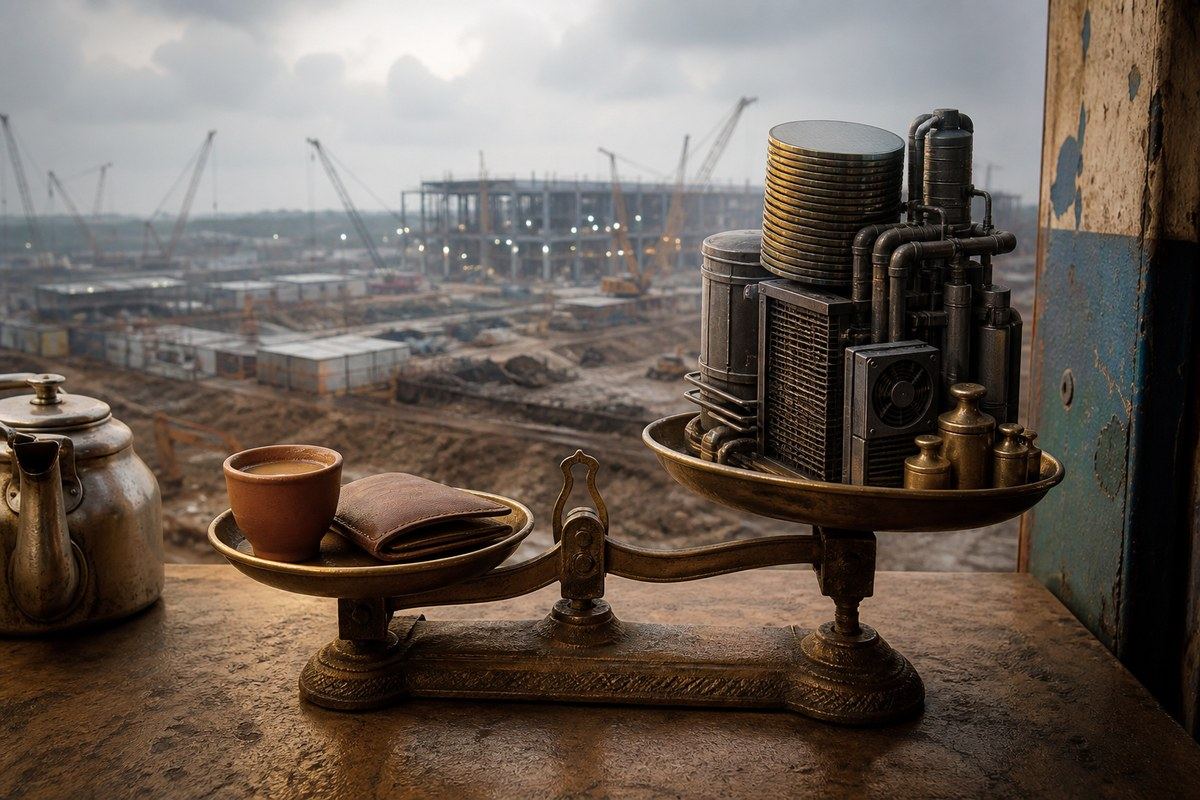
A data centre in a water-stressed Indian city is not just a technology asset. It is a new mouth at the municipal tap.
This is why location matters. Mumbai has cable landing stations and commercial gravity. Chennai has connectivity and a big data centre ecosystem. Hyderabad and Bengaluru have technology depth. Delhi-NCR has demand and proximity. West Bengal wants data centre investment too. State policies speak of capacity, parks, investment, jobs, digital growth. The words are smooth. They go down easily.
Then you remember the pump.
You remember that in many places water is already a negotiation between municipality, groundwater, tanker, storage drum, and luck. You remember that climate change is not coming later with a polite appointment. It is already here in heat waves, erratic rainfall, flooding, cyclones, sweating nights, failed crops, and city drains that give up like overworked clerks.
So when a policy says data centres need continuous water supply for cooling, a citizen is allowed to ask: continuous for whom?
For the machine room?
For the apartment?
For the basti?
For the tea stall?
For the old woman filling bottles before the pressure drops?
This is not anti-technology. This is adult suspicion.
The easiest villain is AI. But AI is not quite the villain. The villain is bad accounting. The villain is pretending that compute is abstract while its costs are physical. The villain is annual greenwashing, where a company says it has matched its electricity with renewable purchases over a year, while the grid still burns coal at night to keep everything alive. The villain is calling water use “efficient” without asking whose watershed is being tapped. The villain is building private reliability inside public fragility.
A country can do this foolishly or intelligently.
Foolishly means: announce data centre parks, give tax incentives, promise power, allow groundwater stress to be somebody else’s spreadsheet, celebrate investment, and discover five summers later that the local people are angry, the grid is strained, the diesel generators are louder than expected, and the green claim has more holes than a cheap umbrella in a Kalboishakhi storm.
Intelligently means: treat data centres as power-water-climate infrastructure from day one.
Not IT buildings.
Not real estate.
Not “digital economy assets” floating above the mud.
Infrastructure.
That means every large data centre should disclose its power source, backup fuel plan, PUE, WUE, water source, wastewater reuse, heat strategy, and local grid impact. Not in a 300-page PDF written to anesthetize mammals. In public numbers. Plain numbers. Numbers a journalist, engineer, resident, student, or mildly enraged Bengali uncle can understand after one cup of tea.
It also means no freshwater cooling in water-stressed areas unless there is no practical alternative and the public knows why. Treated wastewater should be the default where available. ZLD should not be a showroom phrase. It should be required where water stress is real.
And power claims must become hourly, not annual. If a data centre runs at night, show what powers it at night. Solar power at noon cannot morally launder coal power at midnight merely because both appeared in the same annual report and shook hands.
Then there is diesel.
Every Indian knows diesel backup. It is the unofficial national hymn of institutional reliability. Hospitals have it. Apartment blocks have it. Offices have it. Wedding halls have it. Data centres will have it. In genuine emergencies, fine. But if DG becomes the hidden spine of AI reliability, then we have built a future that smells faintly of fumes.
The bigger question is not whether AI data centres should exist. They will. The question is what kind of AI deserves scarce Indian reliability.
AI for agriculture, weather prediction, flood modelling, public health, language access, education, courts, scientific research, medical triage, and cybersecurity is one thing. AI for mass spam, synthetic junk video, manipulative advertising, corporate vanity projects, and machines writing reports for people who will not read them is another.
Both may pay.
But should both be treated equally by the state?
That is the question hiding under the table.
Because infrastructure is moral before it is technical. It decides whose discomfort counts. It decides which failure is unacceptable and which failure is merely normal. If a data centre cannot go down for twelve seconds but a neighborhood can lose power for four hours, that is not only an engineering condition. It is a ranking of human importance.
I am not asking India to reject AI. That would be like asking the monsoon to use email. Futile, theatrical, and faintly damp. India must build compute. Indian students must have access. Indian languages must not remain beggars at the English-speaking gate. Indian researchers need GPUs. Indian startups need affordable infrastructure. Indian public systems need domestic capacity.
But build it honestly.
Build it where water can support it.
Build it with real renewable power, not certificate perfume.
Build it with public reporting.
Build it with local grid upgrades that also help surrounding communities.
Build it with treated wastewater.
Build it with heat and flood planning.
Build it with rules for diesel.
Build it with the understanding that a tropical country cannot copy a temperate-country cloud fantasy and paste it near a stressed city.
Because the fear is simple. If the best power, best water, best land, best administrative attention, and best engineering urgency go to AI first, then the rest of us become background noise. We become the people outside the compound wall, sweating in the dark while machines inside answer questions about the future.
And perhaps one evening, when the fan stops again and the phone battery is at 11 percent, some chatbot running in a beautifully cooled data centre will tell me that India is becoming a global AI superpower.
I may even believe it.
But I will still want to know who got the electricity.
Word Cloud
Related reading
Selected by shared topics and section, with closer publication dates breaking ties.