Samir Ranjan Das and the Visual Mind
Uses the speech voice supplied by your browser or device.

Acronyms used: PhD means Doctor of Philosophy, the highest university research degree. US means United States, where many Indian scientists, engineers, and professors build long careers. OPNET means Optimized Network Engineering Tools, a simulation platform once used for modeling communication networks. AI means Artificial Intelligence, software that performs tasks associated with reasoning, language, prediction, and pattern recognition. Gini index means a statistical measure of inequality, where a higher number usually means a more unequal society.
Some teachers do not explain the world to you. They quietly loosen one screw in your head, and twenty-five years later the whole machine begins making a different sound.
I remembered my PhD advisor yesterday. Dr. Samir Ranjan Das. He was once my go-to person in that fragile, nervous, immigrant-student way: not a guru on a tiger skin, not a motivational wall calendar, but a serious mind nearby when the fog came down. I still respect him deeply. That matters. Respect, after fifty, becomes rarer than good fish in a late evening market. Most things by then have been handled too much, priced wrongly, and left under a weak bulb.
He lives in the US. I am glad he does.
That may sound odd, because we Bengalis have a theatrical attachment to return. Come back, we say. Serve the land. Build the nation. Eat muri, argue about Tagore, and die slowly under a leaking ceiling while someone’s cousin blocks your file. Bengal has a remarkable talent for losing its brilliant minds and then behaving as if the loss were an unfortunate weather condition. Ah, the monsoon came. Ah, the professor left. Ah, the drain overflowed. What can one do?
Quite a lot, actually.
But we usually do not.
There is no proper public register of this intellectual bleeding. No neat board at Howrah Station saying: this many toppers left, this many researchers left, this many teachers left, this many came back and were beaten into paste by office politics, family demands, municipal decay, and that special Indian invention, the permanently offended mediocre man. The best often go abroad and settle there. The lesser mortals who come back, like me, discover that the country has kept a welcome tray ready. On it are three items: a hockey stick, a lecture from relatives, and a silence so thick you can spread it on toast.
Samirda was light years ahead of most people I met. Technically sharp, intellectually clean, and modest in that old Bengali way which is now endangered, like the quiet tram conductor who knew every stop but never announced himself as a mobility solutions expert. He was not falsely sweet. He had no great patience for mediocrity. I liked that then. I like it more now.
Age is a dangerous spice. Add a little and life gets flavor. Add too much and every sentence tastes burnt. These days I find myself becoming familiar with the irascible side of aging. This is not helped by living on the far edge of Kolkata, where the day begins with the sound of pressure pumps, crows, bargaining, and someone somewhere trying to repair civilization with a hammer. You step outside and immediately the city offers you five subjects for indignation before tea.
Dengue returns to Kolkata with the punctuality of a bad subscription. Every season the mosquito arrives like a tiny flying auditor and reviews our drainage, governance, garbage, and civic imagination. It finds many opportunities for improvement. The city, poor thing, has become a poster child for what happens when public health is treated like a press conference rather than a daily discipline. Stagnant water, tired hospitals, heroic nurses, private bills, political smiles. The usual orchestra.
And yet this essay is not really about dengue.
It is about what a mind can do to another mind.
I went to Samirda in 1998 as a PhD candidate. His field was mobile wireless communication. I should confess, politely but honestly, that the subject did not make my inner sitar vibrate. Signals flew through the air, protocols negotiated, packets wandered about like confused relatives at a wedding, and I tried to look suitably scholarly. But something else happened. He introduced me to OPNET.
That was the crack in the wall.
I had always loved graphics. Diagrams. Visual structures. The strange relief of seeing an idea take shape. Some people can stare at code and hear music. I stare at code and often see a dead lizard until someone lets me draw the thing. Give me a graph, a state machine, a flow, a network of boxes and arrows, and suddenly the room lights up. The same lifeless instruction becomes a little city. Traffic moves. Signals change. Somebody is late. Somebody has taken the wrong turn. Now I can think.
This has bothered me for most of my life.
Not in a tragic way. More in the way a ceiling fan bothers you when it makes a faint clicking sound at night. You can live with it. But you cannot stop hearing it.
Why do some minds love symbols while others need shape? Why can one person build cathedrals out of pure code while another needs the scaffolding visible? Why does one brain swallow abstraction like rosogolla while another has to cut it into pieces, inspect the syrup, and ask whether the shop is trustworthy?
I do not know the full answer. But I know this much: Samirda, perhaps without intending to, gave me permission to take my own way of seeing seriously. He did not drag me into his exact intellectual house and force me to sit on the approved chair. He opened a door. The room beyond it was mine.
That is a rare gift from a teacher.
Many teachers hand you conclusions. Better teachers hand you tools. The best ones change your appetite. After them, you do not merely want answers. You want mechanisms. You want the back of the clock. You want to know why the trick works, why it fails, and why everyone in the audience is clapping at the wrong moment.
This is why I still find visual tools fascinating. Take something like InfraNodus. It lets you look at the internal structure of a text as a network of ideas. Suddenly a paragraph is no longer a paragraph. It is a neighborhood. Some words are crowded markets. Some are lonely tea stalls. Some are bridges. Some are decorative lampposts pretending to be infrastructure. You begin to see where the thought is dense, where it is thin, where it repeats itself, where it hides its real obsession.
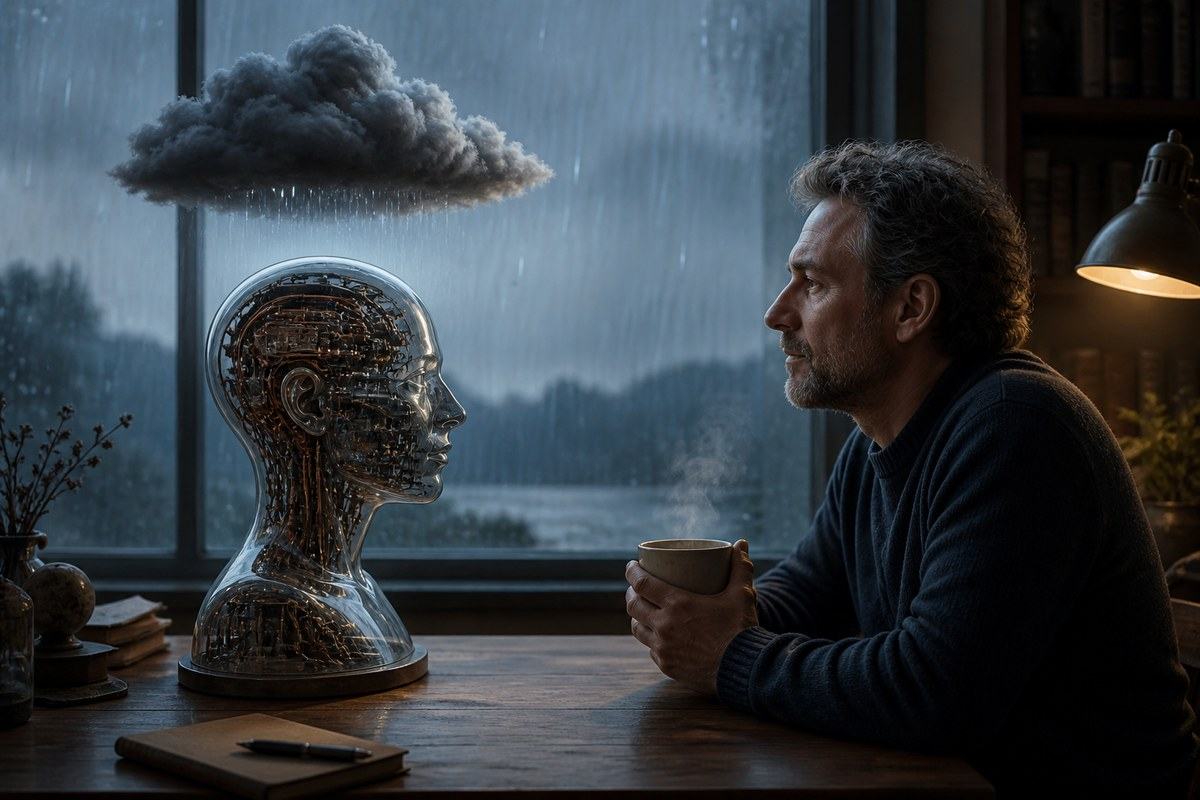
That matters even more now because AI has entered the room wearing a nice suit and speaking fluent confidence. It gives answers. Clean answers. Smooth answers. Sometimes useful answers. Sometimes rubbish in a silk kurta. But what is the shape inside the answer? What did it connect? What did it ignore? Which words became magnets? Which ideas were pushed to the edge like poor people during a beautification drive?
A black box is not made less black because it speaks politely.
This is where the memory of Samirda returns. The next few decades will need people like him. Not influencers. Not panelists. Not professional visionaries who say “disruption” with the seriousness of a man announcing a cyclone. We will need serious minds with technical depth, moral impatience, and the ability to detect nonsense before it becomes a government scheme, a corporate platform, or a university brochure.
Unfortunately, academia often cuffs such minds. A professor should be a live wire. Too often the system turns him into a form-filling mammal. Grants, committees, administrative rituals, performance metrics, ranking games, polite frauds. The mind that could help shape a country is made to attend meetings where everyone says “stakeholder” and nobody risks a thought.
Meanwhile the world is being steered by brawn and bluster. India is not unique in this. We should not flatter ourselves even in failure. Everywhere, money has grown muscles. Noise has grown wings. Mediocrity has discovered branding. And now AI arrives, not as a neutral angel, but as a machine entering an already unequal room.
Here is the part that should worry us.
AI may increase inequality not because it is evil, but because tools usually strengthen the hands that already have grip. The person with data, capital, English, bandwidth, institutional access, and legal cover gets a telescope. The person without them gets a fogged window. Then everyone is told the future is here. Wonderful. For whom?
The Gini index may not care about our poetry. It measures inequality with the cold manners of a clerk. But behind the number are human days. A man waiting for freelance work. A woman teaching tuition in a damp room. A graduate applying for jobs that ask for five years of experience in a technology invented last Tuesday. A middle-aged single fellow in the southern fringe of Kolkata, drinking tea that has gone slightly overboiled, wondering whether his life became a footnote while the world upgraded its software.
This is not self-pity. Self-pity is too luxurious. This is inventory.
And yet, strange as it sounds, gratitude survives.
I remember Dr. Samir Ranjan Das not because he solved my life. Nobody does that. Lives are not equations, and anyone who claims to solve them is usually selling a course. I remember him because he helped awaken a form of curiosity that remained mine through failure, detour, illness, return, unemployment, consulting scraps, and the long unglamorous business of trying to keep one’s mind from rusting.
That is not a small thing.
A teacher may not give you a destination. Sometimes he gives you a lantern. Years later, when the road is broken, the city is feverish, the bank balance is sulking, and the future is behaving like a badly trained goat, you discover the lantern still works.
So yes, I am glad Samirda stayed in the US. Let him keep august company. Let him be among people and institutions that know at least somewhat better how to use a mind like his. Bengal will still produce brilliance. It always has. But unless it learns how to hold brilliance without strangling it, the best minds will keep leaving, and the rest of us will keep standing under the leaking roof, arguing about heritage while the water rises around our ankles.
The mosquito will hum.
The machine will think.
And somewhere, if we are lucky, one good teacher will still open one small door in one confused student’s head.
P.S. Dr. Samir R. Das is Professor and Chair of Computer Science at Stony Brook University, part of the State University of New York system. His work is in mobile and wireless networking, especially protocols, systems, and performance evaluation. He earned his PhD in Computer Science from Georgia Institute of Technology, after earlier studies at Jadavpur University in Kolkata and the Indian Institute of Science in Bangalore, and worked briefly at Indian Statistical Institute. Before Stony Brook, he held faculty positions at the University of Texas at San Antonio and the University of Cincinnati. He directs the Wireless Networking and Systems Lab, known as WINGS, and is one of the authors of RFC 3561, the Ad hoc On-Demand Distance Vector routing protocol for mobile ad hoc networks. His public Stony Brook profile also notes his NSF CAREER Award, ACM MobiSys Best Paper Award, IEEE Computer Society Distinguished Visitor role, major editorial service, and leadership in premier mobile networking conferences.
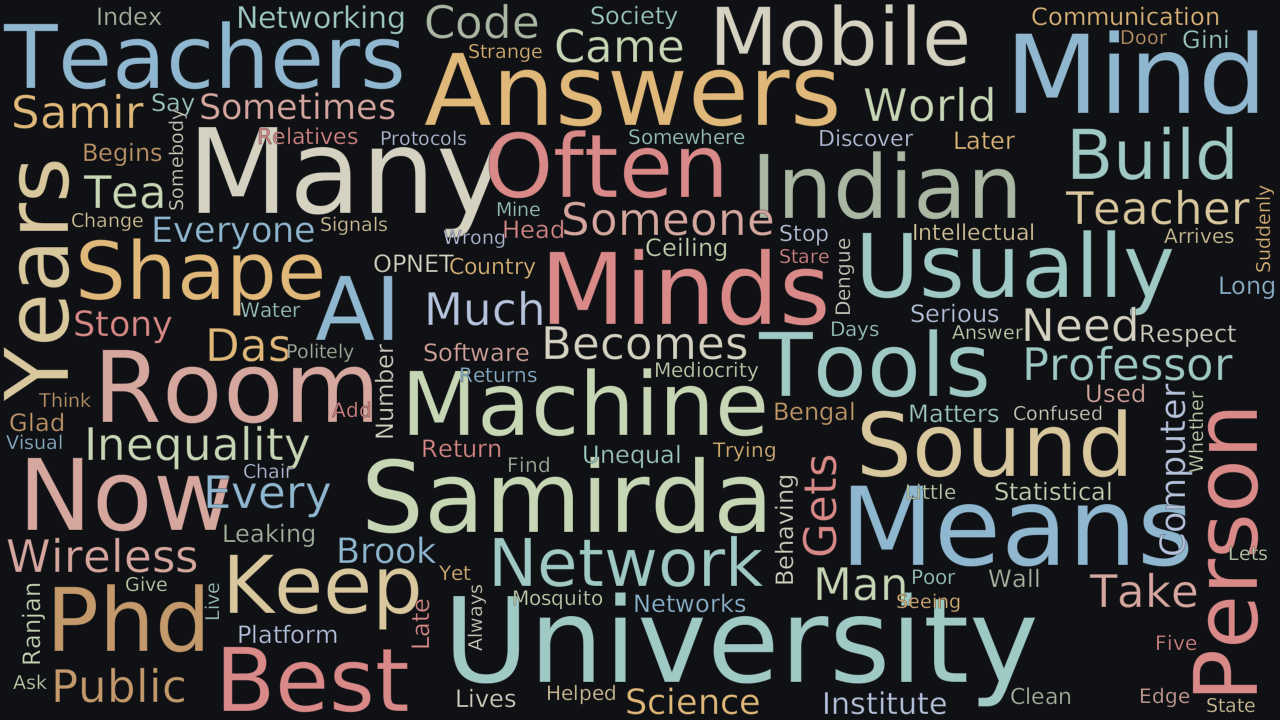
Word Cloud
Related reading
Selected by shared topics and section, with closer publication dates breaking ties.