The Dhoti, the Toothache, and the Great Bengali Flapping Problem
Uses the speech voice supplied by your browser or device.

A toothache is not pain. Pain is too polite a word, like saying the monsoon is a little damp or the local political party is mildly fond of wall-writing. A toothache is a tiny municipal demolition crew inside the jaw, arriving without notice, chewing paan, refusing tea, and beginning excavation at 11:47 at night when every dentist in the city has sensibly gone home.
Under such conditions I have reached a conclusion of some philosophical importance: most people, in sufficient proximity, are difficult mammals.
There. See how civilized I am being.
In my younger days, before the US furnished me with a few compact words for human disappointment, I would have used something more Bengali, more ripe, more ancestral. My father, in his last years, had perfected the art. He could insert an insult into ordinary conversation the way some people add green chilies to dal. Not much. Just enough to wake the dead. Only during his morning Gita reading did the household get a brief ceasefire, as if even language had to take off its slippers before entering that room.
The trouble with toothache is that it removes the false ceiling from character. The polite plaster falls. You see pipes, rats, old wiring, and one suspicious smell from 1988.
People with full stomachs, cooperative intestines, respectable bank balances, and teeth lined up like schoolchildren at assembly will not understand this belligerence. They will advise calm. They will suggest warm salt water. They will say, “Don’t think too much.”
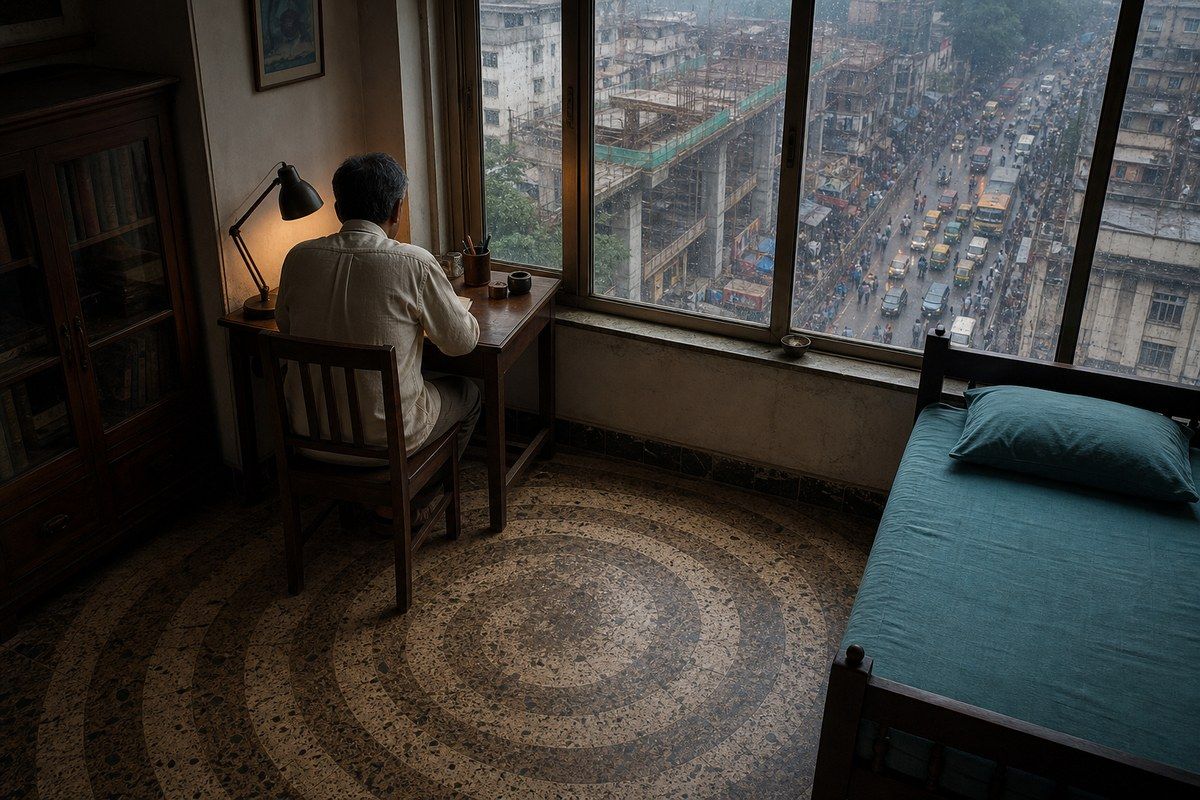
This is because they have not spent an evening in the shanty boondocks of Calcutta, single at 51, worrying about dental bills, consulting income, old age, the price of eggs, and whether the world has quietly become an enormous gated community where the gatekeeper has never heard of you.
Meanwhile, the news keeps arriving like a drunk uncle at a wedding. Somewhere a billionaire is buying another island. Somewhere a minister is inaugurating a bridge that may or may not survive the next serious rain. Somewhere artificial intelligence is promising to replace writers, doctors, clerks, poets, drivers, and possibly fishmongers, though I would pay good money to see an algorithm bargain with a Garia market fish seller and come out alive.
And here I am, unable to chew on one side.
Still, one must maintain ambition. One day I may again dress like a Bengali babu and go to a wedding. I have not been to one in years. At this rate, by the time someone remembers to invite me, my teeth will have left the premises like disappointed tenants. The invitation card will arrive embossed in gold, and I will be sitting with soup, dignity, and a face like an underfunded museum.
Then there is the dhoti.
What an object.
The dhoti is not clothing so much as an opinion. It declares that the wearer is prepared for poetry, litigation, afternoon sleep, and moral commentary, but not for sprinting. It is roomy, yes. Magnificently roomy. A whole village dispute could take shelter inside one in a storm. But useful? Only if your life involves standing, sitting, blessing, scolding, or walking at the speed of ancestral memory.
No race should make major civilizational claims while wearing a garment that can be defeated by a bicycle chain.
Perhaps this is why we Bengalis became so attached to talk. Talk is safe in a dhoti. Debate is safe. Literary criticism is safe. Revolution is safe, provided it happens after tea and within walking distance. But factory work, football, emergency plumbing, or running after a bus? The dhoti becomes less a garment and more a conspiracy.
I know this is unfair.
But irritation is rarely a fair-minded historian. It is more like a para club secretary with a microphone: loud, selective, and convinced of its own importance.
Still, those old black-and-white photographs trouble me. The forefathers sit there in their dhotis, grave as unpaid judges, looking as if Bengal’s decline was caused entirely by someone else. Beside them the foremothers sit with sealed faces, carrying the whole household in silence: rice, grief, fever, children, accounts, gossip, desire, endurance, and the eternal question of who left the wet towel on the bed.
They look absurd.
They look tender.
They look like us before we became us.
And perhaps that is the most irritating part. I mock them, but I carry them. Their laziness, their wit, their vanity, their music, their sulking, their impossible hunger for respect. Their genius for complaint. Their tragic faith that a sentence, properly sharpened, can still wound the universe.
The tooth goes on throbbing.
The city goes on sweating.
The dhoti flaps somewhere in history, triumphant and useless, like a white flag that refuses to surrender.
Word Cloud
Related reading
Selected by shared topics and section, with closer publication dates breaking ties.