Tea with George Orwell
Uses the speech voice supplied by your browser or device.

A teacher once praised my English essay, and the damage was permanent.
Not spectacular damage. No lightning. No violin. No sudden entry of a publisher in a white Ambassador car, stepping out with a contract and two sandesh. It was quieter than that. My teacher Ira Paul said something kind about what I had written, and a small illegal structure went up inside my head. You may know the type. In Calcutta we understand illegal structures. They begin as one hopeful brick and then, before anyone notices, there is a balcony, a flowerpot, three wires, and a man in a lungi arguing that it was always part of the plan.
That compliment became one such balcony.
From then on, I had the dangerous suspicion that my thoughts, if washed, combed, and made to sit straight, might pass as sentences. Not grand sentences. Not sentences wearing velvet coats. Just useful ones. The kind that could catch a passing mood before it ran into the drain with the afternoon rainwater.
Later, off and on, I found that writing things down helped. Diarizing is a fancy word for it, but the act itself is humble. You take the daily grind, which usually arrives like an unpaid electricity bill, and you put it into words. The day says, “I am meaningless.” You say, “One minute, let us check the evidence.”
And evidence appears.
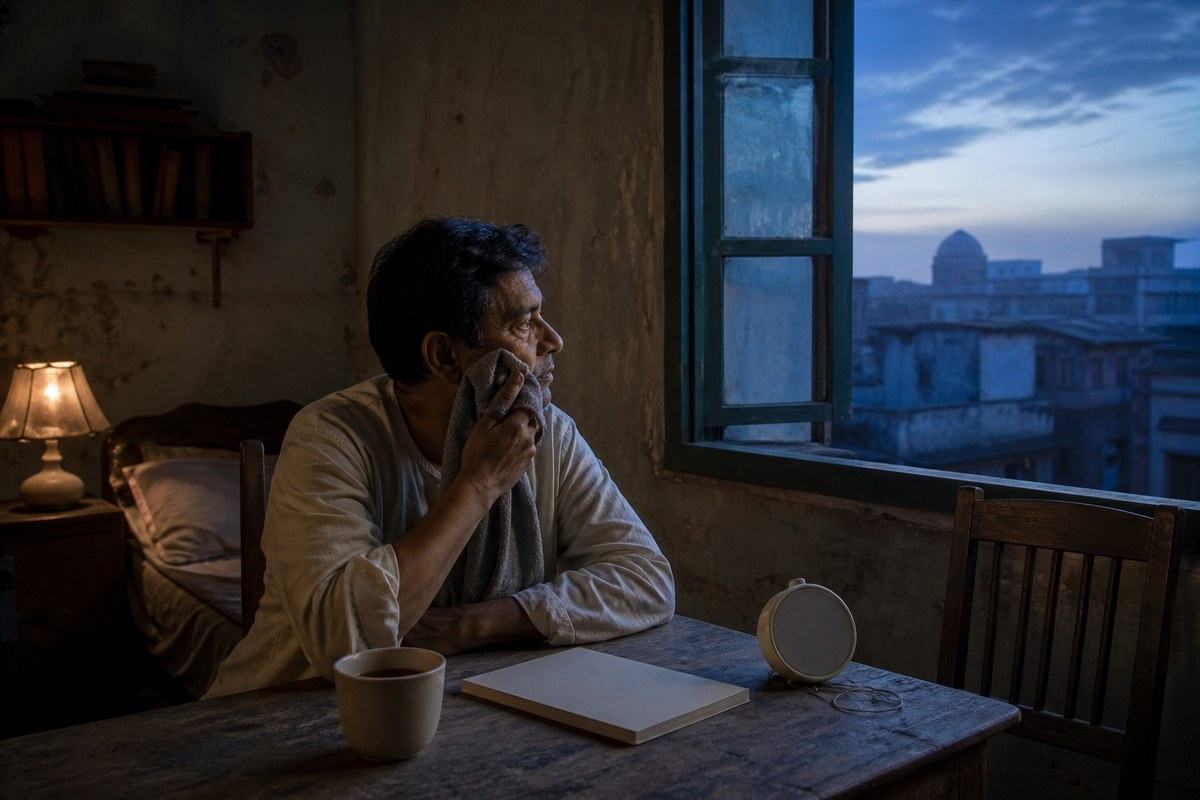
The tea was too sweet. The ceiling fan made a noise like a small helicopter losing faith. The phone showed three pieces of bad news, none of which I could influence, which is the modern citizen’s main hobby. Somewhere in the lane a scooter coughed. Someone’s pressure cooker whistled with the authority of Parliament. I had no great victory. I had no great defeat. Yet by night the day had become material. Not gold. Not even brass. But material.
That is the first miracle of a diary. It does not make life noble. It makes life visible.
The second miracle is more embarrassing. It shows you that you are not as original as your suffering claims. We all like to think our private misery is a special edition, leather-bound, signed by the author. Then the diary slowly reveals the cheaper truth. Fear repeats. Hope repeats. Vanity repeats. Laziness repeats wearing a new shirt. The human animal, our proud Homo sapiens, is very often the same old goat standing in a different patch of grass.
And yet.
The details are everything.
A man in London is lonely in fog. A man in Motihari is born under empire. A boy in Calcutta waits for a teacher’s red pen. A middle-aged single fellow on the shabby edge of the city sits with tea, anxiety, and a book that makes his mind voluble. Same species. Same hunger for dignity. Same fear of being laughed at. But what different smells, weather, rooms, mothers, debts, buses, alphabets, and afternoon shadows.
That is why I still like short essays and poems. They fit into the cracks of life. A novel asks you to clear furniture. A short essay comes in like a clever visitor, says two sharp things, eats one biscuit, and leaves before the family quarrel starts. A poem can sit in the mind for forty years, doing tiny carpentry in the dark.
Some pieces I reread not because they improve me, though improvement would be welcome and is still technically possible, but because they return me to school days. Not the whole school day. I am not foolish. Childhood was not one long golden tram ride through virtue. There was fear, boredom, comparison, sweating before exams, and the mysterious cruelty of children who could detect weakness faster than airport security detects nail scissors. Still, some remembered pages carry the smell of chalk, ink, damp exercise books, and that young belief that language was a secret staircase.
George Orwell did not stand on that staircase at first.
I discovered him later. Many people know him mainly through Nineteen Eighty-Four, which is a little like knowing a man only from his X-ray. Important, yes. Frightening, yes. But not the whole fellow. Orwell the novelist became a warning siren: Big Brother, thoughtcrime, doublethink, the whole machinery of lies polished until it shines. But Orwell the essayist is the one I would invite for tea.
He was born in Motihari, Bihar, in 1903. This permits us, with the shameless generosity of geography, to claim him a little. Not Indian in the modern free-India sense. Not ours in any neat patriotic way. He was born into the British imperial world, which is not a small footnote but the room itself. Still, Motihari is not Manchester. Bihar is not an accidental comma. A birthplace leaves dust on the shoe even when the shoe walks away.
So in my mind Orwell is never entirely English. There is a faint Indian heat around the edges of him. A file in some colonial office. A baby born under empire. A future writer who would spend his life sniffing out lies, including the lies of empire, class, politics, and comfortable people who speak softly while sitting on someone else’s neck.
If I had tea with him, I would not take him to a posh café where the tea arrives looking ashamed of itself. I would take him to a roadside place. Not filthy enough to become adventure tourism. Not polished enough to become Instagram. A proper tea stall. Aluminum kettle. Boiling milk. Biscuit jar. A bench that teaches posture through pain. Someone nearby discussing politics with total confidence and no evidence, which is one of our oldest democratic traditions.
Orwell would look around.
He would notice the tea-seller’s hands. The flies. The man reading yesterday’s newspaper as if it were scripture, except scripture is not usually folded into four and used to swat mosquitoes. He would notice the boy washing glasses in water that had abandoned ambition. He would notice the unemployed graduate checking his phone, pretending not to wait for a message that may change nothing.
He would not sentimentalize them. That is why I trust him.
We sentimentalize poverty too easily in writing. We make it picturesque, then feel decent for having noticed it. Orwell’s better instinct was harsher and cleaner. He did not turn dirt into decoration. He did not treat suffering as scenery. He looked at the thing and asked, almost rudely: what is actually happening here?
That question is a broom.
It sweeps away many comfortable cobwebs.
What is actually happening when we say we are busy? What is actually happening when we say the country is improving? What is actually happening when a man writes daily but still cannot pay all bills with dignity? What is actually happening when memory makes schooldays glow, conveniently dimming the parts where you were terrified, lonely, vain, or simply bored?
Here Orwell would sip the tea and probably complain that it had too much sugar.
I would reduce the sugar and quietly consider him uncivilized.
Then I would ask him about diaries. He kept them. Not always as confession. Often as record. Weather. Politics. Health. Hens. Eggs. Crops. The stubborn furniture of ordinary reality. While the world was marching toward catastrophe, Orwell noted whether the hens were laying. This sounds funny until you think about it properly. Then it becomes profound in the most irritating way.
Reality is not made only of speeches, wars, slogans, and prime ministers. It is also made of eggs, rain, toothache, coal, tea leaves, unpaid rent, and whether the window leaks.
The diary respects this.
A diary says the large world enters through small doors. The headline arrives on your phone, yes, but so does the price of onions, the mood after lunch, the neighbour’s drilling, the sudden shame of remembering something foolish you said in 1998. The public world and the private world do not live in separate houses. They share a wall and quarrel through it.
This morning, for instance, a middle-aged man in the outer territories of Calcutta may open his phone and find the world busy with its usual circus: markets rising, markets falling, leaders promising, experts explaining, some new machine threatening to replace human judgment, some old human judgment proving it was not worth preserving. He may then go to make tea and discover there is less milk than required. Suddenly geopolitics must wait. Milk is immediate. The planet can burn later; the tea is in danger now.
This is not trivial.
This is the scale on which life is actually lived.
The great trick of writing is to connect the milk to the planet without sounding like a lunatic.
Orwell did that often. He could move from tea to empire, from language to tyranny, from a hanging to the moral ugliness of power, from a school memory to the cruelty hidden inside respectable institutions. He understood that plain language is not simple-minded language. Plain language is language with its windows open.
We need that badly. Especially in Bengal, where we are wealthy in words and frequently bankrupt in clarity. We can talk. How we can talk. Give us a bench, tea, and one half-informed topic, and we will build a parliament, a university, and a civil war by sunset. Add rain and muri, and civilization may not recover.
The Bengali adda is one of the world’s great informal technologies. At its best, it is philosophy without admission fees. At its worst, it is a machine for converting time into steam. Orwell might have admired the energy and mistrusted the adjectives. We would find him dry. He would find us over-seasoned. Everyone would be right.
But I think he would approve of the diary.
Not because the diary flatters the writer. It does the opposite. A good diary is a suspicious friend. It watches you repeat yourself. It sees the same complaint return every Tuesday with a different moustache. It sees how often sadness disguises itself as philosophy. It sees how often laziness applies for the post of moral principle. Mine has caught me many times. I respect it and resent it.
Writing the day down also saves it from the day itself.
This is important.
A bad day, while happening, behaves like a dictator. It claims total control. It says, “I am your whole life.” But once written, it shrinks. It becomes an incident. A paragraph. A line. Sometimes even a joke. Not always. Some sorrows are heavy and refuse to become literature on schedule. But many daily irritations are bullies. Put them in sentences and they lose height.
This may be why that compliment from Ira Paul stayed with me. A teacher praising a school essay is not merely saying, “Good boy, nice composition.” She is handing you a matchbox in a power cut. You may not burn down the universe with it. You may not even light the stove. But you learn that darkness is not absolute.
I often think of that.
Especially now, at fifty-one, when life has become less a ladder and more a staircase in an old Calcutta building: cracked, useful, dimly lit, and always smelling faintly of something unidentifiable. You climb carefully. You do not perform optimism. You check the railing.
The young imagine writing as expression. The old know it is also accounting.
Not financial accounting, though I would not object to improvement in that department. Inner accounting. What did the day cost? What did it give? Where did I lie to myself? Where was I kinder than expected? Where was I a small-time fool? Where did the world reveal its old joke?
A diary answers slowly. It does not shout. It accumulates.
After weeks and months, patterns appear. The same way stains appear on a wall during monsoon. At first, nothing. Then a patch. Then a map of a country no atlas recognizes. You begin to see that your life has weather. Not just events. Weather. Pressure systems. Recurring storms. Clear mornings. Foolish humidity.
Orwell, I think, would like that word: weather. He had a farmer’s respect for actual conditions. He knew that ideas without conditions become slogans. And slogans are dangerous because they save people the trouble of seeing.
This is the part of Orwell that matters more than the schoolroom version of Orwell. Not just the man who warned us about surveillance and authoritarian language. Not just the man whose book titles are dragged into every argument by people who have sometimes read only the quotes. The useful Orwell is the man who asks us to look again at the ordinary object.
Tea.
A sentence.
A political phrase.
A beggar.
A school memory.
A diary entry.
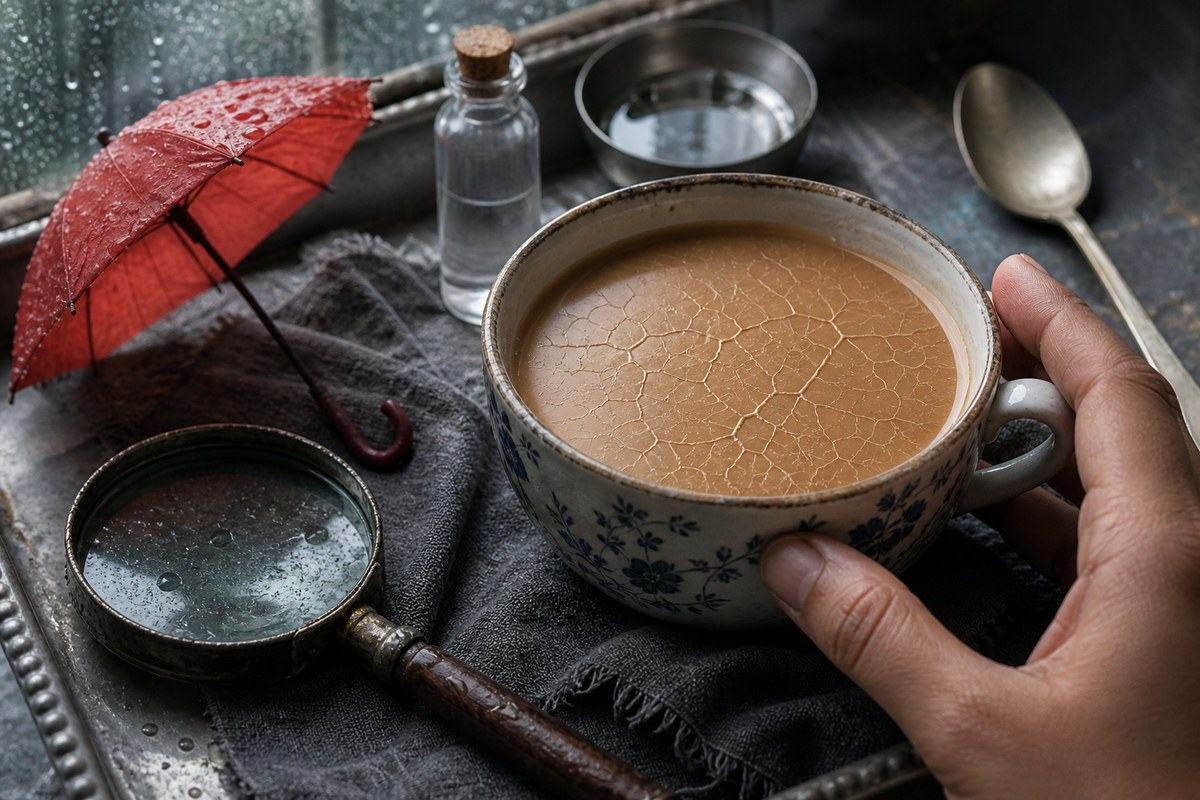
A cup can hold more than tea. It can hold class, climate, habit, empire, digestion, loneliness, hospitality, and argument. In Bengal, tea is practically punctuation. Morning comma. Afternoon semicolon. Evening full stop. Exam-time exclamation mark. Bad-news ellipsis.
Tea keeps appearing because life needs small ceremonies. Not grand belief. Not divine management. Just ceremonies. Wash the cup. Boil the milk. Add tea leaves. Wait. Strain. Sip. Continue.
Writing is similar.
You gather the leaves of the day, boil them with memory, add a dangerous amount of opinion, and hope the result is drinkable.
Sometimes it is not.
Sometimes the page sits there like a failed luchi, flat and accusing. Sometimes every sentence sounds like it has been translated from a government notice. Sometimes the mind refuses sparkle and produces only damp cardboard. This is normal. Any writer who denies this is either lying or selling a course.
But then, occasionally, a sentence arrives with a little ankle-bell sound. You know it. Not perfect. Not immortal. Just alive. It moves. It has knees. It can cross the room.
That is enough to continue.
If Orwell sat across from me, I would not ask him for wisdom about success. Successful people often become dangerous after the third question. They begin to prescribe their accidents as method. I would ask him how to remain honest when honesty does not pay reliably, does not flatter friends, does not impress committees, and does not trend.
He might answer by example rather than advice.
Look closely.
Use plain words.
Distrust fashionable fog.
Notice who benefits when language becomes unclear.
Do not worship your own side.
Do not turn pain into decoration.
Write it down before memory hires a lawyer.
That last one is mine, but I think he would allow it after tea.
The odd comfort is that writing does not require a grand life. In fact, grand lives may be a disadvantage. Too much scenery. Too many invitations. Too many people saying “brilliant” near cheese cubes. A modest life supplies better material than it gets credit for. The leaking tap. The half-paid bill. The school memory. The old poem. The mother tongue hiding behind English. The city that both feeds and insults you. The panic that arrives at 4 p.m. for no respectable reason. The small pride that survives anyway.
That is a life.
Not a polished life. Not a brochure. But a life with texture.
And texture is where writing begins.
So yes, I would have tea with George Orwell. In Calcutta. Near a lane where the drain is not heroic, the biscuits are soft from humidity, and the tea-seller has the face of a man who has seen every ideology fail to pay on time. I would tell Orwell that he arrived late in my reading life but found a chair. I would tell him that many of us first came to him through Nineteen Eighty-Four, but stayed for the essays. I would tell him that Motihari gives him a faint claim on our gossip. I would tell him that a teacher’s praise can outlive buildings.
Then I would show him my diary.
Not all of it. I am honest, not suicidal.
Just a page or two. Enough to show the grind. Enough to show the man trying to make sense of a day before the day disappears into the common drain of forgotten things.
He would read it without smiling much. He was not built for easy smiling. Then perhaps he would push the notebook back and say something plain, almost disappointing.
“Keep going.”
And really, what better advice is there?
The tea cools. The city darkens. Somewhere a pressure cooker starts again, because civilization is mostly repetition with better lighting. The old school essay is gone. Ira Paul’s compliment remains. Orwell returns to the shelf. The diary waits, patient and slightly cruel.
Outside, Calcutta continues its lifelong experiment in survival, argument, decay, beauty, tea, dust, and noise.
Inside, one sentence asks for another.
That is how they get you.
By the bye this blog is that diary!
Word Cloud
Related reading
Selected by shared topics and section, with closer publication dates breaking ties.