Fellow Passengers and the Broken Record
Uses the speech voice supplied by your browser or device.

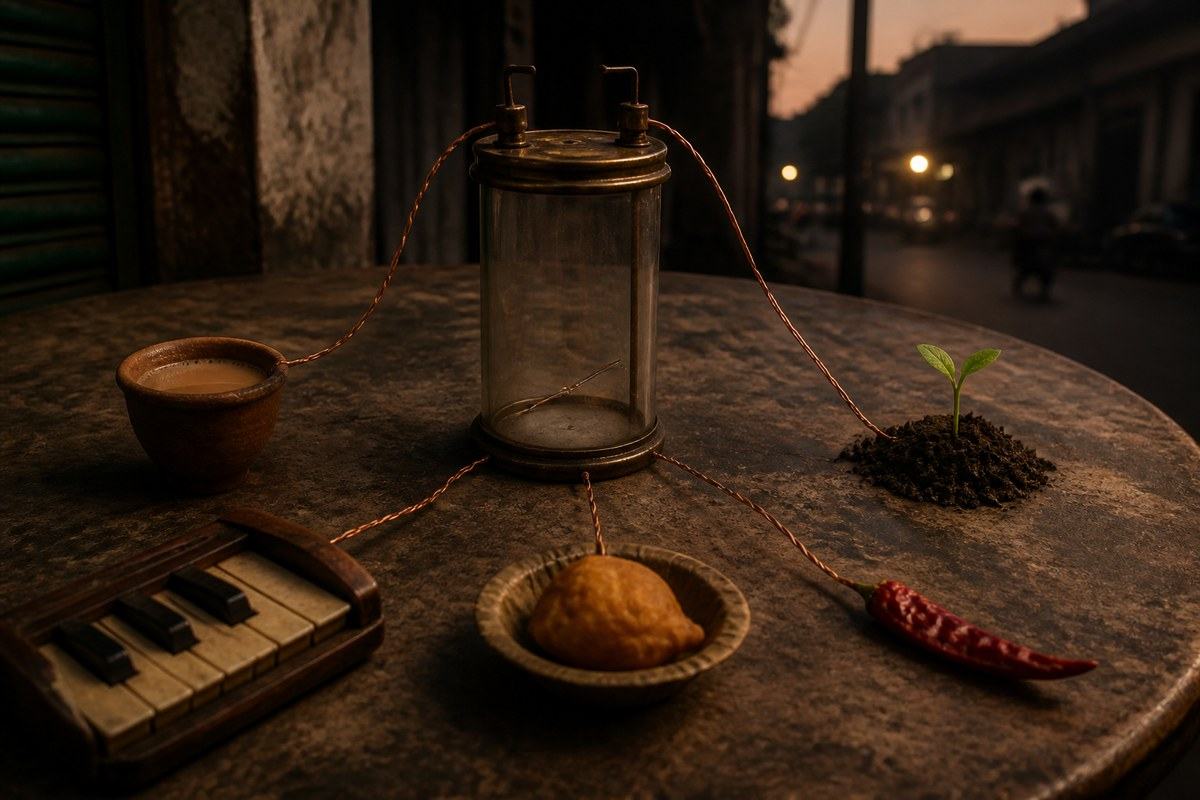
Some people enter life like a song from a half-open window.
Not a full concert. Not a grand orchestra with lighting and tickets and men in black suits coughing into their fists. Just a line of melody. Two notes, perhaps three. A face in a train. A classmate. A colleague. A woman who once said something kind when your day had already folded like a cheap umbrella in a Kalbaishakhi wind. You hear them once, and for some reason the air changes.
Then, before you can learn the words, the song is gone.
That is the cruelty. You think the first stanza has begun, but life, that old clerk with paan stains on his file, has already stamped “completed” on the last page. Some people are like that. By the time you know their value, the scene has changed, the bus has left, the phone number is lost, the city has eaten the road, and memory is standing there with one slipper in its hand.
Then there are the others.
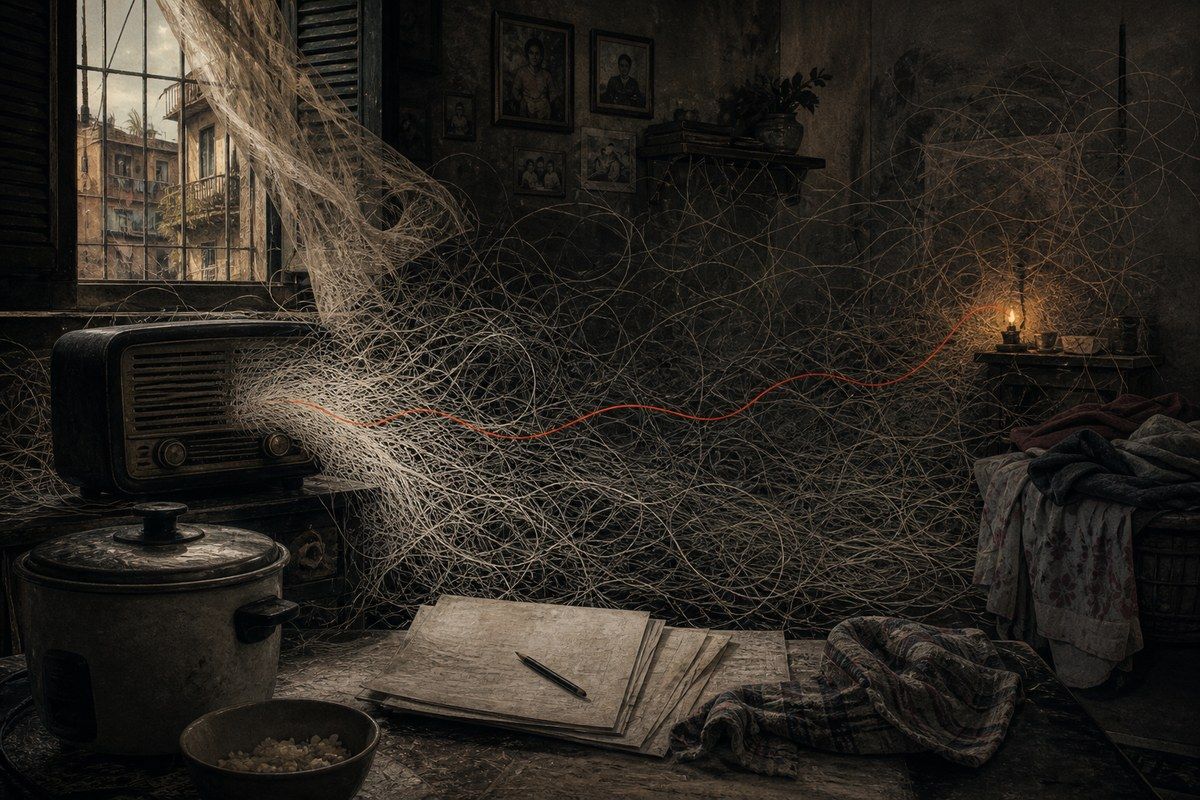
They do not pass like songs. They occupy the air like a broken ceiling fan in May. Same sound. Same wobble. Same threat of falling, but never falling, because that would at least be an event. These people do not need discovery. Their character arrives before they do, like the smell from a fish market lane at noon. You know everything before the first sentence is over.
Scratch. Screech. Repeat.
A life can become very crowded with such records.
In Kolkata, especially in the shanty edges where the city forgets to comb its hair, privacy is not a room. It is a theory. Someone is always shouting into a phone. Someone is frying something. Someone is watching a video at full volume, because headphones, apparently, are a Western conspiracy. A pressure cooker whistles, a scooter coughs, a dog conducts foreign policy with another dog three lanes away, and in the middle of this, you are expected to become peaceful, productive, hygienic, forgiving, and possibly employable.
Life has jokes.
At fifty-one, one learns that fellow passengers are not always companions. This is a useful distinction, though it comes late, like most useful things. A companion travels with you. A fellow passenger merely shares the vehicle and sometimes places his elbow into your ribs with the confidence of empire.
Family, neighbors, colleagues, old friends, clients, landlords, shopkeepers, relatives who remember your failures better than your birthday—life puts them all into one overstuffed tram and then tells you to enjoy the ride.
You think closeness creates understanding.
Not quite.
Closeness creates heat. Understanding requires attention. And attention, in human beings, is a very costly item. We pretend it is free because everyone has eyes, ears, and a face that can be arranged into an expression of listening. But real attention is expensive. It requires the temporary death of one’s own importance. Most people cannot afford it. Some never even try. They hear you only as a gap before their own next announcement.
This is why the soft people feel miraculous.
They listen without making a performance of listening. They remember one small thing. They do not convert every conversation into a court case. They do not treat your tiredness as laziness, your silence as insult, your sadness as bad manners, or your poverty as a moral weakness. They leave a little space around you. In a world where everyone wants to sit inside your skull with muddy shoes, space is love.
But here comes the annoying part.
The soft people are often hidden among the loud ones.
The song is not always in a clean room. Sometimes it is behind the broken record. Sometimes the kind person is married to the human foghorn. Sometimes the tender friend comes attached to a social circle full of unpaid emotional taxes. Sometimes the only good conversation of the week comes after two hours of nonsense so stale it should legally be composted.
So the art is not simply to find good people and avoid bad people. That would be tidy. Life is not tidy. Life is a kitchen shelf in a rented house: one good cup, three cracked plates, a mysterious plastic lid that fits nothing, and a packet of turmeric from 2019 that nobody has the courage to throw away.
The art is to find the song without surrendering to the noise.
This is difficult, because noise has stamina.
A screeching person can fill a whole day. They can enter your morning before tea, sit in your afternoon like a sweating uncle, and remain in your night like an unpaid electricity bill. They do not merely speak. They occupy. They become weather. And slowly, if you are not careful, you stop listening for music at all.
That is the real danger.
Not anger. Anger is at least alive. The danger is deafness. You hear so much ugliness that you begin to expect ugliness as the normal language of the world. Then, when kindness comes, you suspect it. When gentleness appears, you call it weakness. When someone offers affection without invoice, you search for the hidden clause.
This is how bad company continues its work even after it has left the room.
One must resist that.
Not with saintliness. I distrust saintliness. Too often it is merely exhaustion wearing clean clothes. Also, as an atheist, I have no interest in polishing suffering and calling it divine training. Suffering is often just suffering, like a leaking roof is a leaking roof. It does not become spiritual because someone has written a quote under a sunset.
Patience is useful.
But patience is not slavery.
Adjustment is useful.
But adjustment is not self-erasure.
Compassion is useful.
But compassion does not mean allowing another person to use your nervous system as a public dustbin.
This distinction matters. Many of us, especially in our part of the world, are trained to confuse endurance with goodness. We are told to adjust, tolerate, manage, smile, understand, forgive, and then adjust again, as if the human soul were a rubber band manufactured in Howrah for industrial use. But a rubber band also snaps. Then everyone acts surprised.
The trick is smaller and more practical.
Know who is a song.
Know who is noise.
Know who is noise with a hidden wound.
Know who is simply noise.
This last category exists. We should not become sentimental fools. Some people are not misunderstood violins. They are loudspeakers with legal documents. They must be kept at a distance, answered briefly, and mentally wrapped in newspaper like old glass.
Others are more complicated. Their scratchy sound has a story. Fear. Failure. Humiliation. Illness. Old disappointment. A childhood where nobody listened. A marriage where nobody softened. A life where money was always short and dignity shorter. Such people may still hurt you. Their history does not become your handcuffs. But knowing the source of the sound may help you not become poisoned by it.
This, perhaps, is where luck enters.
Some people are born into rooms where voices are gentle. Some are born where every sentence arrives with a slap hidden inside it. Some meet teachers, friends, lovers, mentors, neighbors, or strangers who enlarge the world. Others meet people who shrink it, then lecture them on gratitude.
Luck is not everything.
But it is not nothing.
The self-help industry dislikes this because luck is bad for business. It cannot be sold in a hardcover edition with a smiling author on the cover. Yet any honest person knows it. A life can turn because one decent person appears at the right time. A life can also bend because the wrong people stay too long.
In the late afternoon, when the light in my part of Calcutta turns the walls the color of old tea, I sometimes think of this. The day has done its usual circus. The news app has muttered its disasters. The market has remained expensive. The body has complained like a retired railway employee. Somewhere nearby someone is drilling a wall with the spiritual intensity of a man opening a tunnel to another planet.
And still, amid this, a small thing happens.
A cup of tea tastes right.
A line of an old song returns.
A friend sends one sentence that does not demand anything.
A stray dog sleeps with complete philosophical authority under a parked scooter.
The world, without improving much, becomes bearable.
That is not a small achievement.
Maybe life is not about collecting only beautiful people. Maybe that is impossible unless one is rich, detached, or living inside a carefully edited social media lie. Real life mixes everyone together. The sweet, the sour, the exhausting, the luminous, the half-mad, the generous, the petty, the brave, the boring, the ones who stay, the ones who vanish, the ones we miss, and the ones we survive.
So we make adjustments.
Not grand heroic adjustments. Small ones. Human ones.
We move the chair away from the noise. We keep the window open for the song. We stop expecting mangoes from a lamppost. We stop explaining our whole heart to people who treat listening as a punishment. We save our better selves for those who can receive them without using them as furniture.
And when a song comes, even briefly, we do not waste it.
We hum the first word.
We let the last stanza go.
Then we return to the ordinary room, where the fan wobbles, the tea cools, the city sweats, and the broken record begins again.
But this time, perhaps, we are not entirely defeated by it.
Somewhere inside the noise, we have kept a little music.
Word Cloud
Related reading
Selected by shared topics and section, with closer publication dates breaking ties.