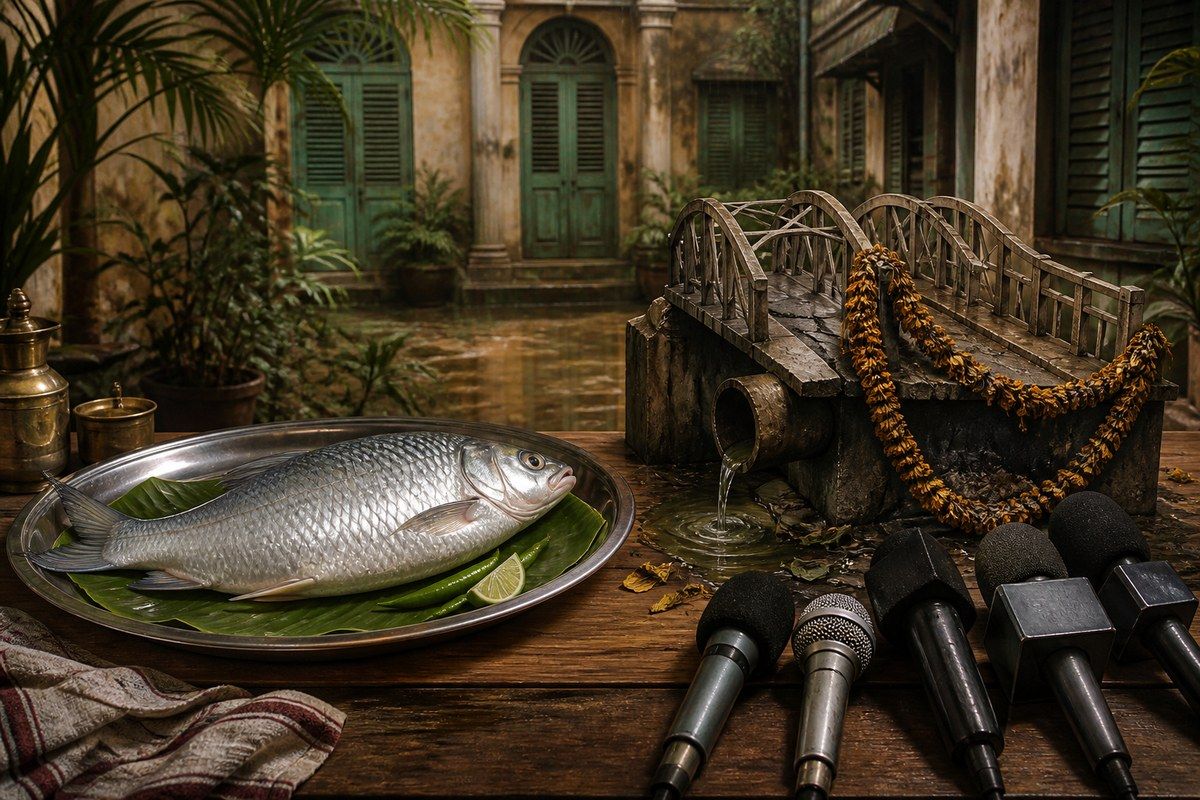
The Classification and Variety of Rotting People in Calcutta
Uses the speech voice supplied by your browser or device.

Acronyms and local terms:
MLA — Member of Legislative Assembly, an elected state-level politician who often becomes more useful to citizens as a broker of favors than as a maker of law.
NGO — Non-Governmental Organization, a private or nonprofit body that may do real social work, perform decorative charity, or sometimes both before lunch.
EMI — Equated Monthly Installment, the monthly loan payment that keeps half the middle class walking around with a polite face and a financial fever.
TV — Television, the box that now mostly shouts while people eat.
WhatsApp — A messaging app that has become India’s unofficial university of rumor, miracle, panic, and family surveillance.
Calcutta does not rot like a fruit kept too long in the kitchen; it rots like a whole cupboard where everyone knows something is smelling, everyone opens the door for one second, everyone says “hmm,” and then everyone shuts it again.
This is not a neat rot. No, no. That would be too European. Calcutta has varieties. Subspecies. Neighborhood mutations. Seasonal flavors. There is the office rot, the devotional rot, the family rot, the intellectual rot, the political rot, the gentlemanly rot, the poor-man’s-not-allowed-to-breathe rot, and that special local item, sweet-talking rot, served warm with tea and two Marie biscuits.
The mistake is to think the poor are rotting first.
They are not.
The poor are usually being stored badly by the city, like fish in a market where the ice melted three hours ago and the seller is still saying, “Fresh, fresh.” The man sleeping near the drain is not the scandal. The scandal is the drain. The scandal is the stolen money that should have fixed it. The scandal is the respectable person who looks at him and thinks poverty has a smell, while his own conscience has been dead in the almirah since 1998.
You want classification? Let us begin with the clean-shirt rot.
This one sits behind a desk. It has a pen clipped to the pocket and a face trained by decades of saying no without appearing rude. It never says, “Give me money.” That would be vulgar. It says, “File ta ekto dekhe nite hobe.” The file must be seen. The file must be moved. The file has emotions. The file needs encouragement, like a weak child before arithmetic exam.
A poor man comes with a paper. A widow comes with a certificate. A small shopkeeper comes with fear in his throat. The clean-shirt rot looks at them with that pale government expression, the face of a ceiling fan rotating over human misery. Nothing dramatic happens. No thunder. No villain music. Just delay. Delay is the cheapest weapon in India. It kills without leaving fingerprints.
Then there is the holy rot, which is my least favorite because it arrives with flowers.
You know this person. We all know him. He forwards spiritual wisdom before sunrise and cheats the maid before breakfast. He touches feet, rings bells, donates loudly, and speaks of culture as if culture is a stick for beating younger people. He can discuss purity with a straight face while throwing plastic plates into the lane after a community feast.
The miracle of Calcutta is that one loudspeaker, four lights, two banners, and a flex poster can make a local bully look like a guardian of civilization.
Yesterday he blocked the footpath. Today he sponsors devotion. Tomorrow he will stand beside a priest, or a minister, or a film actor who has come to smile professionally. Everyone knows. Everyone eats. Everyone goes home. The city burps and calls it tradition.
I am not talking about faith. Faith is private. Faith may be tender. Faith may even keep a tired woman alive through the week when rice is costly and the son is useless. I am talking about public religiosity as deodorant. Spray enough of it, and even corruption starts smelling like sandalwood.
Now comes poverty, and here we must be careful, because educated people become foolish very quickly when poverty enters the room.
Poverty is not a character defect. Poverty is not laziness wearing a torn shirt. Poverty is the mother bargaining over ten rupees because ten rupees is not ten rupees; it is the difference between egg and no egg. Poverty is the old man choosing which medicine to skip. Poverty is a boy studying while mosquitoes hold a blood donation camp on his legs. Poverty is a woman washing utensils in three houses and still being spoken to as if she has borrowed oxygen from the middle class.
What poverty does is more sinister. It narrows the world. It makes the future small. It turns every choice into a small knife. Then, after squeezing people for years, society stands at a distance, pinches its nose, and says, “Look how they live.”
Wonderful. First we build the cage, then we insult the animal for pacing.
The real rot begins where power gets comfort.
Look at the local strongman. He is not very strong, actually. Usually he has a stomach, a phone, two boys on bikes, and a permanent tone of helpful menace. He knows the councillor. He knows the police. He knows which illegal construction belongs to whom. He can arrange a bed, stop a notice, start a rumor, silence a complaint, or make a pavement disappear.
The city does not officially employ him. That is the beauty. He is the unofficial hinge on which official life swings.
A normal citizen in Calcutta does not go straight from problem to solution. That would be childish. He goes from problem to uncle, uncle to party office, party office to someone’s cousin, cousin to local committee, local committee to tea stall, tea stall to payment, payment to perhaps. This is our civic operating system. It has bugs, but it runs. Like an old bus with one headlight and philosophical brakes.
The intellectual rot is more perfumed.
This variety reads. It quotes. It sighs historically. It has opinions on capitalism, fascism, neoliberalism, postcoloniality, masculinity, Tagore, Marx, cinema, and the collapse of civilization, but cannot treat the domestic worker with punctual payment. It can explain oppression using excellent vocabulary, then ask a poor student to work for “exposure.”
Exposure is what happens when the roof leaks. It is not a salary.
I say this with some shame. I am also a Bengali man with too many books and not enough money. I live on the edge of the city, where the lanes are thin, the drains are ambitious, and the afternoon heat sits on your skull like a fat relative who refuses to leave. Some days I look at my own life and wonder whether dignity has an expiry date. Consulting income comes like a nervous guest. Bills come like landlords.
So I am not writing from a marble balcony.
I am writing from a room where the fan makes more noise than progress, where the news from the world arrives in ridiculous chunks: some billionaire building another machine to replace workers, some politician promising purity, some city drowning, some market rising, some young man making a motivational reel while his mother cooks on borrowed gas. The world is burning in high definition. My kettle still whistles in low resolution.
But this is exactly why one must speak plainly.
The family rot may be the most intimate. It does not wear a party badge. It sits at the dining table.
In Bengal we often confuse love with ownership. A child is not raised; he is edited. A daughter is not advised; she is monitored like a suspicious parcel. A son is not allowed to fail quietly; his failure becomes a neighborhood festival. Marriage, job, marks, salary, skin color, body weight, fertility, reputation—everything becomes open for public discussion, like fish prices.
“What will people say?” is the national anthem of small minds.
People will say many things. People also spit on walls. This does not make spitting a philosophy.
Family can save you. Let us not pretend otherwise. In a hard city, family is often the last umbrella. But some umbrellas leak acid. Affection comes tied with obligation. Sacrifice comes with a bill. Care arrives with a hidden camera. The young learn early that independence is expensive and obedience has free lunch.
Then one day they become adults and reproduce the same prison, with fresh curtains.
The middle-class rot is quieter but more comic, if you have a cruel sense of humor, which by 51 you either develop or perish.
This person wants clean roads but throws garbage at night. Wants honest politicians but pays to jump a queue. Wants women to be safe but laughs at dirty jokes in the para group. Wants modern life but ancient obedience. Wants English-medium confidence in the child and medieval silence from the daughter-in-law. Wants the poor to be disciplined, the rich to be generous, the government to be efficient, and his own small cheating to be understood as practical necessity.
We are not hypocrites in a grand Shakespearean way. That would require style.
We are retail hypocrites. Small packets. Daily use.
There is also the shiny new rot, wearing sneakers and saying “startup.”
It has a logo before it has a product. It has a pitch deck before it has a customer. It speaks of disruption while asking employees to accept late salary as team spirit. It wants innovation, but not accounting. It wants scale, but not responsibility. It wants young people to work like founders and live like unpaid cousins.
In old Calcutta, corruption had a paan-stained smile. In new Calcutta, corruption has a laptop sticker.
Same appetite. Better font.
Now, do not ask, “Why does nobody fix it?” That question is too innocent. The better question is: who benefits when it stays broken?
Broken drains benefit contractors. Broken hospitals benefit brokers. Broken schools benefit coaching centers. Broken policing benefits local muscle. Broken paperwork benefits clerks. Broken morality benefits everyone who wants to sin privately and lecture publicly.
A broken city is not always an accident. Sometimes it is a business model.
This is the part that makes me tired.
Not angry. Tired.
Anger is hot. Tiredness is damp. It sits in the bones. It comes when you see the same pattern again and again: the poor blamed, the powerful garlanded, the honest mocked, the clever rewarded, the loud promoted, the gentle crushed, the hypocrite invited to the stage. After a while, your mind becomes like an old wall in the monsoon. The plaster does not fall all at once. It bubbles first.
But Calcutta still has small disinfectants.
The tea seller who gives credit and never announces it. The schoolteacher who actually teaches. The nurse who still looks at the patient’s face. The old man who stops a child from throwing plastic into the pond. The woman who pays her help properly. The clerk who moves a file without demanding worship. The young person who says no to the local bully and then trembles afterward, because bravery is not the absence of fear; it is fear wearing clean underwear and going anyway.
These people exist. They are not enough. But they exist.
And this is where the classification of rot becomes useful. Not because we enjoy disgust. Disgust is cheap. Any fool can sniff and make a face. The point is to identify the source.
The poor are not the rot.
The slum is not the rot.
The handcart, the hawker, the tired mother, the barefoot child, the man selling cheap socks near the station—they are not the rot. They are often the evidence. They are what happens when a city’s promises bounce, like a bad cheque.
The rot is impunity. The rot is public lying. The rot is cruelty with a clean vocabulary. The rot is prayer used as makeup. The rot is education without courage. The rot is family without respect. The rot is politics without shame. The rot is the little daily permission we give ourselves to look away.
And yes, sometimes the rot is us.
Not always. Not equally. Do not let the powerful escape by saying everyone is guilty. Everyone is not equally guilty. The man stealing crores and the man slipping fifty rupees to survive a hospital queue are not twins. But the smaller compromises feed the larger monster, like crumbs feeding rats behind the cupboard.
So here we are, in this beloved, maddening, paan-streaked, book-hoarding, fish-frying, slogan-shouting, rain-damaged, memory-drunk city.
Calcutta smells of many things.
Frying luchi in the morning. Wet dust before rain. Old paper. Cheap perfume. Hospital corridors. Diesel. River mud. Incense. Fear. Hope. Stale politics. Fresh tea.
And underneath, that other smell.
The one we keep explaining away.
Maybe the city will not be saved by heroes. Heroes are unreliable and usually busy posing. Maybe it will be saved, if it is saved at all, by ordinary people becoming slightly harder to buy, slightly harder to frighten, slightly harder to fool, and slightly less eager to worship anyone with a microphone.
Not saints.
Just citizens with spines.
Until then, the cupboard remains closed, the smell grows stronger, and we stand in the room saying, “Something is wrong here,” as if the whole house has not known it for years.
Word Cloud
Related reading
Selected by shared topics and section, with closer publication dates breaking ties.