The Room, the Light, and the Brittle Brain
Uses the speech voice supplied by your browser or device.

Some days the room stops being a room and becomes an accusation.
Not a grand accusation, mind you. Not the kind with a judge in a wig, a wooden hammer, and some noble prisoner making speeches before history applauds from the balcony. Mine is more economical. A cheap room. A hard bed. A light too bright for mercy. The fan circling overhead with the enthusiasm of a tired clerk. The walls closing in not dramatically, but bureaucratically, like they have received a memo from somewhere.
And there I am.
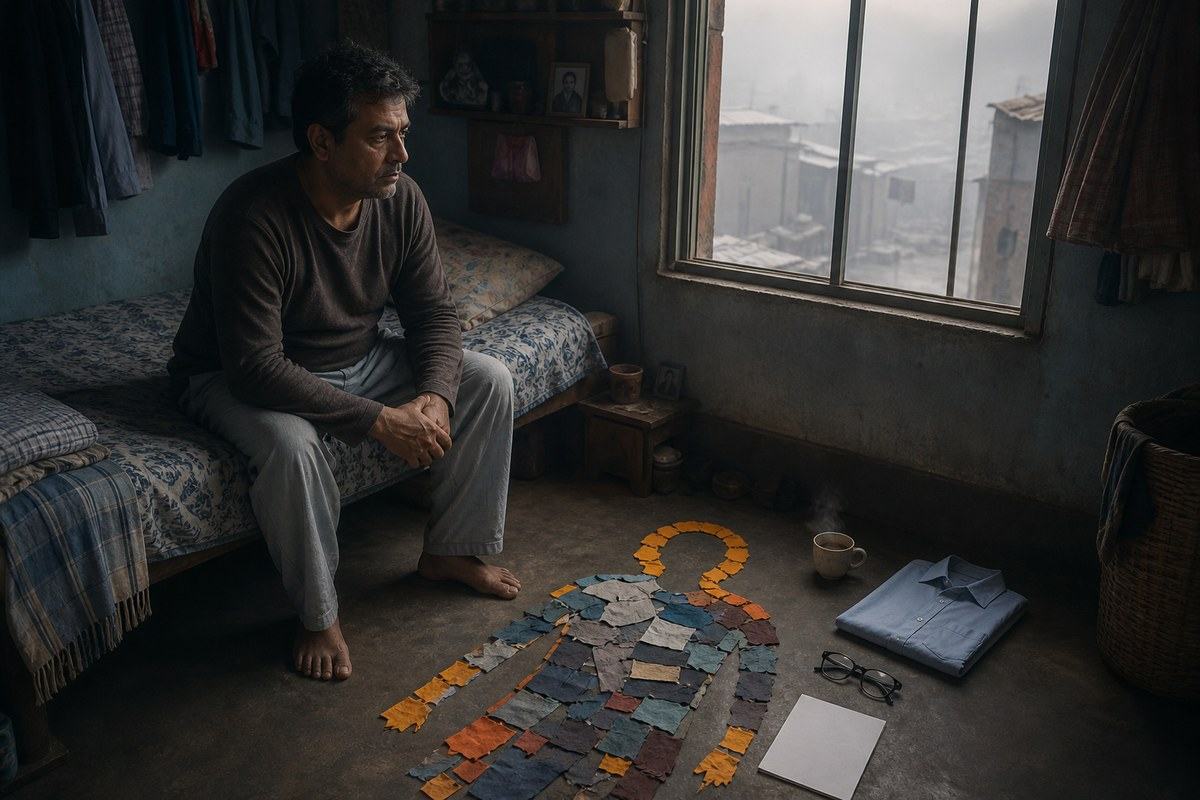
Fifty-one. Single. Bengali. Lower-middle-class. Living on the damp edge of Calcutta, where the city seems to have come out in its old vest and forgotten to shave. Educated enough to know the names of my troubles. Poor enough to negotiate with them daily. Experienced enough to have spent years inside American healthcare information systems, where data travels through wires wearing clean shoes while human beings outside the system limp along barefoot. Now back here, trying to earn by consulting, month by month, invoice by invoice, rupee by rupee, like a man collecting raindrops in a cracked cup.
On the bad days I feel tied to the leg of a gurney.
The strange thing is that I am not even properly tied. There is no rope. No guard. No locked ward. No dramatic villain with a clipboard. The restraint is inside the skull, which is the most economical prison ever invented. No rent, no maintenance, no guard salary, and it is open twenty-four hours.
The light burns above me.
It is not merely a light. It becomes a white question. What have you done? Where did the years go? Why are you still afraid of the next phone call? Why does a small unknown demand feel like a tiger entering the room wearing office shoes?
A sturdier fellow may laugh at this. Let him. The world is full of sturdy fellows, mostly produced in bulk, like plastic buckets. They say things like “just go out,” “just take a chance,” “just be positive,” as if the brain were a ceiling switch near the door. On. Off. Done.
But the bipolar brain is not a switch.
It is more like an old neighborhood transformer after a storm. It hums. It sparks. It works, mostly. Then suddenly the whole lane goes dark because one lizard, one wire, one small wet leaf entered the wrong place at the wrong time.
This is the part respectable people do not like to hear. Fear is not always philosophical. Sometimes it is physical. It sits in the stomach. It tightens the jaw. It makes the chest feel as if someone has kept a sack of damp rice on it. It makes a simple errand feel like crossing a border without papers. It makes the future arrive not as tomorrow, but as a police jeep at midnight.
Then, for comic relief, I look at the news.
Bad idea.
The news now is not news. It is a traveling circus that has lost the animals but retained the smell. Men with polished faces discuss destruction as if ordering snacks. Countries threaten each other with the calm of pension office clerks. Heat rises. Prices rise. Tempers rise. Lies rise first, usually in business class. Some billionaire somewhere announces the future. Some politician somewhere announces the past. Some poor fellow somewhere is told to adjust, sacrifice, believe, endure, stand in line, produce documents, and smile for the camera.
At this point a small suspicion enters the room, wearing rubber slippers.
What if I am not the insane one?
What if the room looks like a cell because the world outside has become a much larger cell, only with better lighting and advertising?
I do not say this with pride. There is no medal here. I am not turning private fear into public wisdom and asking the band to play. I know my mind exaggerates. I know loneliness puts a magnifying glass over everything. I know depression is a dishonest accountant. It takes one unpaid bill, one bad memory, one cloudy afternoon, and produces a complete financial report proving that life itself is bankrupt.
Still.
Look outside.
A man can be fragile and still observe correctly that the building is on fire.
This is the terrible comedy of my situation. Inside, I am frightened of the world. Outside, the world is making a rather strong case for being frightening. My room becomes a prison. Then it becomes a bunker. Then a prison again. Then, on a slightly better afternoon, after tea, it becomes only a room.
That is recovery sometimes.
Not triumph.
Not birdsong.
Not violins.
Just the room becoming a room again.
A plastic chair. A cup. A phone charger. A shirt drying on the back of a chair because there is never enough space. A packet of biscuits going soft in the humidity. The distant honk of traffic, the dog quarrel near the lane, the neighbor’s pressure cooker giving three whistles as if announcing a minor election result. The city continues. Indifferent, damp, noisy, hungry, impossible.
And I continue inside it.
This is not a motivational sentence. Please do not frame it and put it in a wellness seminar. I continue because what else is there? The rice must be bought. The rent must be handled. The electricity bill does not respect emotional nuance. The body asks for food even when the mind is busy filing appeals against existence.
Middle age is rude in this way. Youth allowed me to be tragic with some style. At twenty-five, despair had hair. At fifty-one, despair has acidity, reading glasses, and a suspicious knee.
There is a dark joke hidden here, and like most dark jokes it is not entirely a joke. When you are young, you fear failure. When you are older, you fear unfamiliarity. Failure becomes almost familiar. You know its smell. It sits in the room like an old relative who has overstayed but at least knows where the bathroom is. The unfamiliar is worse. A new office. A new demand. A new conflict. A new injustice. A new person with power over you and no interest in your interior weather.
That is what my brittle brain fears most.
Not hardship alone.
A bad, unfair, unfamiliar situation.
The phrase sounds plain, but it contains a whole zoo. Bad means painful. Unfair means you cannot reason with it. Unfamiliar means you do not know where the exits are. Put the three together and the mind begins to behave like a cat inside a sack.
So I shrink the world.
This is dangerous, I know. A life can shrink so politely that you do not notice the theft. First you avoid one invitation. Then one meeting. Then one phone call. Then one opportunity. Then the road outside becomes a country. Then the country becomes a planet. Then the room becomes the last safe geography.
But let us not become melodramatic. Even a shrunken life has windows.
Books are windows. Writing is a window. Tea is a window. A line of absurd humor is a window. The memory of having once walked in San Antonio under a large American sky is a window. The knowledge that I have repaired systems, understood systems, survived systems, and occasionally outwitted systems is a window. Even the stray cat on the boundary wall, looking at me with professional contempt, is a window. It says, without speaking, that the world remains ridiculous and therefore not entirely conquered by despair.
The room lies.
The news lies.
The brain lies.
But not all the time.
That is the small crack through which air enters.
There are moments when I can say: this is a thought, not a verdict. This is fear, not prophecy. This is depression doing its tax audit again. This is anxiety arriving with a measuring tape to prove that the corridor is narrower than it is. This is the old machinery grinding, not the universe announcing a final decision.
And there are moments when I cannot say any of that. Then I do smaller things. I wash a cup. I open the window. I make tea. I read one paragraph. I write three lines. I let the bad weather pass through the nervous system like a power cut passing through a summer evening in Calcutta. It is miserable. It is sweaty. It feels eternal.
Then the fan starts again.
Not always. Not immediately.
But often enough.
That “often enough” is not romance. It is engineering of the soul, done with cheap tools. No golden revelation. No heroic sunrise. Just maintenance. Tighten one screw. Replace one fuse. Drink water. Do not believe the worst sentence the brain produces after midnight. Remember that the mind, like the city, has load-shedding.
I do not want to pretend that freedom is simple. Some people speak of freedom as if it were a fresh shirt. Wear it and go. For some of us, freedom comes with paperwork, risk, weather, money, humiliation, noise, negotiation, and the possibility of being misunderstood in a language we ourselves barely command on bad days.
But captivity is not simple either.
A room can protect you and reduce you at the same time. A limitation can save your life and quietly steal its width. A routine can be a railing on a dangerous staircase, and also a cage if you grip it forever.
So I do not know whether my room is a prison or a shelter.
Maybe it is both.
Maybe the trick is not to smash the door open in one dramatic scene. Maybe the trick is to open it a little. Let the air come in. Look out. Close it if needed. Open it again tomorrow. Stand near the threshold like a suspicious old Bengali man inspecting rain before deciding whether to go buy eggs.
There is dignity in that too.
Small dignity, but real.
For now I remain here, under the blazing light, with my fragile thoughts, my small income, my cracked courage, my ridiculous worries, my battered education, my Calcutta humidity, my stubborn cup of tea, and this one useful knowledge: a bad thought can be loud without being true.
The room is not the whole world.
And the world, mad as it is, has not yet managed to cancel tea.
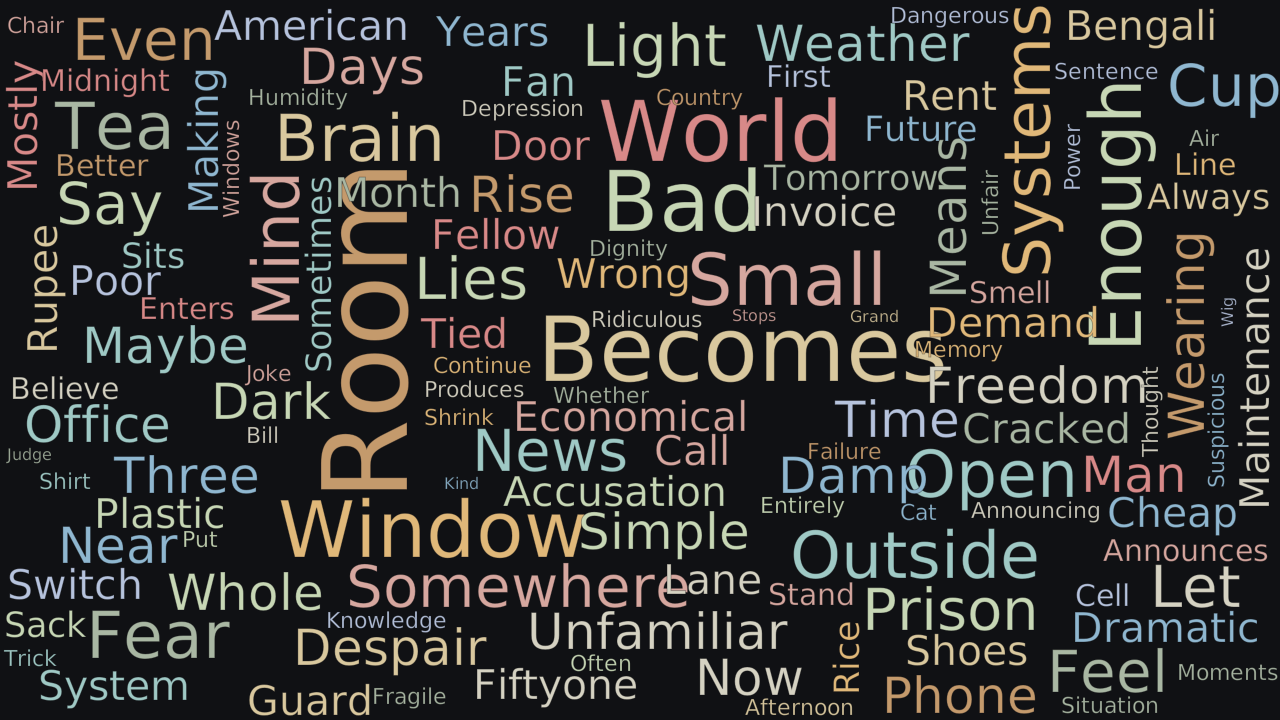
Word Cloud
Related reading
Selected by shared topics and section, with closer publication dates breaking ties.