Hedonist Hollow Men on the Selfie Treadmill
Uses the speech voice supplied by your browser or device.

The modern Indian tragedy is not that everyone owns a phone. It is that the phone now owns a small temple inside everyone.
Not a grand temple with bells, incense, and philosophy. More like one of those plastic roadside shrines that appears overnight beside a drain, gathering flowers, coins, dust, and municipal reluctance. Inside this new shrine sits the self. Not the soul, not the mind, not character, not conscience. Just the self: freshly filtered, slightly tilted, chin lifted, lips arranged, background edited, caption polished, waiting for applause from people who themselves are waiting for applause.
This would be funny if it were not becoming the operating system of public life.
You think the selfie is the disease. Not quite. The selfie is only the rash. The fever is deeper.
The fever says: be seen before you become. Display before you understand. Shout before you think. Consume before you can afford. Belong before you examine what you are belonging to. Be outraged before breakfast. Be spiritual by lunch. Be patriotic by evening. By night, lie in bed scrolling through the lives of people you secretly envy and publicly despise.
A full day’s work, really. Exhausting, like carrying a refrigerator up three floors during a power cut.
In the southern fringe of Calcutta, where I live my little lower-middle-class life among stray dogs, broken pavements, damp walls, and mosquitoes with the confidence of corporate lawyers, the thing is visible without needing a sociology department. A boy stands near an open drain and films himself as if he is arriving at Cannes. A family takes a restaurant photo with the solemn concentration of surgeons. A man in a tea stall forwards a thundering nationalist message on a phone assembled by a world he would call foreign conspiracy if it came with subtitles. A devotee records his charity, because goodness, poor thing, now needs camera support like an elderly aunt climbing a bus.
Everything must be shown.
Even kindness.
Especially kindness.
Once upon a time, not in some golden age — spare me that syrupy nonsense — but in a poorer and less illuminated time, people still knew that life had private rooms. You prayed or did not pray. You loved or failed to love. You helped someone or avoided helping them and felt mildly ashamed. You ate what you could. You bought what you needed. You lied a little, boasted a little, envied a little, and then went to sleep under a fan that made the noise of a tired helicopter.
Now the fan still groans. The rent still rises. The medicine bill still bites. The water still comes late. But on top of that, life must be staged.
This is not progress. This is theatre with monthly installments.
The new citizen is not merely living. He is producing evidence that he is living correctly. His food must prove taste. His clothes must prove status. His holiday must prove arrival. His child must prove parental worth. His politics must prove courage. His religion must prove purity. His anger must prove masculinity. His cruelty must prove clarity. His loneliness must be hidden behind group photographs where everyone grins like hostages at a toothpaste convention.
And under all this glitter runs one ugly little treadmill.
Not a normal treadmill. A normal treadmill at least admits that you are going nowhere. This one is placed on an incline. Everyone is running upward on it — toward more money, more beauty, more status, more followers, more approval, more tribal belonging, more visible success. The advertisement says, climb. The motivational speaker says, climb. The neighbor says, climb. The uncle with digestive problems and strong opinions says, climb.
But here is the catch.
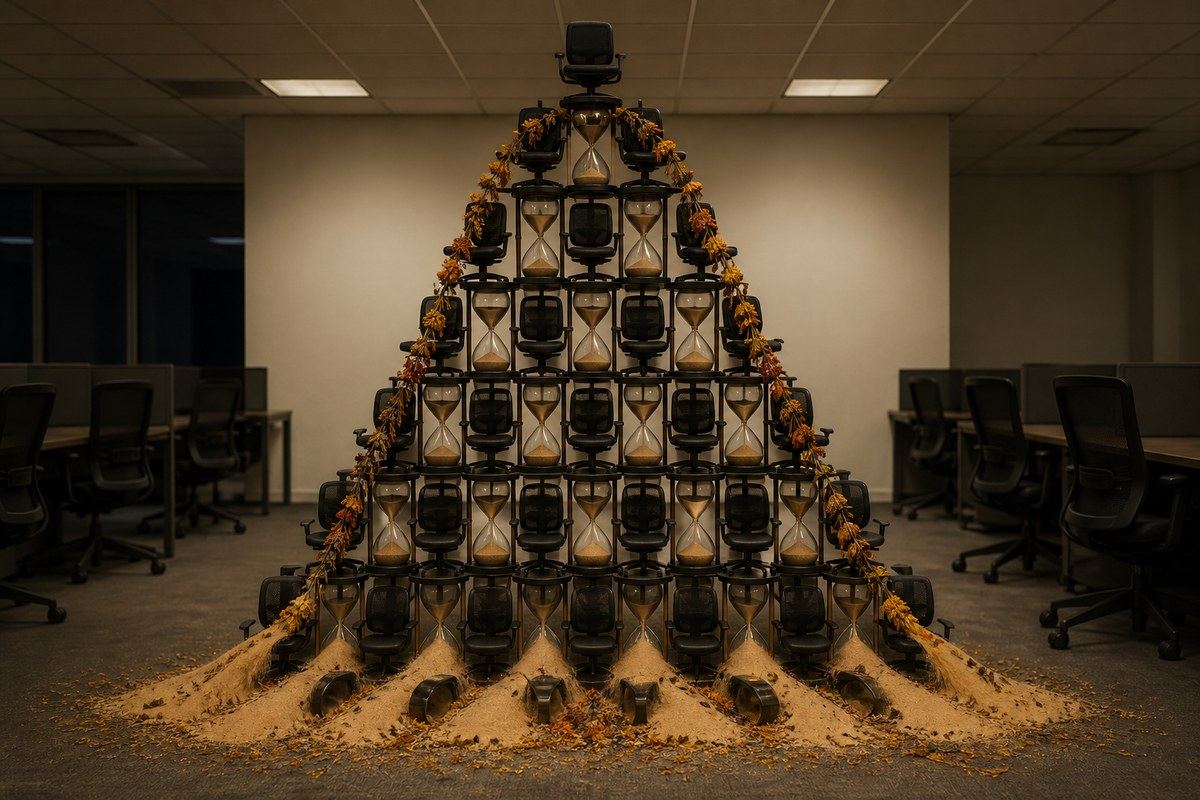
The incline is a pyramid.
And by design, not everyone can fit at the top.
This is the part our cheerful frauds do not say aloud. A pyramid needs a broad bottom. A status society needs the humiliated many. A consumer dream needs people who can see the goods but cannot reach them. A political mob needs enemies. A religious superiority machine needs outsiders. A social-media ladder needs invisible people staring up at visible people, feeding them attention like goats being fed before a festival they have misunderstood.
The poor are told to aspire.
The middle class are told to perform.
The rich are told they deserve everything.
Then everyone is told that failure is personal.
What a neat trick. Like stealing someone’s umbrella in monsoon and then selling him a course on positive thinking.
This is where narcissism stops being comic and becomes macabre. I do not mean the medical kind. I am not diagnosing the nation while sitting in a vest near a table fan, though the temptation is sometimes strong. I mean the public habit of narcissism: the belief that one’s wounds are sacred, one’s opinions are naturally profound, one’s group is eternally noble, and one’s enemies are not mistaken human beings but insects requiring removal.
That habit is everywhere now.
It is in the way people speak online, as if volume were evidence. It is in the way every disagreement becomes betrayal. It is in the way nationalism becomes less about roads, schools, courts, hospitals, rivers, food safety, women’s dignity, and honest work, and more about who can shout the loudest slogan with the wettest eyes. It is in the way religion, which should make a person smaller before mystery, often makes him larger before other people.
That is a bad bargain.
Real patriotism is dull and demanding. It asks whether the local clinic has medicines. Whether the school roof leaks. Whether police protect the weak. Whether courts move before witnesses die of old age. Whether rivers are being poisoned. Whether workers can live with dignity. Whether the old can afford their tablets. Whether a girl can walk home without calculating danger like a chess problem.
Jingoism avoids all this tiresome account-keeping.
It waves a flag and asks for emotional obedience.
Much easier.
Religious bigotry performs a similar magic trick. Real faith, if it has any worth, should soften the ego. Public bigotry hardens it. It gives the frightened man a throne. It gives the failed man an enemy. It gives the hollow man a crowd. It lets a person feel morally tall while standing on someone else’s neck.
Very efficient.
Very ugly.
And very marketable.
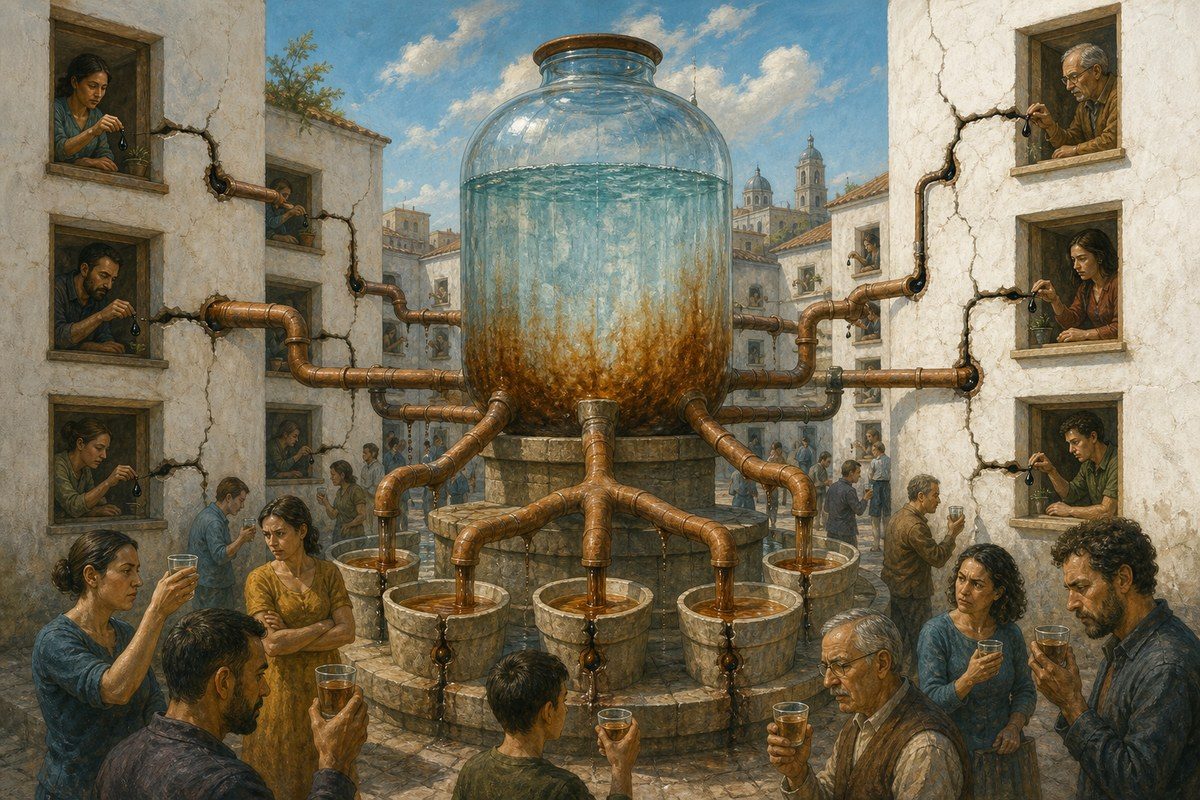
Do not underestimate the marketplace in all this. The market has discovered that insecurity is the finest renewable resource. Better than sunlight. Better than wind. You can mine insecurity every hour. Tell people they are not attractive enough, not rich enough, not pure enough, not patriotic enough, not modern enough, not traditional enough, not successful enough, not spiritual enough, not masculine enough, not feminine enough. Then sell them the repair kit.
A cream.
A course.
A phone.
A slogan.
A guru.
A party.
A godman.
A diet.
A flag.
A hate.
The genius of the age is that it can turn even emptiness into a subscription plan.
Meanwhile, actual life stands in the corner, sweating.
There is the father who cannot say he is scared because the family still expects him to be a pillar, though he feels more like damp cardboard. There is the young woman trying to look glamorous while carrying invisible family negotiations on her back like a sack of potatoes. There is the boy who speaks English online but cannot confess that his degree has not given him dignity. There is the old mother whose blood pressure medicine costs more than anyone planned. There is the single middle-aged man in Calcutta — let us not pretend he is a mythical creature; he is available in several neighborhoods, usually near tea — who has read too much, earned too little, slept badly, and now watches the circus with the expression of a goat studying tax law.
That man knows something.
He knows the glitter is not free.
Someone pays.
Usually the person at the bottom pays first. Then the lonely. Then the honest. Then the thoughtful. Then the weak. Then, finally, everyone.
A society can survive vulgarity. India has survived many things: empire, famine, partition, bureaucracy, television panel discussions, and wedding decorators who believe purple lighting improves civilization. We are a durable people. But no society can safely combine inequality, humiliation, fantasy, tribal rage, and public cruelty for too long.
That mixture is dry straw beside a welding torch.
The problem is not that Indians are suddenly worse. Human beings have always been vain, fearful, tribal, greedy, tender, foolish, brave, generous, and ridiculous. The ingredients are ancient. What changed is the machine.
The machine rewards the worst timing of the worst impulses.
Earlier, if you had a stupid thought, it might die peacefully between your skull and the tea cup. A merciful death. Now it can be typed, decorated, forwarded, defended, monetized, and turned into identity before evening. Earlier, a rumor needed legs. Now it travels first class. Earlier, bigotry had to gather people physically. Now it arrives through a screen while you are eating muri.
And because everyone is tired, everyone becomes easier to fool.
Fatigue is the secret partner of irrationality. A man who has fought traffic, bills, heat, bosses, family drama, and the general Indian obstacle course of getting one simple thing done is not always looking for truth at night. He is looking for relief. Give him a villain and he will accept the discount. Give him a tribe and he will accept the uniform. Give him a slogan and he may mistake it for thought.
This is not stupidity.
It is exhaustion with a loudspeaker.
The cruel part is that the pyramid keeps pretending to be moral. Those above are called hardworking. Those below are called lazy. Those who shout are called brave. Those who doubt are called weak. Those who consume are called aspirational. Those who cannot consume are called backward. Those who hate in groups are called defenders. Those who ask for evidence are called enemies.
Language itself starts wearing a cheap wig.
And once language rots, thought follows. Slowly. Then suddenly.
You know a society is in danger when words no longer describe things but protect groups from reality. “Culture” becomes control. “Faith” becomes threat. “Nation” becomes a stick. “Freedom” becomes selfishness. “Success” becomes display. “Tradition” becomes selective memory wearing sandalwood paste. “Modernity” becomes buying things on credit and calling it lifestyle.
In this fog, the decent person looks confused.
He should be confused.
Confusion is sometimes the last honest room in the house.
The answer is not to become a monk, or a scold, or one of those people who announce they are leaving social media and return after four days like a cat who has discovered the moral limits of independence. We are human. We like attention. We like beauty. We like praise. We like new shirts. We like good food. We like being admired by people whose judgment we otherwise consider poor. Fine. Let us not pretend to be made of Himalayan granite.
But pleasure must remain pleasure.
It must not become anesthesia.
Patriotism must remain responsibility.
It must not become theatre.
Religion, for those who practice it, must remain humility.
It must not become a weapon.
Individuality must remain conscience.
It must not become licensed selfishness.
And ambition must remain motion.
It must not become a pyramid where everyone below is told to smile while being stepped on.
The repair will not be grand. Grand repairs are usually announced by men standing before banners, which is already suspicious. The repair begins in smaller, less photogenic places.
A dinner not posted.
A kindness not filmed.
A rumor not forwarded.
A slogan not swallowed whole.
A child not turned into a family trophy.
A poor person not treated as scenery.
A disagreement not turned into treason.
A religious difference not turned into contamination.
A national flag not used to cover laziness, corruption, and cruelty.
A morning walk where the sky is allowed to be sky, not content.
These sound tiny. They are not. Civilizations are made of tiny permissions and tiny refusals. The permission to lie. The refusal to hate. The permission to mock the weak. The refusal to forward poison. The permission to worship the successful. The refusal to measure a life by its packaging.
One day, if enough people refuse the mirror, the mirror loses some of its power.
Not all.
Do not expect miracles. The platforms are rich, the politicians are hungry, the merchants are clever, the gurus are theatrical, and the human ego is an old landlord who never vacates willingly. The treadmill will keep moving. The pyramid will keep glittering. The rodents will keep climbing, each convinced that the cheese at the top is destiny and not bait.
Still, a man may step aside.
A woman may step aside.
A family may step aside.
A reader may pause and ask, very quietly, while the fan turns and the city sweats and the phone glows like a small obedient demon: whose life am I performing, and who profits when I forget to live my own?
Word Cloud
Related reading
Selected by shared topics and section, with closer publication dates breaking ties.