India’s Noise Machine and the Small Man Under It

Acronyms used:
TV: Television, the rectangular shouting-box that once showed news, cricket, cinema, and Sunday morning mythological serials, and now often behaves like a paid wrestler in a suit.
RSF: Reporters Without Borders, an international organization that tracks press freedom across countries.
CPI: Corruption Perceptions Index, a Transparency International measure of perceived public-sector corruption.
V-Dem: Varieties of Democracy, a research project that studies how democratic or authoritarian political systems are becoming.
BJP: Bharatiya Janata Party, India’s current ruling party at the national level.
RSS: Rashtriya Swayamsevak Sangh, a Hindu nationalist organization that has deeply influenced modern right-wing politics in India.
Uses the speech voice supplied by your browser or device.
India has discovered a cheap substitute for governance: keep shouting until the ceiling fan shakes.
You see it everywhere now. On TV. On stage. At rallies. In panel discussions where six men and one exhausted woman scream over one another like crows fighting over a stale luchi. Every public problem is wrapped in a drumbeat. Inflation becomes patriotism. Joblessness becomes conspiracy. Corruption becomes “what about them?” A broken road becomes a civilizational wound inflicted by enemies. A question becomes treason. A fact becomes bad manners.
And the poor citizen, who merely wanted the drain cleaned, stands there holding his plastic folder of documents.
This is the trick.
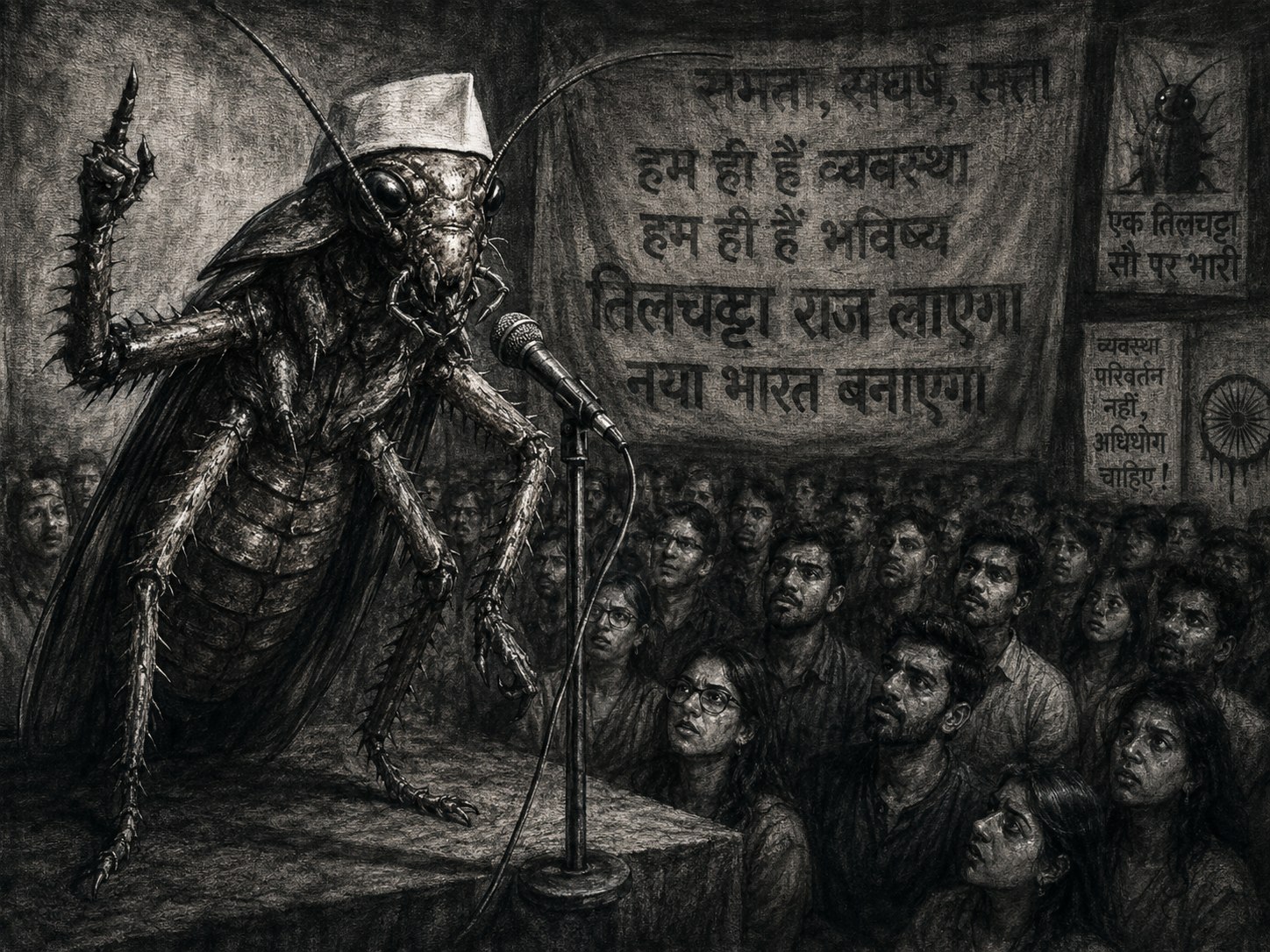
The country is not being ruled only by politicians. It is being ruled by a noise machine. Politician, paid anchor, party intellectual, temple loudspeaker, social-media warrior, contractor, police functionary, business donor, celebrity patriot, and neighborhood tough have all joined hands in one large marriage procession of power. There is light. There is band music. There is smoke. There is dancing.
Somewhere behind the procession, the bride has gone missing.
The bride, in this case, is the republic.
I am not saying India was once a spotless marble goddess and has now fallen into a gutter. That is school-essay nonsense. India has always had corruption, flattery, caste cruelty, communal poison, dynastic privilege, police excess, bureaucratic laziness, and that special Indian talent for making a simple thing complicated enough to require three stamps, two photocopies, and one man named Banerjee who is “not in seat.”
But earlier hypocrisy at least wore a shawl.
It lowered its voice.
It pretended to be ashamed.
Now it comes wearing sunglasses, climbs a stage, folds its hands, and demands applause.
That is the new shamelessness. Not wrongdoing alone. Wrongdoing with chest expansion. Wrongdoing with music. Wrongdoing with a national flag in the background and a TV anchor applying verbal perfume to the corpse.
The political layer is full of bravado. Big talk, big slogans, big statues, big promises, big enemies, big emotional packaging. But lift the tarpaulin and what do you find? The same old leaking bucket. Nepotism. Corruption. Favor-trading. Selective law. Religious bullying. Family networks. Donor networks. Contractors fattened like winter goats. Sons and nephews suddenly revealed as national assets. Loyal mediocrities promoted as visionaries. Competent dissenters treated like termites.
This is not leadership. This is theatre with security cover.
The paid media layer is worse because it pretends to be the mirror while acting as the makeup artist.
A real journalist asks, “What happened?”
A paid performer asks, “How can I make power look heroic before the next advertisement for cement?”
That is why so much Indian TV news now feels like a pressure cooker with a necktie. There is steam, whistling, danger, and no food. The screen glows. The anchor pounds the table. Someone says “nation” twelve times. Someone else says “civilization.” A retired officer looks angry. A party spokesperson smiles like a man who has already been told the questions. The common viewer, sitting in a one-room flat near a railway line, learns only this: someone must be hated tonight.
Not understood.
Hated.
And hatred is convenient. It is cheaper than policy. You do not need to fix unemployment if you can manufacture humiliation. You do not need to improve schools if you can invent enemies. You do not need to repair hospitals if you can organize outrage. You do not need clean air if you can sell ancient glory. You do not need justice if you can arrange spectacle.
This is where religious majoritarianism enters, wearing piety on the outside and power-lust underneath.
Let us be precise. Ordinary Hindu faith is not the enemy. The old woman lighting incense before breakfast is not the problem. The small sweet shop owner putting flowers near a calendar god is not the problem. The family going to a puja, eating bhog, arguing over parking, and returning with indigestion is not the problem. India’s ordinary religious life is messy, noisy, sentimental, superstitious, tender, irritating, funny, and deeply human.
The problem is political Hindu bigotry.
That is a different animal.
It takes faith and turns it into a stick. It takes a vast, argumentative, many-sided religious tradition and compresses it into a party badge. It says, “This land belongs more to us than to you.” It asks minorities to behave like guests in their own country. It asks secular people to prove love of India by keeping quiet. It asks historians to become decorators. It asks citizens to accept mythology as policy and cruelty as cultural pride.
And then it acts hurt when called out.
This is the real genius of the bully. First he pushes. Then he weeps because your ribs made his elbow uncomfortable.
In Calcutta’s shanty boondocks, where I live my lower-middle-class life with a laptop, unpaid bills, an old body, and a brain that sometimes behaves like a badly wired festival light, politics does not arrive as theory. It arrives as heat, price, fear, paperwork, and noise.
The electricity flickers.
The water pressure coughs.
The local road breaks again.
A young man with a degree sits at home scrolling job posts that smell faintly of fraud.
A father pays a bribe with the defeated expression of someone buying his own insult.
A mother tells her daughter not to argue too much outside.
A Muslim neighbor lowers his political voice.
A Hindu neighbor raises his religious one, partly from belief, partly from fashion, partly because power has made certain noises profitable.
Then the TV says the nation is rising.
Rising where? From which lane? On whose salary? With whose lungs?
Here is the uncomfortable part. The noise machine works because it gives many people emotional wages. Not real wages. Emotional wages. Pride instead of employment. Superiority instead of justice. Revenge instead of dignity. A cheap feeling of belonging instead of actual public service. A man who cannot get a decent hospital bed can still be told that he belongs to a glorious majority. It is a terrible bargain, but a bargain nonetheless.
This is how democracies rot without formally closing shop.
The signboard remains.
The election remains.
The court remains.
The news channel remains.
The police station remains.
The press conference remains.
But something inside changes texture. The bread is still shaped like bread, but bite into it and you taste sawdust.
Law becomes selective.
Media becomes theatrical.
Religion becomes political property.
Patriotism becomes obedience.
Corruption becomes manageable if done by friends.
Nepotism becomes “continuity.”
Dissent becomes “agenda.”
And the citizen becomes an audience member who must clap on cue.
One must admire the efficiency. It is like watching a pickpocket lecture the bus about morality while holding everyone’s wallet.
The deepest corruption is not the envelope under the table, though that envelope is still alive and well and probably has children in coaching class. The deeper corruption is the rearrangement of public meaning. Words lose their spine.
Development means publicity.
Security means fear.
Faith means dominance.
Merit means proximity.
National interest means ruling-party interest.
Journalism means noise management.
Accountability means punishing enemies.
Reform means making life harder for people too small to resist.
Once words are corrupted, everything else follows. A society can survive bad roads longer than it can survive bad meanings. Bad roads break axles. Bad meanings break judgment.
And judgment is already gasping.
We have reached a stage where a man may defend corruption because “our side” did it, defend cruelty because “they deserve it,” defend lies because “everyone lies,” defend nepotism because “at least he is capable,” and defend media propaganda because “the other side also has media.”
This is not politics. This is moral load-shedding.
The current goes off in one part of the conscience so another part can run the air conditioner.
There is also a comedy here, black as burnt toast. The loudest guardians of civilization often cannot conduct a civilized conversation. The loudest protectors of religion often display the least humility. The loudest patriots often seem to love the map more than the people living inside it. They will cry for a border but sneer at a hungry citizen. They will worship a symbol but abuse a neighbor. They will praise the motherland and underpay the maid.
A country is not loved by shouting at it.
A country is loved by refusing to lie about it.
That is where the small man still has some power. Not much. Let us not become foolishly inspirational, like a motivational speaker selling sunshine during a cyclone. The small citizen cannot easily fight money, police, propaganda, courts, trolls, and family WhatsApp universities all at once. He has work, rent, illness, parents, school fees, and a pressure cooker needing a new gasket.
But he can do one thing.
He can refuse confusion.
He can say: this is not journalism, this is performance.
He can say: this is not religion, this is political bullying.
He can say: this is not nationalism, this is obedience training.
He can say: this is not merit, this is family privilege wearing a tie.
He can say: this is not governance, this is spectacle with paperwork.
He can say it quietly if needed. In his room. To his friend. In his writing. In his vote. In his refusal to forward poison. In his refusal to laugh at the humiliation of the weak. In his refusal to treat cruelty as strength.
That sounds small.
It is small.
But rot also begins small. So does repair.
India does not need more roaring men. We have enough. Put ten of them in a studio and the oxygen files for resignation.
India needs quieter courage. The kind that asks for evidence. The kind that protects a neighbor. The kind that does not sell its mind for party comfort. The kind that can distinguish a believer from a bigot, a patriot from a bully, a journalist from a drum-beater, a leader from a loudspeaker, and a nation from the government of the day.
This is not anti-India. This is the only pro-India worth having.
Because if loving India means applauding every fraud who wraps himself in the flag, then love has become a pickpocket’s blanket.
I prefer the harder love. The irritating love. The love that checks the bill. The love that asks why the bridge cracked, why the reporter is scared, why the minority child is silent, why the police arrived so fast for one man and so slowly for another, why the minister’s relative is suddenly brilliant, why the anchor never asks the obvious question, why the poor must keep proving loyalty to people who keep failing them.
That kind of love is not loud.
It does not trend well.
It does not get studio applause.
It sits in a hot room in Calcutta, under a fan making a suspicious clicking sound, drinking over-boiled tea, watching the parade of shamelessness pass by, and muttering, “No, dada. I still have eyes.”
And sometimes, in a country trained to clap at noise, merely keeping your eyes open is the beginning of citizenship.
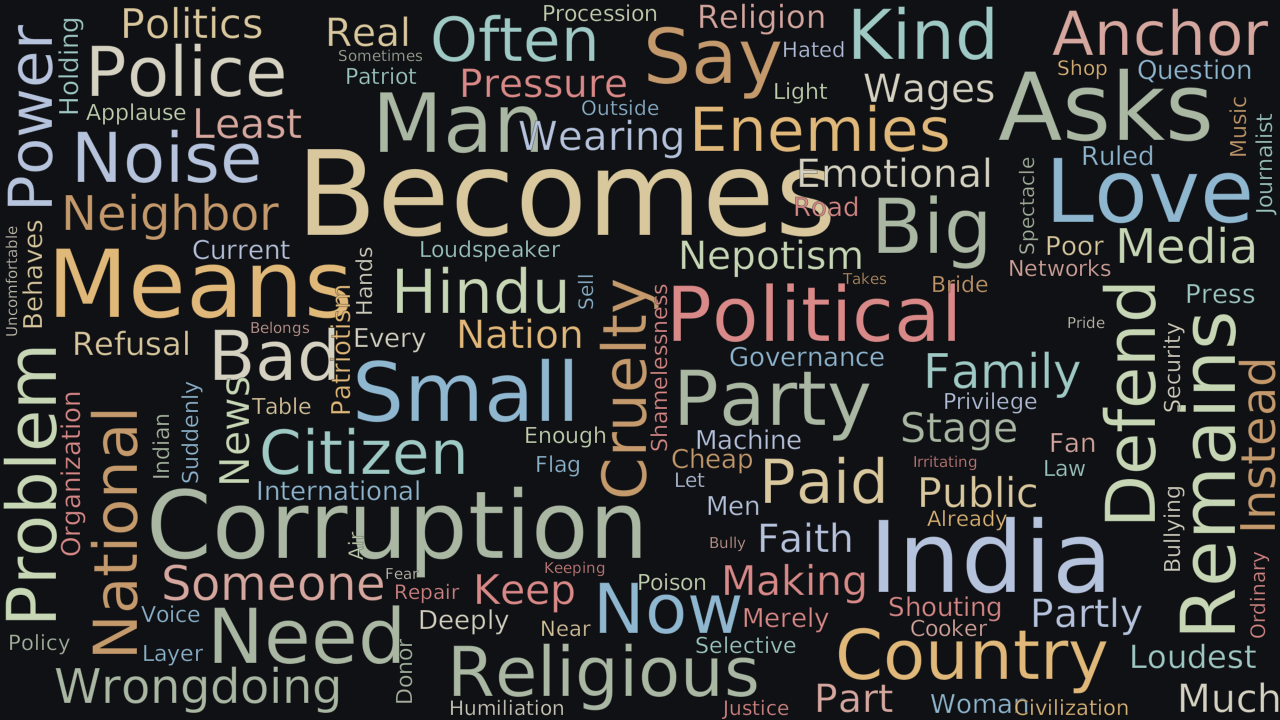
Word Cloud
Related reading
Selected by shared topics and section, with closer publication dates breaking ties.