The Thucydides Trap, Two Superpowers, and a Very Old Greek Headache
Uses the speech voice supplied by your browser or device.

The Thucydides Trap sounds like something an elderly Greek uncle would warn you about while removing fish bones from his lunch.
“Careful, my boy. First comes pride. Then comes fear. Then comes war. Also do not trust wooden horses.”
That is more or less the whole theory, though Harvard later added charts.
The idea is simple enough to fit inside a teacup at a Garia roadside stall. When a rising power grows strong enough to frighten an established power, both may begin to behave like two men in a narrow lane carrying refrigerators in opposite directions. Each believes he has right of way. Each sees backing up as humiliation. Each explains, with rising blood pressure, that the other fellow started it. Then the lane fills with shouting, traffic, neighbors, and one philosophical goat.
This is why the phrase appears whenever Trump, Xi, America, China, tariffs, ships, chips, Taiwan, or military parades enter the same television sentence. The chyron flashes. The panelists grow solemn. Someone says “Thucydides Trap,” and suddenly ancient Greece has been dragged into the studio like an overqualified guest who was promised tea and given a microphone.
But we should not treat the phrase like sacred ash. It is not magic. It is not prophecy. It is a warning label.
Thucydides, the Athenian historian who wrote about the Peloponnesian War, was not selling motivational leadership courses. He had lived through the thing. Athens rose. Sparta feared. The Greek world split into camps. The war dragged on, brutalized everyone, and left Greece weaker, nastier, and more available for future conquerors. This is history’s way of saying: congratulations, gentlemen, you have won the argument and lost the house.
His famous insight was not that war happened because Athens was bad or Sparta was good, or the reverse. That would be too comfortable. He said the growth of Athenian power and the fear this caused in Sparta made war more likely. Fear did not merely sit in the corner. It entered the furniture. It entered speeches. It entered alliances. It entered the way people interpreted every gesture.
That is the first trap.
Not war.
Interpretation.
A ship moves. Is it defense or provocation? A tariff appears. Is it bargaining or strangulation? A chip export ban lands. Is it national security or economic siege? A leader gives a speech. Is it domestic theater or a map of future conquest?
You think countries respond to events. Not quite. Countries respond to the meaning they attach to events. That is where the ghost walks in.
Greek mythology understood this better than most policy seminars. In those stories, disaster rarely enters by kicking down the door. It arrives disguised as common sense. Agamemnon kills his daughter because the fleet must sail. Achilles sulks, then rages, then kills, because honor has been touched on the raw nerve. Icarus flies too high because young ambition is a lovely thing until wax remembers physics. Cassandra tells the truth and nobody listens, which makes her the patron saint of ignored analysts, defeated wives, honest auditors, and every person who has ever said, “This will not end well,” five minutes before it did not end well.
The Greeks had gods, but their gods were also moods with muscles. War had a face. Desire had a face. Jealousy had a face. Wisdom had a helmet. Pride had excellent posture and no brakes.
That word pride matters.
Hubris is often translated as arrogance, but that is too thin. Arrogance is a man boasting that he makes the best biryani in Behala. Hubris is when he declares that rice itself exists because of him. Hubris is overstepping the human limit. It is the king forgetting that the ground is still hard when you fall on it.
Superpowers are especially prone to hubris because the furniture agrees with them. Aircraft carriers agree. GDP agrees. Flags agree. Think tanks agree. Paid consultants agree with particularly shiny faces. The public may grumble about onions, petrol, rent, school fees, and electricity bills, but the state looks at its monuments and begins to believe its own poster.
America has had this disease. After the Cold War, it often behaved as if history had applied for US citizenship. Markets would open minds. Trade would soften rivals. Technology would dissolve tyranny. The world, having been properly connected, would become sensible. This was a beautiful idea, like believing that if all family members are added to one WhatsApp group, peace will follow.
China has its own fever. A century of humiliation, astonishing economic growth, party discipline, infrastructure at terrifying speed, and a civilizational story older than most European nations can produce a dangerous intoxication. The country that once felt pushed around begins to feel history owes it a refund with interest.
Now place these two in the same century.
One hears decline.
The other hears disrespect.
One says rules-based order.
The other hears rules written by someone else.
One says security.
The other hears encirclement.
One says sovereignty.
The other hears expansion.
This is how language becomes gunpowder.
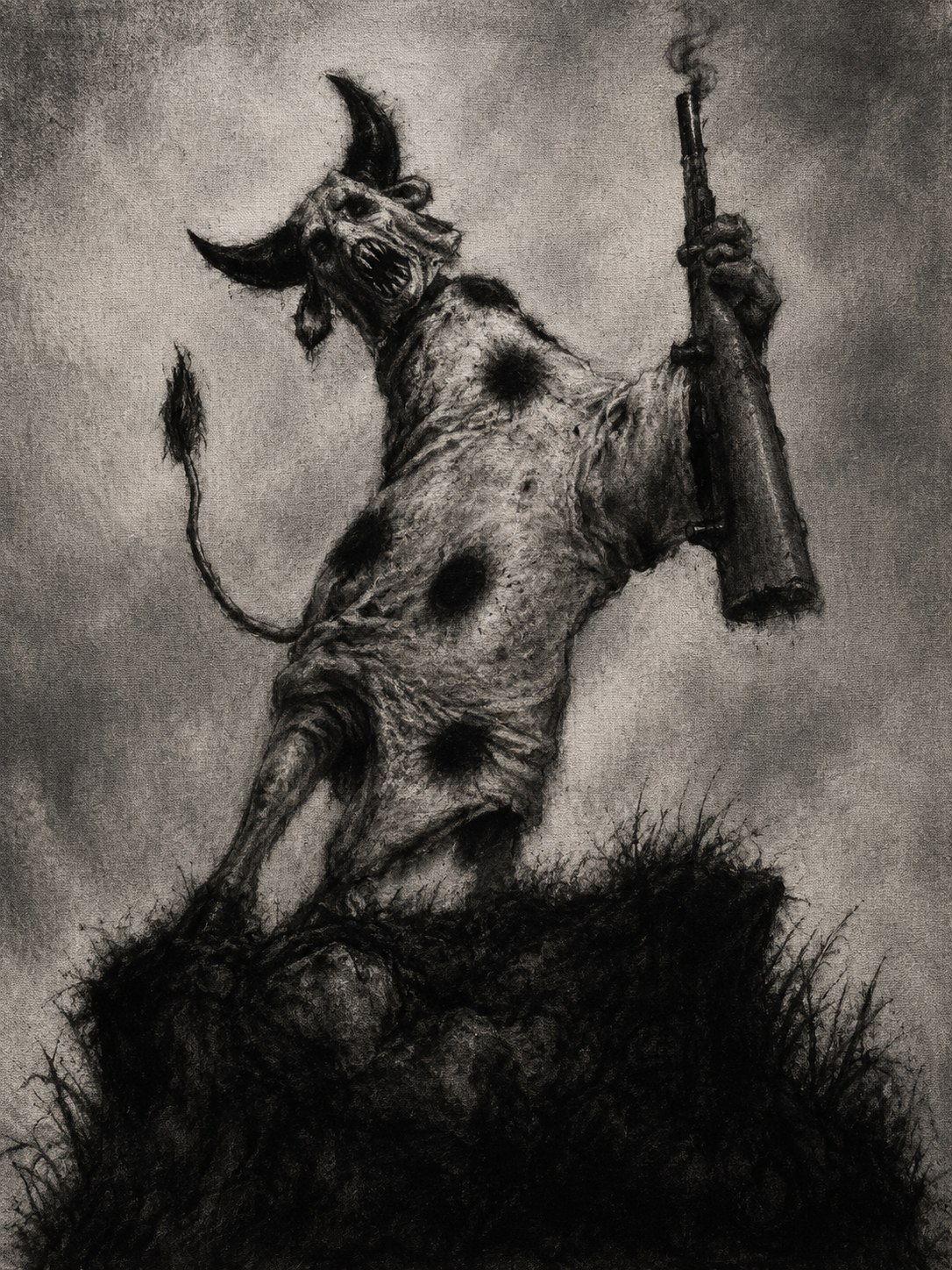
The mythological creature hiding inside the Thucydides Trap is not Ares, the god of war. That would be too obvious. It is probably the Minotaur: half-man, half-beast, locked in the basement of the palace, fed regularly, denied publicly. Every empire has one. The hidden appetite. The thing below the official architecture. The thing that must be fed so the splendid upstairs rooms can remain splendid.
For Athens, the Minotaur was empire disguised as freedom. For Sparta, it was fear disguised as discipline. For modern powers, it may be security disguised as expansion, or dignity disguised as domination, or economic policy disguised as moral destiny.
The ordinary citizen is rarely invited into this basement. He is busy. He has rice to buy, medicine to price, a leaking tap to ignore until it becomes a domestic monsoon. In the southern fringe of Calcutta, a middle-aged man may sit before a fan that rotates with the tragic dignity of a tired bureaucrat, watching global tension scroll across his phone while the local para argues over parking, drainage, and whose dog has insulted whose scooter. This is not a small contrast. This is the world. The grand and the petty always arrive together. Empires quarrel over sea lanes while your tea goes cold.
And yet the grand quarrel matters, because the price of the quarrel eventually enters the small room.
War is not only bombs. War is shipping delays, inflation, shortages, censorship, suspicion, visas denied, students stranded, research blocked, factories relocated, alliances hardened, budgets distorted, and ordinary people told to be patient while powerful people act dramatic under flags.
Here is the catch. The Thucydides Trap is useful only if we refuse to worship it.
If we say America and China are doomed to fight because Athens and Sparta fought, we have not learned history. We have turned history into a cheap horoscope. “Mars is in the seventh house; therefore aircraft carriers must proceed.”
Nonsense.
Athens and Sparta did not have nuclear weapons. They did not have global supply chains. They did not have semiconductor fabs, social media mobs, satellite surveillance, sovereign wealth funds, cyberattacks, AI models, or multinational companies quietly praying that no politician becomes too poetic before quarterly earnings. They did not have a planet where the rival is also the supplier, customer, lender, competitor, factory, threat, and dinner guest.
Modern rivalry is not two boxers in a ring. It is two surgeons operating on each other while standing on a moving bus.
So a clean solution is fantasy. Complete friendship is unlikely. Complete separation is expensive. Complete dominance is dangerous. Complete trust is childish. This is the irritating adult furniture of the problem.
What remains?
First, stop confusing strength with theatrical anger. A country does not become safer because its leaders speak as if every microphone is a battlefield. Second, keep talking when talking feels useless. Especially then. Hotlines, military contacts, boring diplomatic channels, working groups, trade negotiations, scientific exchanges: these are not glamorous. Neither is a drain cover. You miss it only when you fall in.
Third, separate real red lines from television red lines. Not every insult is a crisis. Not every patrol is a prelude. Not every technological gain by the other side is the end of civilization. Some things are competition. Some are warning signs. Some are bargaining chips. Some are just noise wearing a tie.
Fourth, remember the Trojan Horse. Gifts can be threats. Threats can be signals. Signals can be misunderstood. Misunderstandings can become policy. Policy can become machinery. Machinery, once built, asks to be used.
That is the part that should make us nervous.
The most dangerous moment in great-power rivalry is not when leaders hate each other. Hatred is crude and visible. The dangerous moment is when both sides become convinced that their own fear is wisdom. Fear then hires lawyers. Fear writes budgets. Fear enters school textbooks. Fear rewards the loudest men in the room and calls them realists. Fear makes compromise look like decay.
Cassandra sees this early. Nobody invites Cassandra twice.
The old myths are not old because they are dead. They are old because we keep renewing the subscription. Icarus is still flying, except now he has a defense white paper and a venture capital pitch deck. Achilles is still offended, except now he has nuclear submarines. The Trojan Horse still arrives at the gate, except now it may be a trade deal, a software platform, a loan, a port, a data center, or a beautiful app asking for permissions it does not need.
And Thucydides sits in the corner, not smiling.
His lesson is colder than mythology and more useful than punditry. Power changes how people see. Fear changes what they count as evidence. Pride changes what they count as acceptable. Interest changes what they call principle.
That is the trap.
Not that war must happen.
That war can begin to feel reasonable.
Once that happens, the rest is clerical work.
The only escape is not innocence. No great power is innocent. The escape is disciplined suspicion, including suspicion of one’s own grand story. When a nation says, “We merely seek security,” ask what that security costs others. When a nation says, “We are restoring dignity,” ask who must kneel for the restoration to feel complete. When a nation says, “History is on our side,” hide the sharp objects.
For those of us far from Washington and Beijing, sitting under a slow fan in Calcutta while the news performs its nightly circus, the matter can feel too large to hold. But perhaps the small view helps. We know lanes. We know quarrels. We know how quickly a minor argument becomes a family epic. We know how pride turns a solvable problem into a permanent monument. We know how men would rather spend ten years proving they were right than ten minutes admitting they were frightened.
So yes, the Thucydides Trap is “so-called.”
Good. Let it be so-called.
Call it a trap, a myth, a warning, a mirror, a Greek headache in modern clothes. The name matters less than the nerve it touches. Rising power. Established power. Fear. Honor. Interest. Misreading. Overreaction. The old ingredients are still in the kitchen.
The question is whether we are cooking dinner or burning down the house.
Word Cloud
Related reading
Selected by shared topics and section, with closer publication dates breaking ties.