Hope Dies at Different Rates
Uses the speech voice supplied by your browser or device.

Hope does not die like a cinema hero, one hand on the chest, violins swelling, rain arriving exactly on cue. Hope dies more like a cheap ceiling fan in a rented room. First it makes a noise. Then it runs only on speed three. Then someone ties the regulator with tape. Then one day it moves so slowly that you cannot decide whether it is working or only remembering its former profession.
At twenty, hope is a noisy fellow. It borrows your shirt, eats your biryani, tells you you will do something large with your life, perhaps in America, perhaps in a clean office with glass doors and chairs that do not wobble. At fifty-one, in the far edges of Calcutta, single, anxious, bipolar, middle-class by memory and bankrupt by arithmetic, hope becomes a much quieter creature. It sits in the corner like an old cat who has seen too many landlords.
The funny thing is that education, which was supposed to rescue me, has also blocked several emergency exits.
A religious man can still say, “There is a plan.” A superstitious man can say, “Saturn is angry.” A spiritual man can say, “The universe is testing me.” An astrologer can examine the sky as if the planets are a committee of elderly uncles deciding whether I should get work this month. There is comfort there. Not truth, necessarily. But comfort. And comfort is not a small thing when the mind is burning like a transformer in May.
I cannot use those doors.
Too much education has spoiled me. Not grand education, not marble-hall education, not the kind where people say “epistemology” and then get funded. Just enough science, history, biology, probability, and lived failure to make the supernatural look like a painted window. Beautiful from a distance. Useless when you try to climb through it.
So I am left with prose.
This sounds elegant until you see the actual arrangement. One middle-aged Bengali man, one old worry, one unstable income, one mind that changes weather without notice, one keyboard, one cup of tea, one mosquito conducting unauthorized blood research near the ankle. This is not exactly the romance of literature. This is survival with spell-check.
Still, writing gives me one small handle on life.
Not control. Control is too large a word. Control is for people with fixed salaries, family backing, mutual funds, and dental plans. I have something smaller. I can take a misery that is lying across my chest like a sack of wet rice and turn it into a sentence.
That is not cure.
But it is distance.
When I write, “I am afraid,” I become two things for a moment: the person speaking, and the fear being spoken about. Before the sentence, everything is one black lump. After the sentence, there is at least a crack in the lump. A little air enters. A lizard could pass through. On some days, that is enough civilization.
Many people do not have even this.
They suffer, but cannot say how. The mind darkens, but the mouth produces only “I am fine.” The chest tightens. The stomach misbehaves. Sleep disappears. Anger arrives wearing office shoes. A man shouts at his mother, his wife, the vegetable seller, the driver of an auto who has committed the historic crime of existing near him. Everyone says he has a temper.
Maybe he does.
Maybe he has grief with no dictionary.
This is the part that frightens me.
Animals suffer without articulation. A street dog limps beside a tea stall and cannot write an essay titled “On the Philosophical Disappointment of Being Kicked by Schoolboys.” A goat tied near a butcher’s shop cannot develop a theory of dread. A fish in a plastic bag cannot compose a small poem on oxygen loss. We look at them and feel pity because their pain has no language.
But plenty of human pain also has no language.
It becomes headache. It becomes silence. It becomes prayer. It becomes drink. It becomes a quarrel over nothing. It becomes that long stare at the wall after lunch when even the wall seems to have better prospects.
Expression is not decoration. It is plumbing. Without it, the sewage comes up somewhere else.
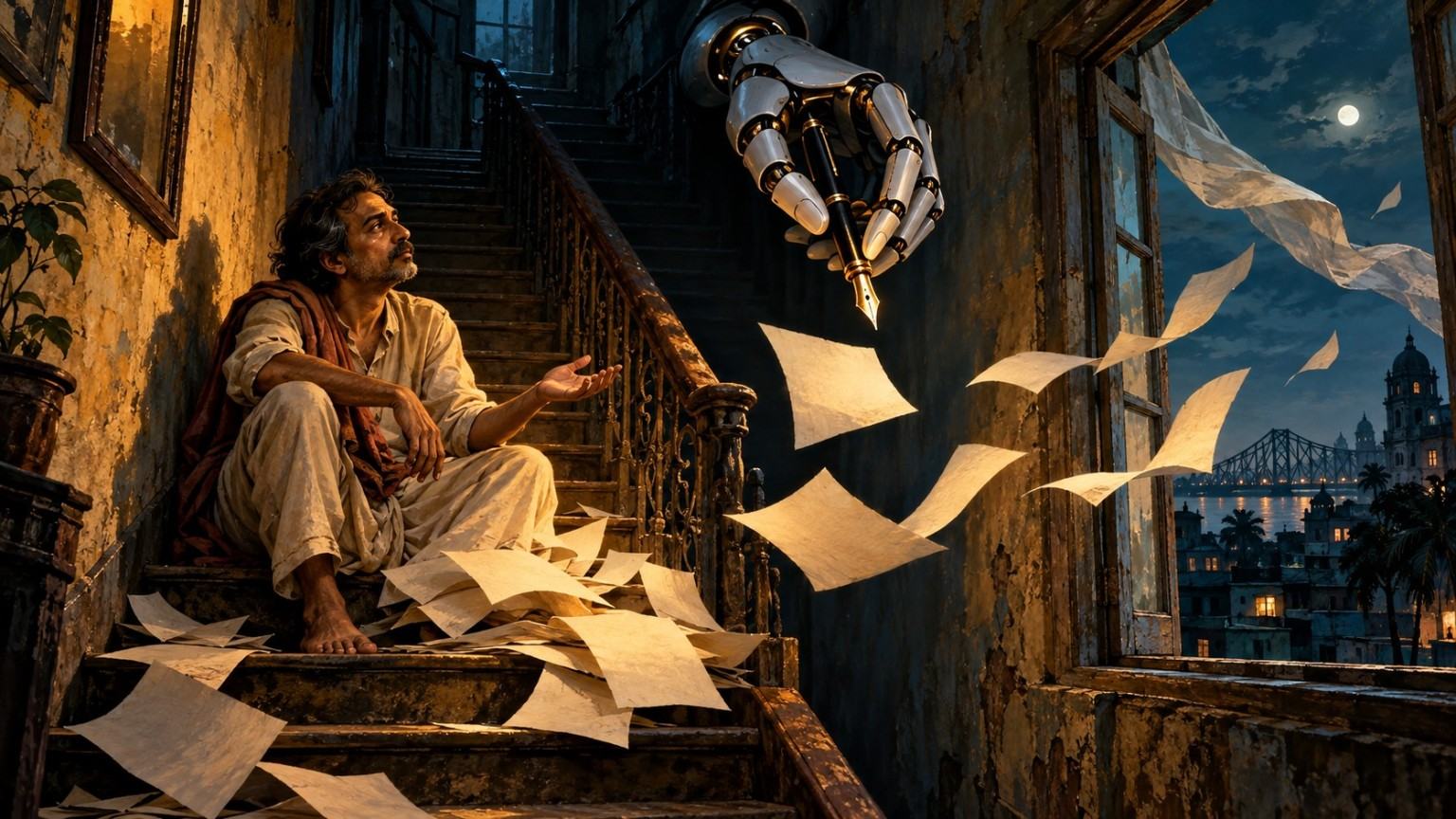
Now comes AI, walking into this already leaky house with polished shoes and a salesman’s smile.
I am not against AI. That would be foolish. I have worked around technology long enough to know that tools are never purely angels or villains. A knife can cut vegetables or reputations. A phone can call a doctor or destroy an afternoon. AI can help a tired student, a lonely worker, a bad writer, a non-native speaker, an old man with a brain full of fog. It can translate. It can tidy. It can suggest. It can hold the torch while you look for the fuse box.
But here is the catch.
What happens when it does the feeling for you?
Not the writing. The feeling.
Because writing is not merely putting words in a row like schoolchildren at morning assembly. Writing is how the mind discovers what it is carrying. You begin with “I am angry.” After three sentences you realize you are not angry. You are ashamed. After five more, you discover you are lonely. After ten, you find a small dead hope under the bed, covered in dust, looking at you with accusing eyes.
A machine can produce the paragraph quickly.
Too quickly.
And speed is not always kindness. Instant language can become instant evasion. You press a button and receive a smooth paragraph about “emotional overwhelm” and “processing difficult feelings.” Very clean. Very balanced. Very suitable for a wellness brochure printed on recycled paper. But where is the broken edge? Where is the smell of your room? Where is the unpaid bill, the afternoon heat, the neighbor’s pressure cooker whistle, the foolish old dream that still refuses to die?
The machine may make you sound better while helping you know yourself less.
That is a bad bargain, like buying polished shoes and discovering they walk in the opposite direction.
We already live in a world where people read less than they scroll, listen less than they react, and confuse noise with knowledge. The phone has turned everyone into a small news channel. Breaking news: your cousin has eaten momo. Breaking news: a celebrity has aged like a human. Breaking news: someone you disliked in school now has a car. The mind is pelted all day with tiny pebbles. Then, at night, we wonder why it has bruises.
Reading used to slow the mind down. Not always. Some books are sleeping tablets with page numbers. But good reading lets you pause. You can stop at a sentence, chew it, dislike it, return to it, argue with it, underline it, misread it, finally understand it three days later while buying eggs. That slow friction is part of thinking.
Writing is even more stubborn.
Writing says: no, don’t run away yet. Sit here. Name it. Is it sadness? Is it fear? Is it envy? Is it humiliation? Is it the old Bengali middle-class terror of falling one rung lower, where the ladder becomes a bamboo pole and then becomes air?
This naming matters.
A feeling without a name becomes a ghost. A named feeling becomes at least a difficult tenant. Still unpleasant, but now it has a doorbell.
My fear is that future children, especially ordinary children, will be trained to skip this labor. Rich children will still be taught to express themselves. They will get workshops, mentors, therapists, creative writing camps, leadership coaching, and expensive notebooks with covers that look emotionally intelligent. Poorer children will be told to use AI to “communicate better,” which often means: sound smoother, safer, less local, less strange, less yourself.
Their roughness will be corrected out of them.
This is not progress. This is laundering.
A boy from a narrow lane writes, “My heart feels like the afternoon has sat on it.” The machine may improve it to, “I am experiencing emotional heaviness.” Congratulations. We have converted a living sentence into hospital porridge.
Do this long enough and a generation may become fluent without becoming expressive.
That is the danger. Not that they will become stupid exactly. Human stupidity has flourished without help for thousands of years and needs no new software. The danger is subtler. They may lose the practice of noticing the small weather inside themselves. They may recognize only the loud emotions: rage, desire, panic, excitement. The softer ones may pass unnamed.
Unease.
Stale hope.
Quiet shame.
Comic despair.
That little morning dread before tea, when the day stands at the door like a creditor.
If you cannot name these things, they do not vanish. They simply rule from behind the curtain.
I know this because my own mind is not a reliable employee. It takes leave without notice. It misfiles documents. It declares emergency during ordinary business hours. Bipolar depression is not romantic. Anxiety is not sensitivity. They are not mysterious gifts wrapped in moonlight. They are, much of the time, boring, repetitive, humiliating, and expensive. They reduce life to maintenance.
Get through the morning.
Answer one message.
Pay one bill.
Do not collapse before lunch.
Do not believe every thought your brain produces, because some thoughts are forged documents.
In such a life, prose is not luxury. It is a small municipal bridge over a dirty canal. Not pretty. Not famous. But without it, you must wade through.
That is why I write.
I write because I cannot honestly pray. I write because superstition does not fit my hand. I write because the market does not care, institutions do not wait, and the body ages like a cheap plastic chair left in the sun. I write because a sentence is one of the few things a broke man can still own without paperwork.
And yes, some days the sentence is bad.
Let it be bad.
A bad human sentence may contain more truth than a perfect machine paragraph. The grammar may limp. The rhythm may cough. The metaphor may arrive wearing mismatched slippers. Fine. At least it came from the wound and not from a server farm with excellent cooling.
Use AI. Of course use it. Use it the way you use a torch during a power cut, not the way you use a priest to outsource your conscience. Use it after you have tried to say the thing yourself. Use it to clean the window, not to replace the view. Use it to sharpen the knife, not to choose what must be cut.
The first draft of pain should remain human.
Misspelled, embarrassing, dramatic, repetitive, sweaty, local, foolish, alive.
Especially alive.
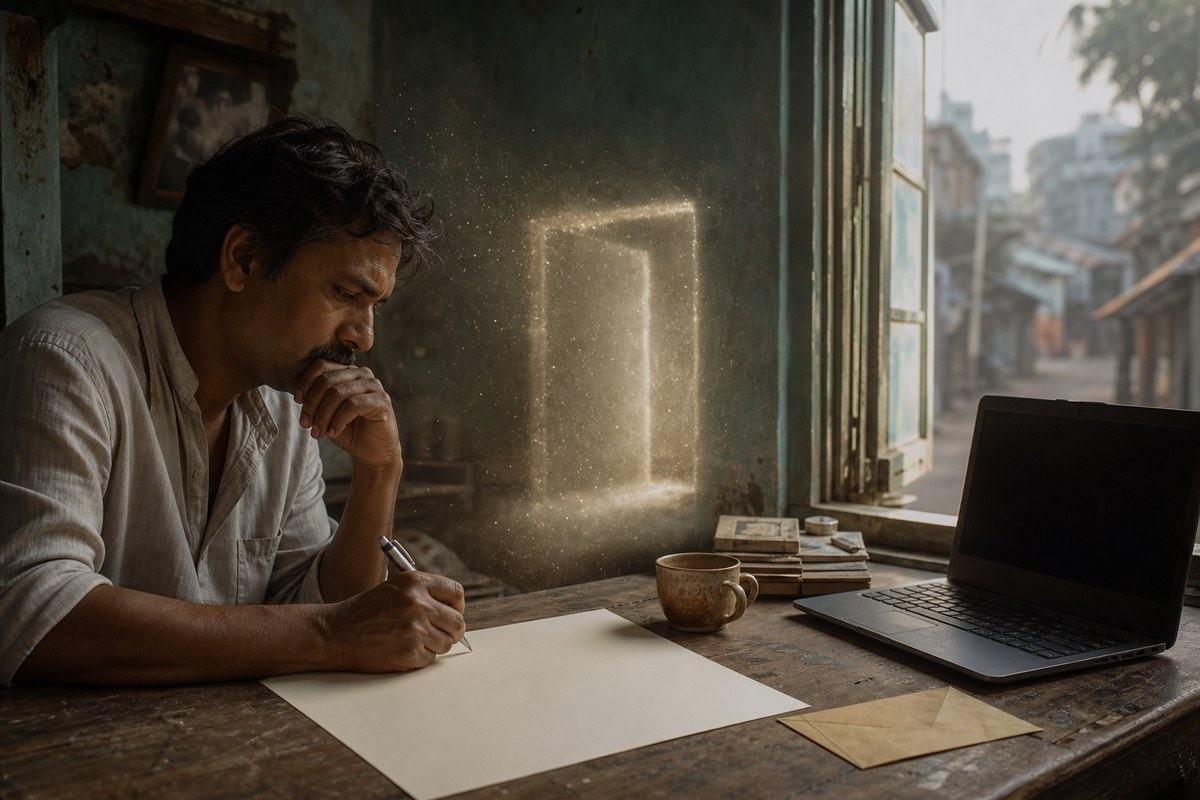
Because hope dies at different rates. Mine has not died with dignity. It limps around the room, mutters, refuses religion, distrusts optimism, laughs at motivational quotes, checks the bank balance, makes tea, and then, against all available evidence, opens a blank page.
That may be my last superstition.
Not that writing will save me.
Only that one clear sentence can hold back the dark for one more evening.
Sometimes, in Calcutta, in a hot room, with mosquitoes singing their thin criminal song, one evening is a large kingdom.
Word Cloud
Related reading
Selected by shared topics and section, with closer publication dates breaking ties.