The Low Market Value of Reality
Uses the speech voice supplied by your browser or device.

There are two kinds of outcast. One burns down the village granary and runs away at midnight. The other answers correctly in class, refuses to flatter idiots at work, and later writes about science and mathematics in a society that would rather buy a horoscope with laminated edges.
I belong, regrettably, to the second group.
My exile began in school, that small sweaty republic of benches, chalk dust, fear, and pencil shavings. In those days a teacher’s praise was not a flower. It was a matchstick. If the teacher said, “Good, very good,” and my copybook was held up like the Constitution of India, the room did not clap. The room cooled. Somewhere behind me, a boy who had just been scolded, or worse, slapped into moral improvement, looked at me with the affection normally reserved for mosquitoes.
That was my first lesson in public life: praise is never evenly distributed, and children notice.
I did not ask to be praised. This is the important joke. I was not standing on the desk waving a flag and declaring myself the little Napoleon of algebra. I merely did the work. But in a classroom where one child’s neat answer sits beside another child’s humiliation, merit becomes a poisoned sweet. The teacher thinks he has rewarded diligence. The class thinks you have joined the police.
This was not childhood. This was training.
Years later, in offices with better chairs and worse morals, the same little drama returned wearing perfume. Meritocracy was spoken of with great respect, like a dead grandfather whose photograph still hangs in the drawing room, garlanded once a year, ignored the rest of the time. Everyone knew the truth. The ladder did not reward the best climber. It rewarded the person who knew when to bend, when to smile, when to nod, when to convert a manager’s half-cooked nonsense into a strategic vision.
I could never do it.
This is not a compliment to myself. Let us not put sandalwood paste on a cracked pot. I have my share of foolishness. I trusted people I should have examined with tongs. I mistimed decisions. I confused intelligence with judgment, which is like confusing a sharp knife with dinner. I lacked the small daily cunning by which many respectable lives are built. Some people can smell power entering a room before the door opens. I notice it after it has taken the good chair and eaten the biscuits.
But one defect stayed with me like a stray dog: I could not lie smoothly enough to be promoted by lying.
A polished liar is called practical. A crude liar is called dishonest. An honest man is called difficult. There is your entire human-resources manual, boiled down to three sentences and served without garnish.
So I drifted, as people like me do. School outcast became workplace misfit, and workplace misfit became the middle-aged single Bengali man in the southern shanty-belt of Calcutta, sweating under a fan that sounds like a helicopter with unpaid loans, writing blog posts about reality as if reality had opened a subscription counter.
It has not.
Reality is not a popular product in Bengal. Reality is like bitter neem paste. Everyone praises its medicinal value from a distance. Then they ask for rosogolla.
Give the Bengali public a little gossip, a little nostalgia, a little political tribalism, a little Tagore quoted like incense, a little motherland, a little football, a little exam anxiety, a little ancient-civilization drumbeat, and you may yet survive. But offer science, evidence, probability, mathematics, the actual machinery of social failure, the grim plumbing behind the drawing-room philosophy, and suddenly you become that guest who has explained digestion during lunch.
Nobody invited this man.
And yet this is what I write.
There is a great joke hidden here, and it is not even a subtle one. If I wanted money, I know the road. It is paved. It has streetlights. It has shops selling destiny in packets. I could write books on astrology with chapter titles like “How Mars Stole Your Promotion” and “Why Your Mother-in-Law Is Actually Saturn in a Cotton Saree.” I could produce homeopathy hymns so sweet that sugar pills would blush. I could declare that water has memory, while politely not asking why it remembers a medicine molecule but forgets the drain, the pond, the plastic bucket, and the handpump near a suspiciously green wall.
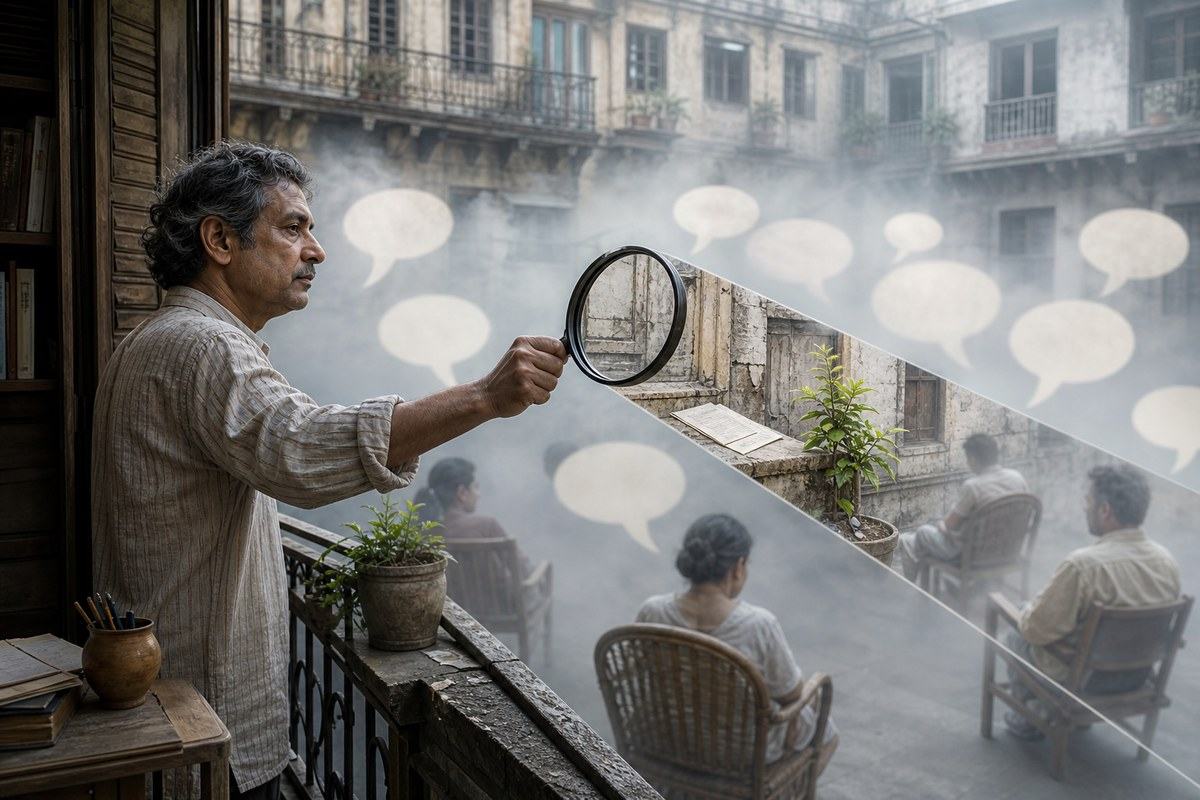
There is money in fog.
Fog is cheap to manufacture. You do not need data. You do not need method. You do not need the inconvenience of being correct. You need confidence, repetition, and the ability to look solemn while saying something that would make a school physics teacher put down his tea and stare at the wall for ten minutes.
The public will help you. That is the truly sad part. People do not merely buy nonsense because they are stupid. That explanation is too lazy, and also too flattering to the educated. People buy nonsense because nonsense is kind in the short term. It gives suffering a villain. It gives failure a planet. It tells the anxious mother that certainty can be bought in a bottle. It tells the worried father that his son’s unemployment has cosmic paperwork behind it. It tells the failed man that the universe has taken a personal interest in ruining him, which is oddly comforting. At least someone is paying attention.
Science does the opposite.
Science is not cruel, but it is unsentimental. It says: maybe your illness needs a doctor, not a mantra. Maybe your poverty needs policy, education, work, luck, and justice, not Jupiter. Maybe your child failed the exam because the system is brutal, the coaching market is predatory, and nobody in the house knows how fear kills learning. Maybe your society is not anciently wise in every matter. Maybe some ancestors were clever, some were confused, and many were simply trying to survive cholera, famine, caste, empire, and the price of rice.
This does not sell well.
The horoscope seller gives you a velvet cushion. The rationalist gives you a chair with one loose leg and says, “Careful, let us repair this properly.” Naturally the cushion is more popular.
Mathematics is worse. Mathematics has the social charm of a tax notice. People treat it as childhood punishment, like handwriting practice or standing outside class holding your ears. Then in adulthood the same people forward investment advice, medical rumors, election predictions, miracle cures, diet plans, and conspiracy theories without the smallest acquaintance with probability. They cross a river daily and refuse to learn what water is.
If you point this out, you are arrogant.
If you do not point it out, the river keeps rising.
This is the trap. A Bengali writer can become popular by warming the reader’s heart with soft mist. I cannot. I have tried. My hand rebels. The sentence turns left. Some inconvenient fact walks in wearing bathroom slippers. A small piece of evidence coughs from the corner. Soon the whole cheerful paragraph is ruined.
I do not hate comfort. Let us be fair. I live in a city where comfort is rationed like good pavement. A cool evening breeze in May can make a philosopher out of a bus conductor. A cup of tea at the right moment can prevent a minor civil war. Comfort is no small thing.
But comfort built on lies has a later bill.
The bill comes as bad medicine, bad politics, bad education, bad public reasoning, bad leadership, and families where fear dresses up as tradition. The bill comes when a patient wastes months on miracle cures. The bill comes when children learn obedience instead of thinking. The bill comes when a society worships exams but insults curiosity. The bill comes when everyone says “merit” while privately shopping for influence.
By the time the bill arrives, the astrologer has moved to a larger flat.
Meanwhile, I remain here, counting coins, counting symptoms, counting views, counting the number of ways a man can be invisible in his own language.
That invisibility has its own weather. In Bengal, exclusion is rarely dramatic. Nobody throws you into the Hooghly while quoting scripture. They do something more efficient. They ignore you. They do not share your work. They do not recommend your name. They do not invite you to the panel, the reading, the project, the adda, the little circle where opportunities arrive like hot telebhaja in paper packets. You become socially absent while physically alive. A ghost with broadband.
It is a remarkable condition.
And yet, from this ridiculous little corner, something remains possible. A man who cannot win the game may at least describe the rules. A man who is not allowed into the club may notice the club’s foundation is sinking. A man with no prize to protect may say what prizewinners cannot afford to say: much of our public life is built on flattery, fear, superstition, and the careful murder of plain speech.
This is not bravery. Bravery wears better shoes.
This is stubbornness. Cheap, dented, unfashionable stubbornness. The kind you find in old steel trunks, cracked teacups, and men who have lost enough that the usual threats sound like yesterday’s rain.
I have said dark things in darker moods. Anyone who lives with bipolar depression knows that the mind can become a room where the furniture moves at night. Anxiety adds commentary. Poverty keeps accounts. Loneliness sits by the window like an unpaid watchman. On some days, the sentence “I would rather starve than sell lies” does not arrive as rhetoric. It arrives as weather.
Still, let us be precise. I do not wish to decorate suffering. Hunger is not noble. Bankruptcy is not a literary device. Mental illness is not a tragic shawl draped over genius. These things are mostly exhausting, humiliating, and administratively inconvenient. The electricity bill does not respect integrity. The pharmacist does not accept metaphors. The rice seller has never once said, “Ah, but your prose has moral tension.”
No. He wants money.
So why continue?
Because stopping would mean handing the room to the fog merchants.
Because there must be, somewhere in this noisy bazaar, one cracked stall selling reality without artificial fragrance.
Because some young person in Dum Dum, Baruipur, Behala, Siliguri, Burdwan, or a rented room near a coaching center may be quietly suffocating under the same nonsense and may need to hear that the problem is not always his soul, his stars, or his lack of obedience. Sometimes the problem is the machine. Sometimes the problem is the lie everyone has agreed to call culture. Sometimes the problem is that the emperor is not only naked but charging consultancy fees.
And because reality, for all its bad manners, has one advantage.
It remains.
The flattery changes. The office kings retire. The school punishments become old stories. The fashionable nonsense gets new packaging. The miracle cure changes label. The WhatsApp uncle discovers a new civilization under the sea. The market rewards another velvet fraud with a microphone and a lighting team.
Reality remains at the table, unpaid, uninvited, chewing slowly.
So I will write for that table.
I will write about science when superstition sells better. I will write about mathematics when people prefer slogans. I will write about evidence when emotion is cheaper. I will write about systems when everyone wants villains. I will write about Bengal not as a postcard, not as a museum, not as a mother goddess, but as a real place full of intelligence, decay, tenderness, vanity, hunger, jokes, fraud, heat, tea, books, mosquitoes, and people who deserve better than sweetened fog.
Call that failure if you like.
Call it poor branding.
Call it the career plan of a man who should never be left alone with a keyboard and an unpaid internet bill.
But I would rather sit in my corner of Calcutta, sweating under the fan, honest and broke, than become rich selling celestial cough syrup to frightened people.
Pariah, then.
Fine.
At least the pariah can still see the road.
Word Cloud
Related reading
Selected by shared topics and section, with closer publication dates breaking ties.