Hanging Season
Uses the speech voice supplied by your browser or device.

THIS IS A WORK OF FICTION
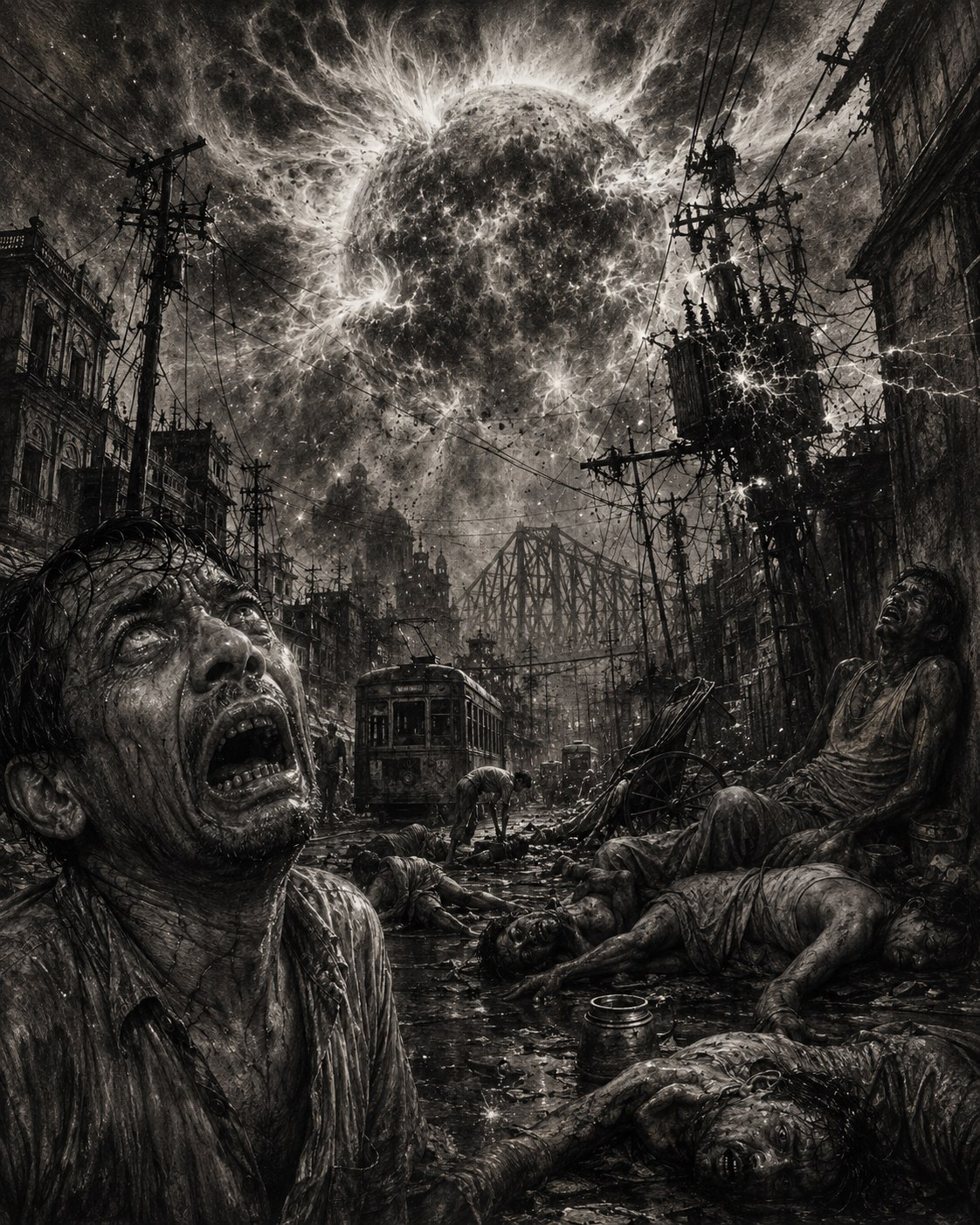
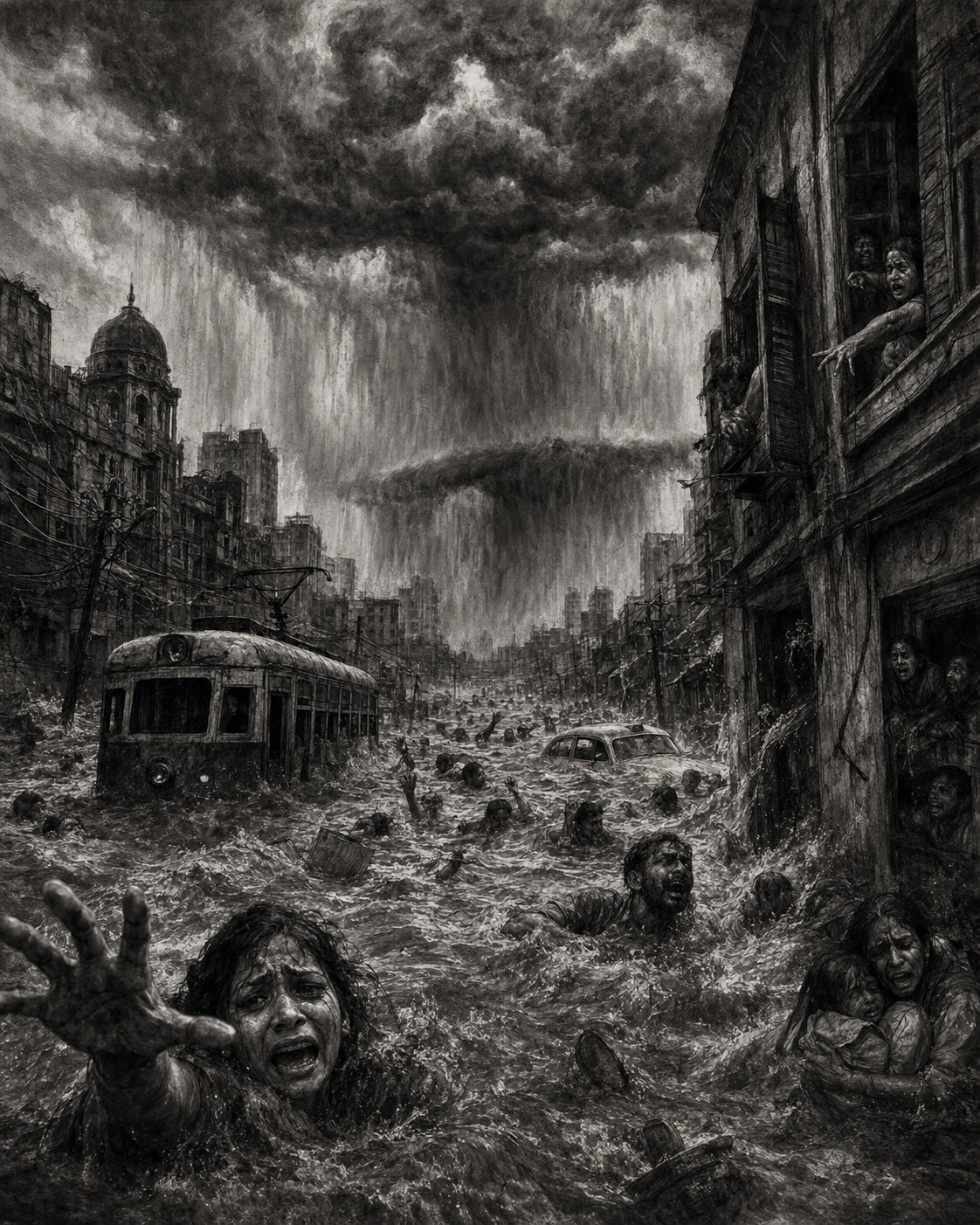
The June heat in Shyambazar did not arrive; it accumulated, like debt. Mitali stood on her third-floor balcony at six in the morning, watching the trams wake in the depot below, their wires singing in the damp air. She held her tea in a chipped ceramic bhar, the rim stained with years of use. The city below was already moving—autos arguing, a fish-seller’s basket scraping the road, someone shouting about milk. It was the ordinary music of North Calcutta, and she had lived inside it for forty-four years, long enough to know that the melody never changed, only the tempo.
Something else had changed, though. She had seen it first three days ago, and now she could not stop seeing it.
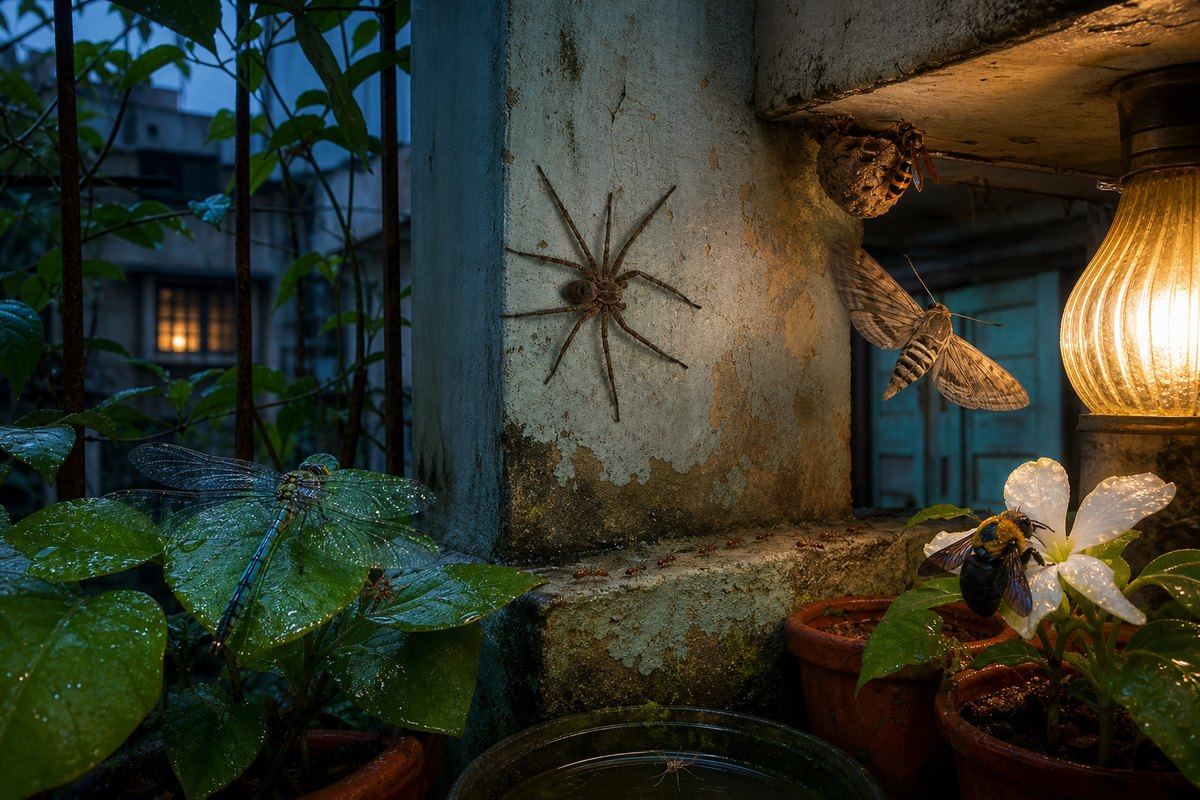
A spider hung from the tram wire opposite her balcony. Not in a web. It hung from a single thread of silk, motionless, its legs curled tight. Dead. The thread was too long, too deliberate. It had not fallen. It had lowered itself, attached the thread, and died.
The newspaper boys had started shouting about it yesterday. Spider suicide epidemic. Record numbers across Kolkata. Scientists baffled. She had bought a copy, read the article twice, and thrown it away. Scientists were always baffled. They had never stood on this balcony at dawn and felt the air turn thick before the sun arrived.
Her phone buzzed. Arun. She ignored it. He was coming at nine, and she needed the hours between now and then to prepare herself. He would bring his reasonable voice, his coaching-center cologne, his spreadsheets about property value. He would want to sell the flat. He would say, Didi, think about Rik’s future. Think about Kota. And she would have to find the strength to refuse without explaining why she could not leave this room, this beam, this particular weight of air.
She finished her tea and went inside. The flat smelled of old plaster, phenyl, and the faint, sweet rot of the neem tree in the courtyard. It was a smell from her childhood, from her father’s time, when the building had been whole and the middle class had been a fortress. Now the plaster was cracking in maps she could read like palms. The middle class was a memory, and the fortress was being sold for bricks.
At nine, Arun arrived with mangoes and bad news. He set the mangoes on the kitchen table and wiped his forehead with a handkerchief embroidered with his coaching center’s logo. He was thirty-nine, younger than her, but he had already acquired the anxious solidity of a man who believed that money was the only wall between his family and chaos.
“The dealer came to my office,” he said, without sitting. “He’s serious. Fourteen lakhs, Didi. Cash component negotiable. For this? In this location? It’s a gift.”
Mitali filled the kettle. “It’s not a gift. It’s a removal.”
“Don’t be sentimental. Rik’s coaching deposit is due in August. Kota isn’t Calcutta. The fees—”
“I know about fees. I proofread textbooks for a living. I know what education costs.”
“Then act like you know.” He softened, or tried to. “I know this place has memories. But Rana is gone three years. You’re not a shrine. You’re a woman alone in three rooms that are falling apart.”
She watched the kettle. The water began to murmur. “Did you see the spider on the stairs?”
“What?”
“On the way up. Second landing. Hanging from the railing.”
Arun frowned. “I saw a dead spider. So what? It’s summer.”
“It’s hanging. By a thread.”
He looked at her then, the way he had looked at her after Rana’s funeral—gently, but with the impatience of a man who needed his sister to be sane so he could sell her flat without guilt. “Didi, the whole city is talking about this spider nonsense. It’s heat. It’s pollution. It’s some virus. Don’t let it into your head.”
He left soon after, taking his mangoes and his reason with him. Mitali stood at the door and listened to his footsteps descend. On the second landing, she heard him pause. He had seen it. The spider, hanging from the iron railing by a single thread, its body swollen and dry. He would tell himself it was nothing. He would tell his wife that Didi was becoming strange, that the flat was making her strange, that they needed to sell quickly before her mind became a legal complication.
She closed the door and went to the bedroom.
The bedroom was the reason she could not leave. It was also the reason no buyer would stay. The beam across the ceiling was dark wood, teak, older than the building. Rana had hanged himself from it three years ago, using a length of jute rope he had bought from the hardware shop on Bidhan Sarani. She had found him in the morning. She had told the police, the neighbors, Arun, everyone, that she had found him dead. She had not told them that when she entered the room, his eyes were open. That he had kicked, once. That she had stood in the doorway for a minute—perhaps two, perhaps longer—holding her house key like a talisman, feeling something terrible and unnameable uncoil in her chest. Not grief. Grief came later. This was a cold, winged thing: relief, calculation, shame. If he died, the debts would die with him. The flat, which was in his name, would become hers. The silence would return.
By the time she cut him down, he was gone. The doctor said the neck broke instantly, that he had felt nothing. But she had seen his eyes. She had seen him see her.
Now she looked at the beam. Two spiders hung from it, separate threads, separate deaths. They were orb-weavers, the golden kind that usually built webs between the neem branches in the courtyard. They did not belong here, in this dry room. Yet here they were, hanging, legs curled, dead.
She had measured the distance yesterday. The first spider hung exactly where Rana’s left foot had swung. The second hung where his right shoulder had turned.
She went to College Street in the afternoon, because the flat was becoming too small to breathe in. The bookstalls were sweating under tarpaulin, the air thick with the smell of old paper and fried food. She bought no books. She bought a bottle of insecticide from a hardware shop, and a newspaper from a boy who shouted, “Spiders dying! Hundreds in Behala! Scientists say climate change!”
On the bus home, she read the article. Entomologists from Calcutta University were calling it “unprecedented.” Spiders of multiple species were abandoning their webs, spinning single threads, and hanging themselves from tram wires, balcony rails, temple eaves, and hospital corridors. The behavior was not territorial. It was not mating-related. It was, the newspaper said, with the relish of a city that loved its own mysteries, suicidal.
She got off at Shyambazar and walked. The insecticide was heavy in her bag. She passed the tram depot and looked up. Three more spiders hung from the wires, spaced evenly, like notes on a line of music. She did not look away. She counted them.
That night, she set her alarm for three o’clock. She wanted to catch one in the act.
She sat in the bedroom chair, the insecticide on her lap, and watched the beam. The fan turned slowly, pushing the hot air around. The city was quiet now, only the occasional truck changing gear on the main road, a dog barking in the lane. She did not turn on the light. She wanted to see it naturally, if it came.
At 3:47, she heard a sound. A thin, almost musical vibration. She looked up.
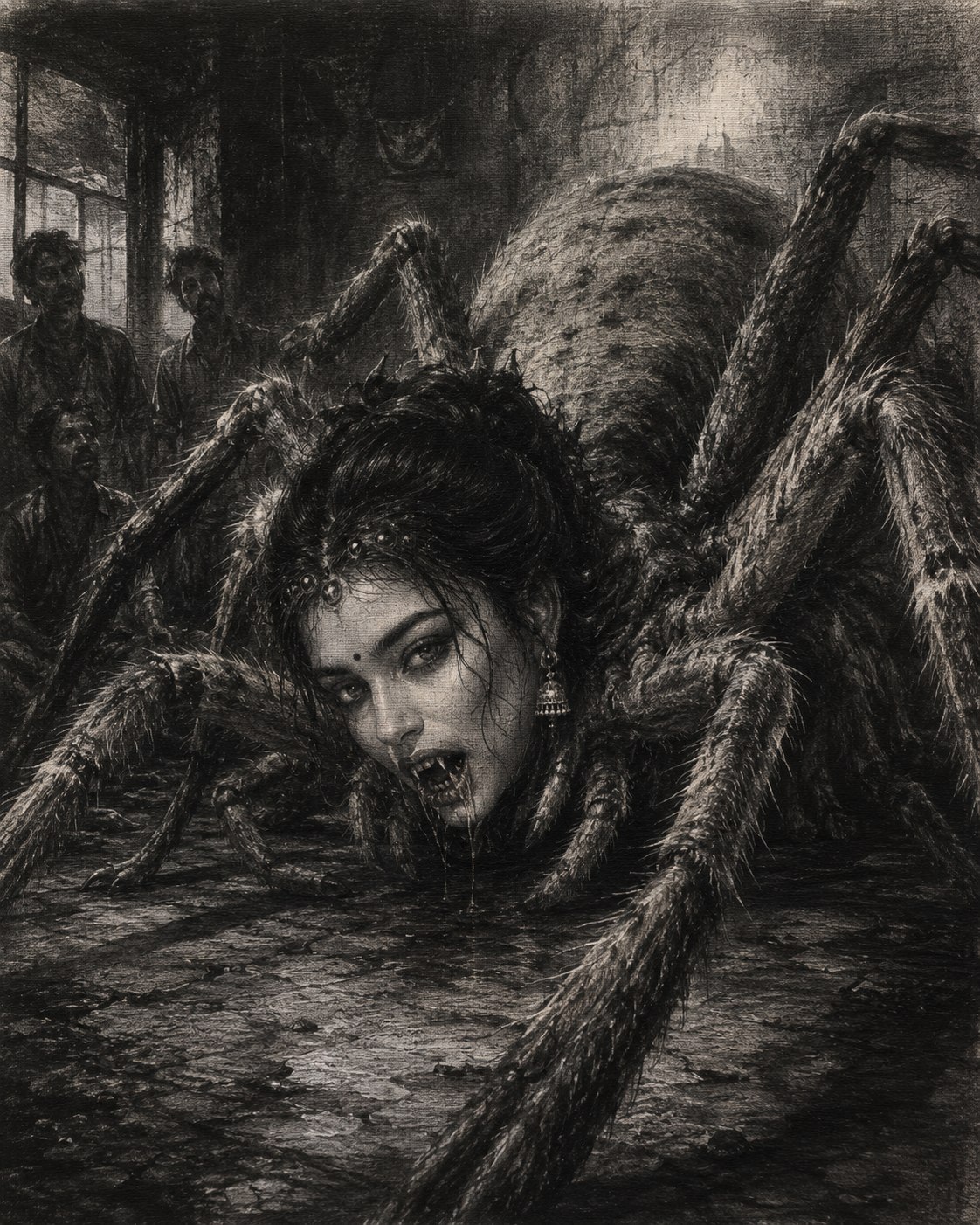
A spider was lowering itself from the beam. It was large, its abdomen pale in the dark. It moved with a terrible deliberation. It touched the beam with its forelegs, spun a thread, attached it, and then dropped. It hung there, spinning slowly in the fan’s draft. Its legs curled. It twitched once. Then it was still.
Mitali stood up. Her legs were numb. She climbed onto the bed, the insecticide forgotten on the chair, and reached up. She touched the thread. It was warm, impossibly warm, like a vein. She touched the spider. It was dead.
She got down. She looked at the new spider, hanging beside the others. Four now. She measured its position with her eyes. It hung directly below the center of the beam. Where Rana’s head had hung.
She did not sleep. In the morning, she went to the landing and knocked on Mr. Pal’s door. Mr. Pal was eighty, a retired tram driver who had lived in the building since the sixties. He answered in a vest and lungi, his eyes filmed with cataracts.
“Didi,” he said. “You look like you swallowed a ghost.”
“Mr. Pal, did anyone die in this building before Rana?”
He coughed, a wet, rolling sound. “Many people died. Old building.”
“By hanging. From a beam. From a railing.”
He stopped coughing. He looked at her for a long time. Then he opened the door wider. “Come in. Don’t stand in the heat.”
His room was a museum of tram tickets, old photographs, and the smell of liniment. He made tea on a kerosene stove and spoke without looking at her.
“1962. Before you were born. A man lived in your flat. A naturalist. Collected insects for the museum. He was… not right in the head. Quiet. One morning, they found him in your bedroom. Hanging from that beam. Same beam. Rope made of silk, they said. He had collected so much silk from spiders, he braided it. Stronger than jute.”
Mitali’s tea was scalding. She did not feel it. “And the stairwell? The second landing?”
“1978. Student. Failed his exams. Hung himself from the railing. I found him. I was the one who cut him down.” Mr. Pal’s hands shook. “Thin boy. Light as a bird. The railing was cold that morning.”
She went home. She did not take the insecticide out of her bag. She went to the bedroom and looked at the four spiders. She looked at the beam. She understood that the building had a memory, and the memory was made of silk.
She found Rana’s notebook that evening. She had never read it. She had been afraid of what she might find—accusations, final hatred, a map of her failures as a wife. Instead, she found a map of the building.
The naturalist’s name was Bose, Rana had written. He believed spiders carried souls between worlds. He hanged himself to test the silk. The student in ‘78 was just a boy who wanted to be light. The building remembers them. It wants weight. It wants the hanging. I have felt it for months. The beam whispers. The spiders are not dying. They are rehearsing. I will join them, and finally I will be part of a story that someone remembers.
Mitali closed the notebook. Her hands were steady. She felt the cold, winged thing in her chest again, but this time it had a name. It was not relief. It was recognition.
She stood on the bed. She reached up and touched the beam. The wood was warm, almost alive. She pressed her fingernails into the crack where the plaster met the teak. She pulled. A piece of plaster came away, then another. Behind it, the wood was not solid. It was hollowed, carved by decades of termites and something else. And inside the hollow, she saw silk.
Not a web. A cocoon. A massive, ancient cocoon of golden silk, filling the space inside the beam like a heart. It was old and new at once, layers upon layers, and within it, pressed against the silk like specimens in a case, were small objects. A button. A pen. A pair of wire-rimmed glasses. Rana’s glasses. And bones. Tiny, delicate bones. The naturalist’s bones. The student’s bones. Rana’s bones.
The beam was not a beam. It was a throat. The building had been swallowing them for sixty years, digesting their despair into silk, and the spiders were its tongue, tasting the air for the next meal.
She should have run. She should have screamed, called Arun, called the police, burned the flat. But she stood there, her hands in the hollow wood, feeling the silk tremble against her fingers. It was warm. It was welcoming. It knew her. It had been waiting for her since the morning she stood in the doorway and hesitated.
She pulled her hands out. She looked at the four dead spiders. She understood now. They were not committing suicide. They were invitations. The building sent them out into the city, into the heat, into the tram wires and the hospital corridors, to find the ones who were already hanging. The ones who hesitated. The ones who stood in doorways and calculated. The city was full of them. The spiders were just the scouts.
And she had been chosen. Not because she was a victim. Because she was a witness who had failed to witness. She had let Rana die in the silence of her own heart, and the building had heard that silence. It had fed on it.
She went to the kitchen. She found the box of matches. She came back to the bedroom and struck one. She held it to the silk in the beam. It caught. The flame was blue, then gold. The silk burned with a smell like hair and incense. The beam blackened. The cocoon curled. She struck another match, and another. She burned the silk. She burned the spiders. She burned the hollow.
The smoke alarm did not work. The neighbors smelled it and came. Someone called the fire brigade. The fire was small, contained to the beam. When it was out, the bedroom was blackened, the ceiling scarred, the beam exposed and hollow like a rotted tooth.
Arun came. He stood in the doorway and looked at the damage, at his sister sitting on the bed with soot on her face. “Didi,” he said. “What have you done?”
“I found the termites,” she said. “The beam was hollow. It had to come out.”
He looked at the burned wood. He looked at her eyes. He did not ask about the silk. He did not ask about the bones. He saw only property damage, insurance, delays. “The dealer,” he said carefully, “will reduce the offer. We’ll need to repair. Or sell as-is. Didi, this is exactly why you can’t manage alone.”
She looked at him. She looked at the beam. The fire had cleared the wood, but the hollow was still there, dark and warm. She could feel it breathing. “I’m not selling,” she said.
“Didi—”
“I’m not leaving. And I’m not paying for Rik’s Kota dreams. Let him study here. Let him learn what the city is. Let him learn what hangs in the walls.”
Arun left. He did not understand, and he would not try. He would tell his wife that Didi had lost her mind, that the flat was cursed, that they should wait for her to die and inherit. The middle class had always been patient. It had always known how to wait for the dead.
Mitali stayed. She cleaned the room. She painted the ceiling white. She left the beam exposed, because she needed to see it. She needed to remember that it was hollow.
The newspapers stopped talking about the spiders after the monsoon came. The heat broke, and the hanging spiders disappeared, washed away by rain or simply stopped, as mysteriously as they had begun. The scientists wrote papers. The city forgot.
But Mitali did not forget. On the first cool morning of September, she woke up and looked at the beam. A single spider hung from it. Not dead. Alive. It was spinning a proper web, a geometric, patient web, catching the dawn light. It was not an invitation. It was a resident.
She watched it for a long time. Then she got up, made her tea, and went to the balcony. The trams were running. The city was loud. The air was clean.
She did not look up at the tram wires. She did not want to know if the spiders were still hanging there, still rehearsing, still waiting for the next witness to fail. She had made her choice. She had burned the silk. She had confessed, if only to the hollow wood.
But when she finished her tea and turned to go inside, she felt something in her hair. A single thread. She reached up and touched it. It was warm. It was attached to her scalp. She pulled, gently, and a spider dropped down in front of her eyes. It hung there, spinning, its legs curled tight.
It was not dead. It was waiting.
She looked at it. She looked at the city below, the trams, the wires, the thousands of windows behind which thousands of people stood in doorways, hesitating, calculating, failing to act. The spider hung between her and the world, a small, golden witness.
She did not brush it away. She let it hang. She turned and went inside, the thread pulling gently against her hair, the spider swaying in the air she disturbed. The door closed. The flat was quiet. The beam breathed. The web grew, thread by thread, in the room where she slept, in the room where she waited, in the room that was hers now, truly and finally, because she had paid for it with the only currency the building accepted.
Outside, the tram bell rang. A newspaper boy shouted something about the weather. The city went on, as it always did, accumulating heat, accumulating debt, accumulating the weight of everything that had been hung and cut down too late. And somewhere, in a window across the lane, another woman stood on her balcony, holding a cup of cooling tea, watching a spider lower itself from a wire, thread by thread, into the humid air, and wondering, for the first time, what it meant to be witnessed.
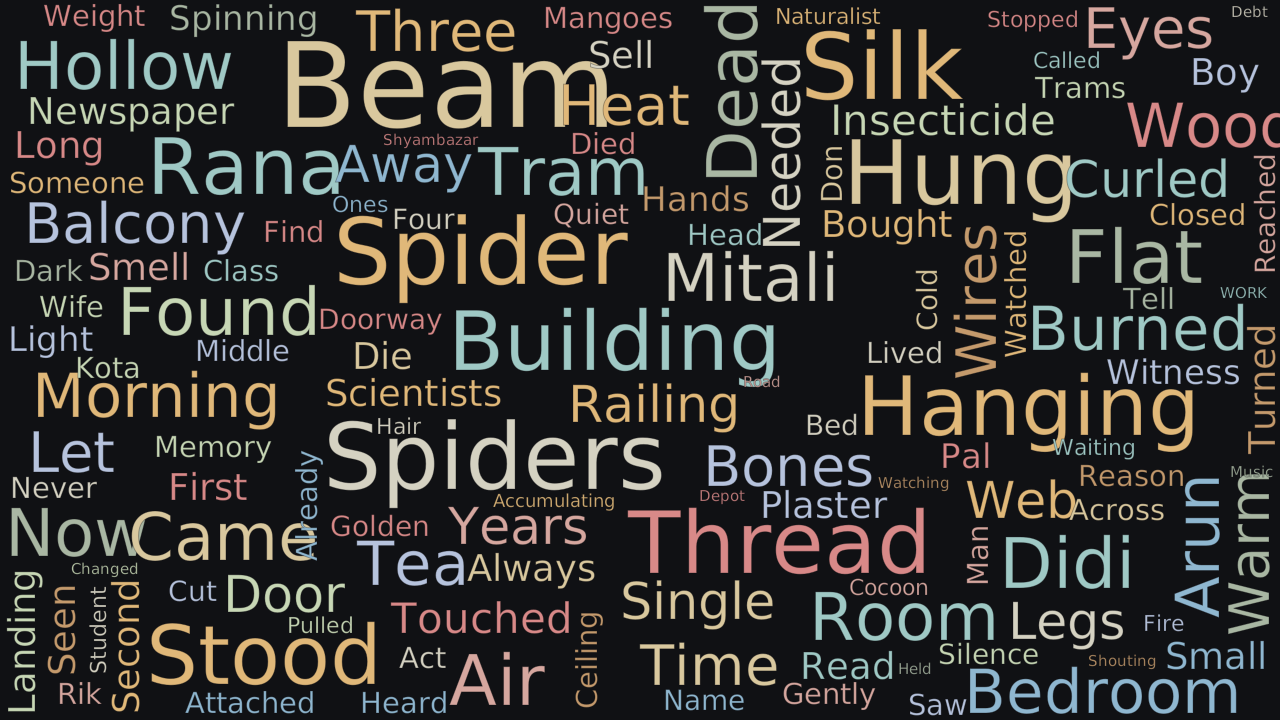
Word Cloud
Related reading
Selected by shared topics and section, with closer publication dates breaking ties.