Pests we love
Uses the speech voice supplied by your browser or device.

Acronyms expanded in this post:
- AI: Artificial Intelligence. software that generates, classifies, predicts, summarizes, or acts on patterns in data.
- IT: Information Technology. the practice of building, operating, and supporting computing systems.
Calcutta is not merely inhabited by insects; it is co-authored by them. The city’s old drains, sweating walls, mango trees, book cupboards, fish markets, tram wires, roof tanks, damp stairwells, puja bamboo, and monsoon puddles form a vast arthropod republic, humming and skittering under the human one. We see only the larger and more theatrical citizens: the cockroach that erupts from a kitchen drain like a guilty clerk, the huntsman spider flattened against the bathroom wall like a hairy punctuation mark, the winged termites that appear after rain as if the furniture itself has begun to dream of aviation, the dragonfly patrolling a pond with the competence of a fighter pilot, the red ant descending from a guava tree with the moral seriousness of a tax inspector.
The first useful distinction is simple and surprisingly powerful. Insects are arthropods with six legs, usually with antennae, and often with wings at some life stage. Arachnids are arthropods with eight legs, no antennae, and no wings. Cockroaches, termites, ants, bees, wasps, flies, mosquitoes, beetles, butterflies, moths, mantises, crickets, grasshoppers, dragonflies, and damselflies are insects. Spiders, scorpions, ticks, and mites are arachnids. Centipedes and millipedes, often dragged into the same household panic, are neither insects nor arachnids; they are myriapods, a separate many-legged delegation that deserves a footnote in the city’s crawling parliament but not the main chair here.
The great secret of Calcutta’s arthropod life is that the city is warm, wet, old, porous, and edible. That is nearly the whole story. Warmth accelerates metabolism. Moisture saves small bodies from drying out. Old masonry provides cracks, voids, damp joints, timber, lime, and darkness. Food waste, kitchens, markets, drains, flowerpots, overwatered balconies, standing water, and neglected roof corners supply the buffet. Humans call this “infestation” when the organism is inside the house and “biodiversity” when it is photographed in a park. The insect does not know the difference. To it, a Salt Lake apartment, a Ballygunge garden, a College Street bookshop, and a para drain are simply different arrangements of shelter, food, humidity, and risk.
The cockroach is the city’s most unfairly charismatic insect. In Calcutta, the large one most people notice is the American cockroach, Periplaneta americana, though its name is a geographical comedy, not a reliable passport. It is reddish brown, winged, fast, fond of drains, kitchens, storerooms, sewers, garbage rooms, and the dark underside of civilization. The smaller German cockroach, Blattella germanica, is more intimate and more troublesome indoors: tan, compact, quick-breeding, happy inside cabinets, appliance motors, false ceilings, and food-service spaces. A large cockroach in a bathroom may simply be a visitor from a drain. A small persistent population in a kitchen is a domestic republic.
Cockroaches are not dangerous because they are monstrous. They are dangerous because they are successful generalists in places where hygiene, moisture, and food residue overlap. They mechanically move microbes from filthy to clean surfaces, contribute allergens, and aggravate asthma in susceptible people. Their real genius is architectural. They understand the city as a network of hidden corridors: pipe chases, cracks behind tiles, floor traps, cupboard backs, cable holes, and the warm darkness behind refrigerators. Spraying the visible adult is like arresting one pickpocket at Howrah Station and announcing the end of crime.
Termites are more misunderstood still. They are commonly called white ants, but they are not ants. They are closer to cockroaches, which is the kind of family revelation that makes the drawing room fall silent. Termites are pale, soft-bodied, social insects that digest cellulose with microbial help. They do not eat wood because they hate furniture. They eat wood because cellulose is a planet-sized food bank and they have evolved the microbial accounting department required to unlock it.
In Calcutta, termites matter because the city contains exactly what termites appreciate: old wood, damp walls, leaking plumbing, soil contact, paper, cardboard, books, door frames, skirting boards, and cupboards pressed against walls that never quite dry. Subterranean termites usually move from soil into structures through mud tubes, those narrow brown highways along walls, beams, and foundations. Drywood termites can live inside relatively dry timber, though they are usually less dependent on soil contact. The spectacular moment comes after rain, when winged reproductive termites emerge in swarms around lights. People panic because the house seems suddenly invaded. In truth, it is a dispersal event, a brief marriage market with wings. Most die quickly. A few, if lucky, become founders of new colonies.
A termite problem is not solved by murdering the flyers. The colony is elsewhere: underground, inside timber, behind plaster, or within a structure’s damp logic. The right question is not “How do I kill what I saw?” but “What pathway, moisture condition, or cellulose source made this possible?” That is a more boring question, and therefore much closer to the truth.
Ants are Calcutta’s other great social insects, and unlike termites, they are often visible in full daylight, conducting supply-chain operations across windowsills and sugar jars. Urban Kolkata has recorded a surprisingly rich ant fauna in gardens and built landscapes, which should not surprise anyone who has watched a line of ants solve a routing problem better than half the municipal departments of the world. Some are tiny sugar ants or ghost ants, appearing like moving punctuation near sweets and tea spills. Some are black house ants or crazy ants, erratic and exploratory. Carpenter ants may nest in decayed wood but do not digest wood like termites. Weaver ants build leaf nests in trees and will defend them with a stingless but memorable bite. Fire ants and other aggressive species may turn lawns and garden edges into hostile border zones.
The important thing about ants is that their presence is often diagnostic. A few ants are scouts. A stream of ants is a map. They reveal moisture, food residue, plant pests producing honeydew, wall voids, or cracks. Ant control fails when it treats the line but not the attractant. Wiping a trail may confuse them briefly. Removing the food, sealing the route, correcting dampness, and using bait that workers carry back to the colony is usually more rational than drowning the kitchen in poison.
Bees and wasps occupy the part of urban nature where admiration and alarm sit at the same table. Honey bees may nest in cavities, tree hollows, roof spaces, or building ledges. The giant honey bee, Apis dorsata, can form exposed combs on tall buildings and large trees, a living pendant of thousands of insects with a collective intelligence older than the city. The Indian honey bee, Apis cerana, is smaller and often cavity-nesting. Carpenter bees, large black or blue-black insects often seen around wooden beams, bamboo, and flowers, are solitary bees. They look like small flying engines and are much less interested in people than people are in them.
Wasps are a different temperament. Paper wasps build open comb nests under eaves, window shades, balcony corners, and garden structures. Potter wasps make small clay pots, each a nursery provisioned with paralyzed caterpillars. Mud daubers construct mud cells in sheltered corners and hunt spiders. Parasitoid wasps, many tiny and unnoticed, regulate caterpillars, flies, beetles, and other insects. Calcutta’s parks can contain highly specialized wasp life that even specialists are still describing. A recently reported wasp from Salt Lake’s Central Park is a good reminder that even an urban green patch may contain ecological negotiations so intricate that a citizen walking past with phuchka in hand is passing a biological opera without knowing it.
The practical rule is simple. Do not harass a bee or wasp nest. Do not smoke it, stone it, spray it casually, or perform amateur heroics for the benefit of an audience. Bees usually sting once and die; many wasps can sting repeatedly. Most stings are painful but manageable. Allergy changes the arithmetic completely. Facial swelling, breathing difficulty, dizziness, widespread hives, or a sting in a child or medically fragile person deserves urgency, not bravado.
Mosquitoes are small, but no serious account of Calcutta’s noticeable arthropods can omit them, because they have shaped public health more than many larger creatures combined. The visible drama of a cockroach is often less consequential than the near-invisible needle of a mosquito. The city’s mosquito problem is not one problem but several species exploiting different water habits. Aedes aegypti, the famous dengue vector, prefers clean or relatively clean container water near humans: flowerpots, buckets, discarded cups, roof gutters, trays, tires, construction debris, bamboo cavities, and anything that can hold a few quiet spoonfuls of rain. Aedes albopictus, the Asian tiger mosquito, is comfortable in vegetation-rich and peri-urban settings but also uses containers. Kolkata Municipal Corporation [KMC, the civic body responsible for city services including vector control] has also reported Aedes vittatus within the city, another reminder that vector ecology is not a fixed school chart but a moving field problem. Anopheles stephensi is historically important for urban malaria. Culex mosquitoes, often associated with drains and polluted water, are the whining night parliament around sewers and stagnant organic water.
The crucial point is that fogging adult mosquitoes is visible politics, while source reduction is dull biology. Dengue control lives in containers. Malaria control lives in breeding habitat, surveillance, diagnosis, and treatment. Culex control lives in drains, sewage, and stagnant organic water. A mosquito is not born from “bad air,” whatever the old word malaria once implied. It is born from water. In Calcutta, that water may be in a coconut shell, a terrace tank overflow, a construction pit, a puja structure, a flower vase, a clogged roof channel, or the politely ignored saucer under a money plant.
Flies are the city’s sanitation index with wings. House flies breed in decaying organic matter and move between garbage, drains, food, and wounds with the casual sociability of a bad idea. Blowflies and flesh flies are larger, metallic or gray, often associated with meat, fish, carrion, and open waste. In a fish market, they are less an aberration than a biological inevitability. Drain flies, those tiny moth-like creatures resting on bathroom tiles, breed in the gelatinous organic film inside drains. Fruit flies rise from overripe fruit, fermenting peels, and bins. The lesson is beautifully unromantic: flies are not controlled by indignation. They are controlled by waste management, drain cleaning, screens, covered food, and speed.
Dragonflies and damselflies are among the most elegant things the city produces after rain. Dragonflies hold their wings out like aircraft; damselflies often fold theirs more delicately above the body. Their young are aquatic predators, living in ponds, wetlands, tanks, and slow water, where they hunt mosquito larvae and other small aquatic life. Adults hunt in the air. Watch one over Rabindra Sarobar or a neighborhood pond and you are watching a creature that solved flight, predation, and hydraulic engineering long before humans discovered tax files. Dragonflies do not exist to solve the mosquito problem for us, but their presence usually hints at water, prey, vegetation, and some minimum ecological structure.
Butterflies are the city’s public relations department for insects, because they arrive wearing color. Common urban species around Kolkata may include lime butterflies, common Mormons, common crows, plain tigers, grass yellows, emigrants, pansies, and various blues and skippers, depending on season, host plants, and locality. Their caterpillars are often treated as plant damage, which is biologically true and aesthetically incomplete. A butterfly is a leaf-eating worm that was allowed to finish its argument. Remove every caterpillar and you remove the later winged visitation. Urban butterfly richness depends on larval host plants as much as nectar flowers. A manicured garden with exotic flowers but no host plants is a sweet shop with no kitchen.
Moths are the nocturnal majority: less adored, more numerous, and often more ecologically important. They come to lights because artificial lighting confuses ancient navigation systems tuned to celestial cues. Large hawk moths hover like hummingbirds at flowers. Geometrid moths, tussock moths, tiger moths, noctuids, and many others pass through balconies and stairwells. Hairy caterpillars should not be handled casually; some cause irritation. Bagworms, casebearers, and clothes moths remind us that larvae are the eating stage. The adult moth is often just the winged afterword.
Beetles are the great armored order. Ladybird beetles eat aphids and scale insects and are allies in gardens. Longhorn beetles have dramatic antennae and larvae that bore into wood, often dead or stressed wood. Scarab and rhinoceros beetles may appear after rain or around lights, heavy-bodied and slightly absurd, like polished toys that learned to fly badly. Click beetles snap themselves into the air when overturned. Fireflies, where still present, are beetles too, their biochemistry turning courtship into lantern work. Wood-boring beetles in furniture are easy to confuse with termites, but their clues differ: round exit holes, fine powder, and larvae tunneling within wood. The remedy depends on the insect. Misidentification is expensive.
Praying mantises are the ambush philosophers of the balcony garden. They stand with folded forelegs, giving the impression of prayer, though what they are really contemplating is murder. They eat flies, moths, small butterflies, grasshoppers, and sometimes each other. They are beneficial predators but not pets. A large mantis can pinch or bite if mishandled, not because it is venomous, but because it is a small predatory machine with no interest in your sentimental education.
Crickets, grasshoppers, katydids, and cicadas provide the city’s sound layer. Crickets call from cracks, vegetation, and damp corners. Mole crickets dig and may damage lawns or seedlings. Grasshoppers chew leaves openly. Katydids, leaf-like and often green, are masters of botanical disguise. Cicadas, when present in trees, make a dry electric racket that seems too large for the body producing it. Their lives are tied to seasons, trees, soil, and heat. To hear them is to hear the weather translated into insect machinery.
Earwigs, silverfish, booklice, and other indoor insects live in the margins of damp domestic life. Silverfish are not large, but in Calcutta’s book cupboards they have historical significance. They eat starches, glues, paper coatings, and organic residues. A damp library is not a room; it is a slow buffet. Booklice graze on mold and microscopic organic matter. Their presence often says more about humidity than about dirt. Reduce dampness and you remove the invisible pasture.
Bed bugs are insects, not arachnids, and although not large in the theatrical sense, they deserve mention because they are emotionally enormous. They hide in mattress seams, bed frames, cracks, luggage, and furniture. They feed on blood, usually at night. They are not proof of poverty or moral failure. They are proof that a flat-bodied insect can exploit human sleep, travel, and upholstery. Control requires heat, inspection, laundering, encasement, crack treatment, and often professional help. Casual spraying scatters them and educates them, which is a poor civic outcome.
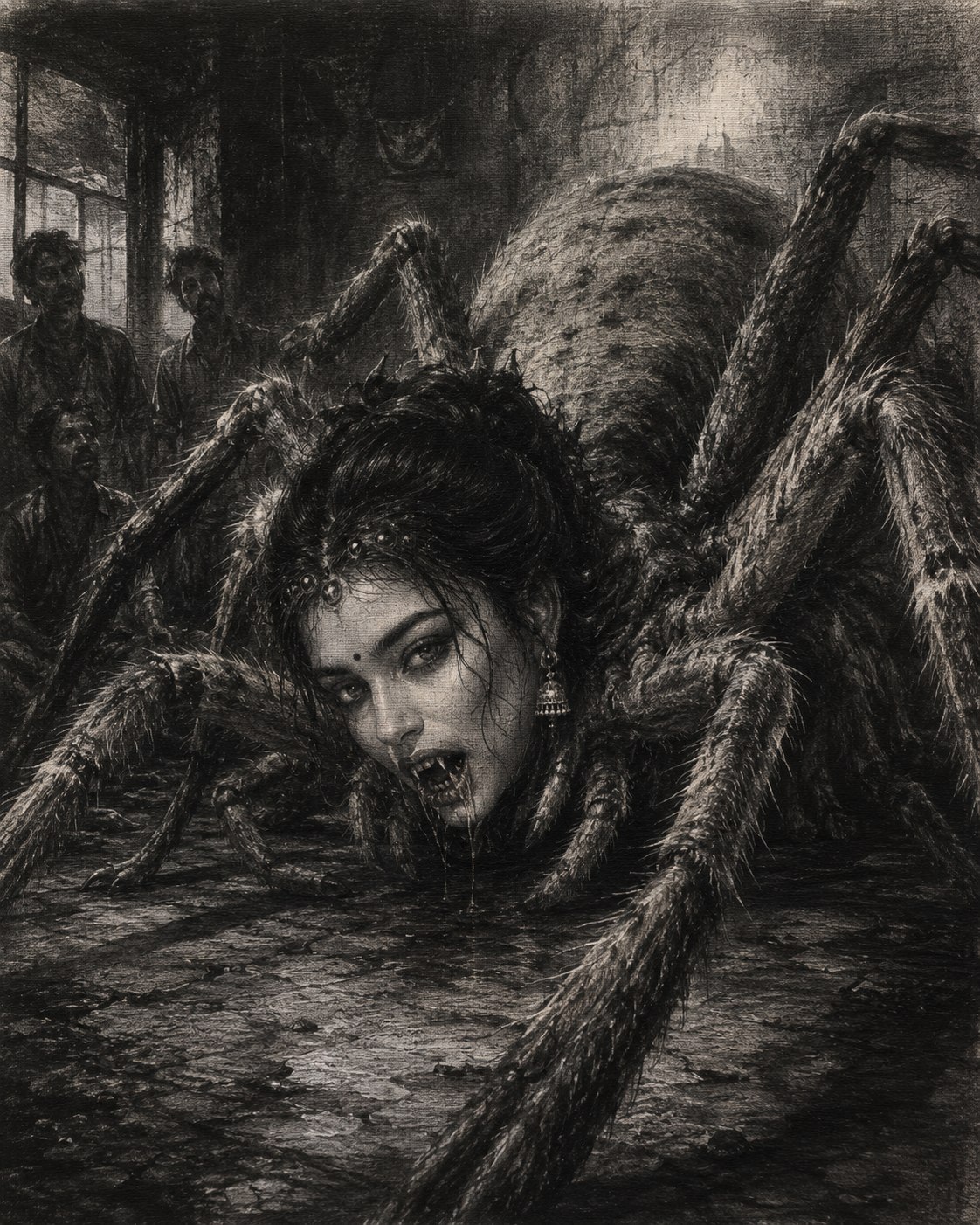
Now to the arachnids, the eight-legged household aristocracy. The largest spider most urban Calcuttans are likely to meet indoors is almost certainly the huntsman, often the pantropical huntsman or giant crab spider, Heteropoda venatoria, though close relatives may be casually given the same name by non-specialists. This is the famous bathroom-wall apparition: wide, flat, brown, laterigrade-legged, moving sideways and forward with the unnerving confidence of a creature that has read the floor plan. Its body is not enormous, usually only a few centimeters long, but the legs are the point. Spread across a wall, it can look the size of a human hand, and in the dim yellow light of a monsoon bathroom it may appear to have arrived from a minor mythological department. It is not building a web to trap you. It is a roaming hunter, an ambush-and-chase predator of cockroaches, moths, crickets, and other household insects. This is why older houses, gardens, drains, and cockroach-rich service areas often produce huntsman sightings. The spider follows the pantry.
The huntsman’s fright value is mostly geometry. It is broad rather than bulky, fast rather than aggressive, and designed to slip behind bark, shutters, loose wall fittings, cupboard backs, and the thin cracks where large animals imagine nothing can live. It is one of those animals whose harmlessness is difficult to believe because its silhouette has already conducted a coup against the nervous system. It can bite if grabbed, crushed, or trapped against skin, and the bite may hurt, swell, or itch, but it is not regarded as a medically dangerous spider for healthy adults. The sensible response is not slaughter but eviction: place a wide container over it, slide stiff paper underneath, and release it outside, preferably near vegetation or an exterior wall. Killing it may feel like victory for six seconds. Leaving it alive means the cockroach population has retained one of its more competent auditors.
Jumping spiders are the opposite sort of spider: small, bold, big-eyed, and almost mammalian in their apparent curiosity. They do not build prey-catching webs. They stalk, calculate distance, anchor a silk safety line, and leap. Their vision is extraordinary for an animal so small. On a windowsill, a jumping spider is not a pest but a tiny tiger with spectacles.
Orb-weaving spiders are the architects of visible silk. In gardens, parks, and less disturbed corners, they build circular or irregular webs that catch flying insects. Some are small; others, especially in greener urban patches, may be large enough to command attention. Their webs across a path at dawn can turn an unsuspecting walker into a temporary deity of panic. Most orb-weavers are harmless to people and valuable predators. The web is not dirt. It is infrastructure.
Cellar spiders are the long-legged tremblers in ceiling corners and bathrooms. They are often confused with daddy-longlegs, a name used carelessly for several unrelated creatures. These spiders make messy webs and feed on small insects, including mosquitoes and other spiders. They are harmless. The main problem is that their webs collect dust, making good predators look like bad housekeeping.
Wolf spiders are ground hunters. They do not sit in elegant webs; they run. Females may carry egg sacs or young spiderlings on their backs, which is one of the more startling sights in small-scale urban nature. Crab spiders wait on flowers, often camouflaged, grabbing visiting insects. Lynx spiders patrol vegetation. Funnel-web-like sheet-web builders in Indian homes should not be confused with the medically notorious Australian funnel-web spiders; common-name panic travels farther than biology.
Scorpions are arachnids too, and in urban Calcutta they are far less common than cockroaches or spiders but not imaginary. They are more likely in ground-floor houses, old compounds, rubble, gardens, woodpiles, construction debris, drains, and peri-urban edges than in sealed high-rise interiors. The Indian black scorpion associated with eastern India is large, dark, and intimidating. Smaller buthid scorpions can be more medically significant in some regions of India. A scorpion sting should be treated with respect, especially in children, elderly people, or anyone developing systemic symptoms. Do not cut, suck, burn, or perform folklore on the wound. Immobilize, clean, manage pain sensibly, and seek medical care when symptoms go beyond local pain or when the victim is vulnerable.
Ticks and mites are arachnids, though usually smaller than the creatures this essay is chiefly about. Dog ticks may enter homes with pets and attach to animals or occasionally humans. Dust mites are not visible household monsters but are important in allergy. Scabies mites live in human skin and cause intense itching; that is a medical condition, not a cleanliness sermon. Chiggers and other mites may cause bites or dermatitis in grassy or semi-rural settings. The city’s arachnid world is therefore not only the big spider on the wall; it is also the microscopic politics of skin, dust, bedding, pets, and humidity.
A useful Calcutta field method is to ask five questions before panicking. How many legs? Six suggests insect, eight suggests arachnid, too many suggests myriapod. Does it have wings? Many adult insects do; arachnids do not. Is there a narrow waist? Ants and many wasps have one; termites do not. Where was it found? Drain, light, bed, plant, wood, wall corner, stagnant water, food, pet, or bookcase all tell different stories. Was it alone, in a line, in a swarm, in a nest, in powdery wood dust, or in water? Pattern is often more informative than the animal itself.
Most household arthropod trouble is not caused by a lack of poison. It is caused by habitat. Water, food, shelter, and entry points are the four horsemen of the domestic exoskeleton. A kitchen with nightly crumbs and greasy backsplashes breeds cockroach confidence. A flowerpot saucer breeds mosquitoes. A damp cupboard breeds silverfish and mold-grazers. A timber frame touching damp masonry invites termites. A bright outdoor light beside an open window recruits moths, beetles, and the predators that follow them. A dog without tick checks becomes a public bus for arachnids.
Integrated Pest Management [IPM, a practical method that combines prevention, monitoring, habitat reduction, targeted treatment, and minimal necessary pesticide use] is the grown-up answer. It is less dramatic than spraying and more effective over time. Seal cracks. Fix leaks. Clean drains. Store food tightly. Remove standing water every few days. Screen windows. Keep garbage covered. Move cupboards slightly away from damp walls. Inspect timber. Use mosquito nets and repellents where appropriate. Use baits rather than broadcast sprays for cockroaches and ants when possible. For termites, get proper inspection and treatment rather than cosmetic surface killing. For bees, large wasp nests, scorpions, serious bed bugs, and structural termites, call competent help. Competent is doing heavy lifting in that sentence.
The ecological side matters too. A city that kills every spider will have more insects. A garden that removes every wasp loses parasitoids. A park that replaces layered vegetation with decorative sterility loses butterflies, moths, beetles, mantises, dragonflies, and the birds that feed on them. Arthropods are not decorative extras. They pollinate, decompose, aerate soil, recycle nutrients, regulate pests, feed birds and bats, and convert the city’s organic sloppiness into biological consequence. They are the small clerks of the biosphere, processing forms at counters we did not know existed.
Yet admiration should not become foolishness. Dengue mosquitoes are not charming neighbors. Cockroach allergens are not poetry. Termites can ruin books, doors, beams, and sleep. Wasps can sting. Scorpions deserve caution. Bed bugs can turn a bedroom into a psychological courtroom. The correct attitude is neither squeamish extermination nor misty-eyed worship. It is informed discrimination. Know who is harmless, who is useful, who is a nuisance, who is a vector, who is a structural threat, and who has merely wandered into the wrong bathroom at the wrong hour.
Urban Calcutta is a layered habitat pretending to be only a city. Under the human map lies another map: termite galleries, ant trails, mosquito nurseries, spider territories, wasp hunts, moth flights, beetle burrows, cockroach corridors, dragonfly patrol routes, and mite-scale sovereignties. The tram bell, the frying oil, the wet dust after rain, the sour sweetness of fruit peel near a market, the green shine of a pond at evening, the old books swelling in a monsoon cupboard—all of these are not background. They are instructions. The insects read them fluently. The arachnids read the insects. And we, large, literate, overconfident mammals, are still learning the script. At fifty-one, I sometimes feel that the insects understand Calcutta better than I do: they ask very little of it, make no grand bargain with the future, and simply exist in the cracks, drains, eaves, cupboards, and wet green margins where the city still permits existence without rent or achievement. I am a Bengali at fifty-one, by some quiet civic arithmetic, finally and officially over the hill; and bleak as my prospects already are, there is no irony left in admitting that the year numbers now feel less celebratory than lane closures, each year narrowing the road ahead until the metaphorical tunnel grows absurdly long and the light at the end of it is so dim it might as well have been extinguished. I feel old, not older. I do not think I brood; brooding suggests a kind of theatrical luxury, and I have lost even the ambition for that. There is no life left in this old dog, or so it feels on certain afternoons when the world I thought I was being prepared for turns out not to be the world I inhabit now. This one is faster, slipperier, more baffling, lacquered with lies, and curiously generous to talents I was neither born with nor can acquire: a nimble lack of scruple, a cheerful intimacy with adulterated facts, a professional ease with saying what is useful rather than what is true. So I look at the cockroach, the huntsman spider, the termite after rain, and I envy, a little, their lack of biography. They do not have to be relevant. They do not have to explain why they failed to become the proper modern thing. They endure, repellent and miraculous, in a city that has already changed its locks on me.
Related Posts
Word Cloud
Related reading
Selected by shared topics and section, with closer publication dates breaking ties.