Do Not Let It Wake Facing the City
Uses the speech voice supplied by your browser or device.

THIS IS A WORK OF FICTION
Anjali’s measuring tape came back warm from the bridge.
That was wrong for three reasons. First, the tape belonged to her mother, who had said, “Do not drop it, do not bend it, and do not use it as a sword.” Second, it had been clipped to the cold steel of Howrah Bridge for only ten seconds. Third, the little numbers on the tape had shifted while she was holding it.
The mark that should have read 42 centimetres now read 43.
Then, with a soft click, it changed back.
Anjali Sen wanted only one ordinary thing that morning: to finish her school project before Bappa and Mina arrived with their grand, useless ideas. The project was called Bridges of Our City. Anjali had planned to measure one girder, draw the river, write three neat facts, and be done before breakfast.
Instead the bridge had measured her back.
“Ma,” she called.
Her mother was speaking to Mr Dutta, her supervisor, near the railing. They both wore yellow helmets. Mr Dutta had a moustache like a wet paintbrush and the expression of a man who had misplaced his patience in 1998.
“No delays,” he was saying. “The inspection report must go today.”
“The old expansion joint needs another look,” Ma said.
“Everything in Calcutta needs another look. That is not a business plan.”
Anjali did not call again. Grown-ups became deaf when work was wearing shoes.
She held the tape against the steel. The girder under her palm gave one slow thump.
Not a sound. A feeling.
Like a heart heard through a pillow.
A tiny mew came from below.
Anjali froze. “Hello?”
The mew came again, thin and cross.
She bent carefully and peered through a gap in the maintenance walkway. Far beneath, on a lower beam, a small white kitten clung to a rusted plate. Its tail stood up like a question mark. Beyond it the Hooghly moved brown and wide, carrying flowers, plastic, and the morning light.
“Oh no,” Anjali whispered.
The kitten looked up at her and shouted in kitten language, which mostly meant, “You have failed to organise the world properly.”
Anjali had to get it.
She looked around. Her mother was still arguing. Mr Dutta was saying, “Sign first, worry later.” Two workers were carrying tools. A tea seller pushed his bicycle on the far pavement. No one else had seen the kitten.
Anjali tucked the tape into her pocket and followed the narrow service path to a ladder. It led down to the lower beams. There was a sign that said AUTHORISED PERSONS ONLY.
Anjali was not authorised.
But she was ten, and the kitten was smaller than a school tiffin.
“I am coming,” she whispered.
The ladder was cold at first. Then, after five steps, it was warm.
At the bottom, she found an old man sitting on a beam as calmly as if it were a bench in a para lane. He wore a faded maintenance uniform and carried a cloth-bound notebook.
“You are early,” he said.
Anjali nearly dropped the tape. “Who are you?”
“Prabir.”
“Are you authorised?”
“For fifty-two years.”
That sounded difficult to argue with.
The kitten mewed again.
Prabir pointed with his chin. “Little Raja has gone exploring again. He does this when the bridge is restless.”
“The bridge is not restless,” Anjali said, though her palm still remembered the thump.
Prabir opened his notebook. The pages were filled with times. 3:17 a.m. 3:17 a.m. 3:17 a.m. Beside each time were tiny measurements and drawings of ribs, lungs, and long sleeping eyes.
“Every morning,” he said. “The bridge breathes.”
Anjali stared at him.
“You may laugh,” he said.
“I am not laughing because I am choosing to be polite.”
“Good. Politeness saves time.”
The steel beneath them lifted.
Only a little. Enough to make Anjali grab a bolt. Enough to make the kitten flatten itself and yowl. Enough to make every hair on Anjali’s arms stand up.
The bridge settled back.
Above them, buses and taxis rolled on, not noticing. That was the most frightening part. Calcutta was carrying on with breakfast while the great bridge beneath its feet took a breath.
Prabir wrote in his notebook. “3:17 by bridge time.”
“But it is morning,” Anjali said.
“It is always 3:17 when it remembers itself.”
“That makes no sense.”
“Most important things do not, at first.”
Anjali wanted to climb back up, pull her mother by the sleeve, and tell her everything. She also wanted the kitten safe. The kitten sneezed, as if voting.
“I need Raja,” she said.
“Then you need to go three beams down and one beam across. Do not step on the red plate.”
“Why?”
Prabir pointed to a scratched line in the steel beside his foot.
Do not let it wake facing the city.
The words were cut deep. Not painted. Cut. Under them were dates: 1943, 1962, 1989, 2004. Then, in fresher marks, one more date. 2026.
“Who wrote that?” Anjali asked.
“People who listened.”
“To what?”
The bridge gave another slow thump.
Prabir smiled sadly. “To that.”
Anjali crawled along the beam. The steel smelt of rain, rust, and something warm like a closed room. Her knees collected black dust. Her plait came loose. She wished Bappa were there so he could say something silly and make the fear smaller.
The kitten watched her with round blue eyes.
“Do not jump,” Anjali told it. “This is not the Olympics.”
It sneezed again.
Halfway across, a tram bell clanged from somewhere on the Calcutta side. The sound reached the bridge and changed. It became lower, longer, like a spoon tapped against a sleeping giant’s tooth.
The beam tilted.
Anjali slid.
Her fingers caught the edge of a rivet. Her shoe scraped empty air. The river flashed below her.
“Anjali!” shouted Prabir.
She bit her lip and pulled herself flat. Her heart banged so hard she could hardly hear the traffic.
The kitten, who had clearly decided humans were slow, leapt into her lap.
“Now you come?” Anjali whispered.
It dug ten needles into her shirt.
She hugged it with one arm and crawled back, inch by inch. When she reached Prabir, he lifted both of them as if they weighed nothing.
“You are brave,” he said.
“I was frightened.”
“That is where bravery starts.”
The kitten licked black dust from its paw.
Above them, someone shouted. Anjali’s mother was leaning over the walkway. Her face had gone the colour of uncooked luchi.
“ANJALI SEN!”
Anjali winced. Full names were thunder.
When she climbed back up with Raja inside her shirt, Ma grabbed her first and scolded her second. This, Anjali felt, was the correct order.
“There was a kitten,” Anjali said.
“There was a sign!”
“The kitten could not read.”
Mr Dutta took one look at the scratches on Anjali’s arms and said, “This is why children should not be near infrastructure.”
Raja hissed from inside Anjali’s shirt.
“The bridge moved,” Anjali said.
Mr Dutta sighed. “The bridge is a bridge.”
“It breathes at 3:17.”
Ma stopped.
Prabir had climbed up behind them. He held out his notebook. “Your daughter noticed.”
Mr Dutta snapped, “Not this foolishness again.”
“Again?” Anjali said.
The word flew out before anyone could stop it.
Ma looked at the notebook. Her mouth became a straight line. “My father mentioned this.”
“Your father wrote the 2004 warning,” said Prabir.
Anjali stared. “Dadu?”
Ma did not answer at once. The wind tugged at her helmet strap. Below, the river moved as if it had somewhere secret to go.
“He said the bridge was turning,” Ma said softly. “He said it had been caught mid-step long ago. I thought it was his illness talking.”
The road beneath them groaned.
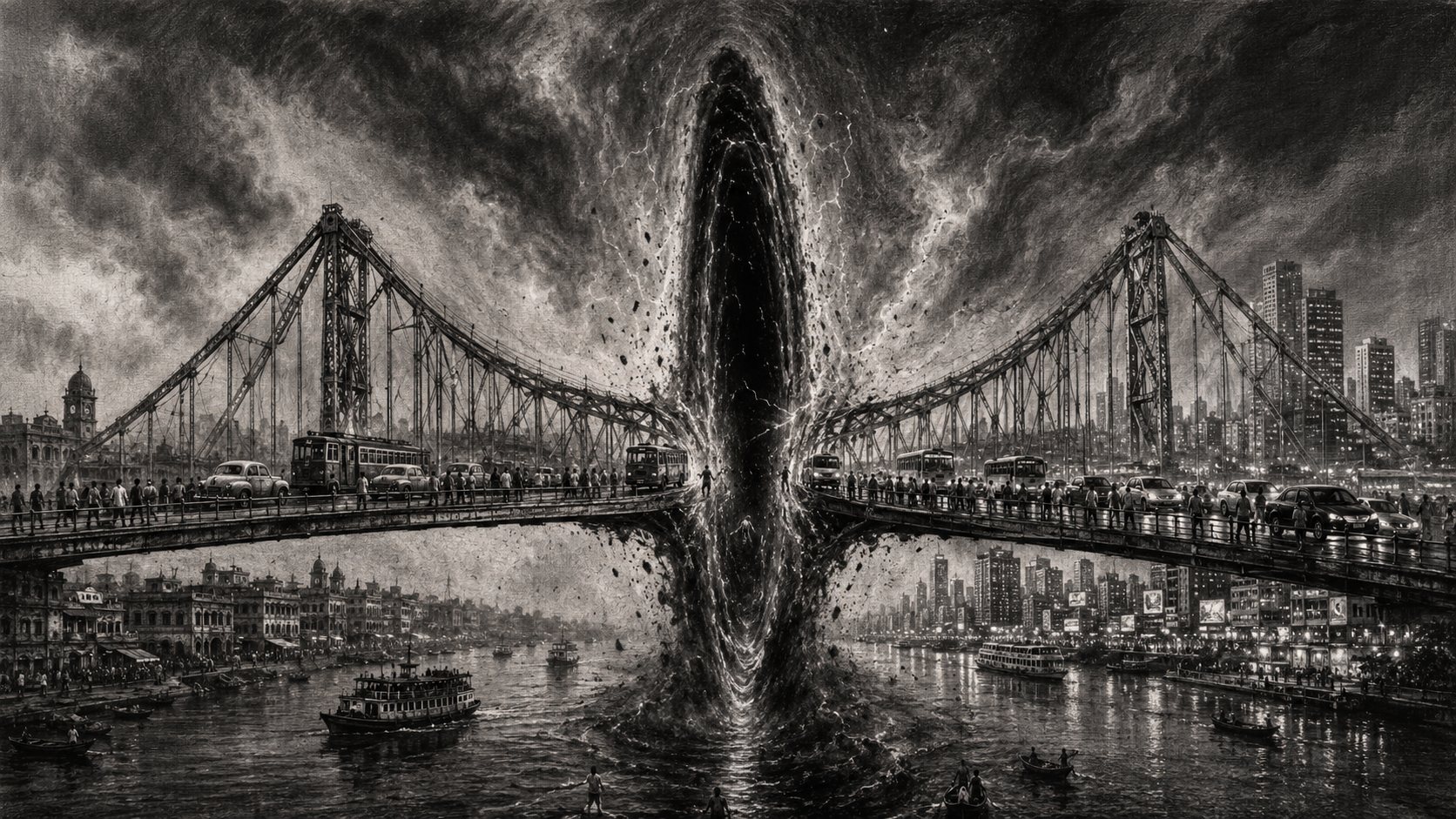
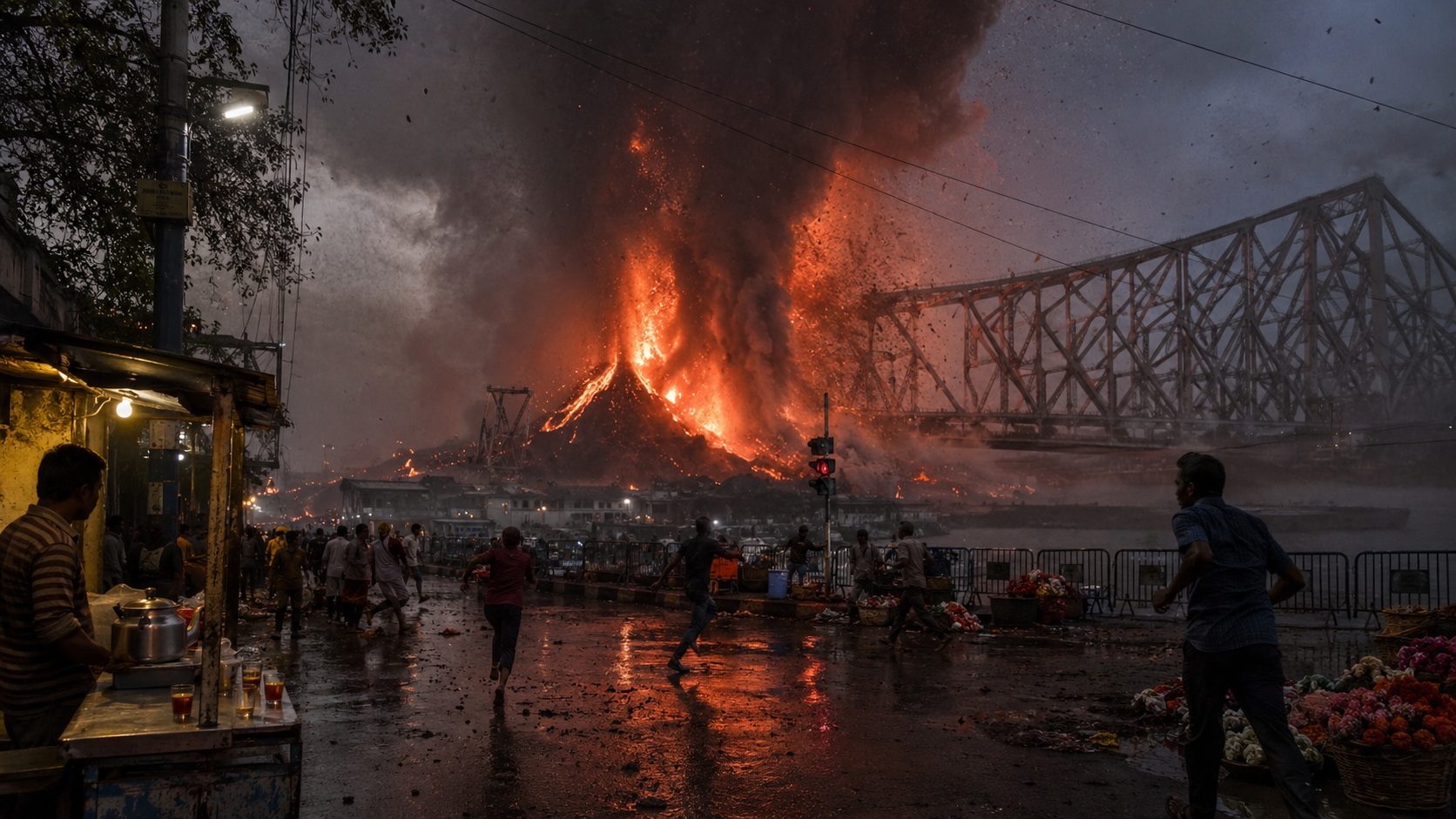
Cars braked. A bus horn wailed. On the Howrah side, people turned their heads. The bridge had shifted, not enough to break, but enough for everyone to feel the huge sleepy roll of it.
Raja wriggled from Anjali’s shirt and bolted towards the railing.
“Catch him!” cried Bappa’s voice.
Anjali spun. Bappa and Mina had arrived, each carrying a school notebook, two pencils, and the expression of children delighted to find danger already in progress.
“You started without us,” Mina said.
“The bridge started,” Anjali said.
The bridge moved again.
This time, the whole road seemed to lean towards Calcutta.
The warning flashed in Anjali’s mind. Do not let it wake facing the city.
“It is turning the wrong way,” she said.
Prabir nodded. “It hears the city. Horns, engines, shouting, digging, drilling. It thinks the city is calling it.”
“Then we must call louder from the river side,” said Mina at once.
Everyone looked at her.
Mina shrugged. “If my little brother wakes facing the wall, Ma shakes his other shoulder.”
It was a strange idea. It was also the only idea.
Ma ran to the workers. “Stop traffic. Now.”
Mr Dutta made a noise like a punctured football. “We cannot stop traffic on Howrah Bridge because children have invented a sleeping bridge.”
The steel beneath his shoes rose six inches, held its breath, and settled back down.
Mr Dutta swallowed. “Temporarily stop traffic.”
The next ten minutes became a Calcutta muddle of whistles, waving arms, angry drivers, frightened drivers, and one tea seller who refused to leave until someone paid for six glasses. Anjali, Bappa, Mina, Prabir, and Ma hurried to the river-facing side of the bridge.
“What sound does a bridge like?” Bappa asked.
“Not horns,” said Anjali.
“Not Mr Dutta,” said Mina.
Prabir handed Anjali the notebook. On the last page was a drawing of the bridge as a long road, walking away from the city, not angry, only tired.
Under it was written: Remind it of crossing, not holding.
Anjali understood suddenly. A bridge was not meant to be a prison for two banks. It was meant to help things cross.
She looked at the river. A ferry below gave a soft horn. Oars splashed. Someone on the ghat laughed. The sound rose gently.
“Sing,” Anjali said.
“What?” said Bappa.
“The ferry song Dida sings. The one about going across.”
Bappa’s ears turned red. “I only know half.”
“Then sing half.”
They sang. Badly at first. Then Mina joined. Then Prabir, in a cracked old voice. Then Ma. The tea seller, who knew every song in Bengal if someone else began it, joined with such confidence that people nearby forgot to be afraid.
The song was not magic. It was smaller than that and bigger. It was a human sound about crossing water, going home, carrying rice, calling from one bank to another.
The bridge listened.
Anjali felt the steel under her feet change. The heat cooled. The thumping slowed. The roadbed eased away from the city and turned a little towards the river.
The kitten Raja sat on the railing, washing one ear as if he had arranged the whole affair.
At last the bridge sighed.
Everyone felt it.
Not a groan. Not a crack. A sigh.
The traffic lights blinked back to ordinary. The halted bus stopped leaning. Mr Dutta sat down on a toolbox and said, “I need tea.”
Prabir wrote one line in his notebook and showed Anjali.
- Children listened.
By afternoon, the official story was that a minor vibration had caused a temporary traffic pause. Grown-ups liked small words for large wonders. Anjali did not mind. Her school project had become much better than three neat facts.
That evening, on the terrace, she drew Howrah Bridge with ribs inside its girders and a kitten asleep on one beam. Bappa drew Mr Dutta falling off a toolbox. Mina wrote the title in careful letters:
Do Not Let It Wake Facing the City.
“Will it wake again?” Bappa asked.
Anjali looked west, where the sky over the river was turning the colour of guava flesh.
“Maybe,” she said. “But now it knows we are here.”
Below, a tram bell rang. Far away, or perhaps not far at all, something made of steel breathed in and out, peacefully, while Calcutta crossed the river and came home.
Word Cloud
Related reading
Selected by shared topics and section, with closer publication dates breaking ties.