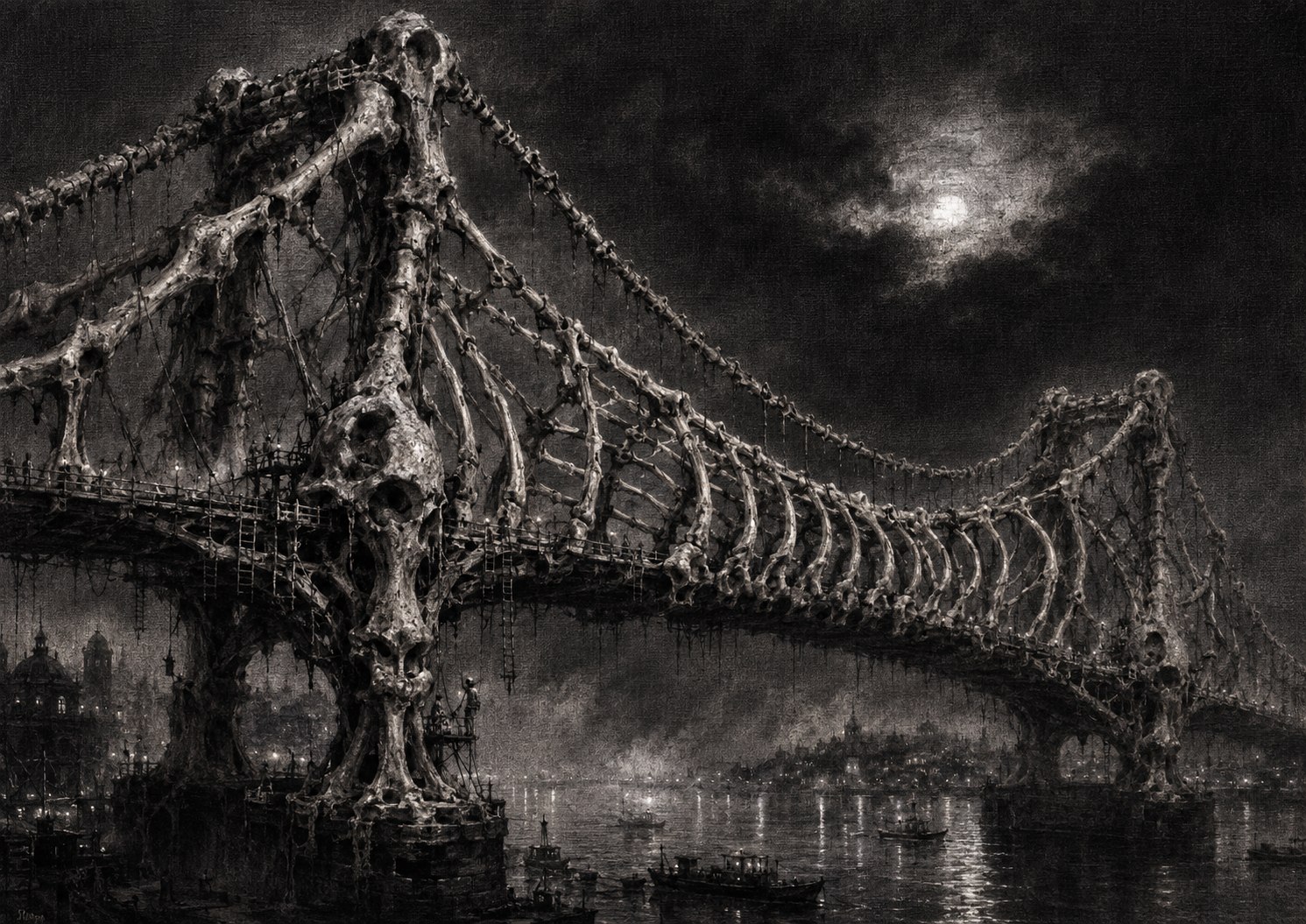
The Bridge That Breathed Backwards
Uses the speech voice supplied by your browser or device.

THIS IS A WORK OF FICTION
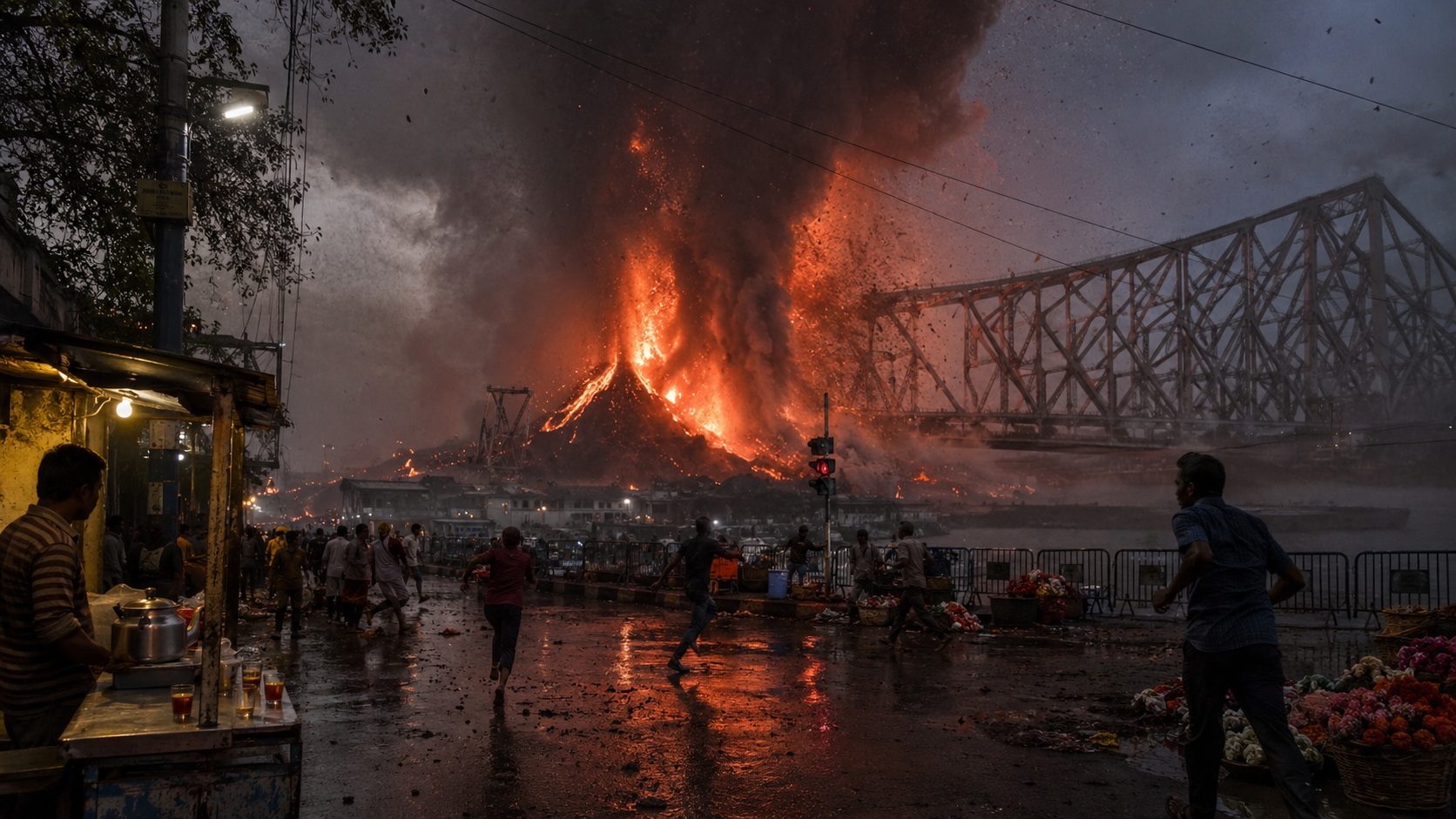
At six-twenty in the evening, when Howrah Bridge was at its usual stage of civic madness, Bappa Mondal saw the sky split open above lane three.
This was inconvenient.
A minibus had stalled with its nose toward Brabourne Road, two yellow taxis were arguing by horn, a handcart stacked with cauliflower was trying to become a philosophy of resistance, and rainwater from the afternoon shower still lay in the shallow dents of the metal road like little mirrors that had given up on beauty. Men with bags, women with umbrellas, office clerks, porters, schoolchildren, flower sellers, policemen, lovers, liars, all moved in the same damp compression of sweat, impatience, diesel, frying oil, wet rope, fish scales from the market, incense from some invisible puja, and the river below, dark and broad and old enough to be bored by everything.
Bappa had been walking from the Howrah side toward Calcutta, carrying two sacks of loose tuberose and marigold for his cousin’s stall in Mullick Ghat. The plastic rope had cut into his palm. His shirt stuck to his back. His left knee, always inclined toward treason, had begun its familiar hot ache.
Then the air above the road made a sound like a tram turning inside a bottle.
People looked up.
The split widened.
It was not lightning. Lightning was quick, rude, familiar. This was slow. A round blackness unfolded in mid-air, rimmed with a pale blue fire that did not burn. It hung between the bridge’s steel ribs and the traffic below, perhaps twelve feet across, slightly tilted, like a pond lifted from some other world and nailed to the evening. Inside it, something moved.
A bus conductor shouted, “Ki holo? Shooting?”
A policeman blew his whistle with the dignity of a man trying to stop weather.
From the black roundness came another Howrah Bridge.
Not reflected. Not the same. Older.
Bappa saw it as if through dirty glass: fewer cars, more buses with boxy fronts, tram wires still near the approach, men in loose shirts, women in cotton saris, hand-painted signs, Ambassador taxis glossy with rain, and a boy selling cigarettes from a wooden tray. The air through the opening smelled different. Coal smoke. Damp jute. Cheap hair oil. Something fried in mustard oil. The city’s old breath, kept in a jar.
The crowd pressed back, then forward, because Calcutta had never fully respected danger if there was a chance of seeing it for free.
A man from the other side stepped through.
He was in his early thirties, thin, moustached, wearing a pale bush shirt and brown trousers too high at the waist. He carried a blue enamel tiffin carrier in one hand. He did not fall. He simply came out of the opening and stood in the middle of the 2026 traffic, staring at a white bus with LED route lights as if the gods had finally lost discipline.
“Where is this?” he asked.
Nobody answered. Half the bridge had gone quiet in that special Bengali way in which silence is not absence of speech but speech collecting ammunition.
The man turned. His eyes passed over faces, vehicles, the new paint, the old steel, the river. Then they stopped on Bappa.
The tiffin carrier fell from his hand.
“Bapi?” he said.
Bappa’s childhood name, unused for thirty-eight years, entered the evening like a small knife.
Nobody called him that anymore. Not his cousin, not the landlord, not even his mother, who had lost many things before memory but not the discipline to call people by their full names when annoyed. Only one person had called him Bapi in that soft, joking tone.
His father.
Haripada Mondal had vanished on a wet August evening in 1984 while crossing Howrah Bridge after work. He had been thirty-four. Bappa had been ten. The family story had hardened over the years into something respectable enough to tell: accident, political trouble, river, who knows, those days were bad. In Calcutta, when the past is inconvenient, people put “those days” over it like a bedsheet.
Bappa looked at the man before him.
The same narrow face from the photograph in the tin trunk. The same notch in the left eyebrow. The same quick, apologetic smile beginning and failing.
The bridge roared back into noise.
Someone screamed because a cyclist from 1984 had entered 2026 and been clipped by a taxi. Someone else laughed too loudly. Two office boys began arguing about whether entry should be taxed. The policeman shouted that nobody should move, which caused everyone to move.
Haripada grabbed Bappa’s arm.
“You became old,” he said, with genuine offence.
Bappa laughed once, a dry broken thing. “And you remained punctual?”
The opening pulsed.
From the 1984 side, people were gathering too. Faces pressed toward the impossible. A woman in a red sari crossed halfway, saw the modern bridge, and fled back. A boy pushed a crate through, then pulled it back, testing time like a fish seller testing hilsa gills.
Bappa snatched up the fallen tiffin. The enamel was warm.
“Come,” he said.
“Where?”
“Off the road before Calcutta kills you in the future.”
He dragged his father toward the railing. The sacks of flowers lay abandoned. Marigolds spilled under shoes, bright heads crushed into the wet road.
Under the bridge, the Hooghly moved with the fat indifference of a creature that had seen empires, dead sons, floating idols, and municipal promises.
By nine that night, the police had failed to close the bridge.
By ten, the army had arrived.
By midnight, hawkers were selling tea, muri, boiled eggs, and detailed opinions.
The opening did not close. It hung on the bridge, breathing in two directions. From the Calcutta side, anyone who stepped through entered 1984. From 1984, anyone who stepped through entered 2026. The direction mattered. The bridge had become a mouth with two throats.
Bappa took Haripada to the little room he rented near Sobhabazar, because there was nowhere else to take a dead man who had returned wearing Bata sandals from the Emergency era’s aftertaste. His mother, Reba, sat on the bed under the slow fan, her hair white, her legs swollen, her eyes sharp when not clouded by tiredness.
When Haripada entered, she looked at him for three seconds.
Then she said, “You took your time.”
Haripada stood in the doorway like a thief at his own funeral.
“Reba,” he whispered.
She turned to Bappa. “Give him water. He always came home thirsty and dramatic.”
The tenderness of this nearly killed Bappa.
They sat on the floor because there were only two chairs and one was broken. Outside, the lane supplied its normal orchestra: pressure cooker whistle, scooter cough, television serial from a neighbour, a child crying as if cheated personally by existence, a man spitting with philosophical depth.
Haripada drank water from a steel glass and stared at the room. The peeling wall. The plastic bucket. The medicine strips near Reba’s pillow. The unpaid electricity bill tucked beneath the clock. His eyes returned again and again to Bappa’s face, finding the boy inside the older man and perhaps not liking what time had done with the material.
“You have children?” he asked.
“No.”
“Wife?”
“No.”
“Own house?”
Bappa smiled without humor. “You have reached 2026. Please reduce expectations.”
Reba made a small sound. “He works. He manages.”
That was how mothers lied in poor rooms: not with falsehood, but with thin cloth held over a wound.
Haripada lowered his head.
“I was only crossing,” he said. “There was rain. I had fish in the tiffin. Your mother had asked for coriander. A light came on the bridge. I thought some lorry’s headlamp. Then I stepped wrong. After that—this.”
Bappa opened the blue tiffin. Inside, wrapped in old newspaper, lay two pieces of fried pabda, green chilies, and a few coriander sprigs gone dark at the edges.
The smell made Reba close her eyes.
Later, when Haripada slept on the floor under Bappa’s thin sheet, Reba called her son close.
“Do not trust this,” she said.
“He is Baba.”
“Yes.”
“You knew him.”
“I knew him better than you.”
“What does that mean?”
She looked toward the sleeping man. “In the old trunk. Tomorrow bring the letters.”
Bappa slept little. The city outside did not sleep at all. News ran through para gossip faster than official announcements ever could. A cousin called from Howrah to say people had begun queueing at the bridge with bundles, hoping to visit dead parents, buy land cheap, change exam results, prevent marriages, recover gold, escape loans, escape the present, escape themselves. That was the social history of Bengal in one queue: everyone educated enough to know time travel was impossible, everyone practical enough to pack bedding in case it was not.
By morning, the bridge had become a pilgrimage and a riot with barricades.
Bappa went to the old trunk under Reba’s bed. It smelled of naphthalene, paper, and the secret damp that lives inside all Calcutta furniture. He found school certificates, ration cards, a cracked photograph of Haripada holding him as a baby, and letters tied with red thread.
They were from 1984, but not from Haripada.
The handwriting belonged to Nagen Kaku, their former neighbour, now owner of a sweet shop in Liluah and respected donor to Durga Puja committees. In Bappa’s childhood, Nagen had brought sweets after Haripada vanished. He had helped Reba with forms, advised her on compensation, told relatives not to trouble the widow. A good man, everyone had said. Calcutta manufactures good men the way it manufactures damp: steadily, ambiguously.
The letters were brief.
He has begun asking again.
If he crosses today, stop him.
The papers must not reach the union office.
Think of your son.
Bappa read them twice, then a third time because comprehension sometimes arrives late, like municipal water.
He took the letters to Reba.
She did not look surprised. This angered him more than shock would have.
“What papers?” he asked.
Reba pressed her lips together.
“Your father worked in the jute warehouse office. Accounts. Wages were being cut. Names were changed. Dead workers shown alive, alive workers shown absent. Money going somewhere else. He had copied pages.”
“Nagen?”
“He was with the owner’s people. Also with the party people. In those days everyone was with someone, except fools and honest clerks.”
“Baba was going to expose it?”
“He said if he kept quiet, men would not get paid. Families would starve.”
“And Nagen stopped him?”
Reba looked at her hands. The fingers had thickened with age, but Bappa remembered them young, quick, washing rice in a steel bowl, oiling his hair, slapping mosquitoes dead.
“Nagen came that afternoon,” she said. “They argued outside. Your father left with the papers. Then he disappeared.”
“Why didn’t you say?”
“To whom? Police? Party office? Your father was gone. I had a ten-year-old boy. Respectability was all I had left. A widow with accusations becomes entertainment.”
It was not cowardice, Bappa understood. It was arithmetic.
That afternoon Haripada woke and asked to go back.
The words landed badly.
“Back?” Bappa said. “You vanished from our lives, returned after forty-two years, slept one night, and now you have errands?”
Haripada sat up. “If I do not go back before I left, the papers will not reach.”
“They didn’t reach.”
“Then I must make them reach.”
Reba laughed, bitter and small. “Still clerk. Still file. Still thinking the world is waiting for proper documentation.”
Haripada looked at her with pain. “Men were cheated.”
“We were cheated,” she said.
Silence grew in the room.
The fan clicked overhead. A lizard moved behind the calendar. Somewhere outside, someone was bargaining over tomatoes with the fury of a constitutional lawyer.
Bappa said, “If you go back, what happens?”
Haripada touched the blue tiffin. “Maybe I disappear as before.”
“You already did.”
“Maybe this time I don’t.”
Hope entered the room, ugly and underfed.
By evening, Bappa had made his decision. He would take Haripada to the bridge, cross into 1984 with him, find the papers, and see what could be changed. He told himself this was for justice. Then he admitted it was for his mother. Then, because he was not a dishonest man, he admitted it was also for himself: for the boy who had stood at the window every evening for months, expecting footsteps that never came.
Reba gave him the letters and a cloth bag.
“If you see me there,” she said, “do not speak too sweetly. I was a foolish woman then. I may believe you.”
At the bridge, the crowd had become enormous.
Barricades bent under human want. Police shouted. Priests chanted. A man sold framed photographs of the wormhole. A woman wailed that her son had gone through and returned older by ten minutes but useless as before. The blue rim pulsed above the road, calm as a tax office.
Bappa and Haripada slipped through a gap near a stalled lorry. A constable tried to grab them. Bappa ducked. Haripada, thin and quick, moved like a man still used to his body obeying.
They reached the opening.
The air smelled of old rain.
Bappa stepped through.
The world folded.
For one second he felt himself stretched across years, all his birthdays threaded through his bones. Then he was on Howrah Bridge in 1984, and the city was louder in a younger register.
No LED lights. No flyover glare in the distance. Posters pasted thick on walls near the approach. Buses painted in tired colors. Men smoking freely. Newspaper boys shouting headlines. The same bridge, but less exhausted, as if it had not yet learned how much it would have to carry.
Bappa touched his own face. Still old. Time had not made him young. It had merely relocated his disappointment.
Haripada gripped his arm. “Come.”
They crossed toward the Calcutta side. Near the flower market, the stalls were smaller, the mud deeper, the smell more intense, green stems and river rot and human effort. Haripada led him through lanes toward a warehouse near Strand Road.
There, beside a shutter streaked with rust, stood Nagen.
Younger Nagen. Heavy hair. White shirt. Gold ring. His face was handsome in the smug way of men who have not yet been punished by digestion.
He was arguing with a woman.
Reba.
Bappa stopped.
His mother was thirty, perhaps thirty-one, wearing a blue sari, hair thick down her back, anger bright in her face. She held a packet wrapped in newspaper.
“You cannot hide it here,” Nagen said.
“He will come,” she replied.
“He will be killed.”
“He will come.”
Nagen lowered his voice. “Reba, listen. Give me the copies. I will manage. You think your husband understands the world? He understands columns. Totals. He does not understand men.”
Haripada beside Bappa inhaled sharply.
Reba clutched the packet. “Move.”
Nagen grabbed her wrist.
Bappa moved before thinking. He crossed the lane and struck Nagen in the face.
It was not a heroic punch. It was a middle-aged, knee-pained, flower-carrier punch, powered by childhood and poor sleep. Nagen stumbled into the shutter. Blood appeared at his lip.
Reba stared at Bappa.
Haripada stepped forward.
“Reba,” he said.
She turned. The packet fell from her hand.
For a moment the old city stopped.
Then the younger Reba looked from young Haripada to old Bappa, and some terrible intelligence passed through her. She did not scream. She had never been a woman to waste breath on the obvious.
“You are mine,” she said to Bappa.
He could not answer.
Nagen, holding his bleeding mouth, began to laugh. “What is this? Theatre?”
Haripada picked up the packet. “The papers.”
Reba’s eyes filled. “You came back?”
“I came late.”
The blue light flashed at the bridge approach, visible above the buildings like a second moon.
Nagen saw the papers in Haripada’s hand. His fear became practical. He pulled a knife from his waistband.
Again Bappa moved.
This time Nagen was quicker. The knife went into Bappa’s side, not deeply at first, then deeper when Nagen shoved in panic. Pain opened white and immediate.
Haripada hit Nagen with the tiffin carrier. The enamel cracked. Nagen fell. The knife came free.
Reba caught Bappa as he sagged.
“Go,” Bappa gasped.
Haripada knelt. “No.”
“Go. Take them.”
The final foolishness of sons is that they believe fathers can be instructed.
Haripada lifted Bappa instead.
The packet of copied accounts lay in the mud between them. Reba snatched it, shoved it inside Haripada’s shirt, and slapped him hard across the face.
“Now go,” she said. “At least be useful once.”
They ran toward the bridge, Reba and Haripada half-carrying Bappa. Behind them Nagen shouted. Men turned. A whistle blew. The city began assembling witnesses, as cities do, too late and with great interest.
At the bridge mouth, the wormhole trembled.
From the 2026 side, lights glared. Soldiers shouted through megaphones. From 1984, people surged in confusion. The opening was shrinking.
Bappa understood then the clue he had refused to assemble: the blue tiffin warm in his hand, the coriander still fresh after forty-two years, his father calling him old, Reba saying do not trust this. The bridge had not returned Haripada by accident. It had returned him because someone had crossed before him and made a loop. Someone had always been there in the lane. Someone had always stopped Nagen long enough.
He looked at young Reba.
She was staring at his face not with fear now, but with the grief of recognition before loss.
“You knew,” he whispered.
“I knew enough,” she said.
“Did I come home?”
Her mouth trembled.
In that hesitation was his whole life.
Haripada tried to pull him toward the opening.
Bappa pushed the packet harder against his father’s chest. “You take these through to your union office. Not 2026. Your office. Your time.”
“If I go back there, I die.”
Bappa smiled. “Welcome to parenthood.”
Haripada shook his head. “Bapi—”
Bappa gripped his father’s collar with the last strength in his hand. “If you come to 2026, nothing changes. Ma grows old waiting. I grow old wrong. You must not come to us. You must go where you were going.”
The opening shrank again. The blue rim flickered.
Reba took Haripada’s face in both hands.
“Go,” she said. “And this time, do not vanish uselessly.”
Haripada looked at Bappa, then at Reba, then toward the Calcutta end of the 1984 bridge, where the union office waited, and perhaps danger, and perhaps the only version of courage available to an accounts clerk with a cracked tiffin.
He ran.
Not through the wormhole.
Away from it.
Into 1984.
The opening convulsed.
Wind rushed over the bridge. People cried out. Bappa fell to his knees. Young Reba held him as if he were a child again, though he was older than she was.
The bridge breathed once, hugely, backwards.
Then the wormhole closed.
Bappa woke in his own room.
The fan clicked overhead. The wall peeled. Outside, the pressure cooker whistled. His side hurt, but when he touched it there was no wound, only an old scar he had apparently always had and never noticed, puckered under the ribs like a comma placed by a careless god.
Reba lay on the bed, asleep.
On the table stood the blue enamel tiffin carrier, cracked along one side.
Bappa sat up slowly.
The room was different in small ways. A framed photograph hung above the calendar. Haripada, older, grey-haired, standing beside Reba at some rally long ago, his face stern with embarrassment. Under it, a newspaper cutting, browned and carefully preserved, mentioned a wage fraud inquiry at a jute warehouse in 1984. Two clerks had testified. One had later died of fever. Not murder. Not martyrdom. Just fever, because history is often cheap after being expensive.
Bappa stood and went to the window.
Morning had entered Calcutta without apology. Tea stalls opened. A man cursed a drain. A child in uniform dragged a schoolbag like ancestral property. Across the city, Howrah Bridge stood ordinary and immense, carrying everyone again, saying nothing.
Behind him, Reba woke.
For a moment her eyes were clear.
“You came back,” she said.
Bappa turned.
She was not speaking to the room.
She was speaking to the scar.
Word Cloud
Related reading
Selected by shared topics and section, with closer publication dates breaking ties.