The Smoke Under Howrah
Uses the speech voice supplied by your browser or device.

THIS IS A WORK OF FICTION
By seven in the morning, the tea stall at the Strand Road corner was already doing what tea stalls in Calcutta do better than universities, police stations, courts, and the municipal corporation: gathering evidence, corrupting it with opinion, and serving it hot in small glasses.
The smoke came from a crack beside the tram tracks.
Not much at first. A thin white sigh, the sort one might blame on a leaking pipe or an old god exhaling through the road because even gods, in Calcutta, must learn patience. It curled past a poster of a smiling councillor, crossed a faded hand-painted wall slogan promising jobs to youth, and disappeared under the vast grey ribs of Howrah Bridge, where buses groaned, taxis honked, and men in sweat-dark shirts hurried with bags of flowers, fish, cheap plastic toys, and their private punishments.
“Gas line,” said one man.
“There is no gas line here,” said another, with the serene authority of a man who had not checked.
“Then sewer.”
“Then why smell like burnt matchbox?”
“Because your nose is sewer.”
Everyone laughed. The tea seller, Bappa, poured another glass without looking. He had one cataract, two sons preparing for government exams, and the fatalistic competence of a man who knew that if Calcutta caught fire, people would first ask whether tea was available.
Dr. Arka Sen stood near the stall with his office bag pressed against his side, watching the smoke.
He had spent twenty years studying things that rose from below: methane, steam, radon, old water, hot brine, the secret breath of faults. Once, in a better country with cleaner instruments, he had been the sort of man whose emails were answered. Now he worked as a consultant for a construction company that specialized in turning old houses into apartment towers called things like The Sapphire and Utsav Heights, as if aspiration could be poured into concrete along with sand stolen from some river nobody important had loved.
“Dada, cha?” Bappa asked.
Arka nodded.
The smoke thickened. A cyclist stopped, cursed, and lifted his front wheel over the crack. The rubber of his tyre left a wet black line. A yellow taxi driver spat paan, looked down, and said, “If there is smoke, there is fire.”
The phrase landed in Arka’s chest with a small professional ugliness.
Smoke did not always mean fire. Sometimes smoke meant steam made visible by cold air. Sometimes it meant vapour from chemical waste. Sometimes it meant the earth trying very politely to inform a city that the paperwork filed above it was incomplete.
His phone buzzed.
PAROMITA: Are you near Howrah side?
He looked at the crack again.
ARKA: Strand Road. Why?
PAROMITA: Don’t go close to any smoke. Call me.
He called.
Paromita Banerjee answered on the second ring. Her voice had not changed in fifteen years. It still carried that clipped Presidency College impatience, as if she had an actual life waiting and language was a taxi stuck at Esplanade.
“Arka, listen carefully. Are people touching it?”
“Touching smoke?”
“The ground.”
“Of course. This is Calcutta. People touch electric wires in the rain.”
“I’m serious.”
“So am I.”
Behind her voice came the hollow announcements of the metro: platform number, next train, mind the gap. Paromita worked for an urban tunneling contractor now, inspecting soil reports no one wanted to read unless a machine sank or a minister came for photographs.
“We picked up heat anomalies near Mahakaran and Burrabazar last night,” she said. “Three maintenance workers fainted in a service tunnel. One had burns on his palms.”
“Electrical?”
“No. The rail wasn’t live.”
Arka watched the smoke pull sideways in the morning wind. A schoolgirl in a white uniform recorded it on her phone. A flower seller balanced a basket of tuberoses on her hip and stepped around the crack without slowing down.
“What temperature?” he asked.
“Surface ninety-one Celsius.”
He almost dropped the tea glass.
“That’s not possible.”
“That is what people say before possible becomes expensive.”
A municipal jeep arrived, its blue light useless in daylight. Two men got out with masks dangling from their chins. One poked the crack with a bamboo pole. The end hissed. A murmur went through the crowd, rich with pleasure. Danger at a safe distance is the city’s oldest entertainment.
“Arka,” Paromita said. “Do you remember the survey?”
He said nothing.
It was an old file, old as shame in the way only a PDF can be old: searchable, copyable, impossible to bury entirely. Twenty-two years ago, as a junior researcher at the Geological Survey, Arka had been part of a team mapping microtremors beneath the river basin. The data had shown something absurd under central Calcutta: a circular gravity low, fractured basalt, pockets of heated groundwater, and a buried ring structure too large and too wrong for the polite diagrams of the Bengal Basin.
His supervisor had called it noise.
A developer had later called it an opportunity.
Arka had eventually called it nothing at all, because his mother needed surgery, his younger brother needed coaching fees, and a man may discover, under pressure, that scientific honesty is a luxury good like quiet balconies or imported cheese.
“I remember nonsense,” he said.
“You signed the amended report.”
He closed his eyes. The tea glass was burning his fingers, but he did not move.
“Where are you?” he asked.
“Central metro control room. Come.”
“I have a meeting.”
“Cancel it.”
He nearly laughed. Meetings, in Calcutta, survived cyclones, funerals, elections, and food poisoning. The city could sink six inches and someone would still ask for minutes.
Then the bamboo pole caught fire.
Not like paper catching fire. Not even wood. It blackened first, split, and then a small blue flame ran up it with insect speed. The municipal worker shouted and threw it away. The crowd surged back, phones lifted like ritual lamps.
From the crack came a new sound.
Not a hiss now.
A low knocking.
As if someone under the road had begun to tap politely on the door.
By noon the smoke had appeared in seven places.
One coil rose behind the flower market, smelling of sulphur and wet pennies. Another seeped from the broken pavement outside a coaching centre where boys preparing for bank exams watched it through grilled windows, faces blank with the special exhaustion of educated unemployment. A third came through the floor of a sweet shop in Burrabazar and ruined two trays of fresh chamcham, an event some witnesses described with more emotion than the fainting of the owner.
The television vans came before the fire brigade.
By one, social media had made its diagnosis. The city was being poisoned by illegal factories. Or punished by river spirits. Or sabotaged by a foreign power. Or suffering from “volcanic activity,” a phrase delivered by men in sunglasses who could not spell volcanic but were willing to speak on camera.
At three, Arka reached the metro control room through rain that had not been predicted. It fell hard and warm, flattening dust, raising drain smell, turning political posters into melting faces. Outside the station, delivery riders waited under the awning, their insulated food boxes like small square shells, each man watching his phone with the private terror of ratings.
Paromita met him near the stairwell.
She had cut her hair short. Silver threaded it at the temples. She wore a blue kurta, mud on her shoes, and the expression of a person who had been proven right too late to enjoy it.
“You look terrible,” she said.
“You always knew how to flirt.”
“I knew how to leave.”
That ended the joke.
They had once shared an apartment in Jodhpur Park with damp walls, secondhand books, and a balcony where she grew basil in a cracked mug. Then his brother’s accident, his mother’s hospital bill, his consulting contract with Eastern Habitat, the amended report. Paromita had asked him what he had done. He had explained. That was worse than lying. Explanation made cowardice respectable.
She led him into a maintenance corridor where the air smelled metallic. A young engineer named Riddhi sat before three monitors, chewing her thumbnail.
“Dr. Sen?” she asked.
“Formerly.”
Paromita clicked open a map. Red dots pulsed across central Calcutta and Howrah like mosquito bites.
“Heat vents,” she said. “Increasing. This is from tunnel sensors, electric substations, telecom ducts, groundwater pumps.”
Arka leaned closer.
The pattern was circular.
Not perfect. Cities distort the truth. Roads, drains, pylons, old ponds, filled canals, Metro lines, and human greed had chewed the geometry. Still, the outline was there: a buried ring from Howrah across Burrabazar, under BBD Bagh, curling toward Sealdah, then back beneath the river.
A caldera.
The word sat inside him like a stone dropped down a well.
“No,” he said.
Paromita smiled without amusement. “You always begin with no.”
“This is Bengal. Alluvium. Sediment. Delta.”
“And underneath?”
“Old basement rock. Rajmahal volcanics farther west. Not here.”
“Farther west on school maps,” she said. “Do rocks obey school maps?”
Riddhi turned one monitor toward him. “Sir, we detected harmonic tremor.”
The line on the screen wavered and sang. It was not earthquake noise. Earthquakes are violence; this was pressure finding rhythm. Arka had heard recordings like this from volcano observatories in countries where mountains behaved with theatrical honesty. But here, under tea stalls, tram lines, bad drainage, and families bargaining for hilsa?
“Could be construction vibration,” he said.
“There is no construction at this frequency.”
“Metro boring?”
“No active boring today.”
“Generator resonance?”
Riddhi’s face tightened. “Sir, please don’t make me list everything it is not. We already did that.”
He deserved the rebuke.
Paromita opened another file. Scanned pages, old stamps, signatures.
His signature.
Arka Sen, Junior Hydrogeologist.
The amended report had removed “deep thermal anomaly,” “radon spike,” and “ring fracture.” It had replaced them with “localized instrumentation error,” that soft professional pillow used to smother inconvenient babies.
“You kept this?” he said.
“I keep many stupid things.”
“Why show me now?”
“Because your company is building on three vent points.”
He stared at her.
“Eastern Habitat,” she said. “Riverside Arcadia. Two towers, thirty floors, four basement levels, luxury river view, temple, gym, senior citizen deck. You signed geotechnical clearance last month.”
“Based on boring logs.”
“Provided by whom?”
He said nothing.
Outside the control room, the lights flickered. The backup generator coughed awake. In the corridor, someone shouted. A second later the floor shifted under their feet, not violently, but with a deep animal adjustment.
Riddhi whispered, “Again.”
On the monitor, the tremor thickened.
Paromita looked at Arka. “How many people moved in?”
“Tower A partially. Tower B next month.”
“How many?”
“Four hundred. Maybe five.”
“And the basements?”
“Parking. Generator. Water treatment.”
“Built into a vent.”
He wanted to say he had not known. That was true in the small legal sense and false in every other way. He had not known because he had spent twenty-two years arranging not to know. He had taught himself the useful middle-class art of looking just beside the thing. It is how the city survives: don’t see the bribe, don’t see the damp wall, don’t see the old parent shrinking in the next room, don’t see the unemployed son sleeping through daylight, don’t see the heat beneath the pavement until smoke rises and spoils traffic.
His phone rang.
Ma.
He let it ring.
Paromita saw the name. “Answer.”
“I can’t.”
“Arka.”
He answered.
His mother’s voice came thin and breathy. “Tui kothay? The news is saying bridge side smoke.”
“I’m working.”
“Come home early. The lift stopped again. I am not feeling—”
The line crackled. For a moment there was another sound under her voice, low and hollow, as if a conch had been blown very far below water.
“Ma?”
No answer.
The call dropped.
Riddhi said, “Sir.”
On the largest screen, one red dot near Howrah Bridge had turned white.
At five-thirty the bridge was closed.
That had not happened for smoke, nor for rain, nor for public panic. It happened because a section of Strand Road had risen nearly eighteen inches, lifting asphalt in a smooth blister. Steam poured from cracks around it. A tram rail bent upward like a soft wire. Police pushed back crowds who pushed back with questions. Hawkers tried to save their goods. A man carried a cage of green parrots. A woman in a synthetic sari dragged two children by their wrists. The river, swollen and brown under the bridge, moved with ancient indifference.
Arka, Paromita, and Riddhi came in a metro maintenance vehicle through a service route and emerged near the old warehouses, where rainwater ran hot around their shoes.
Bappa’s tea stall was still open.
Of course it was.
He had moved it twenty yards away and was serving policemen.
“Daktar-babu,” he called when he saw Arka, using the title Calcutta grants to anyone educated beyond its comfort. “Now what? Gas?”
“Move farther,” Arka said.
“How far is farther?”
Arka looked at the road blister. It pulsed faintly.
“Across the river.”
Bappa laughed, then saw his face and stopped.
Paromita carried a handheld thermal camera. She pointed it at the road and swore softly. The display bloomed white.
“Two hundred degrees surface.”
Riddhi looked toward the bridge. “The cables?”
“Steel loses strength with heat,” Arka said.
“How much heat?”
“Less than what is coming.”
A policeman approached. “Who are you people?”
Paromita flashed an ID. “Infrastructure safety.”
“Madam, we have orders. No alarm.”
The word was so perfectly Calcutta that Arka almost admired it. The city had refined alarm into a bureaucratic category, like trade license or mutation certificate. People could burn, but alarm required authorization.
The ground knocked again.
This time everyone heard it.
Three knocks. Pause. Three knocks.
Somewhere in the crowd a man began chanting a prayer. Someone else shouted at him to shut up. A bus stranded near the barricade belched diesel. Above them, Howrah Bridge stood enormous and grey, carrying no traffic now, suddenly naked without its usual burden, like a famous actor seen without costume.
The road blister split.
A jet of black steam shot upward thirty feet, carrying stones, mud, and scraps of buried cable. People screamed. The steam hit a streetlight, and the paint peeled off in one breath. A policeman fell. Riddhi ran to him but Paromita grabbed her backpack and pulled her down behind a concrete divider.
“Don’t touch the water!” Arka shouted.
Hot rain fell. Not from the sky—from the plume, condensed and filthy, spattering arms, faces, tarpaulin. The crowd broke. Phones dropped. Sandals slapped water. A goat ran between two police barricades with the outraged dignity of a pensioner denied service.
Then came the smell.
Sulphur, yes. Burnt wire. River mud. But underneath it something mineral and deep, a smell with no household equivalent, no kitchen metaphor, no market comparison. It was the smell of stone becoming news.
Paromita looked at Arka, and for one brief second they were young again, standing in a field camp with borrowed helmets, believing evidence could save the world if only one measured carefully enough.
“Say it,” she said.
“Magma-water interaction,” he said. His throat was dry. “Phreatic eruption.”
“From a caldera?”
He looked at the bridge. At the smoke rising around its feet.
“Yes.”
Riddhi said, “But Calcutta has no volcano.”
The road opened.
Not cracked. Opened.
A circular section of pavement collapsed inward with a sound like a building sighing. Steam exploded, white and black together. The nearest warehouse wall folded. A police van slid nose-first into the hole and vanished. For a moment Arka saw down through the vapour: brick, pipe, old foundation, black rock, and below that an orange glow moving slowly, terribly, alive.
The Hooghly answered.
River water poured into the new vent.
The explosion lifted the evening.
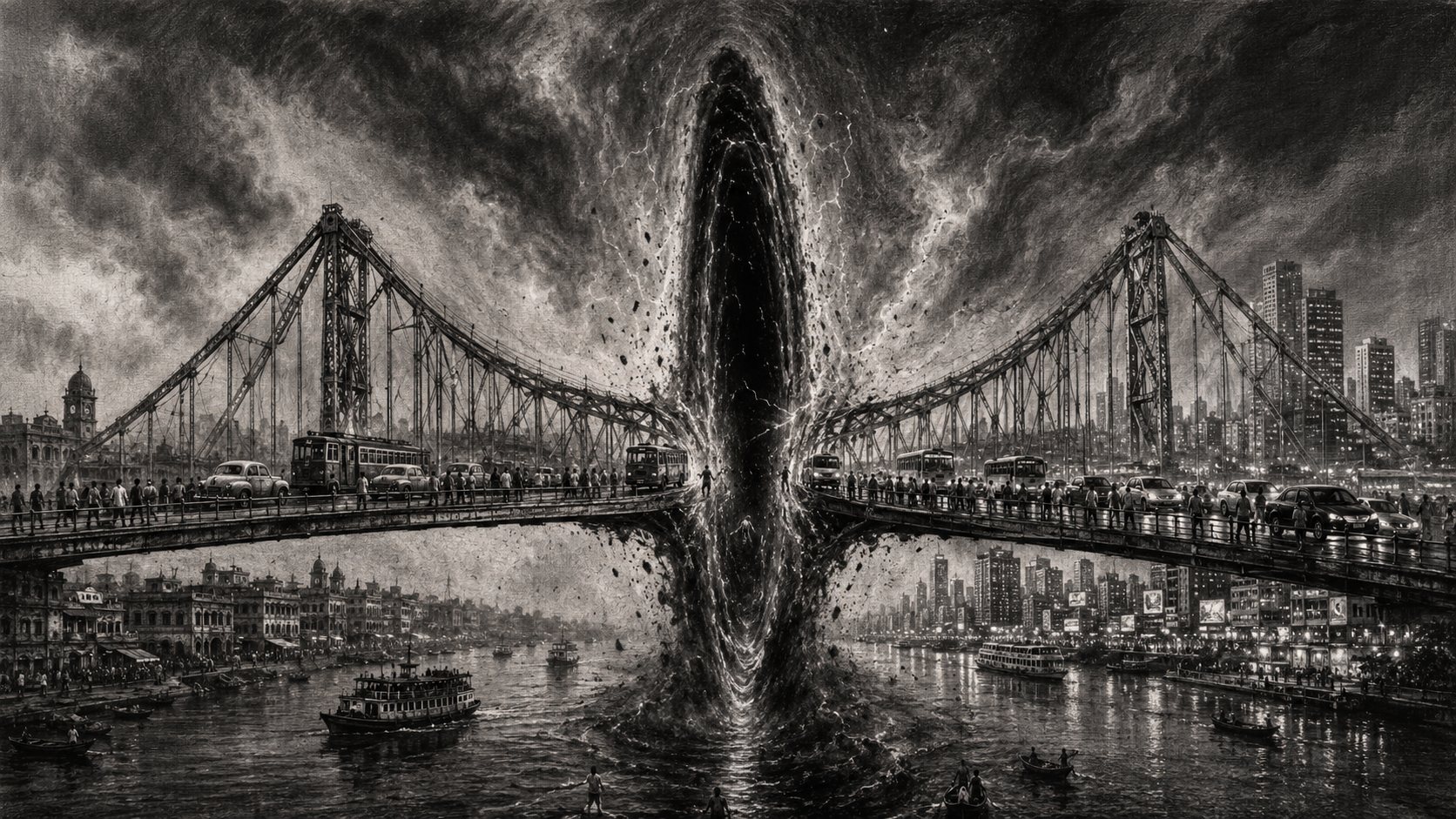
It punched upward beside Howrah Bridge in a column of mud, steam, shattered masonry, fish, iron bolts, and flame. The shock threw Arka flat. His ears became two rooms full of bells. The sky turned brown. The bridge disappeared behind a boiling wall. Something hot struck his shoulder and rolled away. Around him people crawled, screamed, prayed, called names that could no longer answer.
Paromita lay three feet away, bleeding from the forehead, eyes open.
Riddhi was gone.
For several seconds, or several centuries, Arka could not move.
Then ash began to fall.
Not snow. Never that pretty. Ash fell like the city’s burnt paperwork, grey flakes settling on hair, tea glasses, police caps, flower baskets, the wet backs of fleeing men. It covered the councillor’s smiling poster. It coated the words JOBS FOR YOUTH until they looked archaeological.
Through the ash, a red fountain rose where Strand Road had been.
Lava.
The word was childish and exact.
It welled up thickly, not racing like cinema, but shouldering through its own broken throat, folding over rubble in glowing slabs. When it touched rainwater, it hissed and made more steam. The old warehouses began to burn. A scooter melted into a shape that looked almost thoughtful.
Howrah Bridge emerged in pieces behind the ash, its lower steelwork lit from beneath by an impossible orange dawn.
Arka crawled to Paromita.
“Can you stand?”
“Riddhi?”
He did not answer.
“Riddhi?” she said again.
He looked around. No blue backpack. No green helmet. Only ash, bodies, running silhouettes, and the new volcano growing beside the bridge with obscene calm, building itself out of the city’s floor.
Paromita gripped his wrist. “Your mother.”
He had forgotten.
The shame of that was worse than fear.
They moved east through streets losing electricity block by block. Burrabazar burned in patches, not from lava but from panic: overturned generators, shorted wires, cooking gas cylinders abandoned mid-meal. Men pulled shutters down against ash, as if commerce could be saved by refusing to participate. A jewellery shop owner stood in the road holding a velvet tray of bangles while his assistant begged him to run. Overhead, the evening sky had become a low black ceiling pulsing red toward the river.
At a crossing near BBD Bagh, they found Riddhi.
She sat against a lamp post, face grey, both hands wrapped around her phone. One side of her hair was singed.
“I called control,” she said. “No one picked up.”
Paromita knelt. “Can you walk?”
Riddhi nodded, then shook her head, then laughed once. “My mother told me government job is safer.”
Arka took her arm. “Come.”
They reached his mother’s building near Girish Park after dark. The power was out. The old apartment house leaned into the lane with balconies full of faces, each face lit by phone glow. Ash had turned the narrow lane into a ghost of itself. Someone had drawn a wet cloth across the entrance to keep dust out, as if ash respected domestic effort.
His mother was on the third floor.
The lift, of course, was dead.
Arka climbed the stairs with his lungs burning. On the second-floor landing, Mrs. Mukherjee clutched a steel tiffin carrier and asked, “Is it true Howrah Bridge fell?”
“No.”
“Then?”
“Not yet.”
She stared. In Calcutta, “not yet” is often the whole truth.
He found his mother sitting on the bed, a wet towel over her mouth, the window sealed with newspapers. She was small now, smaller than he ever allowed in memory. Her hair was white, her feet swollen, her eyes sharp with fear and irritation.
“You did not come early,” she said.
“No.”
“Always work.”
He nearly laughed. Always work. If only. For years he had hidden unemployment, underemployment, compromised work, delayed payments, and professional decay from her behind the same old word: work. It was the most useful lie in middle-class Bengal. Work explained absence, failure, silence, irritability, even love.
“We have to leave,” he said.
She looked at Paromita in the doorway. Recognition moved across her face, followed by something like apology.
“You came,” his mother said.
Paromita nodded. “Yes, Mashima.”
“Good. He needs someone sensible.”
Under other circumstances, this would have been funny enough to wound everyone.
They carried her down in a plastic chair with two neighbours helping. Outside, ash fell thicker. The lane had filled with people moving north and east, away from the river, carrying documents, medicines, children, pressure cookers, framed gods, laptop bags, caged birds, and the peculiar Indian conviction that catastrophe becomes manageable if one brings the right papers.
Then the sirens stopped.
All at once.
The silence after them was enormous.
From the west came a roar so deep it seemed not to enter through the ears but through bones.
Over the rooftops, beyond the black skeletons of tram wires, the sky tore open in red.
The main eruption began at 8:12 p.m.
Later, if there was a later for records, someone might call it a Plinian column, might measure ash height, pyroclastic density, vent radius, sulfur dioxide, casualty estimates. But to Arka, standing in a lane where laundry lines sagged with ash and neighbours held their breath like children, it was simply the earth standing up.
A column of fire and pulverized city rose beside Howrah Bridge, higher than any tower, higher than rain clouds, turning night into a furnace. Lightning crawled inside the ash plume. The sound flattened thought. Windows shattered along the lane. His mother cried out. Paromita held her upright. Riddhi whispered, “It’s beautiful,” and then covered her mouth as if beauty were indecent.
Arka watched the bridge bend.
Not fall entirely. Not at first. It twisted at one end, the steel groaning through the roar, and for a moment that great cantilevered beast, which had carried generations of hunger, office bags, wedding parties, protest marches, exam candidates, migrant workers, bodies, gods, and gossip, seemed to resist not geology but humiliation.
Then the Howrah side support vanished in steam.
The bridge dropped.
A gust of ash-wind rushed through the lane. People screamed and ran. Arka’s mother’s chair tipped; he caught it. Something inside him, some final bureaucrat stamping forms in the office of denial, quietly left his post.
He knew where to go.
Not east. Everyone would go east, clogging roads, stations, flyovers. Not north. The ash cloud would follow wind. The old survey had shown the ring fracture, the vents, the weak points.
There was one stable block of old basement high beneath the Medical College zone, a stubborn geological knuckle. He had erased it from the public report but remembered it now with obscene clarity.
“This way,” he said.
Paromita heard the certainty and understood its source.
“You knew,” she said.
“I knew enough.”
“Enough then?”
“No.”
“Enough now?”
“Maybe.”
They moved through College Street under falling ash. Bookstalls burned blue where plastic covers caught fire. Pages flew loose, charred at the edges: entrance guides, Marxist pamphlets, romance novels, organic chemistry, Rabindranath, cheap pirated medical texts. It was a whole education system becoming weather.
Near a closed coffee house, they paused. His mother could not breathe. Riddhi found an inhaler in an abandoned pharmacy drawer. Paromita tore cloth for masks.
Arka’s phone buzzed again.
An unknown number.
He answered without knowing why.
A man’s voice said, “Dr. Sen? This is Eastern Habitat. Sir, Riverside Arcadia basement has flooding and smoke. Residents are asking if evacuation is needed. Sir? Sir, please advise. Media is here.”
Arka looked west. The sky pulsed.
“How many still inside?”
“Some families. Sir, we told them stay indoors to avoid panic.”
He closed his eyes.
There it was again. No alarm. Stay indoors. Keep calm. Maintain property value until death enters the lobby.
“Get them out,” Arka said.
“Sir, official instruction?”
“Get them out now.”
“Sir, but if we create liability—”
The line went dead.
Perhaps signal failed. Perhaps mercy.
Paromita was watching him.
“You cleared it,” she said.
“Yes.”
“My God, Arka.”
“I needed money.”
“So did everyone.”
That was the whole judgment. No thunder needed.
They reached the Medical College compound near midnight. The hospital was operating under generator light, wounded people spread through corridors, relatives fanning them with cardboard. Doctors moved with ash in their hair. Nurses shouted for saline. Somewhere a baby cried with furious commitment to ordinary life.
In the courtyard, under a rain tree whitened by ash, Arka settled his mother on a bench. Riddhi lay down on the ground and slept at once. Paromita stood apart, looking west.
The eruption continued. A red fountain rose and fell behind buildings. Ash drifted across the hospital lamps.
Arka sat beside his mother.
She touched his burnt sleeve. “You are hurt.”
“I am fine.”
“You always say fine when not fine.”
He nodded.
After a while she said, “Your father used to say this city is built on mud and stubbornness.”
“He was half right.”
“And you?”
“I was less than half right.”
She did not ask what he meant. Perhaps mothers know the shape of confession without needing the inventory.
Near dawn, the ash thinned.
Arka walked to the edge of the courtyard. Paromita joined him. Neither spoke for a long time.
Where the west had been, a new shape glowed through the dark: a cone of black and red rising beside the river, shouldering through warehouses, roads, memories, maps. Howrah Bridge was broken around it like an offering refused. Steam towered where lava met the Hooghly. The city had acquired a mountain in one night, as if some absent-minded god had put Darjeeling in the wrong drawer.
Paromita said, “The 2004 samples.”
“What?”
“You remember the deep borehole cores? The ones marked contaminated?”
He remembered. Black glassy fragments. Vesicles. Heat-altered clay. Organic material carbonized in layers far younger than expected.
“You said contamination,” she said.
“My supervisor said contamination.”
“You agreed.”
He looked at the new volcano.
Paromita took a folded paper from her pocket. Ash had smeared it, but the print remained. Another old page. Another old sin.
She handed it to him.
It was not from their survey.
It was older. Much older. A British geological note from 1897, copied from an archive, with a sketch of smoke vents near the river after the great Assam earthquake. At the bottom, in faded ink, a line had been underlined twice.
Native accounts indicate similar fires beneath the old bridge approach in 1737, after the cyclone and shaking, but Company officers dismissed these as bazaar superstition.
Arka read it twice.
Then the final understanding came, slow and cold, while the volcano painted Paromita’s face red.
This was not the first eruption.
The city had not been sitting unknowingly on a sleeping volcano. That would have been almost innocent.
Calcutta had known in the old way cities know things: through rumours, burnt wells, temple stories, cracked ghats, family warnings, impossible smells after earthquakes, and the practical wisdom of people whose testimony never became data because they sold flowers, pulled rickshaws, cleaned drains, or spoke in languages official reports treated as weather.
Science had not discovered the fire.
It had merely arrived late, wearing shoes, and helped deny it.
At sunrise, the new cone gave a soft internal boom. Ash lifted from its slope like breath from a beast turning in sleep. Around Arka, the hospital stirred, hungry, damaged, alive. Someone asked for tea. Someone answered yes.
And under the courtyard stones, very faintly, the city knocked back.
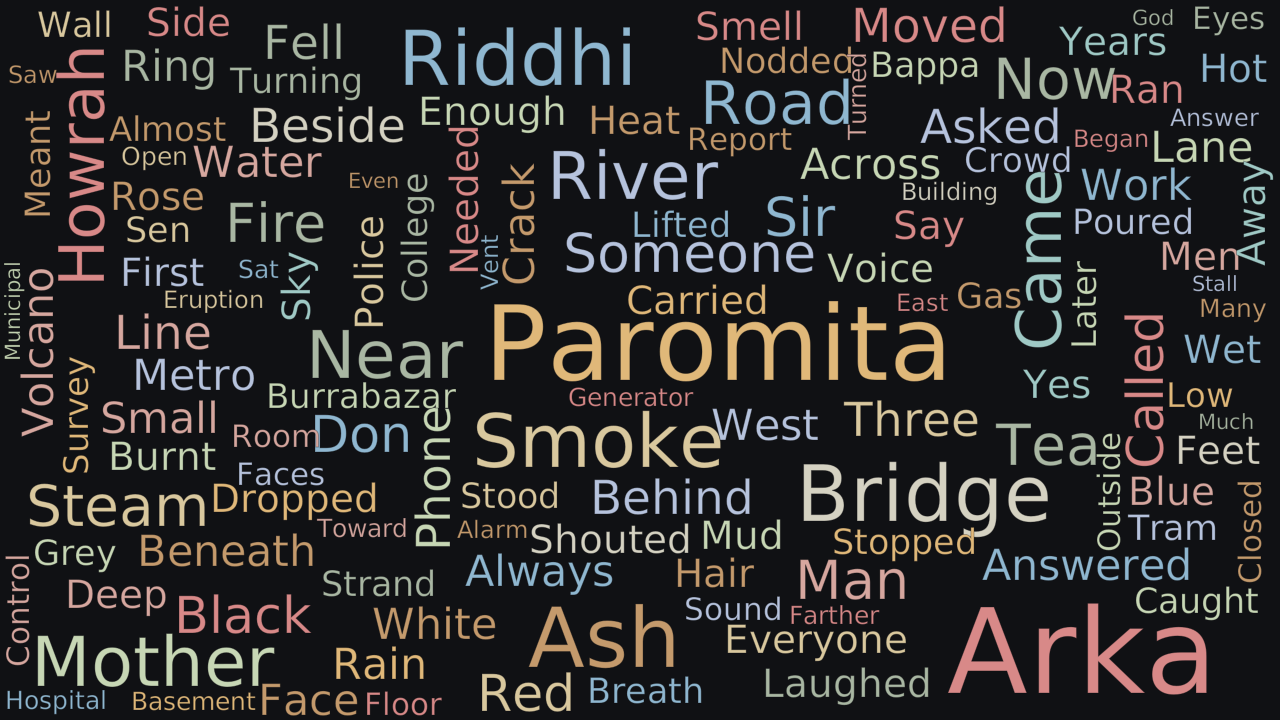
Word Cloud
Related reading
Selected by shared topics and section, with closer publication dates breaking ties.