Hilsa and the Family Court of Appetite
Uses the speech voice supplied by your browser or device.

Acronyms and terms: Tenualosa ilisha means the scientific name of hilsa. Anadromous means a fish that lives in the sea but swims into rivers to breed. Osmoregulation means the biological management of salt and water inside the body. Isothiocyanates are sharp-smelling mustard compounds that attack the nose with the enthusiasm of a para committee during Durga Puja subscription season.
The first warning is the smell.
Not bad smell exactly. Bad smell is a dead rat behind a cupboard or wet socks forgotten in a schoolbag. Hilsa gives off something more complicated. It is metallic, riverine, faintly royal, faintly criminal. It rises from the fish belly inside a steel thala as if somebody has opened a tiny ancestral morgue beside the kitchen sink.
There are silver scales stuck to the drain cover. One eye looks upward with the calm resentment of a zamindar whose estate has been acquired by the government. I am standing there in my lower-middle-class Calcutta kitchen, mustard oil on my fingers, stomach making a small written complaint to the municipality, wondering how a fish became such a large cultural trap.
Because hilsa is not food in Bengal.
Food is rice.
Food is dal.
Food is yesterday’s aloo, heated again, floating in jhol like a government scheme that has lost the file.
Hilsa is different.
Hilsa is memory with bones.
No Bengali merely eats hilsa. He appears before it. He is summoned. Somewhere an aunt appears in the mind, even if she has been dead for twenty years, and says, “Ki re, ilish khabi na?” And suddenly the matter is no longer lunch. It is loyalty. It is childhood. It is river. It is Partition. It is monsoon. It is whether you are still properly Bengali or have become one of those suspicious modern fellows who eats boneless chicken and says “protein” with a straight face.
I have lived in America. I have worked in clean offices where food came in boxes and fish did not arrive with eyes, ancestry, and emotional blackmail. There, a man could eat salmon and nobody’s grandmother rose from the steam to interrogate him. Salmon is healthy. Salmon is polite. Salmon minds its own business.
Hilsa does not.
Hilsa enters the house like a family elder with cash in one hand and judgment in the other.
Scientifically, hilsa is already a show-off. It lives in the sea and swims into rivers to breed, changing its internal salt-and-water machinery as it moves from one world to another. This is not a small thing. Human beings change neighborhoods and complain for six years about the new milkman. Hilsa changes salinity.
If an MBA discovered osmoregulation, he would put it in a slide deck and call it adaptive ecosystem transformation.
The fish just swims.
Then we catch it.
This is the part where our poetry develops a limp.
The hilsa swims upstream to reproduce, and we arrive with nets, engines, auctions, prices, gossip, appetite, festival demand, and that touching Bengali belief that if something is beloved, we must immediately apply maximum pressure upon it. We catch the big fish, the small fish, the future fish, the almost fish. Then we sit at lunch and speak about heritage in the tender voice of people chewing through inheritance.
I am not innocent. Please do not imagine me standing here as some river saint in a cotton shawl. I am a Bengali man of fifty-one. I live in the sticky outskirts of Calcutta, earn a precarious consulting income, and occasionally calculate whether buying decent hilsa is financially closer to cuisine or dental surgery. I have moral opinions. I also have a tongue.
When mustard oil heats in the pan, morality quietly leaves by the back door.
That smell is not cooking. It is a political announcement. The oil smokes slightly. The mustard paste waits, yellow and dangerous. Green chillies lie there like small green threats. Then the whole thing comes together: oil, salt, turmeric, mustard, fish, steam.
The kitchen changes weather.
Eyes water. Nose runs. The throat tightens. The air becomes sharp enough to edit your personality. The isothiocyanates do their small molecular hooliganism, and for one second everyone is equal: landlord, tenant, software engineer, retired schoolteacher, failed lover, party worker, unpaid consultant, man with EMI, woman with patience, cousin with opinions. All are crying. Bengal has tried many political experiments. Mustard remains the most successful mass movement.
Then comes the first bite.
This is where civilization loses.
The flesh slips loose in soft oily flakes. Rice catches the gravy. Mustard burns, then blooms. The tongue, that shameless little informant, immediately betrays every budgetary principle you had in the morning. You forget the price. You forget the bargaining. You forget that the electricity bill is pending. For seven or eight seconds, life becomes manageable.
That is not a small gift.
In middle age, eight seconds of clean pleasure is not pleasure. It is infrastructure.
Then the bone appears.
Ah, the bone.
Other fish have bones. Hilsa has strategy. Hilsa has a border security arrangement. Hilsa has a secret committee of needles meeting inside the flesh. You cannot attack it casually. You must negotiate.
A child learns hilsa through fear. The elders do not give lectures. They demonstrate. Press the rice. Separate the flesh. Feel with the tongue. Do not rush. Do not show greed. Do not laugh with your mouth full. Do not breathe like a fool. Pull the thin bone out gently.
If the child succeeds, the table approves. Not loudly. Bengali approval is rationed like kerosene. Perhaps one uncle says, “Hyan, ekhon shikhe gechhe.” That is enough. The child has crossed a small border into civilization.
If the child fails, there is drama.
Every family has a fishbone story. Banana swallowed. Rice ball pushed. Back slapped. Eyes bulging. Doctor mentioned. Deity briefly remembered, even by people who otherwise conduct themselves like practical atheists until fish or fever arrives. The victim survives. Ten minutes later, he takes another piece.
This is the part economists do not understand.
They imagine human beings making rational decisions. Smooth curves, utility, preference, price sensitivity. Very nice. Very clean. Very air-conditioned. Put a Bengali before shorshe ilish and the whole theory begins to sweat. We are not calculating machines. We are smell-driven, bone-risking, memory-fed animals who will overpay for a fish because somewhere in the mind a river still runs past a childhood courtyard.
The real market force is not supply and demand.
It is loss.
Loss has a smell. In Bengal, often, it smells of mustard oil and river fish.
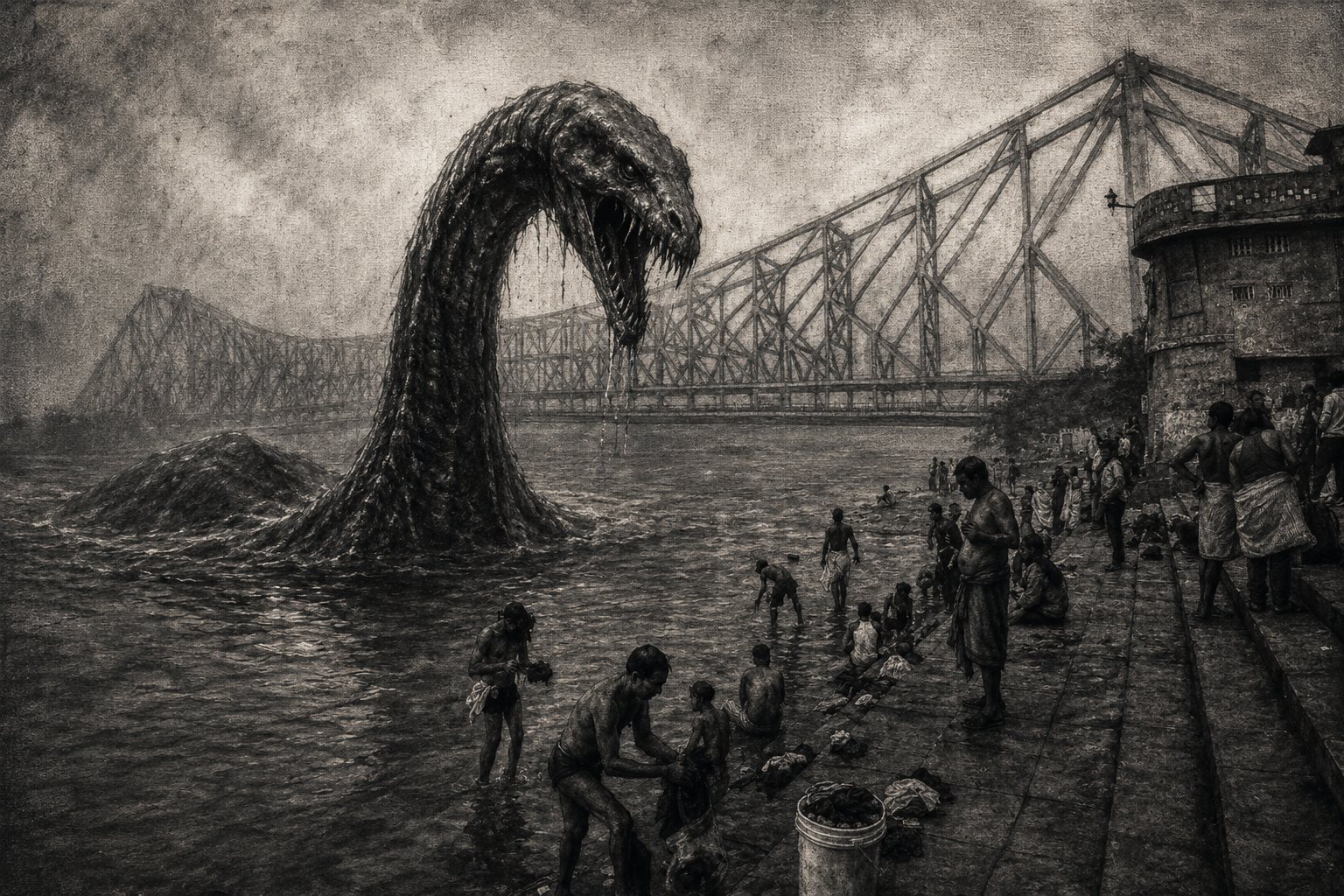
Of course the rivers have their own complaint. Padma, Meghna, Brahmaputra, Hooghly. Say the names slowly and they sound like wet bronze bells. Then look at what we do to them. We dam them, dredge them, poison them, worship them, drain into them, fight over them, photograph them at sunset, and speak of them in speeches written by men who have not touched river mud since childhood, if then.
We want rivers to remain ancient while we treat them like municipal drains with better mythology.
This is our gift. We sentimentalize what we exhaust.
Then we ask why the fish is expensive.
Bangladesh enters the matter like a superior cousin who knows it is superior. Padma ilish has a reputation that can make a Kolkata fish market fall silent in the way a classroom falls silent when the headmaster’s shoes appear at the door. We pretend not to care. Of course we care. We inspect belly, fat, smell, gill, scale, weight, rumor. Partition divided land, language, families, homes, songs, addresses. It also divided the lunch plate.
History books rarely mention this.
They should.
At the market, hilsa becomes theatre. Men bend over baskets with forensic seriousness. They press the belly. They stare at the eyes. They ask the fishmonger whether it is river hilsa or sea hilsa, as if expecting the man to suddenly abandon centuries of commercial improvisation and become honest in public.
The fishmonger says, “Dada, pure river. Fresh. Just came.”
The buyer knows this may be nonsense.
The fishmonger knows the buyer knows.
Both continue.
This is not fraud exactly. It is social ritual with money attached. A little like marriage, but with more scales and slightly less long-term damage.
Back home the fish is washed, salted, rubbed with turmeric, and divided with great care. Do not underestimate this division. The allocation of hilsa pieces is family politics in edible form. The belly goes to the loved, the head to the serious eater, the roe to the powerful or the secretly favored, the tail to someone who must be kept quiet but not fully honored. One can reconstruct an entire household from the plate.
Give a man the wrong piece and three civilizations enter the room: Freud, Marx, and the Mahabharata, all wearing lungis.
The roe deserves its own small scandal. Orange, grainy, rich, slightly indecent. It is the fish’s future, fried for our pleasure. We call it delicacy because civilized people have excellent vocabulary for appetite. I will not pretend disgust. I will eat it. I will praise it. I will push rice into the last bit of oil and drag it across the plate like a minor bankrupt zamindar recovering revenue from a pond.
That is hilsa’s uncomfortable talent. It exposes us.
Not romantically. Not nobly. Under the tube light. With onion skins near the sink.
We mourn rivers while licking oil from our fingers. We condemn overfishing after asking for a better belly piece. We speak of culture as if culture lives in museums, when very often it lives in bargaining, frying, chewing, swallowing, and pretending not to notice the ecological bill.
That bill is coming. It always comes. Fish do not care about nostalgia. Rivers do not care about Rabindrasangeet. Biology has no special affection for Bengali sentiment. If breeding cycles break, if juveniles vanish, if rivers become corridors of poison and silt, the lunch plate will eventually receive the news in the most direct possible language: absence.
No fish.
No smell.
No argument.
Just rice, dal, and a silence too large for the table.
Still, when the rain begins, I understand the madness.
The window grille smells of rust. Somewhere a pressure cooker whistles with the despair of a local train. The lane outside is half mud, half ambition. The news on the phone is the usual circus: leaders shouting, cities flooding, prices rising, somebody important promising a future with the confidence of a man who has never bought vegetables at 9 p.m. Then the rice steams. The mustard oil glows. The hilsa sits on the plate like a silver insult from a better universe.
At that moment, all my large opinions become smaller.
Not gone.
Smaller.
A man can survive many disappointments if something on the plate still remembers the river. This is not wisdom. It is hunger wearing a clean shirt for fifteen minutes.
So I eat carefully. Fingers yellow. Nose running. Tongue searching for bones. A crow outside screams like a clerk denied tea. The fan turns overhead with the tired philosophy of rented rooms. Inside my mouth the fish performs its old trick. It becomes pleasure, danger, class, river, border, mother’s kitchen, market lie, ecological crime, monsoon memory, and lunch.
Then one tiny bone pricks the gum.
Just enough.
Just enough to remind me who is sovereign.
Not the buyer.
Not the cook.
Not the Bengali with his poems, arguments, and heroic digestion.
The fish.
Still ruling from the plate.
Word Cloud
Related reading
Selected by shared topics and section, with closer publication dates breaking ties.