Taklu Babu Eats the River
Uses the speech voice supplied by your browser or device.

THIS IS A WORK OF FICTION
The fish was still dreaming when Taklu Babu swallowed it.
Not alive-dreaming. The bhetki had been dead for hours, stiff on the marble slab at New Market, its eyes filmed with the gray dust that settles on everything in Calcutta after noon. But when Taklu Babu—bald as a baby, pink scalp showing through sparse ginger patches, named by the rickshaw-wallah who fed him scraps—when he bit into the cold white flesh behind the gill, something entered him that was not protein.
A woman’s voice. Not heard. Known. The way you know your own hunger.
The water is warmer than the air, the fish-memory said. The water remembers the monsoon before you were born.
Taklu Babu dropped the fish. He looked at his paws. They were the same paws: cracked pads, one torn claw from a fight with the black tom behind the cigarette stall. But the stall was different now. He could smell the bidi smoke, yes, but also the intention of the man selling them—the man’s worry about his daughter’s school fees, the specific shape of his boredom, the way he wanted to be home watching cricket and would leave in exactly eleven minutes if no one bought the premium brand.
Taklu Babu had never wanted anything except the next meal, a dry patch of cardboard during rain, and for the black tom to die. Now he wanted to know why the fish knew more than he did.
He ate the rest. Carefully. Each bite was a room in someone else’s house.
The second piece gave him a bus conductor’s memory of touching a schoolgirl’s hip on the 213 route, the shame and thrill braided so tight he couldn’t tell where one ended and the other began. The third piece was an old woman’s last sight of her husband’s face, forty years ago, preserved in the fish like a photograph in formaldehyde. The fourth was a child drowning in the Hooghly, not struggling, just looking up at the rust-colored sky with an expression of mild surprise.
Taklu Babu stopped eating. He was full in a way that had nothing to do with his stomach.
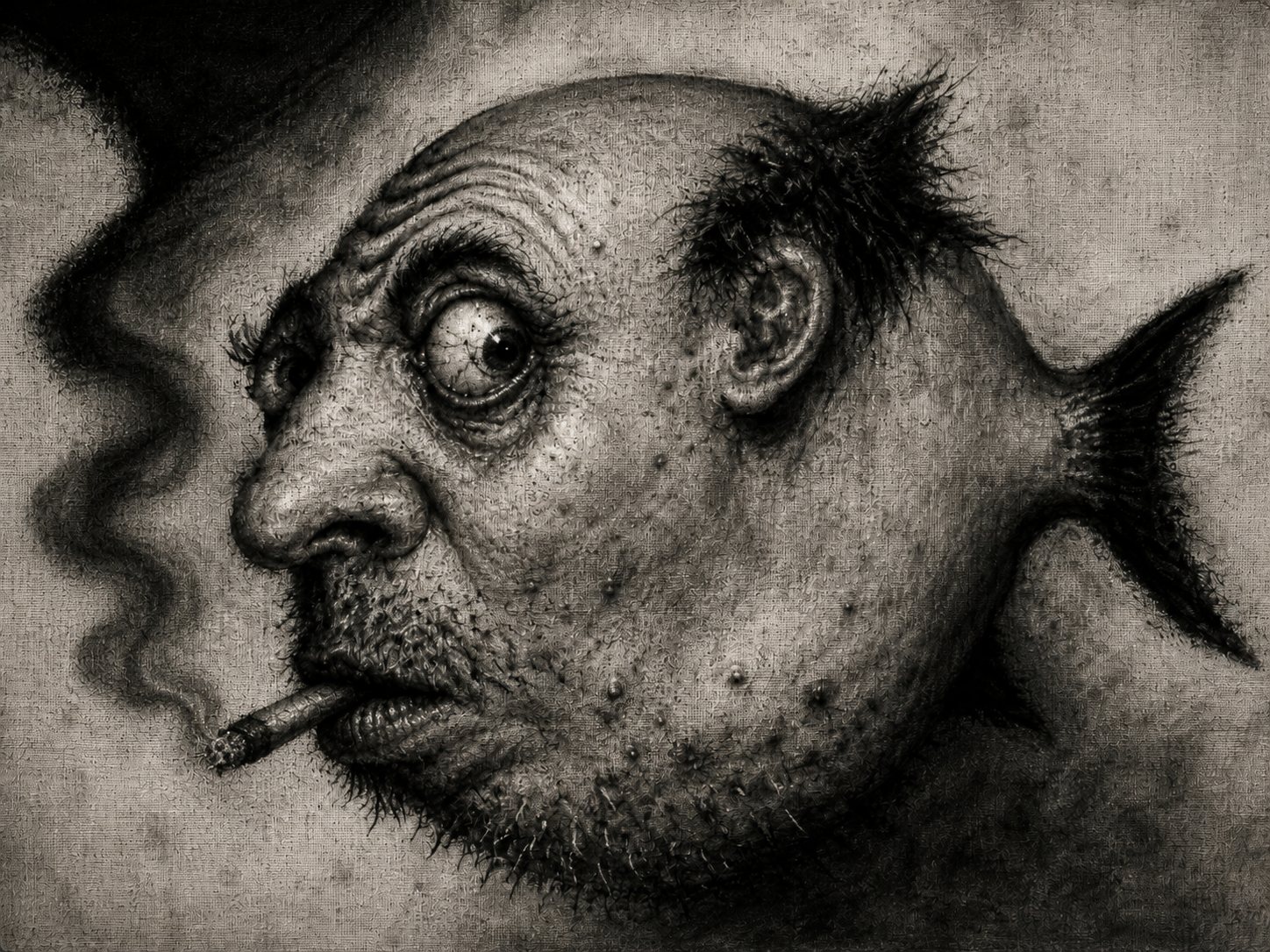
He walked to the gutter and looked at his reflection in the oily water. The pink scalp. The one eye that wept constantly from an old infection. He was ugly. He had always been ugly. The bengalis called him Taklu—Baldy—and laughed when they threw him chicken bones. He had accepted this. Cats do not argue with taxonomy.
But the fish-memories were still moving inside him, and they knew things about humans that humans did not know about themselves.
The rickshaw-wallah who named him was asleep on his vehicle, bare feet dangling, mouth open. Taklu Babu jumped onto the worn leather seat. He had done this a thousand times. The man would wake, curse, shoo him away. Sometimes he saved a piece of mutton from his own lunch.
Taklu Babu stared at the man’s face and thought: You are afraid your wife knows about the money you hide in the rice tin.
The rickshaw-wallah’s eyes snapped open. He sat up, looked around, saw only the bald cat.
“Chhee,” he said. Shoo.
But he did not shoo. He was still looking at the cat with an expression Taklu Babu had never seen before. Not affection. Recognition.
Taklu Babu thought: You will give me the mutton now, and you will tell yourself it is because I am pitiful, but really it is because you need something to forgive you for the rice tin.
The man reached into his lunch box. He held out a piece of mutton on his dirty fingers. Taklu Babu ate it slowly, watching the man’s face crumple and smooth, crumple and smooth, as he performed the arithmetic of his own guilt.
This was the first time Taklu Babu steered a human. He did not know the word steer. He knew only that the fish had given him a map where before there had been only walls.
He began eating strategically.
Not the small fish, the ones that died confused and brief. The big ones. The hilsa that came upriver in monsoon, heavy with the accumulated memory of the Bay of Bengal. The rui that lived ten years in the ponds behind the marble factories, soaking up the dissolved prayers and piss of the city. The pangasius from the sewage-fed tanks, which tasted of copper and carried the dense, compressed recollections of a thousand other fish, a palimpsest of hunger and light.
Each meal expanded him. Not his body—he remained small, bald, slightly ridiculous—but his reach. He could sit on a boundary wall in Ballygunge and feel the housewife three stories up worrying about her daughter’s marriage prospects. He could walk past a tea stall and know which customer was planning to cheat his brother, which was planning to leave his wife, which had already decided to kill himself but hadn’t chosen the date.
The knowledge was not comfortable. Humans, Taklu Babu learned, were mostly not evil. They were unsteered. They moved in directions they did not choose, propelled by currents they could not see, bumping against each other in the dark. The fish had seen this. The fish had always seen this. That was why they looked so stupid, mouths opening and closing: they were laughing.
Taklu Babu began to experiment.
The fat man who ran the electronics shop on Camac Street was easy. He wanted to be feared by his employees and loved by his dead mother, two impossible geometries that left him permanently twisted. Taklu Babu sat in the shop’s doorway for three afternoons, projecting nothing, simply being present in the man’s peripheral vision. On the fourth day, the man gave his best salesman a raise unprompted, then cried in the back room for twenty minutes. He did not know why. Taklu Babu did not know why either, not exactly. He was learning to play an instrument he could not name.
The college girl on Rash Behari Avenue was harder. She was armored in ambition, every decision calculated, every friendship transactional. Taklu Babu followed her for a week, eating the fish from her family’s kitchen through the back window, absorbing her father’s disappointment, her mother’s resignation, the specific texture of her loneliness, which was not loneliness at all but a highly refined form of contempt.
One evening she sat on her balcony studying for the civil service exam. Taklu Babu jumped onto the railing. She startled, then relaxed. Just the bald cat from the lane. Ugly thing.
Taklu Babu looked at her and thought: You will fail the exam not because you are stupid but because you want to fail. You want to be forced back into the ordinary world where your contempt is justified.
She threw her book at him. Missed. He did not flinch.
She failed the exam. She did not remember the cat on the railing, but she remembered the certainty, sudden and complete, that nothing she did would ever matter.
Taklu Babu was not cruel. He was curious. He wanted to see how far the steering went.
The problem with eating fish-memories was that they accumulated. Taklu Babu began to dream in human time, in years and decades instead of seasons. He dreamed of a wedding in Dhaka, 1952, the taste of sandesh, a woman’s hand on his back. He woke and did not know if the woman was dead or if he had simply eaten her ghost. He dreamed of a fisherman who drowned his partner for a boat, the partner’s last thought not anger but the nets will rot without me. He woke and smelled rotting nets for three days, though no nets were near.
He began to avoid the Hooghly. The river was too old, too full. A single hilsa from the deep channel could carry centuries: the East India Company, the famine, the partition, the Naxals, the malls going up where the factories came down. The fish did not distinguish important memories from trivial ones. A child’s first steps weighed the same as a massacre. The river was democratic in its horror.
But he could not stop eating. The hunger was not in his stomach anymore. It was in the new spaces the memories had carved inside him, vast halls that echoed and demanded filling.
He grew bold.
The politician came to the neighborhood in a white SUV with tinted windows, surrounded by men with guns that looked like toys. He was campaigning for something—mayor, chief minister, god, it did not matter. The bengalis gathered to watch, to hope for a glimpse, to touch his hem and be blessed. Taklu Babu watched from a pile of construction sand.
The politician was a fortress. He had been steered by professionals for forty years, his desires buried under so many layers of strategy and survival instinct that Taklu Babu could barely sense them. But there were cracks. A fear of closed spaces, inherited from a childhood locked in a cupboard by an uncle. A secret taste for young men, carefully starved for decades. A dream, recurring, of his own corpse being eaten by stray dogs while his family watched from a balcony.
Taklu Babu ate a hilsa that morning, a big one, twenty kilos, carried by four men to a wedding feast. He ate until his belly dragged on the ground. He absorbed everything: the politician’s childhood cupboard, his starved hunger, his dream of the dogs.
Then he walked to the rally and sat in the sand directly in the politician’s line of sight.
The politician was speaking about development, about roads, about the future. He saw the cat. He faltered. Just for a second. He looked at the bald pink scalp, the weeping eye, the slight tilt of the head.
Taklu Babu projected: The cupboard is dark and the wood smells of your uncle’s hair oil. The dogs are already eating. The dogs are always eating.
The politician smiled. He kept smiling. He finished his speech. He shook hands. He got in the SUV. That night he cancelled three meetings and sat in his bathroom with the lights off for four hours. The next day he announced a new policy: free fish protein for all government schools. No one knew why. His advisors were baffled. The policy was popular. He won the election.
Taklu Babu did not care about schools. He did not care about the election. He cared about whether the steering had worked at a distance, through barriers, across the noise of a crowd.
It had.
He began to think of himself differently.
Not as a cat. The word cat was a small box built by humans who needed animals to be simple. He was something else now, something the fish had made and the city had fed. He moved through Calcutta like a current through water, invisible, inevitable, steering without touching, eating without killing.
The bengalis noticed, but they did not understand what they noticed.
The rickshaw-wallah who named him began leaving whole chickens on the boundary wall, then standing back with his hands folded, not as if feeding a pet but as if paying a tax. The college girl who failed her exam started leaving milk in a silver bowl, though she had never owned a cat. The politician’s men put out fish every Tuesday on the steps of the municipal building, and no other stray dared touch it.
Taklu Babu accepted these offerings. He did not need them. He ate better than any human in the city, the accumulated memory of the Hooghly moving through him like blood. But the offerings were data. They told him who had guessed, however dimly, that he was not what he seemed.
Most humans never guessed. Most humans were too busy being steered by each other to notice an additional current. Taklu Babu found this funny, in the way fish find things funny: without malice, without mercy, with a kind of cosmic patience.
He grew old. Cats do not live long, but Taklu Babu was not exactly a cat anymore. His bald scalp grew pinker, his weeping eye clouded completely, his gait slowed to a ceremonial procession. He no longer needed to hunt. The city fed him. The city steered itself toward him, a slow convergence of guilt and need and half-recognized awe.
The last fish he ate was a hilsa from the deepest part of the river, caught by a fisherman who died of a heart attack as he pulled it in. The fish was enormous, ancient, its scales the color of old coins. It carried one memory only, but that memory was vast: the river itself, not as water but as time, the slow consciousness of moving east, always east, carrying everything that had ever fallen into it, every body, every prayer, every plastic bottle, every dream of fish.
Taklu Babu ate slowly. The sun went down. The city lights came on, a false constellation reflected in the black water.
He understood, finally, that he had never been steering anyone. The river steered. The fish were the river’s nerves, sent into the world to taste and remember. He was just another nerve now, a pink bald node in a network vaster than any human bureaucracy, any election, any god.
The bengalis would continue to be stupid. They would continue to be steered. They would throw fish on walls and vote for men who sat in dark bathrooms and fail exams they had studied for and cry over rice tins and touch schoolgirls on buses and drown in the Hooghly with expressions of mild surprise. They would do these things because the river needed them to, because the river needed memory, because the river was hungry in a way that made Taklu Babu’s old stomach-hunger seem like a whisper.
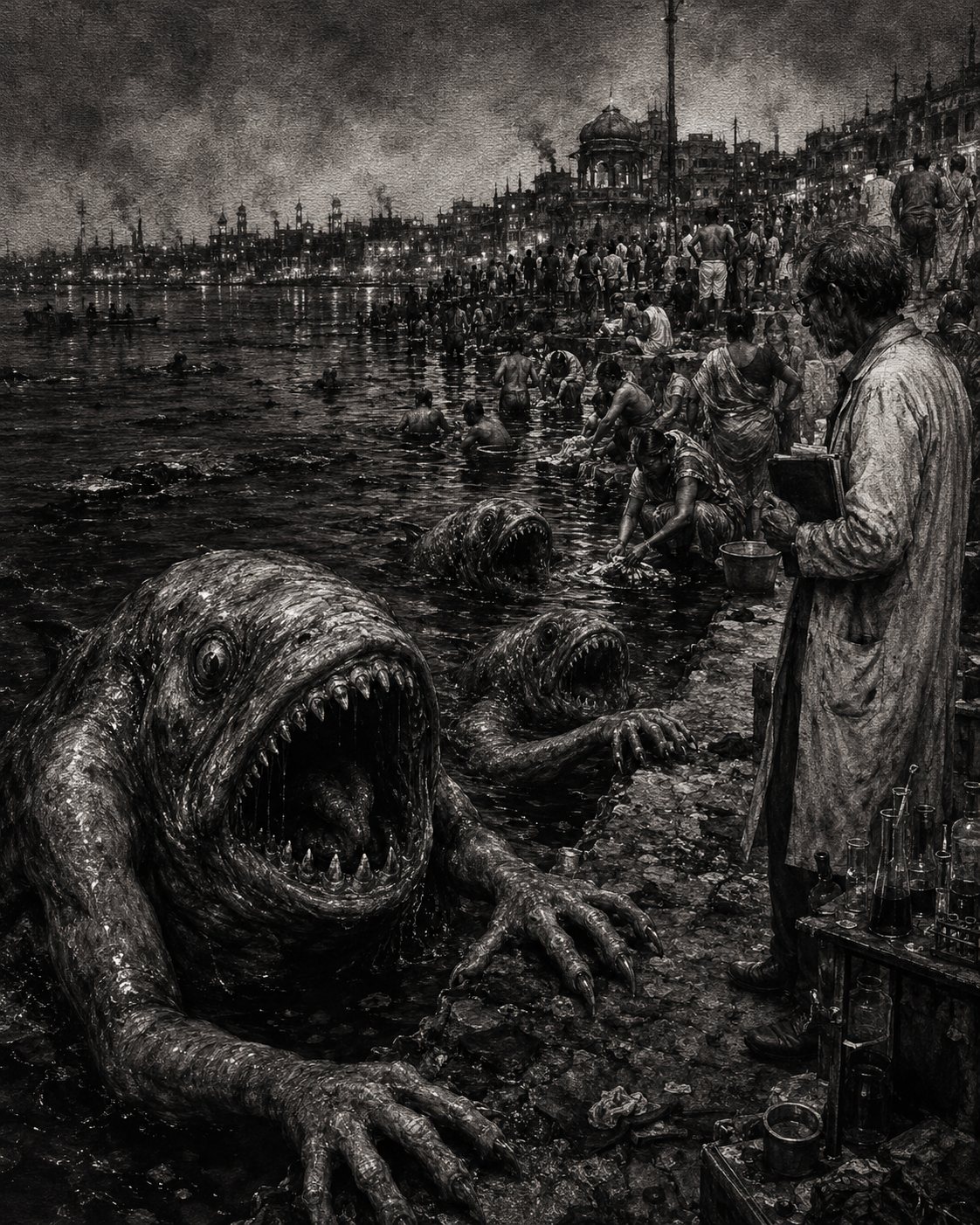
He walked to the ghats. The steps were slippery with offerings—flowers, sweets, the ashes of the dead. He walked down into the water. It was warm, warmer than the air. The water remembered the monsoon before he was born.
Taklu Babu did not drown. He floated. His bald pink scalp broke the surface like a bubble, then sank, then rose again. The current took him east, toward the Bay of Bengal, where the fish were waiting with their mouths open, laughing the way fish laugh, democratic and ancient and full of everything the city had ever been.
On the Camac Street electronics shop, the fat man closed early and went home to his wife. On the Rash Behari Avenue balcony, the college girl burned her civil service books and applied for a job at a call center. In the municipal building, the politician sat in his bathroom with the lights off, not afraid anymore, just waiting. The rickshaw-wallah found the silver bowl empty in the morning and knew, without knowing how he knew, that he would never see the bald cat again.
The river carried Taklu Babu past Howrah Bridge, under the ferries, out into the wide brown mouth where fresh water met salt. He did not struggle. He had never struggled. The steering was not his. It had never been his.
His last thought, if it could be called a thought, was not a memory but a prediction: someday, another cat would eat a fish and wake up hungry in a new way. The river would have another nerve. The city would have another god, small and pink and ridiculous, steering the bengalis toward whatever the water needed them to be.
The fish would be waiting. The fish were always waiting.
Taklu Babu opened his mouth. He did not close it.
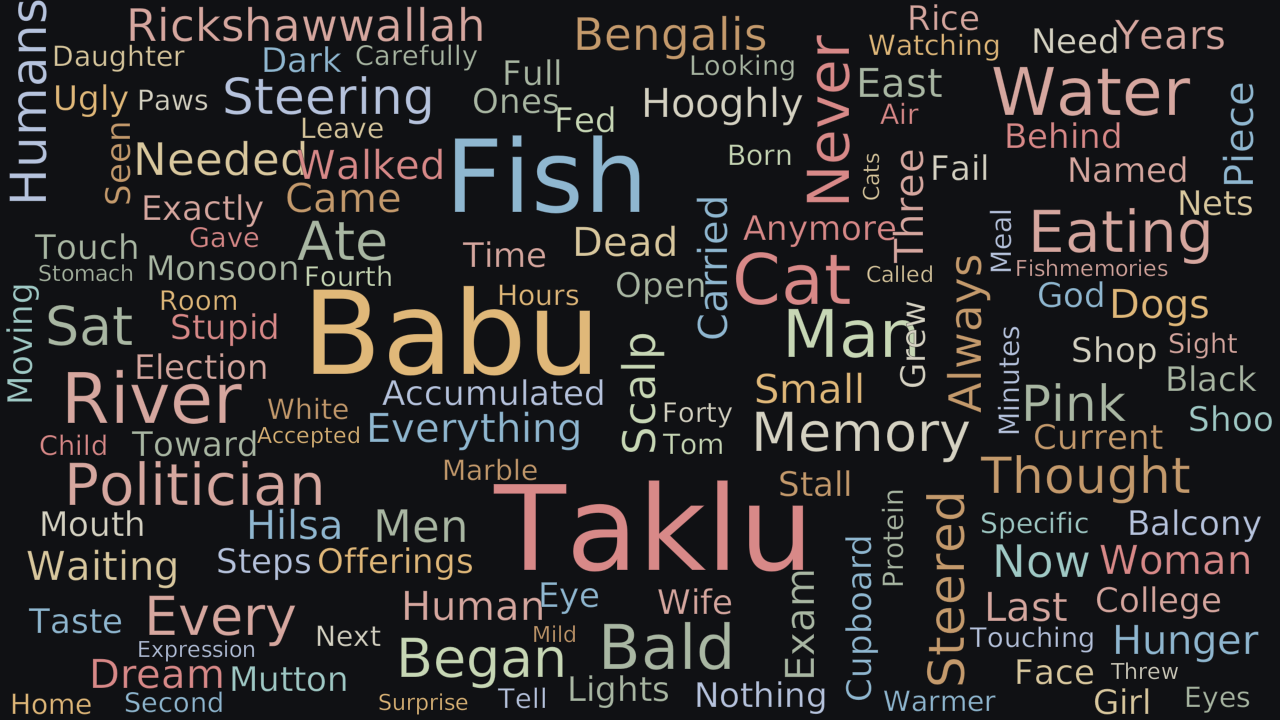
Word Cloud
Related reading
Selected by shared topics and section, with closer publication dates breaking ties.