The Consommé of Governance
Uses the speech voice supplied by your browser or device.

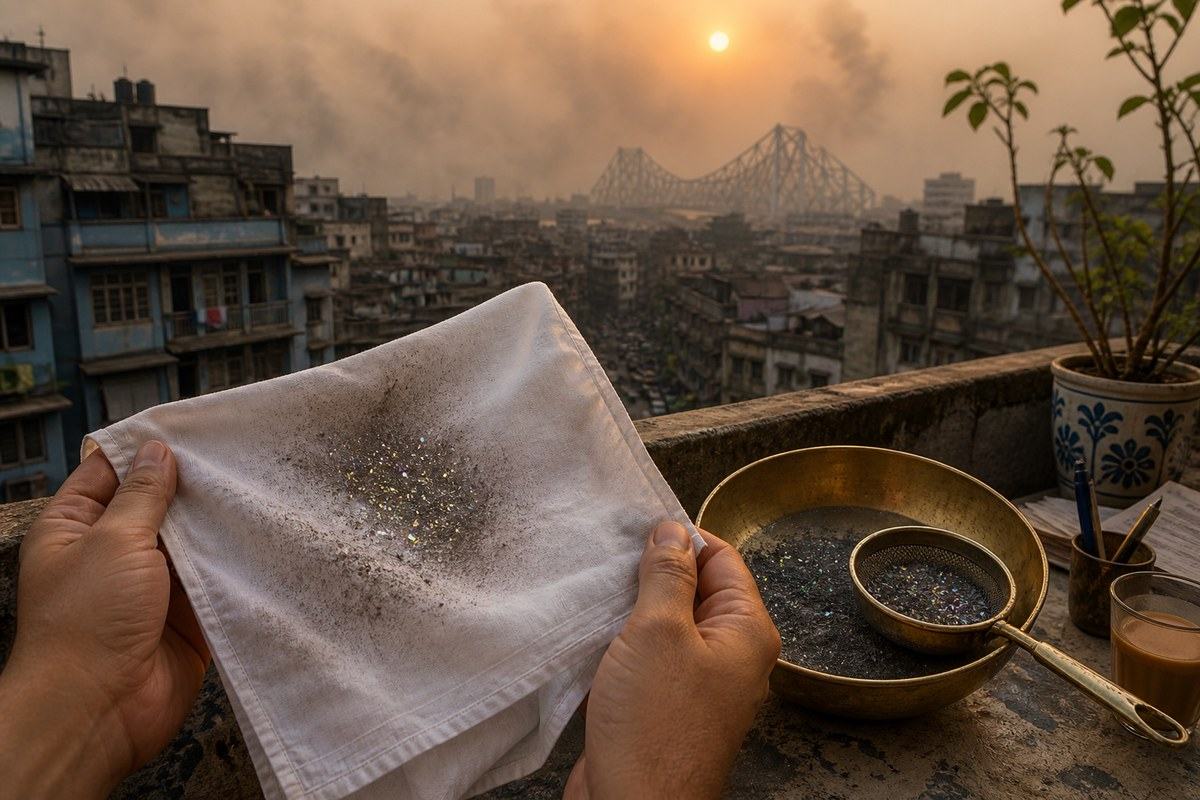
The drizzle—that parsimonious, niggardly spittle from a sky too indifferent to weep properly—has managed to drown Calcutta anyway, not through volume but through the sheer, spectacular incompetence of civic architecture, a city where the drains are less conduits than decorative suggestions, like the promises of politicians, aesthetically present but functionally inert, and I stand watching a rickshaw-wallah navigate a street that has become, in the span of twenty minutes, an urban estuary, his calves submerged in what I can only describe as a tepid consommé of diesel particulate, betel-juice expectoration, and the unprocessed nightmares of a million households, and I think: this is how easily the shoddy systems are overwhelmed, not by catastrophe but by the merest meteorological insistence, by a sky that whispers rather than shouts, and no one cares about this when the months are dry, just as no one cares about the plaintive—whose root, I cannot help but recall, is the Latin plangere, to beat the breast in grief, a word that contains within its two syllables the entire history of unheeded sorrow—until the plaintive becomes a shriek, just as no one cares about the pollution until winter arrives and the air turns into a visible, breathable pudding, unlike the gods who remain stubbornly invisible and therefore impossible to debate away, though the Hindu-Muslim rancor that now serves as the government’s sleight-of-hand distraction prop continues to flourish in their names, a theological puppet show performed while the drains choke on our collective indifference.
It is July tenth, two thousand and twenty-six, and in Geneva the AI for Good Global Summit is concluding its four-day orgy of algorithmic optimism, where men in suits who have never waded through a Calcutta backflow discuss the governance of artificial intelligence as if governance itself were not already an artificial intelligence, a synthetic stupidity programmed by the worst among us to simulate competence, and I wonder if the delegates have ever considered that the truest machine learning is the municipal corporation’s recursive algorithm of neglect: input monsoon, output flood; input drought, output amnesia; input citizen complaint, output circular file; a neural network of incompetence trained exclusively on decades of resignation, and meanwhile the Net Zero Week concludes in the United Kingdom, a nation celebrating its ambition to emit nothing while my city emits everything—sewage, frustration, carbon, despair—in a perfect equilibrium of dysfunction, and I find this hilarious, not in the manner of laughter but in the manner of a rictus, a facial paralysis induced by the absurdity of watching the Space Economy Congress convene in Barcelona on the ninth and tenth, discussing orbital real estate and Martian governance while terrestrial real estate here dissolves into a brownish, viscous liquidity that no rocket, no matter how AI-optimized, could ever escape.
The word, I recall, is kakistocracy—coined by Thomas Love Peacock in his 1829 novella The Misfortunes of Elphin, from the Greek kakistos, the superlative of kakos, meaning bad, joined to kratos, meaning rule or power, and therefore literally the government of the worst, a term that traveled across the Atlantic to be wielded by American senator William Harper in 1838, who believed it had seldom obtained amongst men, poor fool, he had not lived to see Ballygunge register PM2.5 levels at eighty micrograms per cubic meter, a figure that the Centre for Science and Environment tells us is twenty-three percent higher than the citywide average, though what is the citywide average but a statistical lie told to make the poison palatable, a democratic distribution of toxicity, and Kolkata, this despised, ulcerated metropolis, ranked second among Indian megacities this past winter with a PM2.5 average of sixty-five micrograms per cubic meter, fifteen days of poor air quality, eleven days of good air which is the lowest among all megacities except Delhi, and I think of this as I watch the monsoon water carry yesterday’s garbage into tomorrow’s gutter, because the pollution is invisible now, the rain having scrubbed the air into a temporary, fraudulent freshness, but winter will return, and with it the particulate matter will return, and with it the arguments about Hindu and Muslim will return, all of it cyclical, all of it recursive, a weather pattern of hatred designed to obscure the atmospheric truth that we are breathing our own slow extinction, and the tram, that antique yellow dinosaur of Esplanade, groans past on its broken tracks, which is exactly how time moves here: not forward but in a shuddering, sparking lurch, a mechanical complaint that no one repairs because repair is a concept foreign to the kakistocratic mind, which knows only replacement and displacement and the grotesque copulation of corruption.
Is this Ram Rajya? Would the mythological Ram, that paragon of righteous governance, be proud of this coprophagic carnival of subverted democracy, or am I merely a fool wondering foolish things, a fifty-one-year-old Bengali man standing in ankle-deep urban discharge, his dopamine levels fluctuating like the voltage in a CESC grid, his manic phases characterized by the conviction that he can etymologize his way out of despair, his depressive phases by the certainty that even his etymologies are futile, and I remember that Peacock worked for the East India Company, which is to say he worked for the original corporate raiders of this subcontinent, and I wonder if he coined kakistocracy while thinking of us, of the men who would one day inherit his language and his contempt, and the rickshaw-wallah spits into the flood, a gesture of profound philosophical coherence, and I want to weep but the tears would only add to the hydrology, would only contribute to the backflow, would only become part of the municipal archive of liquid sorrow.
The thing about bipolarity in a city like this is that the external environment collaborates with the internal chemistry: when the streets are flooded the brain floods too, when the drains are blocked the synapses block, and the medication that is supposed to regulate my serotonin reuptake becomes as effective as the storm-water drainage system. It does not work. I do not work. The city does not work. And yet we all continue, in our separate dysfunctions, to produce the appearance of motion, and I oscillate between the grandiose conviction that I can diagnose the entire nation’s pathology in a single paratactic sentence and the depressive certainty that I cannot even diagnose my own epidermal insurrections, and the Hindu-Muslim noise rises from the television in the paan shop, a continuous loop of manufactured grievance, a sleight-of-hand so clumsy that one marvels at its effectiveness, because the audience is not only willing but eager to be deceived, eager to inhale the rancor instead of the PM2.5, eager to debate gods while the particulate matter settles in their alveoli like a divine judgment they are too distracted to read, and the smell of the wet asphalt rises, that particular Calcutta petrichor, which is not the clean scent of rain on earth but the complicated, fermented perfume of rain on garbage, a smell that triggers not memory but nausea, a recollection not of childhood innocence but of childhood dysentery, and I am back, involuntarily, in a monsoon twenty years ago or thirty, the water just as high, the complaints just as futile, the government just as kakistocratic, and the realization that I have been standing in the same flood my entire life, only the depth has changed, and my ankles have become my calves, and soon enough my calves will become my knees, and the water will not stop because the water has never stopped, it has only been waiting, like the winter pollution, like the rancor, like the worst among us who always, always find their way to power.
I read that the AI for Good Summit is focusing on standards for a better future, AI skills for everyone, AI governance, and I laugh, a sound like a drain unclogging, because the only artificial intelligence I recognize is the stupidity of governance, a machine learning model trained exclusively on the dataset of human venality, and the only skill I possess is the skill of witnessing, of standing in the drizzle and noting that the streets are already flooded, that the shoddy systems are overwhelmed, that the consommé rises, that the winter pollution waits like a creditor, that the rancor is a distraction, that the gods are absent, that Ram Rajya is a myth, that kakistocracy is the only -ocracy that accurately describes the temperature of this moment, and I am not a fool for wondering but a fool for continuing to wonder when the evidence is ankle-deep and rising, when the etymology is clear, when the history is written in mud and particulate matter, when the only honest sentence left is the sentence that admits there is no sentence sufficient to contain the overflow.
The rickshaw-wallah stops, mid-street, mid-flood, and opens his mouth to the sky, not to drink but to argue, and I realize he is shouting at the clouds, at the municipal corporation, at the absent gods, at the particulate matter, at the whole kakistocratic consommé, and I want to join him but my throat is full of winter, full of the sixty-five micrograms per cubic meter that I have already inhaled and catalogued and etymologized, and so I remain silent, a decorative suggestion, aesthetically present, functionally inert, and the water rises past my ankles to my calves, and I do not move, because where would I go, and why would I go there, and the drizzle continues, and the street continues, and the backflow continues, and the only thing that does not continue is the illusion that any of this was ever going to be otherwise, and I laugh, a sound like a drain achieving consciousness, and the rickshaw-wallah spits again, and the spit floats, and we both watch it float, and that is the end, if end is what you call a moment that simply stops because the observer has run out of syntax and the city has run out of slope.
Word Cloud
Related reading
Selected by shared topics and section, with closer publication dates breaking ties.