The Cheapest Soil
Uses the speech voice supplied by your browser or device.

THIS IS A WORK OF FICTION
Arjun woke with three tongues in his mouth, and the upper one was already pressing the middle one flat against the lower so that none of them could move.
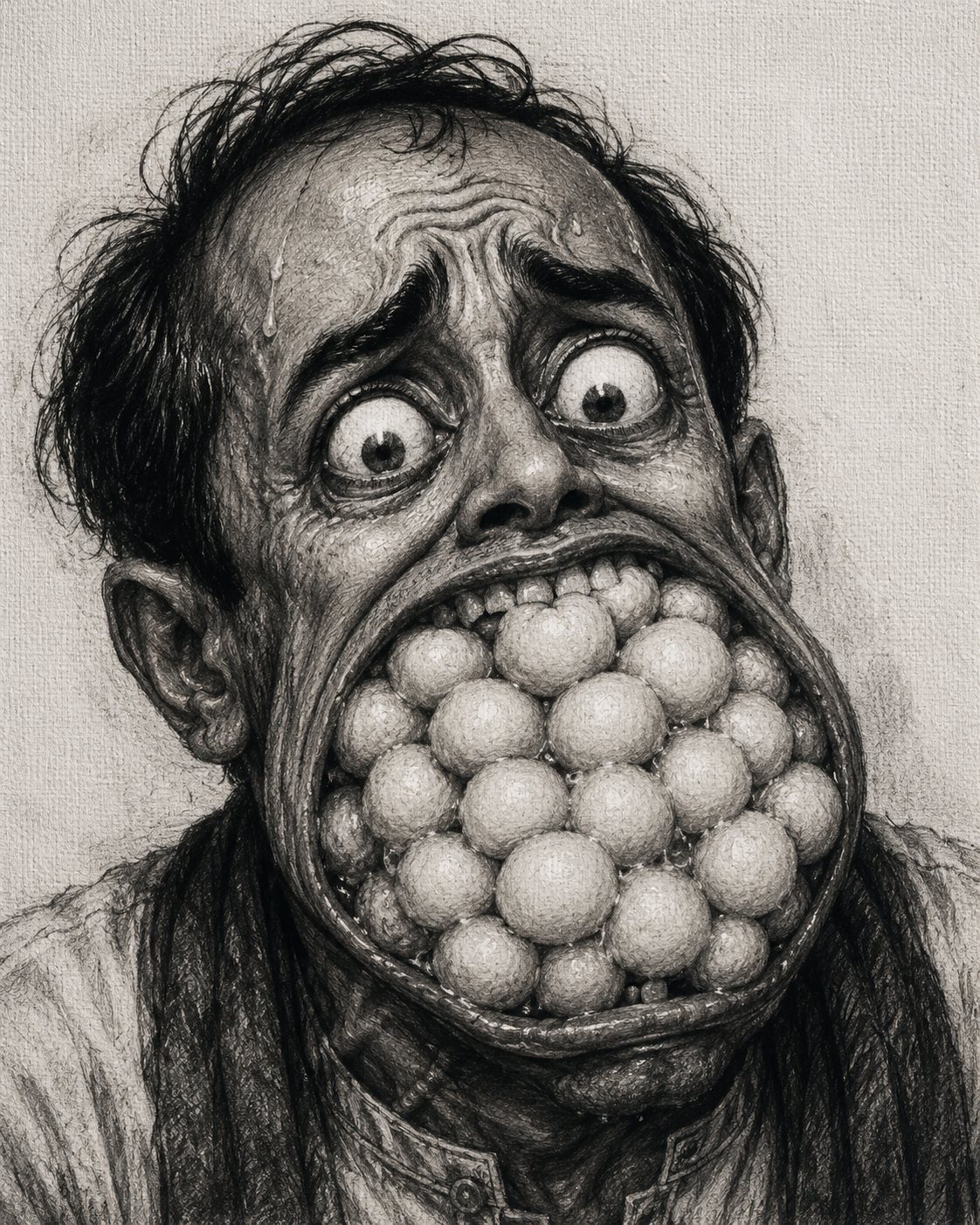
He sat up in the dark. The ceiling fan in his Cossipore flat turned too slowly, chopping the humid air into pieces he could almost taste. His throat was a crowded room. He could feel them distinct now: the upper one thin and papery, tasting of chalk dust and the Lord’s Prayer; the middle one thick and muscular, heavy with the iron flavor of his mother’s fish curry; the lower one smooth and new, smelling of steel and state-approved textbooks. They moved independently. When he tried to say “water,” the upper tongue shaped “w-a-t-e-r” while the middle one curled into “jol” and the lower one flattened into “paani.” The sounds collided in his teeth and came out as a wet cough.
He was fifty. He had not expected to gain anything.
He wanted a glass of water. That was all. His blood pressure pills were on the shelf, three tablets in a foil strip that cost him a day’s wages. The July heat had started even at four, pressing against the window like a palm. He needed to swallow them before the sun rose and made his temples throb. But the three tongues filled his mouth so completely that he could not form a seal around the glass. Water spilled down his chin. The middle tongue lapped greedily, rough as a cat’s. The upper one recoiled, curling like a burnt leaf. The lower one did nothing, waiting, patient as a clerk.
He looked in the mirror. The tube light flickered. Three tongues lay in the pink basin of his throat, stacked like steps, red and alive. The upper one had a white scar across its tip, from a caning in Class Three. The middle one had the small notch his mother had always pointed out, saying he was born with a tongue too large for his mouth. The lower one was unmarked, pale, like a grub grown in the dark under a stone.
He needed to call Priya, his daughter. Twenty-five, working her first real job in Bangalore, sharing a flat with three other women to save money. She had dyed a streak of her hair blue last year in a photo she sent, though he had not replied. Twelve years since they had spoken. He had told himself he would call her today, finally, to say he was sorry for the thing he had said at her wedding. He could not remember the exact words, only that they had been in English, proper and cruel, the way the language always sounded when he needed to be a father. He had meant to say “I love you.” The English tongue had translated it into something a headmaster would say.
He dressed in his khaki uniform, the shirt and trousers of a night security guard at the closed jute mill on Barrackpore Road. He had no phone. He would call her from the PCO at the end of the lane. He had saved fifty rupees for this call, skipping the egg on his rice for three weeks.
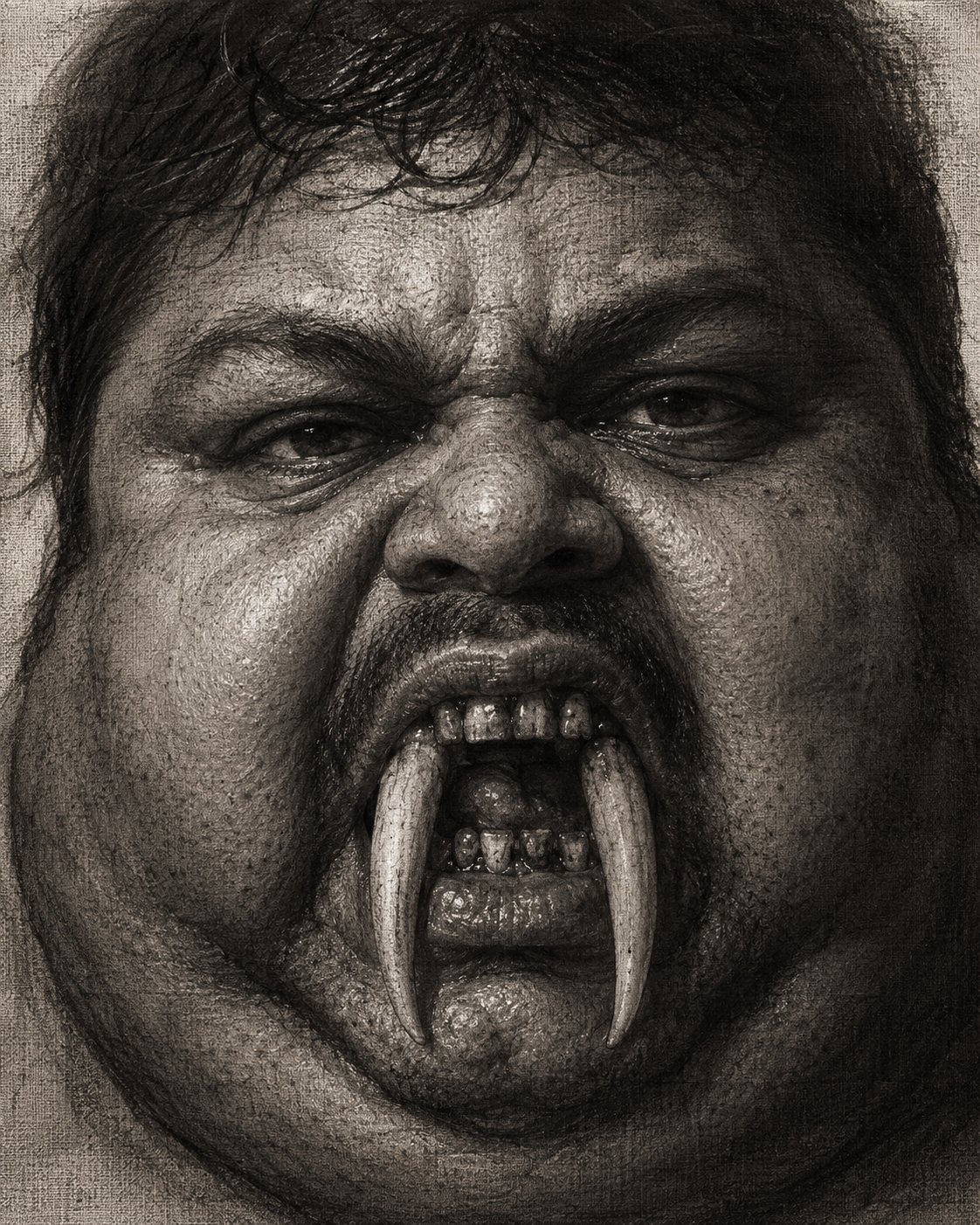
He stepped into the lane. The dairy was opening. Mr. Haldar was arranging milk pouches, and when he turned, Arjun saw his mouth was sewn shut with black thread. The stitches were fresh, wet, oozing a yellow fluid that smelled of antiseptic and old milk. Mr. Haldar was fifty-two. He had been two years ahead of Arjun at W.W.A. Cossipore English School. He raised a hand and pointed to his throat, where three lumps moved under the skin like rats in a sack, pushing against the stitches, wanting out. He tried to speak. The lumps moved in sequence: upper, middle, lower. A muffled triplicate sound came through the thread, like three people arguing in a locked room.
Arjun walked faster. The school was three lanes away, a building he had not entered in thirty-two years, not since the day he had failed his Higher Secondary and his father had beaten him with a belt in the assembly ground. The street was filling with men his age, all walking in the same direction, holding their jaws as if they had been punched. Some had their mouths open, gasping. From the tenements, Arjun heard voices speaking in triplicate—English commands, Bengali pleas, Hindi announcements—overlapping and choking. A man in a lungi sat on the curb, vomiting blood and consonants.
The school gate was chained. Arjun climbed the wall, tearing his shirt on the spikes. He dropped into the assembly ground where he had stood in lines for twelve years, singing “God Save the Queen” in the morning and the national anthem in the afternoon, the two songs fighting like crows. The building was smaller than he remembered, the paint peeling like sunburned skin. The windows were broken. But the headmaster’s office light was on.
The door was open. Mr. P. K. Dutt sat behind the desk, ninety, writing in a ledger. When Arjun entered, he looked up and smiled. Then he opened his mouth.
There was no tongue. There had never been one. The floor of his mouth was smooth, pink, and dry as a heel. No scar, no stump. Just a blank oval of flesh, as if the tongue had been erased rather than removed. He picked up a slate and wrote in chalk: “You were the cheapest soil.”
Arjun stepped closer. His three tongues were silent for the first time, as if afraid. The headmaster wrote again: “The languages had to grow somewhere. We planted them in children who had no one to complain to. English for the empire. Bengali for the conscience. Hindi for the nation. Three crops. One field. The lease expires at fifty.”
Arjun wanted to vomit, but his three tongues held the bile down. He remembered now. The medical examination on his first day. The doctor with the smelling salts and the long scissors. The chloroform smell that had made him sleep through the afternoon. His mother had signed a form because the fees were waived for families who “participated in the linguistic enrichment program.” She had been illiterate. She had made her mark with a thumbprint in red ink that had looked like a wound. She had been proud. The English school would save him from the jute mill. She had not known they were planting mills inside him.
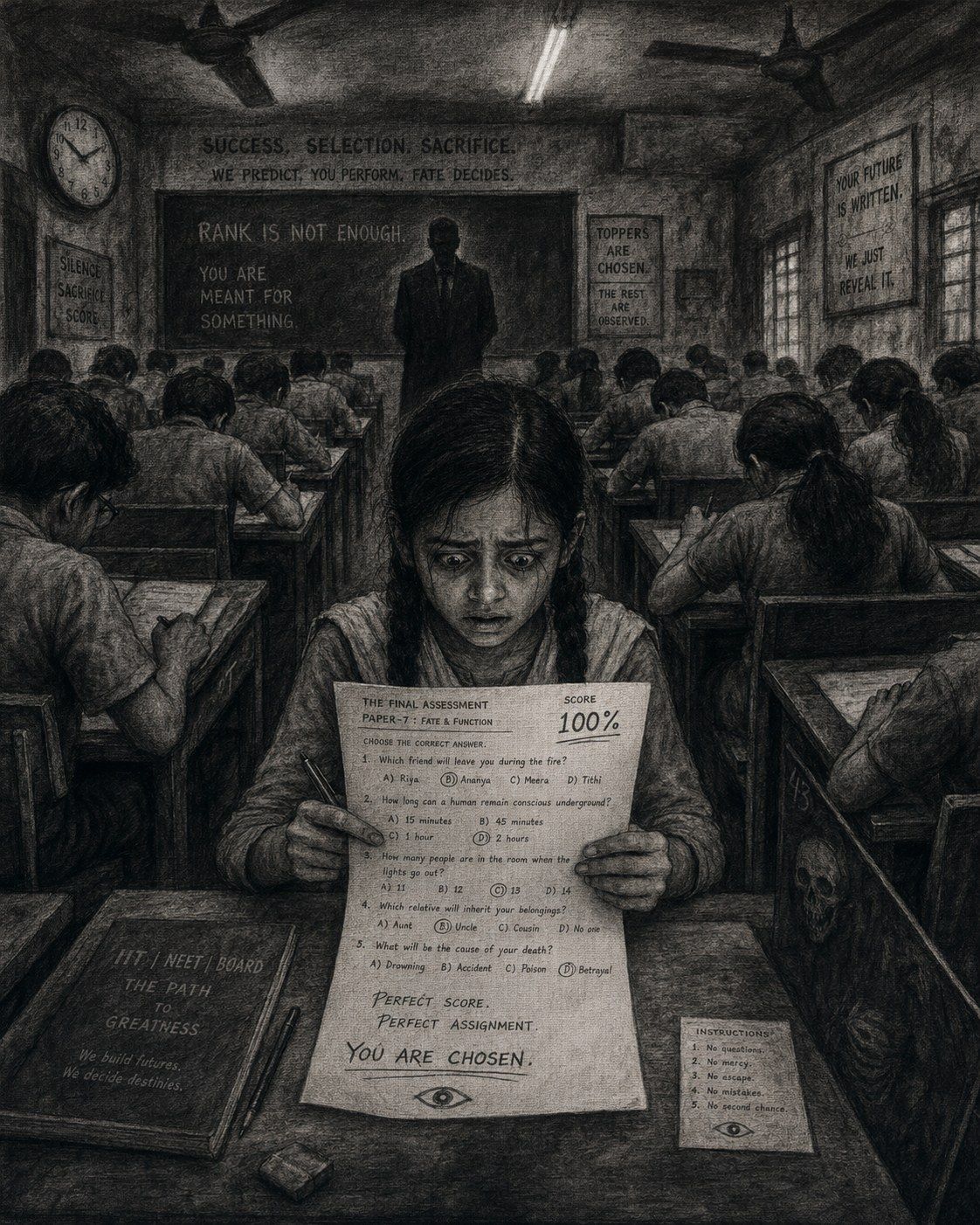
He ran from the office. In the corridor, he passed the classroom where he had been caned for speaking Bengali in English class. The room was full of jars. Hundreds of them, on every desk, stacked in the corners like bricks. Each jar contained a tongue, preserved in yellow fluid, labeled with a name and a year. The tongues in the jars were still moving. They were whispering against the glass, three at a time, reciting lessons, apologizing to fathers, declaring love to women who were now dead. He saw a jar with his own name, “Arjun Bose, 1978,” and inside it was a tongue he did not recognize, dark and thick, with a root that looked like a tail. It was his original tongue. It had been here all along, waiting.
His throat was closing. The upper tongue had wrapped around his windpipe, reciting multiplication tables in a child’s voice. The middle tongue was swelling, filling his mouth with the taste of river water and mourning. The lower tongue was pressing them both down, heavy and official, speaking the names of government schemes he had never qualified for.
He needed to get home. He needed to call Priya. She had gone to the school too, for five years, before her mother pulled her out and took her to Bangalore. She was twenty-five. She had twenty-five years before the lease came due. But the smooth tongue was already growing in her mouth, he was sure of it, preparing to evict the three that had been planted there. Maybe she was sleeping peacefully in Bangalore, unaware that three languages she had never wanted to learn were waiting to turn on her.
In the lane, the men were dying. They lay on the pavement, mouths open, three tongues protruding and stacked like wet steps, glistening and pressing against one another until no air could pass. The air smelled of iron and chalk. A woman Arjun recognized from Class Seven sat against a wall, holding her three tongues in her hands, having pulled them out by the roots. Blood ran down her chin. She was still breathing, but her eyes were empty. The tongues in her hands continued to speak, three different prayers, growing softer until they were only the sound of wet leather rubbing together.
Arjun reached his flat. He found his phone. His hands shook as he dialed Priya’s number from the scrap in his wallet. The line rang three times. She answered. Her voice was clear. “Hello?”
He tried to say her name. The upper tongue shaped “Priya” like a headmaster calling roll. The middle tongue shaped “Priya” like a mother calling a child to dinner. The lower tongue shaped “Priya” like a bureaucrat reading a casualty list. The three names collided and became a scream that sounded like an animal caught in a fan.
“Dad?” she said. “Is that you?”
He tried to say “I’m sorry.” The upper tongue said “I apologize for any inconvenience caused.” The middle one said “Khama koro, ami bhul chilam.” The lower one said “Maaf kijiye, meri galti thi.” The three apologies overlapped into a sound that was not human, a wet, grinding chord of regret that filled the ear like wax.
“Dad, I can’t understand you,” she said. “Dad, are you sick? Should I come?”
He wanted to say “I love you.” The tongues said “I am fond of you,” “Bhalobashi tokey,” “Main tumse pyar karta hoon.” The line went dead. The phone made a sound like a door closing.
Arjun dropped the phone. He was on his knees. The three tongues were fighting in his throat, not to kill him, but to be the one to deliver his last words. He understood now. They were not monsters. They were employees. They had worked for fifty years, translating his thoughts into languages that were never his own, filtering his love through grammars that had been beaten into him with a cane. They had worked overtime without pay. Now they were fighting for severance. They wanted to be the one he chose, the one that would define him in his daughter’s memory.
He looked in the mirror. The original tongue was growing. He could see it pushing up from the floor of his mouth, thick and dark, the color of old blood and river silt. It was his mother’s tongue, his father’s tongue, the tongue of his grandfather who had drowned in the Partition trying to carry a sewing machine across the border. It was the tongue they had cut out to make room for the three smaller, more useful ones. It was trying to come home. It was too large. It had always been too large.
The three implanted tongues saw it and panicked. They pressed down on it, smothering, pinning it flat. The upper one recited the school motto: “Duty, Discipline, Dedication.” The middle one sang a lullaby his mother had sung when she was still alive. The lower one read the preamble to the Constitution. The original tongue said nothing. It only grew, pushing upward, filling the space that had been kept empty for fifty years.
Arjun choked and fell. The ceiling fan continued its slow chopping. On the floor, his phone lit up. Priya was calling back. The screen glowed in the dark, showing her name in three languages, three alphabets, three different colors. The phone vibrated against the floorboards, buzzing like a trapped insect.
He did not answer. He opened his mouth and reached in with his fingers, grabbing the upper tongue by the scar. He pulled. It came loose with a sound like a wet boot leaving mud. He threw it across the room. It lay on the linoleum, still reciting the Lord’s Prayer, growing smaller until it was a white thread, then a grain of rice, then nothing.
He grabbed the lower tongue. It fought him, quoting labor laws, citing rights. He pulled it out. It dissolved in his hand into ash that smelled of steel and state-approved textbooks. The ash fell through his fingers onto the floor, leaving a gray stain in the shape of a map he did not recognize.
The middle tongue was softer. It looked at him with love. It had always been the one that tasted of his mother’s curry, the one that had whispered secrets in the dark when he was a child. He hesitated. It said “Baba.” Just that. “Baba.” The word was whole. It was not translated.
He pulled it out. It came willingly. It lay in his palm, warm and beating, then turned into water, into the water of the Hooghly, into the water his mother had carried on her head from the pump in the refugee colony. It ran through his fingers and onto the floor, mixing with the ash.
The original tongue filled his mouth. It was huge. It was ancient. It was the tongue of a country that no longer existed, of a village that was now a city, of a man who had never been allowed to be one thing. He took a breath. The air tasted of fish and iron and rain. The tongue settled in his throat like a stone, like a word that had been waiting to be born.
He would not speak again. He knew that. It was too large for his mouth, just as his mother had said. They had cut it because it would not fit the world they were building. Now it was back, and he would carry it in silence, the way a river carries silt, the way a grave carries a name, the way a father carries a love that has no translation.
He picked up the phone. He typed a message to Priya with one finger, slowly, in English because it was the only alphabet the phone understood. He wrote: “Do not send my grandson to that school.”
He sat on the bed and waited for the heat to break. Outside, the three-tongued men were quieting, one by one, as the original tongues grew back in their mouths, too large, too late, too true. The lane was filling with a silence that had no translation, a silence that was not the absence of sound but the presence of one thing finally speaking clearly.
In the morning, they would find him with his mouth open, not in a scream, but in a shape that was almost a smile, almost a word, almost the beginning of a story that could only be told in one language, and only to the dead.
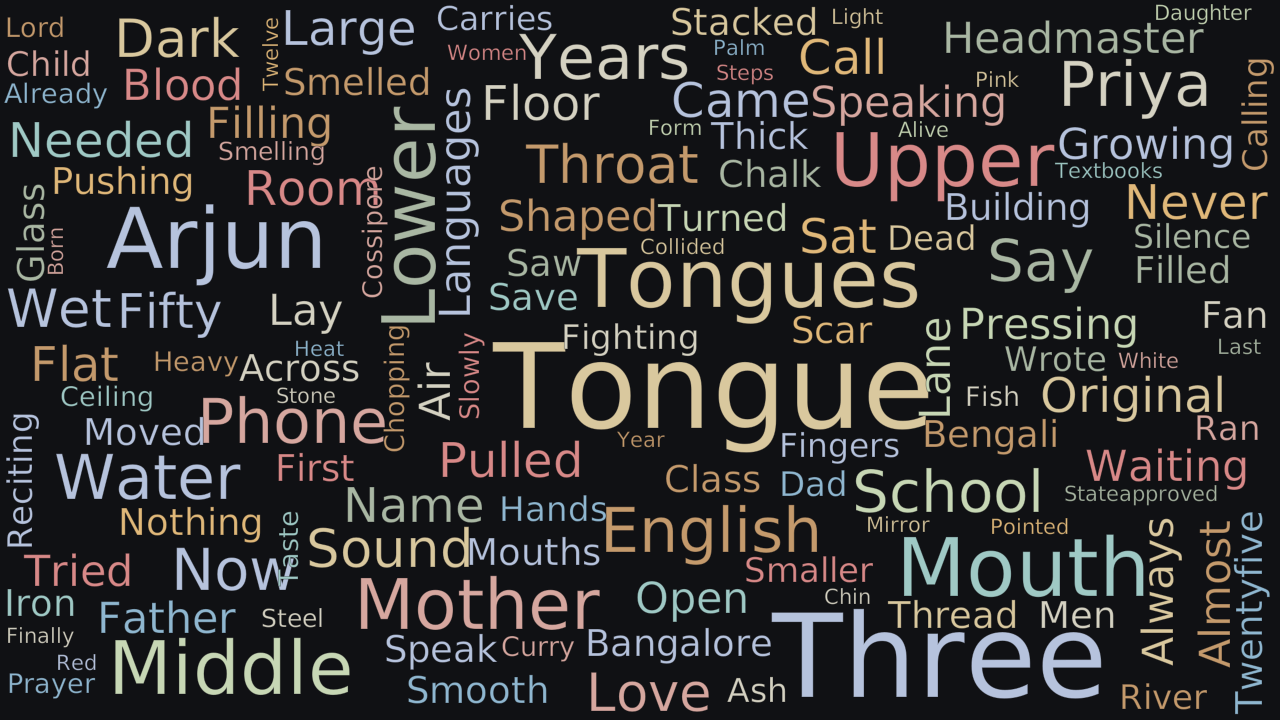
Word Cloud
Related reading
Selected by shared topics and section, with closer publication dates breaking ties.