Receipt
Uses the speech voice supplied by your browser or device.

THIS IS A WORK OF FICTION
The crab fossil had her father’s stroke scar, the flat dent in the left temple where the bone had never grown back right, and Darlene felt her bladder let go a little because her father had been cremated in 2019 and this thing had been buried for seventy million years.
She was alone in the prep trailer. The AC had died at noon and the air smelled like hot vinyl and bone dust. Outside, the Badlands baked. She had been holding her tampon for an hour because the porta-potty was up the ridge and she wanted to finish this matrix before the consolidant set.
She had been working the crab free from its concretion since six that morning. The air scribe whined in her hand, its needle-thin bit vibrating against the limestone, and the matrix fell away in dirty sugar curls. She expected a standard callianassid, maybe a new species. The Hell Creek Formation was lousy with them. But when the carapace emerged, it wasn’t segmented like a normal crab. It was smooth. Rounded. Wrong.
She set the scribe down. She blew the dust away.
The left temple was depressed in a way she knew by heart. She had touched her father’s temple in the hospital, after the ventilator was gone, feeling the wrongness of the bone. This was the same wrongness. The same circumference. The same hairline crack radiating toward the eye socket.
She should call Dr. Henley. She should photograph it.
Instead, she locked the trailer door.
Darlene took out her phone. She scrolled to the last photo she had of her father, the one from his seventy-third birthday, three months before the stroke. She held the phone next to the crab. The cheekbones matched. The mandible was crustacean, jointed and alien, but the overall architecture was his. She measured with her calipers. The distance between the eye sockets was 62 millimeters. Her father’s had been 62 millimeters. She had measured his skull for the cremation permit because she didn’t trust the funeral home not to swap him for a bag of sand.
Her hands shook. The crab was warm. Not sun-warm. Body-warm.
She wrapped it in her flannel shirt and put it in her locker. She was reaching for her keys when the trailer door rattled. Henley.
“Darlene? You in there?”
She froze. She looked at the prep table. The crab was gone from the pad. Good. But her locker was open. She shut it quietly.
“Yeah,” she said. “Just finishing up.”
Henley came in. He was sixty, sunburned, with a nose like a pickled tomato. He looked at the empty foam pad. Then at her. He sniffed.
“You found one,” he said. Not a question.
“One what?”
“The faced ones.” He wiped his forehead. “Don’t bullshit me, Darlene. I’ve been doing this since before you were born. I know what they look like. I know what they do.”
She didn’t say anything. Her heart was a fist in her throat.
Henley sat on the stool. He looked old. “I found my wife in one, back in ‘08. Breast cancer. She died in ‘06. I found her face in a crab from the Judith River Formation. I took it home. I kept it in a shoebox under the bed. For three months, I slept better than I had in years. Then I woke up one morning and my chest was hard. I couldn’t breathe right. I threw the crab in the quarry. I buried it in matrix. It took me two years to feel human again.” He looked at her. “You need to put it back, Darlene. Whatever they are, they eat you from the inside. They trade your life for a memory. The old-timers call it the Receipt Bed. We found twelve last season. The university took them. CT scans showed human brain morphology inside the carapaces. Not similar. Identical. They aren’t fossils. They’re documentation.”
She nodded. She pretended to agree.
When he left, she took the crab from her locker. She put it in her backpack. She took the company truck. She didn’t leave a note.
The truck’s AC was broken. She drove east with the windows down, the hot air battering her face. The backpack sat on the passenger seat. She could hear them clicking. Not constant. Every few minutes. Like a turn signal that wouldn’t quite keep time.
She stopped for gas in Rapid City. She bought a sandwich she didn’t eat. She pissed in the bathroom and washed her hands until they were raw. In the mirror, she looked for the dent in her own temple. She didn’t have one. She was alive. She was fine.
Back in the truck, she touched the crab through the canvas. She felt a memory that wasn’t hers. The smell of Old Spice and oxygen tubing. The weight of a hand on her forehead. Then a choice. A door opening. A cold room. A voice saying, “For her.” Her father’s voice. She pulled her hand back. The memory stayed, humming in her teeth like a struck tuning fork.
She drove through the night. She stopped at a diner in Mitchell. She ordered coffee she didn’t drink. The waitress had a name tag that said Jessie. Darlene flinched. The TV above the counter showed a news report from Minneapolis. A bus accident. A nurse killed. The photo looked like her daughter. Then the report corrected itself. The nurse survived. A bystander pushed her out of the way. The bystander was unidentified. Darlene looked at her hands. They were still clean. She hadn’t done it yet. The crabs were showing her a future she was about to build.
She stopped at a rest area outside Sioux Falls. She slept in the cab with the seat reclined. She dreamed of her father. He was standing in the hospital corridor, holding a clipboard. He said, “Sign here.” She signed. She woke up with the taste of copper in her mouth.
The crabs had moved. They were no longer side by side in the backpack. The father-crab was on top of the Jessie-crab, its mandibles curled around the smaller shell like a parent protecting a child. Darlene stared at them for a long time. Then she zipped the bag and kept driving.
At dawn, she reached Minneapolis. She went to Jessie’s apartment. No one answered. She went to the hospital. The charge nurse said Jessie was off-shift, had left at six. She was fine. She was alive.
Darlene found Jessie on the third floor, changing an IV bag. She was gentle. She talked to the patient, a woman with no hair, and she smiled in a way Darlene had never seen. This was not the sullen teenager Darlene knew. This was a competent woman who had learned kindness without her mother’s help. Darlene felt a grief worse than the crab’s warmth. She had missed everything.
She sat in the truck in the hospital parking lot. She took out the Jessie-crab. The face had changed. The overbite was gone. The cheekbones were sharper. There were lines around the mouth that Jessie didn’t have yet. The crab was aging. It was showing her Jessie’s future face. Or it was absorbing Darlene’s memories of Jessie and updating itself.
She put it to her ear. She listened.
She heard a bus horn. She heard brakes. She heard Jessie say “Oh” in a small voice, the way she had when she was five and dropped her ice cream.
Darlene drove to the bus station. She didn’t know why. She parked. She waited. At 8:47, Jessie crossed the street in front of the terminal, headphones in, coffee in hand, not looking. A bus was turning the corner. The driver was looking at his phone.
Darlene ran. She hit Jessie hard, shoulder to ribs, and they went down on the asphalt. The bus missed them by the width of a hand. The coffee splattered. Jessie’s headphones skittered away.
“What the fuck, Mom?”
Jessie was shaking. She was alive. Her face was flushed. Her overbite showed when she panted. Darlene held her too tight. She smelled Jessie’s shampoo. She felt the heat of her.
Then she remembered the crabs.
She looked back at the truck. The backpack was on the seat. The zipper was open. The crabs were gone.
Darlene felt her stomach drop. She searched the cab. She searched under the seats. She got out and looked at the pavement. Nothing.
Jessie was staring at her. “Mom, you’re bleeding.”
Darlene looked down. Her left temple was bleeding. She touched it. There was a dent. She hadn’t had a dent before. She was sure. She had checked in the Rapid City mirror. But now there was a flat place, a soft place, and blood coming from it in a slow, steady trickle.
She looked at Jessie. Jessie’s face was perfect. The overbite was gone. The cheekbones were sharp. She looked exactly like the crab.
“Jessie,” Darlene said. “Your teeth.”
Jessie ran her tongue over her front teeth. “I got veneers last year. I told you. Remember?”
Darlene didn’t remember. She was sure Jessie had told her. She was sure she had forgotten. She was sure of so many things that now felt assembled from wrong materials.
They went to Jessie’s apartment. Darlene sat on the couch. Jessie made her tomato soup from a can. She brought her a Band-Aid and a beer. The beer was warm. Darlene drank it anyway. She kept touching her temple. The dent was getting deeper. She could fit the pad of her finger into it.
“Why are you here, Mom?” Jessie asked. She stood in the kitchen doorway, arms crossed. “You only show up when someone dies.”
Darlene looked at her. It was true. She had driven to Tucson when her mother died. She had flown to Portland when her uncle died. She had never come for a birthday. Never for Christmas. She was the family’s death notifier. She was the one who signed the forms.
“I thought you were dead,” Darlene said.
Jessie laughed, but it wasn’t happy. “Well, I’m not. So you can go.”
“I can’t.”
“Why not?”
Darlene didn’t have an answer. She didn’t know how to say: because I found a crab with your face, and a crab with Dad’s face, and they are trading places inside my head, and I am becoming the space between them.
Jessie showed her photos on her phone. A trip to Mexico. A girlfriend. A cat. Darlene didn’t know about the cat. She didn’t know Jessie liked cats.
“What’s his name?” Darlene asked.
“Crab,” Jessie said. She laughed. “Weird, right? I found him in a parking lot. He scuttles sideways.”
Darlene froze. Then she cried. She didn’t know why. It felt like the world had clicked into place, or out of it.
Jessie went to work. Darlene fell asleep on the couch. She dreamed of the Badlands, but they were underwater. She was walking through silt, and the crabs were everywhere, each one wearing a face she knew. Her mother. Her ex-husband. Her third-grade teacher. They were all looking at her with the same expression. Not angry. Not sad. Expectant. Like she owed them something.
She woke up at dusk. Jessie was at work. There was a note on the counter. Back at 7. Don’t leave.
Darlene went to the bathroom. She looked in the mirror. The dent in her temple was exactly her father’s dent now. The same circumference. The same crack. She was becoming the receipt.
She understood then. The crabs weren’t fossils. They were records. They were the documentation of a transaction. Someone died so someone else could live. Her father had died so she could live. He had made the trade. The crab was his death, filed away in the Cretaceous so she wouldn’t have to face it. So she could keep breathing, keep working, keep failing to call Jessie on her birthday.
And now Jessie had almost died. The bus. The phone. The driver not looking. Jessie should have died. But the crabs had come to Darlene first. They had shown her the trade. They had given her the chance to pay.
She went back to the truck. The crabs were on the hood. Waiting. The father-crab was larger now. The Jessie-crab was smaller. They had switched sizes. Or they had switched faces. The large one looked like Jessie. The small one looked like her father. Or maybe they both looked like Darlene now. She couldn’t tell anymore. Her eyes were watering.
She picked them up. They were heavy. They were the weight of two lives.
She drove west. She didn’t stop. She passed through Rapid City again, then the Badlands. The quarry was dark. The company had padlocked the gate, but she knew the gap in the fence where the coyotes came through. She carried the crabs down into the pit. The moon was high. The matrix gleamed white in the darkness.
She lay down in the stratum where she had found the first one. She placed the crabs on her chest. They were warm. They were body-warm.
The earth took her slowly. She didn’t struggle. She felt the silt in her nostrils, her ears, her mouth. It tasted like bone dust and time. Her skin split along her ribs. Her blood turned blue. Her jaw unhinged. Her eyes migrated to the sides of her head, and she could see the coyotes watching from the fence, and she could see the stars, and she could see backward into the dark. The crabs clicked instructions. She tucked her legs. She hardened. Her skull flattened into a carapace. Her face became a mask that someone else would recognize in seventy million years.
The last thing she thought was: Jessie would live. Jessie would live, and she would forget her mother’s face, and she would have children, and those children would grow up, and one of them would find a crab in a white layer of stone, and the crab would have Darlene’s dent, and the child would touch it, and feel a memory of a bus horn and a warm beer and a love so sharp it had to be buried to survive.
The earth closed over her. The crabs clicked once, twice, in time with her slowing heart. Then they were still.
Seventy million years later, a preparator named Lou brushed the matrix from a small crab carapace and frowned. The cheekbones were wrong. The left temple had a dent. It looked almost like her mother’s face, but her mother was alive in Minneapolis, and this thing had been dead forever.
Lou should call Dr. Henley. She should photograph it.
Instead, she locked the trailer door.
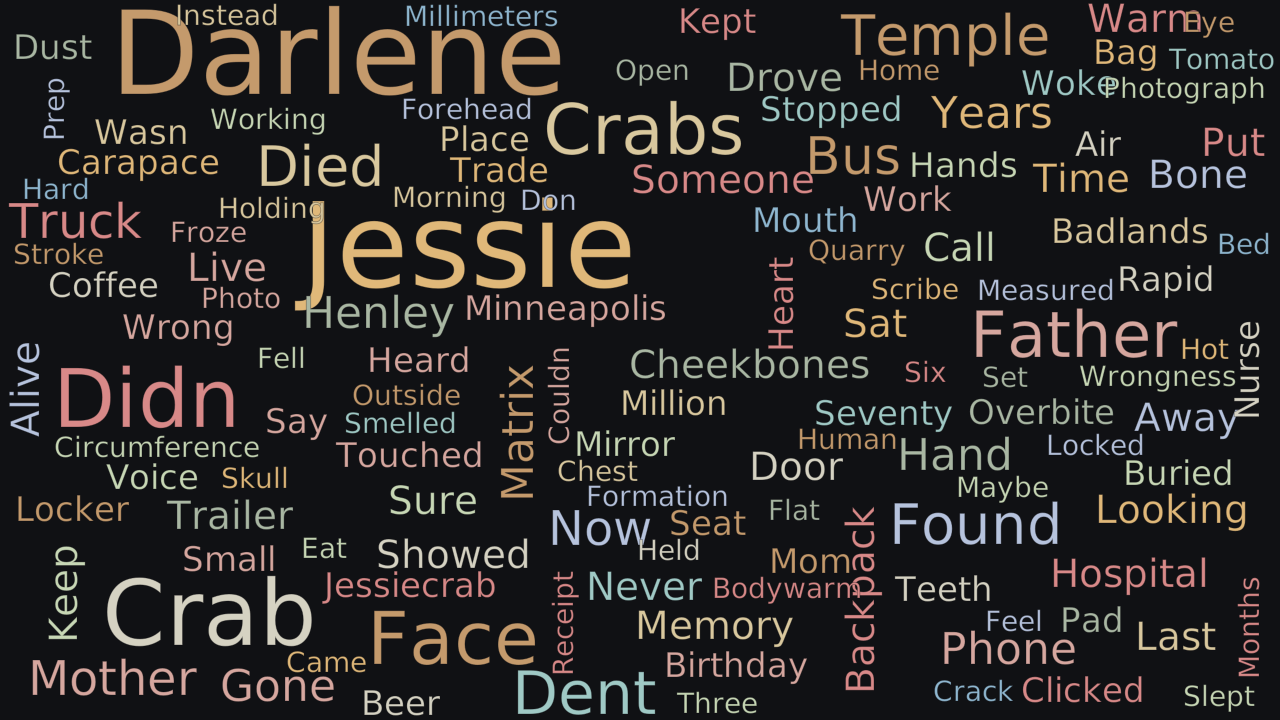
Word Cloud
Related reading
Selected by shared topics and section, with closer publication dates breaking ties.