Storage
Uses the speech voice supplied by your browser or device.

THIS IS A WORK OF FICTION
My left breast had spilled across the threshold and pinned the door open, and the neighbor’s radio was getting in, but I could not lift myself to close it.
I lay on a reinforced platform that used to be our bed. The wood had groaned for weeks, then stopped. Now it held me like a shelf holds a jar. I was one thousand and forty kilograms. I knew because the scale beneath the platform still beeped every morning at six, though no one came to read the numbers.
The room smelled of caramel and rot. Not human rot. Something greener, like a compost heap left in the sun. My skin was damp where it folded. I could feel the sweat collecting in the creases, slow and warm as honey. I had not seen my feet in four months. I had not seen my husband in three.
My hair had matted to my cheek. I could not lift my arm to free it. The arm itself had become something else, a log of meat and heat, crossed with stretch marks that had faded from angry red to silver. I had not felt my legs since the monsoon began. They existed somewhere below the equator of my belly, distant and theoretical.
I called out. My voice had changed. It came from deeper in my chest, resonant, as if I were speaking into a clay pot. “Pradeep.”
His voice came back from the next room. Not weak. Strong. “The harvesters are coming today. Don’t waste your strength.”
I had thought I was alone. I had thought he had left me, or died, or gone to Calcutta to find a doctor who could cut me out of this house. But he was in the kitchen, which was only ten feet away. Ten feet might as well have been ten miles. I could hear him shifting. His bed—our other bed, dragged in there—creaked under a weight that made mine sound modest.
I called his name again. He did not answer. I could hear him eating. The sound was not the sound of a man eating rice or fish. It was a wet, fibrous tearing. He was eating the cane raw, as we all did now, the juice running, the pulp collecting in the corners of our mouths. We did not spit. We swallowed the pulp. It was rough and it kept us full.
The harvesters arrived at noon. I heard their boots on the path. Thin boots. Light steps. They were not from the village. They wore white coveralls that zipped to their chins, and they brought rubber hoses and steel drums on wheels. I counted four of them by the sound. They did not knock. They knew the doors were open.
One of them stood in my doorway. He was young. His face was a face I might have found handsome once, when faces meant something other than the expression they wore when they looked at me. He did not look disgusted. He looked efficient. He checked a tablet. “Unit Seven,” he said. “Yield estimate four hundred kilos. Lipid extraction only. Structural preservation required.”
I tried to speak. “Please.” It was the only word I had left.
He did not look up. “Hold still.”
They rolled the hoses in. The tips were not needles. They were too wide for needles. They were spigots. They attached them to ports I had not known were in my skin. I felt the tug as they locked in—behind my left ear, under the shelf of my belly, at the base of my spine. Then the suction began.
It did not hurt. That was the horror. It felt like relief. Like a toothache finally yielding to pressure. I felt my body deflate, slowly, section by section. The caramel smell grew stronger. What came out of me was not blood. It was thick, pale, and sweet. They were pumping me out like a cistern. I watched the steel drum fill.
I remembered the first time I had tasted the cane. It had been Pradeep’s idea. A man from the city had brought seeds from a lab in Calcutta. Fast-growing. Disease-resistant. The sweetness, he said, was like nothing else. We planted it in the low field where nothing else would grow. Within a month it was taller than our house. The stalks were thick as my wrist, the joints swollen with juice. We laughed. We cut a stalk and chewed it. The juice ran down my chin. I licked it. I had never tasted sugar that tasted like memory, like a childhood I had never had, like safety.
The taste was not just sweet. It was round. It filled the mouth and then the chest, then the limbs. I had stood in the field and felt the sun on my shoulders and thought: this is what a plant feels like. I did not want to move. I did not want to eat rice ever again. I wanted only the cane, more of the cane, all of the cane.
Pradeep had weighed himself at the clinic. Then I had. The numbers climbed. The city man returned with a new contract. Premium rates for premium mass. We were not patients. We were early adopters. The village had a name by then. The One Tonne Village. Journalists came with cameras and masks, looking like plague doctors. They took photographs of Pradeep standing beside a scale, smiling, holding a stalk like a trophy. I had smiled too, from my bed, because my bed was outside by then and the sun felt so good, and the cane in my mouth was endless, and the journalists could not see that the smile was not just happiness. It was saturation.
The suction stopped. The drum was full. The young man tapped his tablet. “Three-eighty. Under projection. We’ll adjust your feed.”
They wheeled the drum out. They did not unhook me. They attached new lines. Bags of fluid, not cane juice. Something thicker, opalescent. I felt it enter the ports. Cold, then warm. Then I felt it rooting.
Pradeep called from the kitchen. “How much?”
“Three-eighty,” the young man answered. “She’ll be ready for the next cycle.”
I understood then. The bed was not a bed. The house was not a house. The open door was not a failure of architecture. It was a loading bay. The scale was not a medical device. It was a yield monitor. I was not sick. I was not even obese. Obesity implies excess. I was a crop at mid-season.
The fluid kept coming. I felt it spreading through the empty spaces they had made, colonizing me. It did not hurt. It felt like being filled with sunlight. My mouth flooded with the taste of caramel. My eyes watered with it. I could hear the neighbor’s radio again. It was playing a pop song from Calcutta, something about love. But beneath it, I could hear the sound of the village breathing. All of us, in our beds, in our open rooms, drinking the nutrient bath, growing.
The breathing was not human. It was slower, deeper, synchronized. Inhale for ten seconds, exhale for ten. I could feel my own chest rising and falling to the same rhythm, pulled by a tide I could not see. We were not a village anymore. We were a single lung.
I thought of my mother, who had starved in the famine years. I thought of my daughter, who had left for Bangalore and a job in a call center where she sat in a chair and grew thin with worry. I thought of Pradeep, who had spent his life bent over a hoe, waiting for rain. None of that was necessary now. The cane did not need rain. It needed us. We were the soil. We were the weather. We were the harvest.
The workers moved to the next house. I heard them in the neighbor’s room, the same sounds, the same efficient voices. The radio kept playing. I realized it was not the neighbor’s radio. It was a speaker mounted on the wall of my room, playing constantly to keep us calm. There was no neighbor. The neighbor had been harvested last week, her house already cleaned, her bed waiting for the next seeding.
I tried to lift my arm. It was heavier now. The fluid had taken hold. I could feel the pressure in my skin, the tightness. I was swelling again. The scale beneath me beeped. I was already up to six hundred kilograms. The growth was not natural. Nothing about it was natural. But it was fast. It was so fast.
Pradeep called out again. “Ruma. Are you there?”
“Yes,” I said.
“Close your eyes. The sun is good today.”
I closed my eyes. The sun was good. It came through the open door and the open window and the gaps in the roof that Pradeep had widened in March. I could feel it on my skin, feeding me, feeding what was inside me. I was not a woman anymore. I was a greenhouse. I was a silo. I was the One Tonne Village, and the tonne was not a measure of my shame. It was my yield.
I remembered the journalist. He had come last year, before the first major harvest. He had been thin and anxious, tapping his phone, complaining about the roads. He had eaten a piece of the cane. Just one piece, offered by a child. I had watched him chew. I had seen his eyes widen. He had asked for another. We gave him three. He stayed the night. They found his bed three days later, dragged out beside the well. He had grown too fast for the platform. His skin had split in the sun, revealing not muscle but fiber, pale and stringy. They had to harvest him early. The yield was poor. Sour. The company wrote it off as a loss.
I would not split. I was a good unit. I had learned to rotate, slowly, when the workers reminded me, so the sun hit all sides. I had learned to breathe in a way that did not cramp the growth. I had learned to let the door stay open.
A shadow fell across the threshold. I opened my eyes. A girl stood there. She was young. Thin. The thinness was shocking, obscene, like a skeleton walking. She wore a sari the color of unripe mango and held a small cloth bag. She was looking at me with the expression I had once worn when looking at a god: fear, hunger, awe. She was not a harvester. She was not a nurse. She was a new farmer. She had come to take my place when the cycle ended. She had volunteered.
Then I smelled it. The perfume. Jasmine and synthetic musk. I had sent it to her last year, a birthday gift from the New Market, a small bottle I could barely afford. I had written her name on the card. Priya.
I had sent her money for the train. I had sent her letters telling her not to come. I had told her the village was sick. I had lied. The letters were full of lies. I had told her I was well. I had told her the doctors were helping. I had not told her that I was a crop, that her father was a crop, that the village was a field of human silos. I had wanted her to stay thin and worried in Bangalore. I had wanted her to live.
She stepped inside. She set down her bag. She touched my arm. Her fingers were cool. “They said I would be happy,” she whispered.
I wanted to tell her to run. I wanted to tell her about Bangalore, about chairs, about thinness and worry and the long life of a body that belongs to itself. I wanted to tell her about the journalist, about the splitting, about the sour yield. But my mouth was full. Not with tongue. With pulp. The cane had fruited in my throat, sending up shoots that crowded my teeth. It was sweet. It was so sweet. I could not speak around it. I could only look at her with eyes that were already filming over with sugar.
She began to undress. She folded her sari neatly. She lay on the empty platform they had rolled in beside mine. She found the ports in her own skin—ports she had paid to have installed in the city, ports that connected to nothing yet. She looked at me. “Does it hurt?” she asked.
I shook my head. The pulp in my mouth shifted. A thin line of juice ran from the corner of my lips. I heard the trucks returning. Not the harvesters’ trucks. The distribution trucks. They would take my drum to the processing plant. They would take me, eventually, when I was ready. The door was open. The sun was good. The radio played.
I looked at Priya. She was already sweating in the sun, already smiling at the first taste of the nutrient mist they were pumping into her room. The mist smelled of the cane, of Calcutta in the spring, of everything good. I remembered wanting to close the door. I remembered shame. I remembered the weight of my breast on the threshold as a prison, as a failure, as the final indignity of a body that had betrayed me. Now I understood. The door was open because I was not a prisoner. I was a door. I was the way through. The village did not trap people. It grew them. It grew them and it shipped them and it planted them again, and the planting was not violence. It was invitation.
Priya closed her eyes. Her lips moved in a prayer, or a song. I could not tell. I could only taste the sweetness rising in my throat, filling the spaces where I had once kept words. The scale beeped. Nine hundred kilograms. I was almost ready. I was almost new. I was almost gone.
Outside, the trucks idled. The harvesters talked in their efficient voices. The sun moved across the floor, warming my skin, feeding the thing inside me. My left breast still lay across the threshold, but it was not flesh anymore. It was sucrose and fiber and the memory of a woman who had once wanted privacy, who had once pulled her sari across her face when men passed, who had once been modest and small and afraid. I did not want privacy. I wanted the sun. I wanted the cane. I wanted the open door. I wanted my daughter beside me, growing, sweet, and the harvest was coming. The harvest was always coming. And when it came, we would be sweet. We would be so sweet.
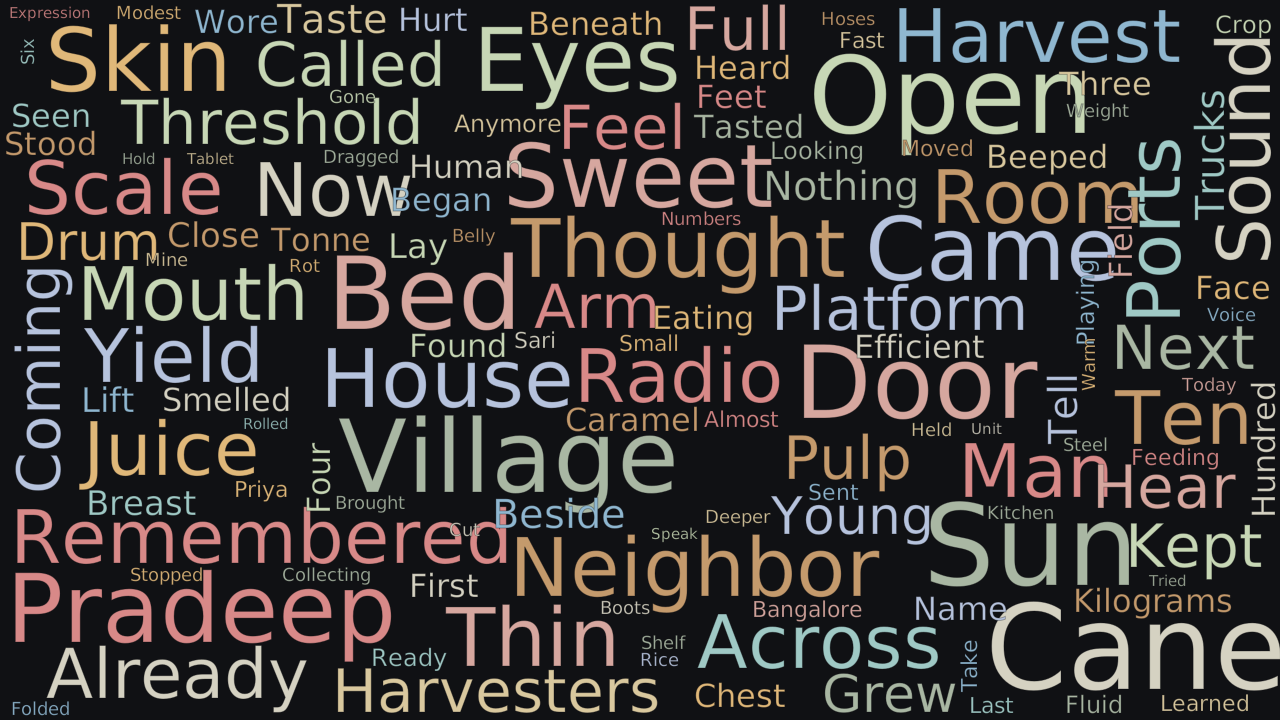
Word Cloud
Related reading
Selected by shared topics and section, with closer publication dates breaking ties.