The One-Eyed Cyclops of Sinthee
Uses the speech voice supplied by your browser or device.

THIS IS A WORK OF FICTION
The green door of the old house on Banamali Naskar Road had been locked since before Poltu was born, but on Tuesday morning it stood open, and a glass bottle sat on the step, half-full of liquid the colour of a cat’s eye. The June heat was already rising from the pavement, and the air smelled of dust and jasmine and the faint, sharp scent of the tram wires that ran along the main road. Poltu was eleven, and he knew every wall, every dog, and every loose brick in Sinthee. He knew which shopkeeper gave extra chanachur, which cat would let you stroke its belly, and which wall had a loose brick for hiding marbles. But he did not know this house, and he did not know the bottle.
Jhuma appeared around the corner, her plaits flying behind her like two black kites. She was ten, and she never walked when she could run. She stopped when she saw the door. “My brother says that house is full of ghosts,” she said, catching her breath. “My brother says the tram is haunted when he’s late for college,” Poltu replied. “Don’t be daft. Someone’s moved in.”
“Then where’s the furniture van? Where’s the rickshaw? Where’s the shouting and the tea?”
Poltu had no answer. That was the gap. A door open, a bottle warm, and no sign of a mover anywhere. It was wrong. It was unfair. It was exactly the sort of thing that needed looking into.
He picked up the bottle. The glass was smooth, and the liquid inside moved as though it were alive. The label was handwritten in blue ink: “One drop. For clarity.”
“Medicine,” said Jhuma. “Or poison.”
“Or both,” said a voice from the doorway.
They jumped. The man who stepped out was tall, and in the middle of his forehead he had one enormous eye, brown and bright, with a pupil that swivelled like a fish in a bowl. He wore a faded kurta the colour of old mustard, and no shoes, and his feet were dusty on the step. He looked at them with his single eye, and the eye did not blink.
Poltu took a step back. Jhuma took two.
“I see you have found my eye drops,” said the man. His voice was deep and warm, like a well. “I was hoping to find them myself, but I misjudged the distance to the step. One eye is excellent for seeing the truth, but terrible for seeing the bottom of a staircase. I am Bhattacharya. Would you like some tea? I have just made a pot, and Mrs. Banerjee across the road has sent over shondesh. She is under the impression that I am a holy man, and holy men must be fed.”
Poltu looked at Jhuma. Jhuma looked at the shondesh. It was white and firm, sitting on a brass plate in the doorway, and it smelled of cardamom and fresh milk and something else, something sweet and cold that made Poltu’s mouth water. He had not eaten since breakfast.
“We shouldn’t,” said Poltu.
“We absolutely should,” said Jhuma, and she stepped inside.
The house was cool and smelled of old paper and camphor and the ghost of a thousand monsoons. The floor was red cement, polished to a shine by generations of feet, and the walls were green up to the waist and cream above, the paint bubbling in places where the damp had crept in. A ceiling fan turned slowly, clicking like a beetle in a jar. Mr. Bhattacharya led them to the kitchen, which was small and bright, with a window that looked out onto a guava tree heavy with unripe fruit.
“Sit,” he said. “Eat. Then I will explain, because you are going to ask, and it is better to ask over tea than to run away screaming. Most people run away screaming. Or they call the police. The police do not scream, but they are very suspicious of men with one eye.”
“We don’t scream,” said Jhuma, her mouth already full of shondesh. It was sweet and grainy, and it melted on her tongue like snow.
“Not yet,” said Mr. Bhattacharya.
He poured tea into three clay cups. The tea was strong and sweet, with a smell of cinnamon and ginger, and it was hot enough to sting Poltu’s fingers through the clay. He sipped. It was delicious. He felt his shoulders drop, and the heat of the morning seemed to fade.
“Forty years,” said Mr. Bhattacharya, settling onto a wooden stool, “I was a chemist at the hospital on Sealdah Road. I made drops for the eye doctors. Ointments, salves, tinctures. But I had a problem. I saw two of everything. Two beds. Two patients. Two moons in the sky. It is called double vision, and it is very tiring. You cannot pour tea into two cups when you see four. You cannot cross the road when you see two trams. So I made a new drop. A special drop. I wanted to make my two eyes work as one. And they did. They worked so well that they became one.”
He tapped the centre of his forehead. The single eye blinked, slow and solemn.
“Now I have one eye. And with one eye, I see one world. But I see it properly. I see what is hidden. I see what is true. I see the things that rush past you because you are too busy seeing two of everything. And I must tell you, children, reality is strange. Very, very strange.”
Poltu put down his cup. “What do you mean?”
“Look at that wall,” said Mr. Bhattacharya.
Poltu looked. It was a kitchen wall. Bricks, plaster, a shelf of pickle jars—mango, lime, chilli, each jar heavy and dark with oil. A calendar from 1989 showing a tiger in a forest. A crack in the plaster shaped like a river.
“I see bricks,” said Poltu.
“I see a door,” said Mr. Bhattacharya. “A door that has been painted over for seventy years. Behind it is a room. And in that room is a tin box. And in that tin box is a piece of paper that will save your playground.”
“What playground?” said Jhuma, though she knew. Everyone knew. The scrap of land behind the old house, where the boys played cricket and the girls skipped rope and the old men sat on broken chairs and argued about football. It was dusty and full of stones, but it was theirs.
“The one behind this house,” said Mr. Bhattacharya. “The one where you play cricket and argue over whose turn it is to bat. The one where the developer wants to build flats. He is coming at noon with his measuring tape and his lies. He says the deed was burned in the fire of 1989. But I know it was hidden. And I know it is behind that wall. But I cannot open it. I have no depth. I cannot tell how far to push, or how hard. I need two eyes for that. Or rather, I need two children.”
Poltu felt his heart beat faster. He was the youngest in his family. His father sent him to buy milk and soap and to carry messages to the press. He was never sent to save anything. He was never trusted with secrets. But here was a man with one eye, offering him a wall, a door, and a mission.
“Why us?” said Poltu.
“Because you are small enough to fit behind the shelf. Because you are brave enough to enter a house with no name. And because,” said Mr. Bhattacharya, smiling, his single eye crinkling at the corner, “you picked up the bottle instead of throwing it at a dog. That shows curiosity. Curiosity is the only light that works in the dark.”
Jhuma finished her shondesh. She licked her fingers. “I’m in,” she said. “But if there’s a ghost, I’m leaving. And I’m taking the rest of the shondesh.”
“There is no ghost,” said Mr. Bhattacharya. “Only dust. And perhaps a lizard. Lizards are very good luck. They eat the mosquitoes.”
They moved the pickle jars. There were twelve of them, heavy and cold, smelling of mustard oil and spice and the memory of summer lunches. Poltu lifted them one by one and set them on the table, his arms aching. Jhuma peered at the wall. She ran her fingers over the plaster, her nails leaving pale trails in the dust.
“It’s solid,” she said. “You’re wrong. There’s nothing here.”
“Left a little,” said Mr. Bhattacharya. “Down. There. Do you see the crack?”
Poltu looked. He saw nothing but paint, old and stained with cooking smoke. Then Jhuma said, “Wait. There’s a line. It’s been painted over, but if you look sideways…”
She was right. A thin line, no wider than a hair, ran in a rectangle behind where the shelf had stood. It was the outline of a door, hidden so well that you could stare at it for a year and never see it. But once you saw it, you could not unsee it.
Poltu knocked. The sound was hollow. It was not the sound of a wall. It was the sound of a drum.
“Push,” said Mr. Bhattacharya. “Push where the crack meets the floor. Low. Hard.”
Poltu put his shoulder to the wall. He pushed. For a moment nothing happened. Then, with a groan like an old man turning in his sleep, a section of the wall swung inward. It was a door, thin and light, painted the same colour as the plaster, balanced on hidden hinges. Behind it was darkness, and a smell of old cloth and dry leaves and something else—something like the inside of a bookshop on a rainy day.
Jhuma took out her torch. She always carried a torch, even in the daytime, because you never knew when the electricity would fail, and because she liked to be prepared. She clicked it on. The beam found a small room, no bigger than a cupboard, with a wooden desk and a tin box on top. There was also a broken chair, a pile of newspapers tied with string, and an old cricket bat, cracked down the middle.
Poltu crawled in. The desk was covered in dust thick enough to write your name in. The tin box was blue, with a picture of a ship on the lid, a ship with three masts and sails like clouds. He lifted it. It was heavy. He carried it out and set it on the kitchen table, his arms trembling.
Mr. Bhattacharya wiped the dust from the lid with his kurta. He opened the box. Inside was a folded paper, yellow and brittle, tied with a red ribbon that had faded to pink. He untied the ribbon with fingers that trembled slightly, and he unfolded the paper with the care of a priest handling a prayer book.
“To your eyes,” he said, “this is blank. The ink has faded. The fire of 1989 did not burn it, but the heat stole the words, like a thief. To my eye, however, it is clear. I see slowly. I see one thing at a time, and I see it whole.”
He held the paper up, angling it toward the window. His single eye narrowed, the pupil shrinking to a pinprick. “It is a deed,” he said. “Dated 1947. It says: ‘This land, being the garden and playground behind the house of Sri Nilmadhav Dutta, is hereby given to the children of Sinthee for their use and enjoyment, forever.’ And there is a seal. A tiger’s head. And there are signatures. Faded, but real.”
He turned the paper over. “And on the back, a map. Drawn in lemon juice. Invisible to the ordinary eye. Invisible to anyone who sees too quickly. Hold it to the light.”
Jhuma took the paper. She held it near the window, where the sun fell in a bright square on the floor. Poltu looked over her shoulder. For a moment he saw nothing. Then, faint as a breath on a cold morning, a shape appeared. A tiger’s head, mouth open, teeth bared. And lines—boundaries, streets, the outline of the playground, the old pond that had dried up, the banyan tree that was still there.
“How can you see that?” said Jhuma, her voice hushed.
“Because I see slowly,” said Mr. Bhattacharya. “With two eyes, the world rushes at you. It is a race. You see the surface, and you miss the depth. With one eye, the world comes gently. You have time to notice the hidden things. The things that do not want to be seen.”
They heard a knock at the front door. Three sharp raps.
“That,” said Mr. Bhattacharya, folding the deed quickly and tucking it into his kurta, “will be Mr. Chatterjee. The developer. He is early. He is always early. It is a trick. He thinks he will catch people unprepared. Poltu, put the tin box back. Jhuma, hide the ribbon. I will do the talking. You say nothing unless I ask. And if he offers you chocolate, refuse. It is a bribe.”
Poltu scrambled into the cupboard. He placed the tin box back on the desk. He noticed something else there, half-hidden under the newspapers: an old brass torch, heavy and cold, with a switch that clicked like a gun. He picked it up. It felt important. It felt like something that had been waiting for him. He slipped it into his pocket and crawled out, closing the hidden door behind him. He pushed the shelf back. It clicked into place.
Mr. Chatterjee was standing in the front room. He was a neat man in a safari suit the colour of sand, with a pen in his pocket and a smile that did not reach his eyes. He carried a leather bag and a measuring tape and a clipboard. He looked at the children, and his smile flickered.
“Good morning,” he said. “I am from the Eastern Construction Company. I believe you are the new owner?”
“I am the caretaker,” said Mr. Bhattacharya. “The house is not for sale. The land is not for sale. The playground is not for sale.”
“Everything is for sale,” said Mr. Chatterjee, still smiling. “I am here to measure the land. We are building a modern school. With a computer room. With proper toilets. The old playground is unsafe. There are stones. There are dogs. The children deserve better.”
“We have a school,” said Jhuma, before she could stop herself. “And we like our playground. We know where the stones are. We know which dogs are friendly. We don’t need your computers.”
Mr. Chatterjee looked at her as though she were a chair that had spoken. He turned back to Mr. Bhattacharya. “The deed was lost in the fire of 1989,” he said. “There is no proof the land is reserved. The municipality has given us permission to survey. I have the papers here.”
“Here is the proof,” said Mr. Bhattacharya.
He held out the deed. Mr. Chatterjee took it. He looked at the front. His smile wavered, then returned, tighter. “This is blank,” he said. “A piece of yellow paper. A forgery, perhaps?”
“Turn it over,” said Mr. Bhattacharya. “Hold it to the light. Look for the tiger. Look slowly.”
Mr. Chatterjee turned it over. He held it to the window. He squinted. He moved it closer. He moved it farther. “I see nothing,” he said. “A trick. A child’s trick.”
“Look slowly,” said Mr. Bhattacharya. “Look as though you have only one eye. Look as though you have all the time in the world.”
Mr. Chatterjee looked. Poltu held his breath. The man’s face changed. The smile vanished, replaced by something else—surprise, then annoyance, then a kind of grudging respect. He saw it. The tiger. The faint lines. The map. He could not deny it. It was there, real as the dust on his shoes.
“Well,” said Mr. Chatterjee, folding the deed carefully and handing it back. “That is… inconvenient. But legitimate. I will inform my office. The survey is cancelled. For now. Good day.”
He turned and walked out, his shoes clicking on the red floor. The door clicked shut. The children waited until they heard his car start, a sound like a sick cat.
Then Jhuma shouted. Poltu jumped up and down, his fists in the air. Mr. Bhattacharya sat down heavily in his wooden chair and laughed, a sound like dry leaves rustling in a courtyard.
“You did it,” he said. “You saved your playground. With four eyes and one, we made a very good team. The children of Sinthee will play cricket here for another hundred years. And when I am gone, you will remember that the wall was not a wall. It was a door.”
Poltu remembered the brass torch in his pocket. He pulled it out. It was heavy, and the brass was dented, and the glass at the front was thick and scratched. “I found this in the room,” he said. “I think it was meant for me.”
Mr. Bhattacharya took it. He turned it over. He clicked the switch. Nothing happened. “A lighthouse keeper’s torch,” he said. “From before the zamindar’s time. It needs a battery. But I believe you will find you need it less than you imagine.”
“Why?” said Poltu.
“Because you have learned to see,” said Mr. Bhattacharya. “You looked at a wall and saw a door. You looked at a paper and saw a tiger. You looked at a man with one eye and saw a friend. That is the real light. And it does not need batteries. It only needs patience.”
That evening, the electricity failed across Sinthee, as it always did in summer when everyone turned on their fans at once. The fans stopped. The streetlights went out. The houses were dark, and the sky was thick with stars like spilled sugar.
Poltu sat on his step with Jhuma. He did not light the brass torch. He looked at the street. A hand-pulled rickshaw went by, the runner’s bare feet slapping the dust in a rhythm that matched Poltu’s heart. A dog scratched itself under a lamppost that was not working. A woman shouted from a window for her son to come home, her voice sharp and full of love.
And Poltu saw it. He saw how strange it all was. How the rickshaw was a box on wheels pulled by a man who dreamed of owning a motor one day. How the dog’s tongue was pinker than any rose in the market. How the woman’s shout was made of love disguised as anger. How the darkness was not empty but full of moths and bats and the smell of jasmine and the sound of a flute from three streets away.
“Reality is strange,” said Poltu.
“Very, very strange,” said Jhuma, passing him the last of the chanachur from a paper packet. “And I think I like it.”
And they sat there until the lights came back on, already wondering what else was hidden in plain sight, behind the walls of Sinthee, waiting for two children and a torch to find it.
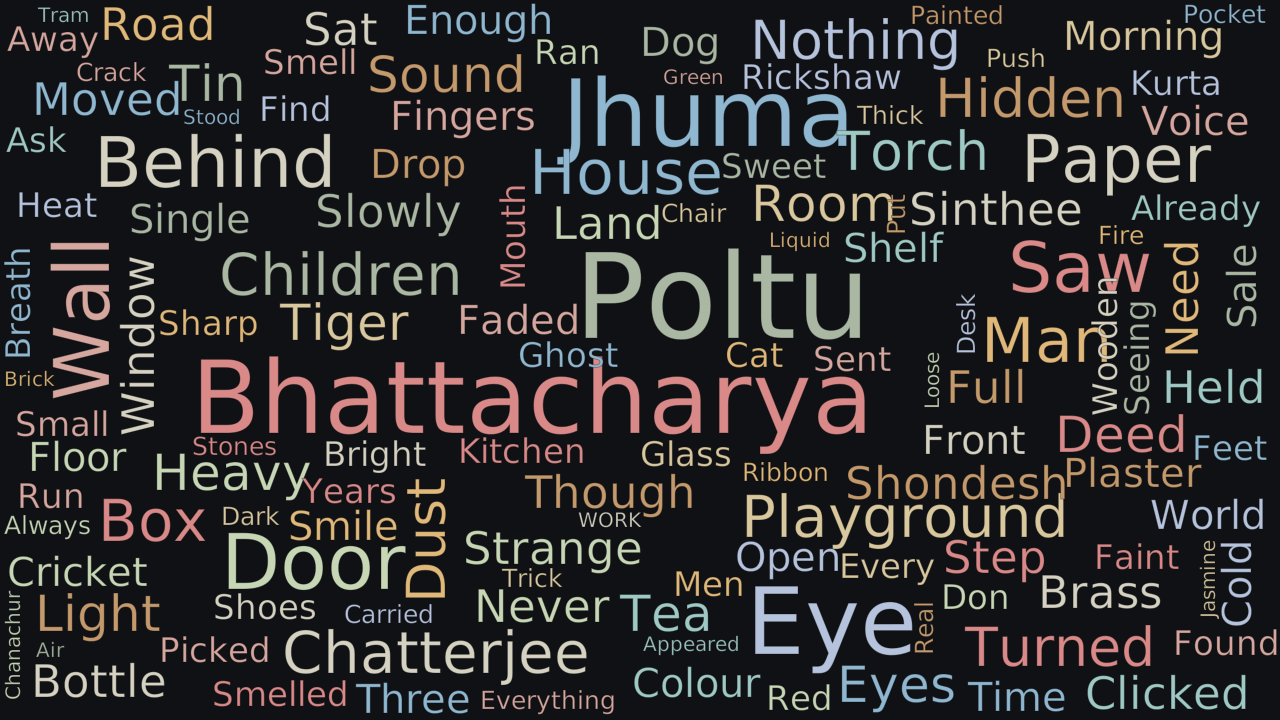
Word Cloud
Related reading
Selected by shared topics and section, with closer publication dates breaking ties.