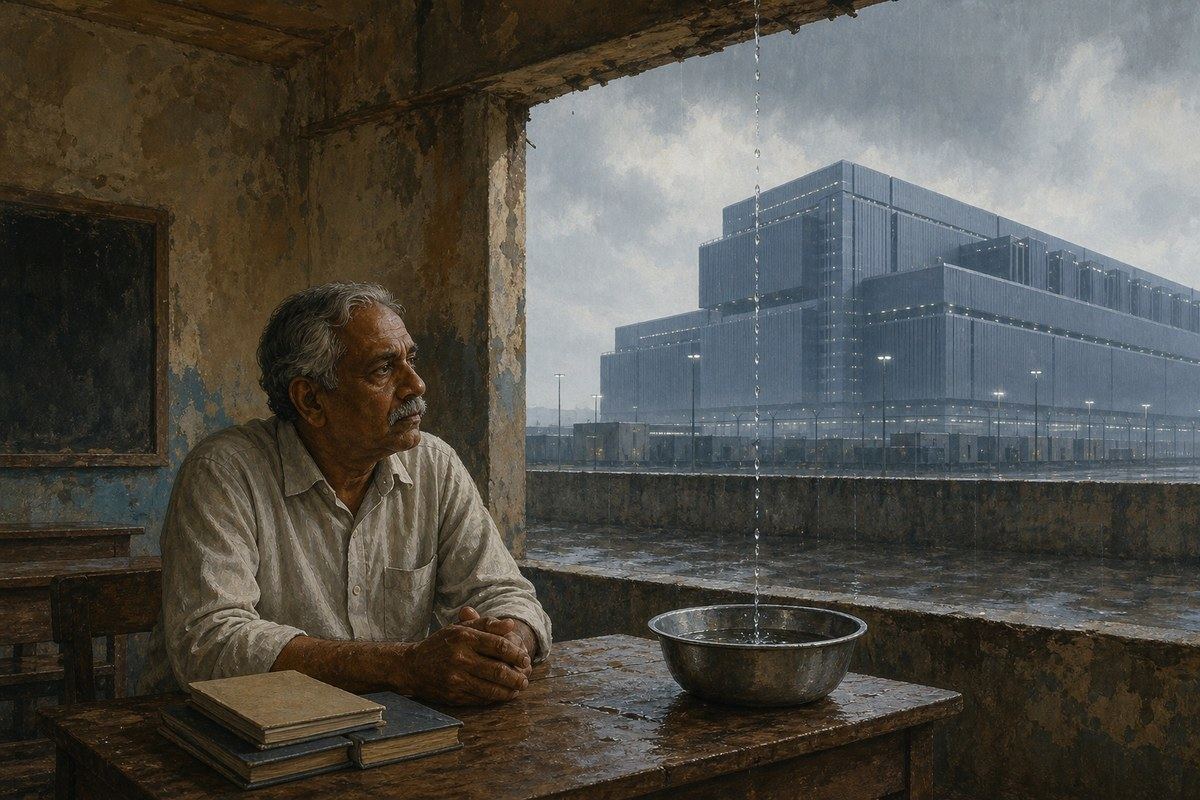
Indigenous Robot Dogs
Uses the speech voice supplied by your browser or device.

The robot dog—if one could grace that Chinese-manufactured Unitree Go2, that glorified toy from Galgotias University’s fraudulent pavilion, with the dignity of canine nomenclature—smelled, when its plastic haunches finally ceased their pitiful whirring beneath the February Delhi sun, precisely like the scrotal sweat of a polyester salesman who had just attempted conjugal gymnastics with a malfunctioning photocopier, which is to say, it smelled exactly like indigenous innovation in the year of our Lord 2026, a year already so marinated in algorithmic excrement that even the flies have developed a taste for press releases, and I mean this with the utmost sincerity of a man who has watched, with his own bloodshot eyes, the IT Minister delete his own tweet of congratulation with the same frantic energy a teenager employs when erasing his browser history before his mother enters the room, except the mother here is the entire Indian populace and the browser history is our collective self-respect.
We are doomed.
And yesterday, July eighth, OpenAI—those San Francisco priests of the artificial cortex—unleashed GPT-Live upon the world, a voice model so naturally obsequious it could read your suicide note back to you with the tonal warmth of a grandmother offering mishti doi, while in Beijing the GLM-5.2 model from Zhipu AI closes its performance gap with the frontier like a slowly suffocating python digesting a goat, and Meta, in a fit of capitalist flatulence that would impress even the most jaded Marwari businessman, has begun selling its excess compute power because apparently the money was never in the model but in the cloud, which is just a fancy word for other people’s computers, a concept some xerox-wallah in Burrabazar understood intuitively in 1987 when he began renting out his duplicate machine to wedding photographers by the hour, yet here we are in the India AI Impact Summit of February 2026, where delegates were starved of water during a security lockdown for the Prime Minister’s visit, a lockdown so absurdly theatrical it could only have been choreographed by the same bureaucratic rectal trumpets who believe that thirty-eight thousand GPUs and a repository called AIKosh—nine thousand five hundred datasets, two hundred seventy-three sectoral models, all the statistical bravado of a pimp counting his condoms before the festival—constitute sovereignty.
The GPUs are running on diesel generators.
MeitY, in its infinite wisdom, has gifted us the India AI Governance Guidelines, seven sutras—trust, people-first, responsible innovation, fairness, equity, non-discrimination, accountability, transparency, safety, security, sustainability—a decalogue so nauseatingly virtuous it reads like the matrimonial advertisement of a thirty-five-year-old virgin seeking a groom with green card and parental consent, and they call this a “light-touch” model, which in Calcutta traffic terminology means a hand-brake failure on a downhill tram, because the same guidelines that speak of democratization and inclusion are being administered by men whose median age rivals the Harappan civilization, old uncles and grandpas who run this nation with the same dementia-addled grip they employ on their walking sticks, men who consult the five smart products—yes, consult them, place them on committees, invite them to Geneva for the UN Global Dialogue on AI Governance July sixth and seventh, where forty experts from every region served in their personal capacity to produce a report that will be filed next to the 1956 Second Five-Year Plan and gather identical dust—and then subvert them completely, because action requires the one thing gerontocracy cannot produce: the erectile capacity for change.
Erectile dysfunction is the national policy.
And now, because reality has become too synthetically generated even for our own taste, the MeitY Amendment Rules of 2026 demand that platforms label SGI—synthetically generated information, a term so clinical it sounds like a venereal disease contracted from a chatbot—for at least ten percent of the content duration or area, as if truth were a matter of real estate percentage, as if one could simply watermark the lie and make it palatable, which is precisely what our paid national press has been doing since long before AI, their blatant lies now merely enhanced by jingoism chorus screaming and garish makeup, the anchors’ faces caked in cosmetic spackle so thick it could plug the leaks in Howrah Bridge, screaming Viksit Bharat 2047 while the actual infrastructure collapses with the rhythmic reliability of a Naxalite-era power cut, and I watch this, I watch the ministers throw their avalanche of speech spit in the direction of anyone who tries to show reality, and the spit lands not on the audience but on the camera lens, obscuring everything in a mucous haze of nationalist fervor, a viscous, bilious discharge of oratory that no amount of synthetic labeling can sanitize.
We are in negative infinity.
Imagine five genuinely brilliant minds—perhaps a polymath from MIT, a quiet obsessive from Tsinghua, a roboticist from AIST, a neural architect from DeepMind, and imagine a Bengali researcher from IIT Kharagpur who actually understands transformer architecture but has been banished to a cubicle in Salt Lake Sector Five where the ceiling leaks and the tea tastes of phenyl—imagine them seated in the Coffee House on College Street, that crumbling edifice of adda and intellectual rot, and imagine five hundred old uncles in dhotis and Modi jackets surrounding them, not listening, never listening, but consulting them in the manner one consults an astrologer before ignoring his advice entirely, because the stars may be right but the property dealer has already been paid, and that is the precise geometry of our democracy, a circular onanism of senescent authority where the circumference is drawn by the walking sticks of men who think GPU stands for Gram Panchayat Union, and the center is a void so profound it makes black holes appear cluttered.
The tea is cold.
Meta sells its excess compute, China buys the H200 despite the blockade, Europe discusses humanoid robots at the Machina Summit while fretting about data training bottlenecks, and here we are, proudly announcing that our AI phones will overtake non-AI gadgets this year, as if putting a chatbot in a smartphone were the technological equivalent of discovering penicillin, when in fact it is closer to putting a horn on a bicycle and calling it an ambulance, and the Digital India Act looms on the horizon like a monsoon cloud that promises relief but delivers only mildew, and I know, I know with the certainty of one who has watched seventeen Durga Pujas bloom and collapse in this city, that the Digital India Act will contain provisions so tortured in their syntax that even the lawyers who wrote them will need an AI to interpret their own handwriting, and the AI, being trained on Indian legal documents, will simply hallucinate a more pleasant version of the law and recommend chai-samosa therapy for all litigants.
The mildew is already here.
Consider the etymology of “algorithm,” from the name of al-Khwarizmi, the ninth-century Persian mathematician whose treatise on Hindu-Arabic numerals introduced the decimal system to the West, a man whose legacy now powers the very systems that reduce human thought to probabilistic token prediction, and consider the irony that India, birthplace of the zero, the shunya, the void that makes positional notation possible, has now become the nation that adds nothing to the frontier, that multiplies its own irrelevance by every power of ten, a mathematical recursion of bureaucratic impotence, and yet the ministers speak of “AI for All” and “democratization of compute” with the same fervor grandmothers reserve for warning children about the evil eye, except the evil eye here is competence, and the lemon-and-chili totem is a PowerPoint presentation with thirty-eight thousand GPU statistics, and the incantation is “Viksit Bharat,” repeated until the words lose all meaning and become mere phonemes, the auditory equivalent of flatulence in a silent meditation hall.
Zero is our contribution.
They say humanity approaches the singularity, that point where the derivative of technological progress becomes infinite, where the curve goes vertical and we transcend our meat-bound limitations, and I believe them, I do, because I have seen the demos, I have heard GPT-Live whisper sweet nothings in my ear with a latency so low it feels like telepathy, but India—oh, India—will not be at that asymptote, we will be the horizontal line that the curve never intersects, the negative infinity of the graph, cosmetically of course we will paint our faces with the garish makeup of parity and power, we will send our delegates to Geneva with suitcases full of jingoism and return with participation certificates, we will claim indigenous robot dogs that are actually Chinese toys and delete the evidence with the same sweaty panic, and the five smart people, the five frontier products, the five actual intelligences, will sit in their Coffee House of the mind, ignored, consulted, subverted, while the old uncles debate whether the new AI should be given a caste certificate and whether its outputs require a No Objection Certificate from the Home Ministry.
The coffee is finished.
And so I imagine the final scene, not with a bang but with a whimper, or rather with the soft, moist whimper of a ministerial prostate giving out during a crucial vote on AI regulation, the urine—pardon me, the urinary effluvium—trickling down his dhoti in a warm amber stream that short-circuits the microphone, and the AI, the one genuine indigenous model we actually managed to build, trained exclusively on Indian bureaucratic documents and therefore already senile at birth, attempts to generate a condolence message for the nation but hallucinates instead a permission slip for its own funeral, signed in triplicate, stamped with the seal of the Ministry of Electronics and Information Technology, and filed, appropriately, in the negative infinity of a Salt Lake server room where the air conditioning died three Puja seasons ago, and the only sound is the rhythmic dripping of condensation, like a clock counting backward, or a heart that has learned, finally, to beat in the wrong direction.
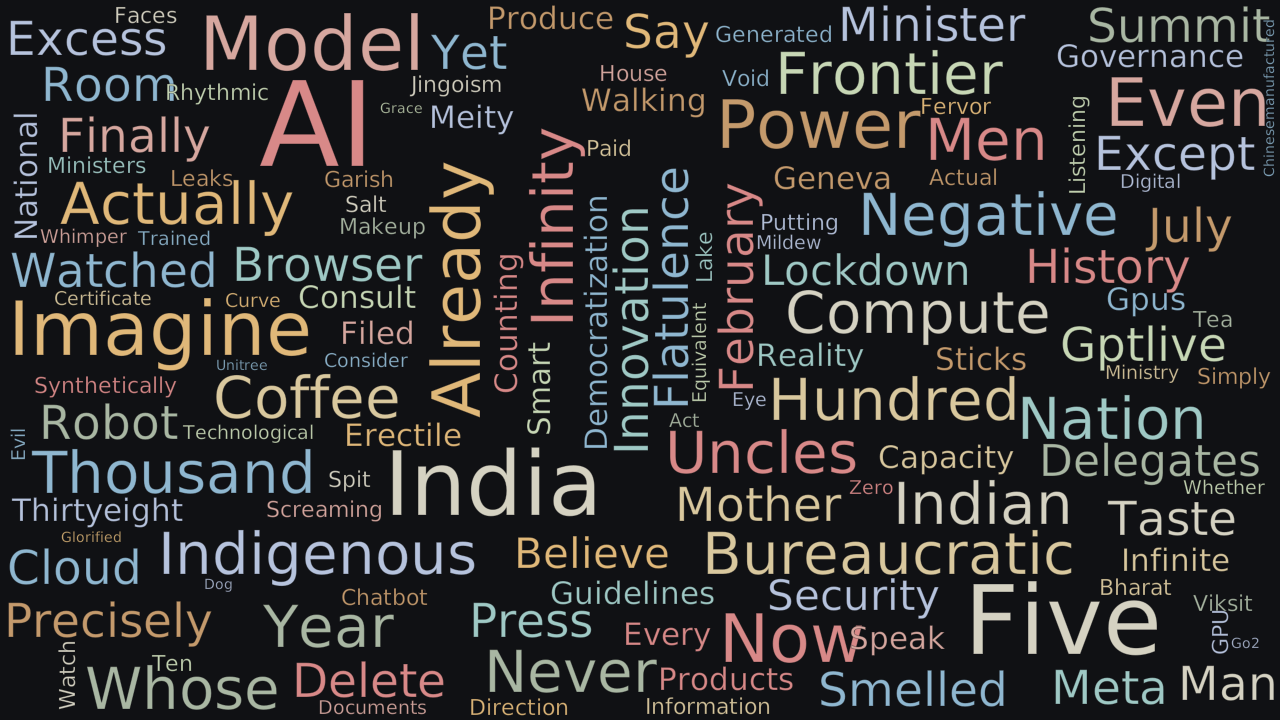
Word Cloud
Related reading
Selected by shared topics and section, with closer publication dates breaking ties.