The Digital Charnel House
Uses the speech voice supplied by your browser or device.

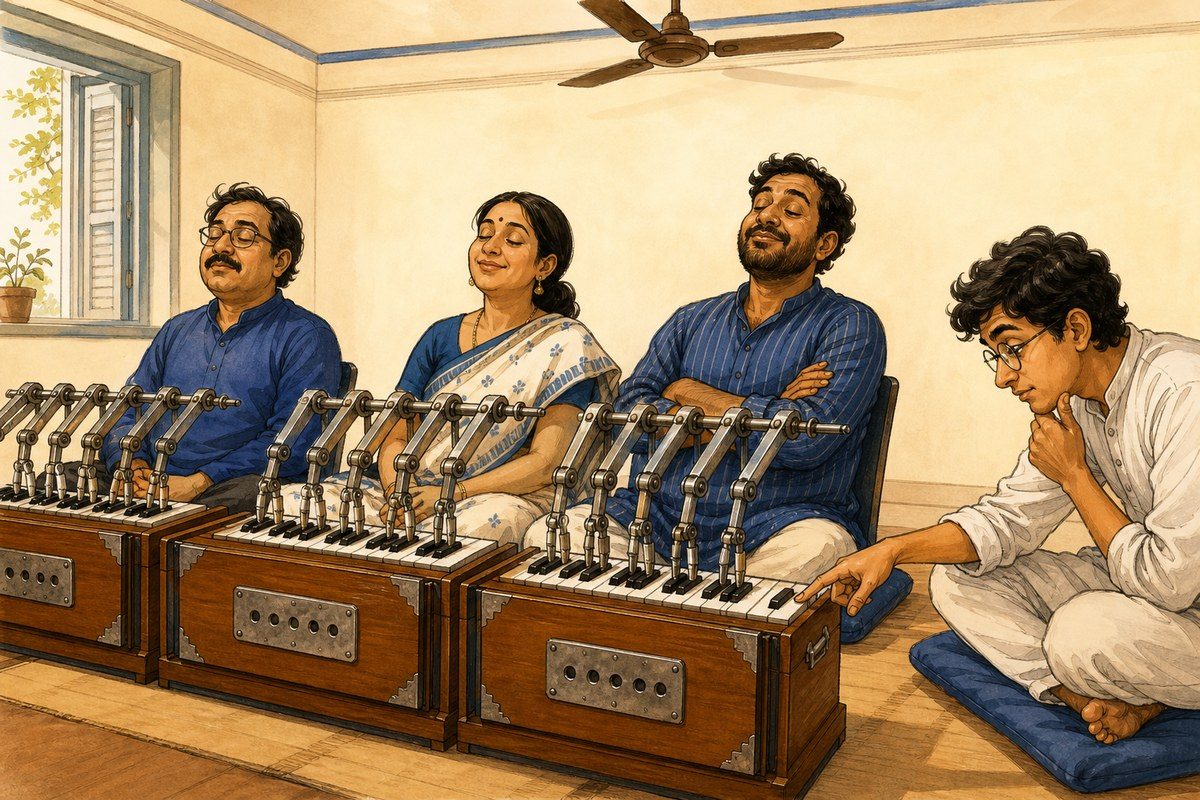
I woke up this morning, or rather I did not wake up so much as I was disgorged from the sticky, viscous membrane of sleep into a reality that already felt like a poorly rendered simulation, and the first thing I saw, the very first thing my rheumy, fifty-one-year-old, single, cancelled, bruised, burnt, brittle, bitter Bengali eyes encountered was not the soft Calcutta dawn filtering through my unwashed curtains, no, it was my phone screen, that rectangular little Judas, glowing with the notification that some algorithm had decided I needed to watch a YouTube video titled “Make $10,000 a Day With This ONE AI Trick (Doctors Hate Him)” and I sat there, my back against a pillow that smelled of old hair oil and the accumulated despair of a thousand sleepless nights, and I felt the bile rise, not metaphorical bile, actual, physical, gastric bile, the kind that burns the esophagus and tastes of yesterday’s stale fish curry and existential dread, because I knew, I knew with the certainty of a man who has spent three decades over-reading books he cannot usefully apply to anything, that this was not a video, this was a shovel, a cheap, rusted, mass-produced shovel being sold to a crowd of gullible, subscription-gold-prospecting wannabes who think that the internet is still a frontier and not a landfill, a charnel house, a digital Ganges where the corpses of genuine creativity float belly-up alongside the turds of algorithmic arbitrage.
And it is July, the ninth of July, 2026, and the UN is in Geneva right now, as we speak, hosting their “AI for Good Global Summit” with Marc Benioff and Paul Kagame co-chairing like some unholy matrimony of Salesforce and Rwandan techno-optimism, and I read that and I laughed, I actually laughed, a sound like a crow with bronchitis, because “AI for Good” is the most beautifully grotesque oxymoron since “military intelligence” or “jumbo shrimp” or “happy marriage,” and I am an atheist, a proper, card-carrying, Dawkins-reading, Hitchens-memorizing Bengali atheist, but I find myself praying, actually praying, to no one in particular, that someone in that Swiss convention center has the courage to stand up and say, “Gentlemen, ladies, and non-binary data points, we have built a machine that vomits text at the speed of thought and we are drowning in our own effluent,” but they won’t, they never do, because the OpenAI people are there offering the US government a five percent stake, a literal equity bribe, forty-two point six billion dollars of regulatory capture dressed up as public good, and Anthropic is fighting the Pentagon over whether Claude can be used for autonomous weapons, which is a bit like arguing whether your kitchen knife should be allowed to stab your neighbor while you’re still using it to chop onions, and the whole thing is so nauseatingly, vomit-inducingly, stomach-churningly performative that I want to throw my laptop out the window, except I live on the first floor and the laptop would probably just bounce off the head of some rickshaw-puller who has bigger problems than my digital disgust.
The etymology of “enshittification,” if we are being precise, which we are, because precision is the only thing standing between me and complete psychic dissolution, comes from Cory Doctorow, that magnificent Canadian scold, who coined it to describe the three-stage process whereby platforms first make things good for users, then good for business customers, and finally good for shareholders at the expense of absolutely everyone else, and I read his book, I read it cover to cover while sitting on my toilet at three in the morning because my sleep schedule has been destroyed by the same internet I am now complaining about, and I thought, yes, yes, this is it, this is the word, the mot juste, the perfect little linguistic scalpel to carve open the abscess of late-stage digital capitalism, but then I went on YouTube, that great digital Ganges, that river of sewage and salvation, and I saw that the enshittification had metastasized, it had gone from platforms to people, from corporations to individual humans, because now every third video is some twenty-three-year-old in a rented Lamborghini telling me that I too can achieve financial independence by reselling AI-generated coloring books on Amazon KDP, or by creating faceless YouTube channels with AI voices that sound like a depressed robot reading a phonebook, or by building “AI agencies” that charge small businesses ten thousand dollars for a ChatGPT wrapper that I could build in my sleep, if I slept, which I don’t, because I am too busy doomscrolling through this tsunami of human slop that precedes, and will certainly be followed by, an even greater tsunami of AI slop, because that is the nature of the thing, that is the telos of the internet now, not communication, not connection, not the glorious anarchic promise of the early web, but a recursive, self-referential, infinitely regressing ouroboros of content eating content, shitting out content, and then eating that shit and calling it a business model.
And I am a hikkikomori, a proper Bengali hikkikomori, which is not a recognized clinical category but should be, because it combines the Japanese withdrawal from society with the Bengali capacity for melodramatic self-pity and the consumption of excessive amounts of tea, and I have not left my flat in eleven days, and the last time I did leave it was to buy medicines, and I stood in that pharmacy queue and I looked at the people around me, these ordinary Calcuttans, these rickshaw-wallahs and housewives and clerks and students, and I thought, these people, these beautiful, stupid, resilient people, they have no idea what is coming, they have no idea that the internet they use to watch Bengali soap operas and send WhatsApp forwards about turmeric curing cancer is the same internet that is being systematically dismantled by a thousand tiny grifters selling shovels to gold prospectors who will never find gold because the gold was never there, it was always just shovels, just an infinite regress of shovels being sold to people who think that buying a shovel is the same as digging.
The scientific term for what I am feeling, if we must have scientific terms, which we must, because I am over-read and therefore compelled to categorize my own despair, is probably something like “chronic digital anhedonia” or “algorithmic dysphoria” or perhaps just “being awake in 2026,” and the WHO, that great bureaucratic behemoth, probably has a code for it somewhere in the ICD-11, nestled between “burnout” and “prolonged grief disorder,” but what they don’t have is a cure, because the cure would require the entire economic system to stop, to just stop, and admit that we have built a machine that produces nothing but the desire for more machine, and that is not going to happen, because Palantir’s CEO, that wonderfully named Alex Karp, called the AI industry “effing insane” and accused the labs of imposing a “wealth tax on business,” which is a bit like the arsonist complaining about the fire department’s water bill, and yet, and yet, I find myself agreeing with him, a Palantir executive, a man whose company probably has a dossier on me right now, flagged as “Bengali male, fifty-one, elevated risk of radicalization via excessive reading and insufficient social media engagement,” and I agree with him because the enemy of my enemy is my temporary ally in the war against the slop, and the slop is winning, the slop is always winning, because the slop requires no talent, no effort, no soul, just a prompt and a prayer and a paywall.
And Grok 4.5 is in private beta at SpaceX now, did you hear, one point five trillion parameters, trained on Cursor data, which means that Elon Musk has managed to combine his two great passions: rockets that sometimes explode and code that sometimes compiles, and the whole thing is being evaluated by SpaceX engineers who are probably too busy trying to keep their rockets from exploding to notice that their AI is just a very expensive autocomplete with delusions of grandeur, and meanwhile Meituan, the Chinese food delivery company, has open-sourced LongCat-2.0, one point six trillion parameters, trained entirely on domestic Chinese chips, which is geopolitically significant and also completely irrelevant to the average human being who just wants their mapo tofu delivered hot, and the whole thing, the whole panoply of frontier models and open-weight alternatives and jailbreak severity frameworks and government equity stakes, it all just blurs into this great humming noise, this digital tinnitus, this ringing in my ears that never stops, because the internet is no longer a place you visit, it is the air you breathe, and the air is full of particulate matter, full of AI-generated microplastics, full of tiny particles of slop that lodge in your lungs and your brain and your soul and never leave.
I think about the Calcutta of my childhood, the Calcutta of the 1980s, when the internet was a science fiction concept and the greatest technological marvel in our house was a black-and-white television that got two channels if you whacked it hard enough, and I remember the smell of the city then, the smell of diesel and jasmine and rotting fruit and incense, and it was not a pleasant smell, it was a real smell, a smell that had history and biology and decay in it, not this antiseptic, algorithmic, Lysol-scented nothingness that passes for experience now, and I think about my father, who has passed away, who never owned a smartphone, who never sent a text message, who wrote letters in English on paper, and I read his handwriting, that cramped, slightly illegible script, and I think, this was a human being, this was a consciousness that existed in the world without a single byte of data to its name, and now we are all data, we are all content, we are all just grist for the algorithmic mill, and the mill grinds on, and the mill grinds fine, and the mill grinds us all into the same gray paste of engagement metrics and ad impressions and subscription revenue.
And the YouTube grifters, oh, the YouTube grifters, with their rented cars and their fake Rolexes and their “five passive income streams” and their “AI side hustles,” they are not the disease, they are the symptom, they are the antibodies of late capitalism, the white blood cells rushing to the site of the infection and making it worse, because their business model is not creation, it is meta-creation, it is teaching other people how to create without creating, it is selling the idea of the shovel without ever having dug a hole, and I watch them, I watch them because I am sick, because I am addicted to the spectacle of my own destruction, and I see the comments, the thousands of comments, “Thanks for the value, bro!” and “This changed my life!” and I want to scream, I want to reach through the screen and shake these people, these beautiful, desperate, hopeful people, and tell them that the only person getting rich is the person selling the course, that the shovel is a lie, that the gold is a lie, that the whole thing is a recursive pyramid scheme built on the corpse of the internet, and the corpse is still twitching, still generating ad revenue, still serving up “recommended for you” videos about how to make money with AI while the world burns, while the UN meets in Geneva to discuss “AI for Good,” while the Pentagon demands access to Claude for autonomous weapons, while OpenAI offers the government a five percent stake in exchange for regulatory leniency, while the slop accumulates, layer upon layer, like geological strata, like the sediment of a dead civilization, which is what we are, which is what we have become.
I have not eaten today. It is seven in the morning. The light is cloudy over Calcutta, that particular bruised, moist light that comes after a drizzle, and I am sitting at my desk, in my underwear, because I have not bothered to dress, because what is the point of dressing when the only people who will see me are the algorithms that track my eye movements and serve me ads for antidepressants and AI writing tools, and I think about the word “slop,” which originally meant “wet feed for pigs,” from the Old English sloppe, meaning “slovenly person,” and how perfectly it applies, how the etymology has come full circle, because we are all pigs now, we are all feeding at the trough of algorithmic content, and the feed is wet and it is cheap and it is endless, and we eat it because we are hungry, because we are always hungry, because the algorithm has destroyed our capacity to be full, to be satisfied, to be done, and so we scroll, and we watch, and we buy the shovel, and we dig, and we find nothing, and we dig deeper, and we find more nothing, and the nothing is infinite, the nothing is the product, the nothing is the business model, and I am so tired, I am so profoundly, existentially, cosmically tired, not sleepy tired, but soul-tired, the tired of a man who has seen the future and the future is a loading screen that never resolves.
And yet, and yet, there is a part of me, the manic part, the part that wakes up at three AM with a thousand ideas and no capacity to execute any of them, the part that thinks I could still write the great Bengali-American novel, the part that believes in the redemptive power of art even as I am drowning in the slop, there is a part of me that thinks, maybe, maybe, the enshittification is not terminal, maybe there is a counter-current, a resistance, a small, stubborn, stupid persistence of the human, the analog, the handwritten, the un-algorithmic, and I look at my father’s writing, and I think, this, this is the shovel I want to sell, not the AI course, not the ChatGPT wrapper, not the faceless YouTube channel, but the idea that a human being sat down with a pen and wrote to another human being about the weather and the price of fish and the health of his mother, and that this was enough, that this was sufficient, that not everything needs to be content, not everything needs to be monetized, not everything needs to be optimized for engagement, and maybe, just maybe, the resistance is not in the grand gestures, not in the UN summits or the Senate hearings or the IPO roadshows, but in the small, private, unshareable act of writing a letter that no algorithm will ever read, that no advertiser will ever target, that exists only between two people and the paper that carries it.
But then I look back at my screen, and there is another notification, another “Make $10K/Month With AI” video, another grinning idiot in a rented car, and the manic part retreats, and the depressive part returns, and I am back in the charnel house, back in the landfill, back in the digital Ganges where the corpses of creativity float belly-up alongside the turds of arbitrage, and I think, no, there is no resistance, there is only the slop, and the slop is winning, and the slop has already won, and we are just the last generation to remember what it was like before, before the shovels, before the gold rush, before the enshittification, before the internet became a machine for turning human attention into shareholder value, and I am so tired, so tired, so tired.
I went to the kitchen just now, barefoot, the floor tiles cold against my soles, and I opened the refrigerator, and there was nothing in it but a half-empty bottle of mango pickle and a Tupperware of rice that had developed a faint, greenish fur, and I closed the refrigerator, and I stood there in the dark kitchen, and I thought, this is it, this is the image, this is the ending, not the UN summit, not the AI IPO, not the frontier model, but a fifty-one-year-old Bengali man, cancelled, bruised, burnt, brittle, bitter, standing in his dark kitchen in his underwear, looking at moldy rice and thinking about his father, while somewhere in Geneva, Marc Benioff and Paul Kagame discuss “AI for Good,” and somewhere in California, Elon Musk evaluates another trillion-parameter model, and somewhere on YouTube, another grifter sells another shovel to another prospector who will dig and dig and dig and find nothing but more slop, more slop, more slop, forever and ever, amen, or rather, not amen, because I am an atheist, and there is no one to hear the prayer, and no one to answer it, and the only sound is the hum of the refrigerator, and the distant honking of Calcutta traffic, and the soft, persistent, inevitable drip of the internet, dripping, dripping, dripping, like a leak in the ceiling of a house that no one lives in anymore, a house that has been abandoned to the algorithms, to the slop, to the endless, recursive, self-devouring nothingness of the digital age, and I am still standing here, in the dark, in my underwear, and the mango pickle is still half-empty, and the rice is still green, and nothing has changed, and nothing will change, and that, my friends, that is the good news, because at least the mold is real, at least the pickle is real, at least the dark is real, and the rest, the rest is just slop.
P.S. The etymology of “hikkikomori” is Japanese, from hiku (to pull, to withdraw) and komoru (to seclude oneself), first documented in psychologist Tamaki Saitō’s 1998 book Social Withdrawal: Endless Adolescence. The term was not in the DSM-IV, is not in the DSM-5, and probably will not be in the DSM-6 because by then we will all be hikkikomori, all withdrawn, all sequestered in our algorithmic bunkers, eating our digital slop, waiting for the loading screen to resolve, which it never will, which it was never designed to do, because the loading screen is the product, the waiting is the business model, and we are the inventory, we have always been the inventory, and the inventory does not get to complain about the warehouse.
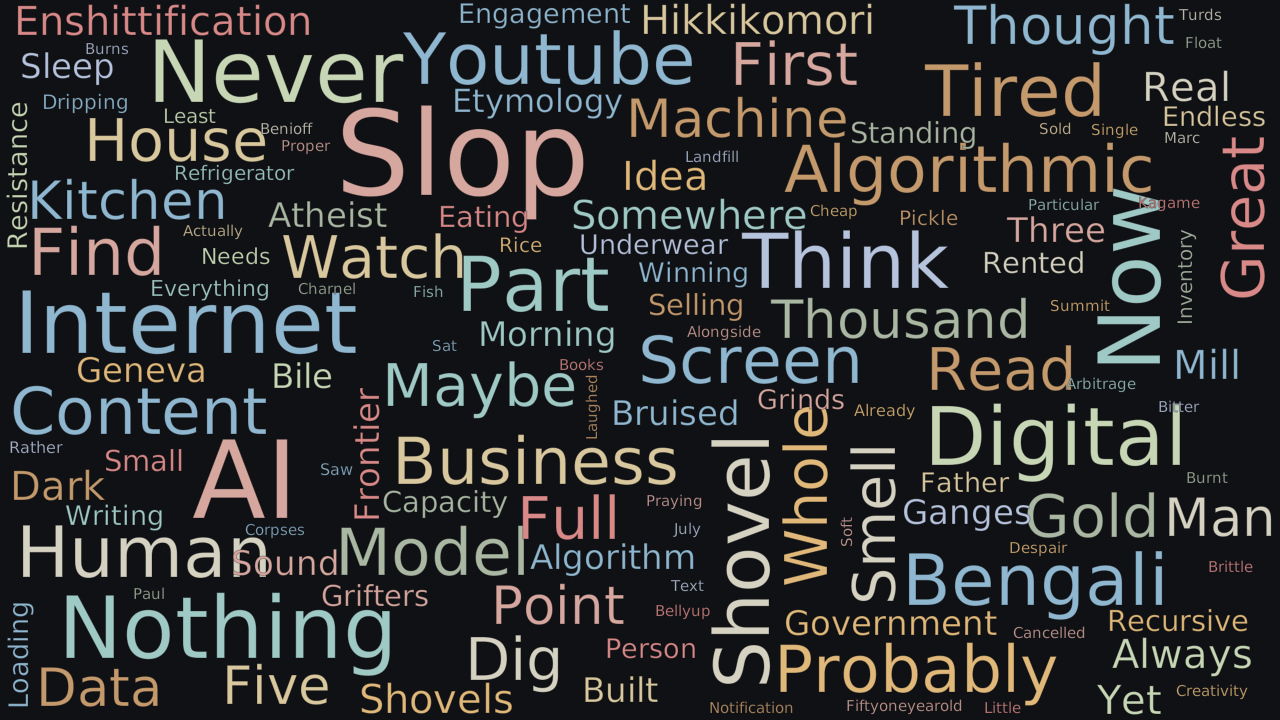
Word Cloud
Related reading
Selected by shared topics and section, with closer publication dates breaking ties.