The Vermicular Parliament
Uses the speech voice supplied by your browser or device.

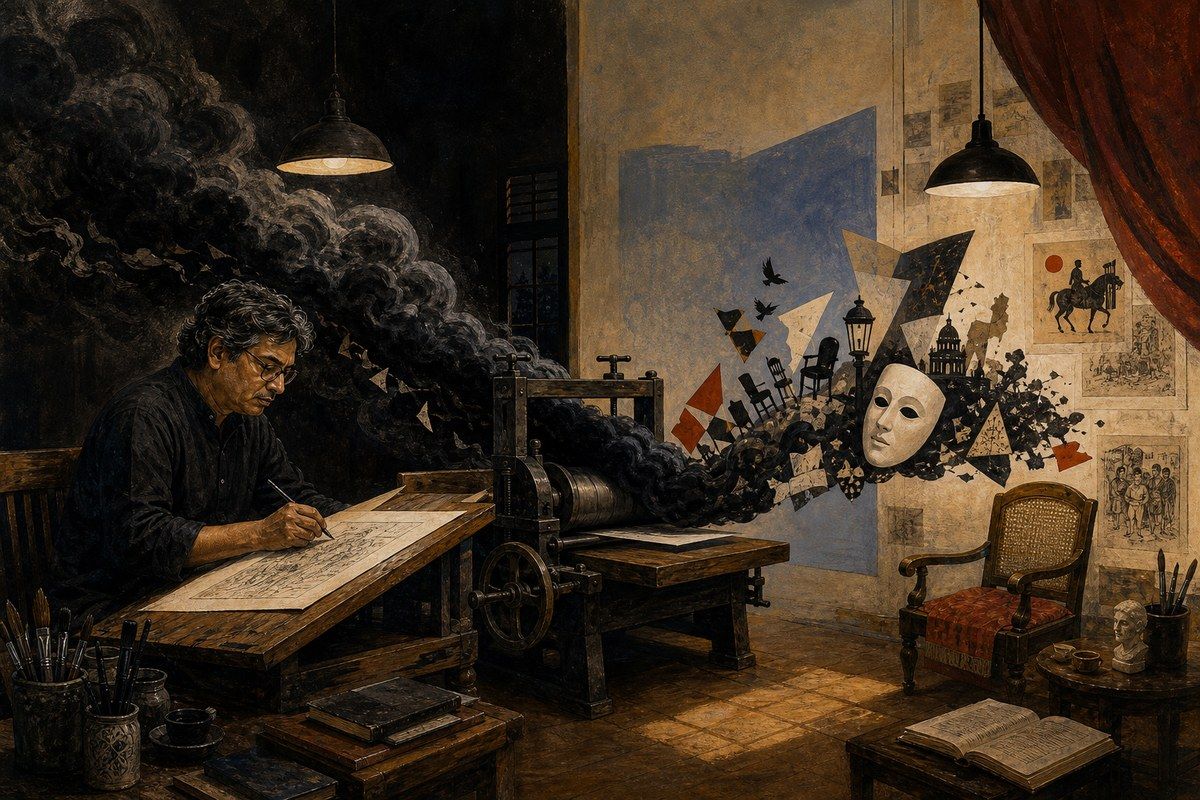
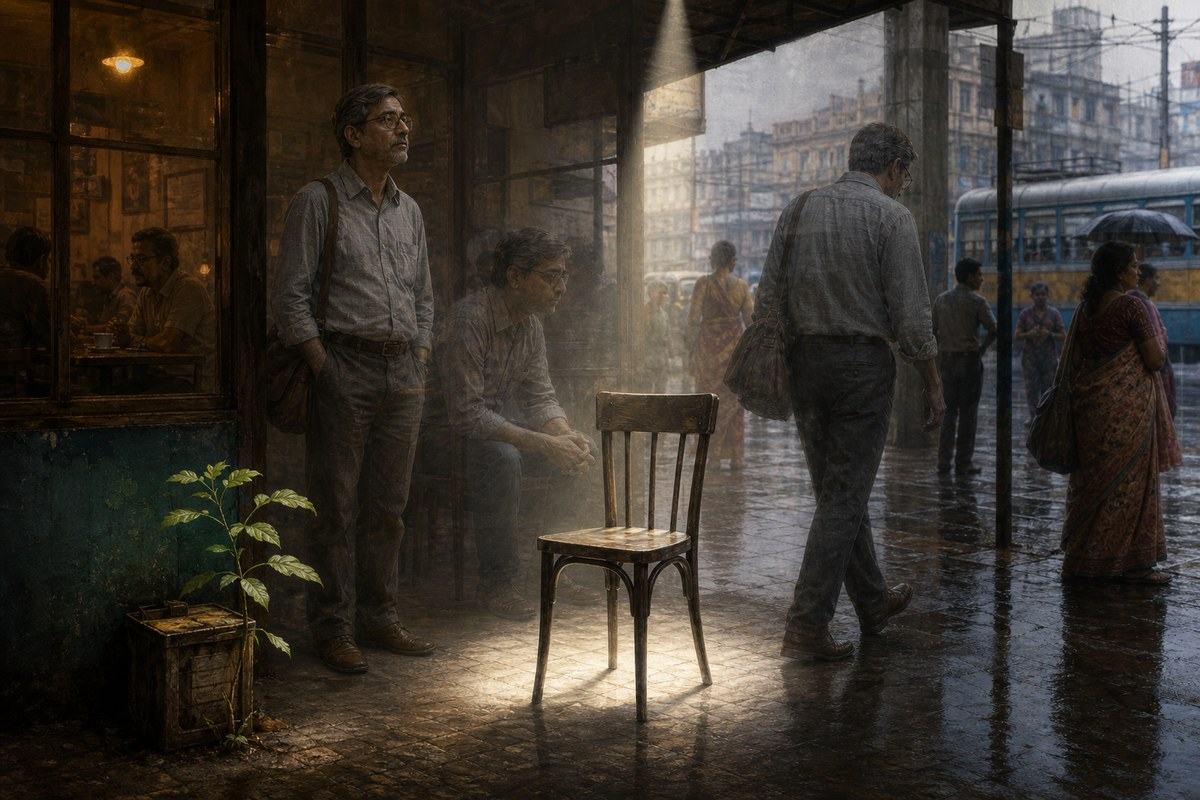
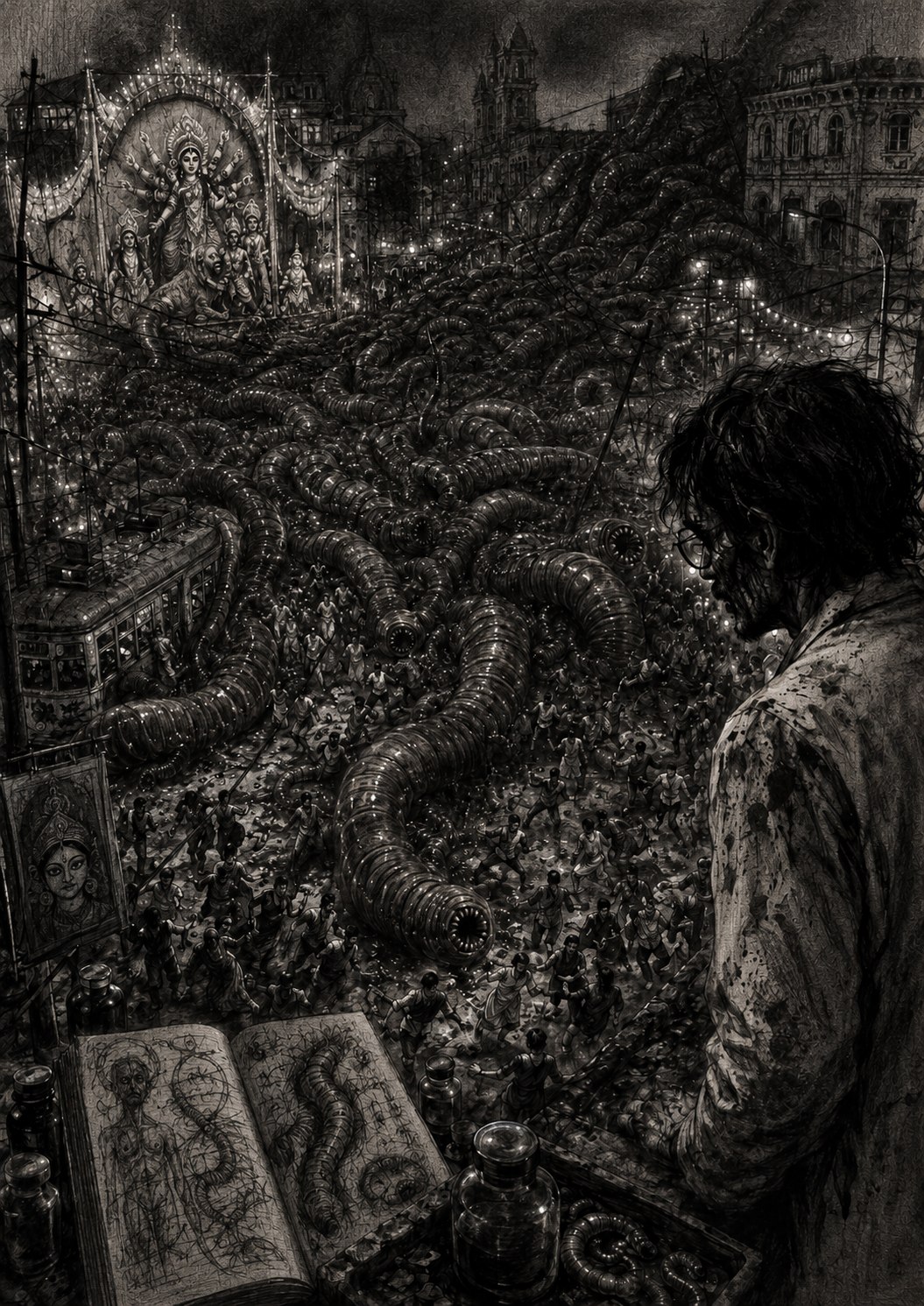
I woke up this morning and the left side of my skull was unlatched again, the parietal bone swinging open on a hinge of gristle and bad faith, and the whole squirming constituency was there, pallid and segmented, glistening in the sodium-yellow pollution-light that seeps through the grimy window of this cheap South Calcutta flat where the plaster peels like the skin of a leper in a heatwave, my personal helminthic congress, the worries, the anxieties, the future-devouring nematodes that I keep stuffed behind the mask of normalcy, the mask I strap on every morning with the enthusiasm of a goat being led to understand its own mortality, the mask that says, “Oh, yes, I am a perfectly functional fifty-one-year-old Bengali man, formerly of North Calcutta-South Sinthee, formerly of Texas where I earned my master’s and spent fifteen years being professionally invisible, formerly of having a life that resembled anything other than a compost heap of aborted intentions,” when in fact I am nothing more than a bruised and brittle assemblage of unlaundered punjabis and unprocessed dread, a cancelled atheist hikikomori renting decay in the suburban sprawls south of the city, over-read in the most useless way possible, introverted to the point of being a biological hermit crab who has misplaced his shell.
The worms are voting.
They are always voting.
My mandible aches.
I am a democracy of disgust.
And today, the ninth of July, two thousand and twenty-six, while the Global Technology Virtual Investor Conference unfolds its circus of AI drones and quantum computing promises in some air-conditioned server farm where the temperature is controlled to the exact decimal point of human delusion, my own personal data center is overheating in its bony chassis, and the only drone in this room is the mosquito that has been performing aural copulations with my ear canal for three hours, a tiny hematophagic analyst predicting a severe downturn in my hemoglobin and my patience, both of which are already trading at historic lows on the prediction market of my bloodstream.
The worry, which derives from the Old English wyrgan, meaning to strangle, to harass, to throttle the breath out of something tender, is doing exactly that to my prefrontal cortex at 3:47 AM, because the voltage in this flat fluctuates like my mood swings, strangling the REM sleep out of me until I am lying in a puddle of my own liquid contempt—no, not the urethral lament itself, though that too comes every forty minutes because the prostate, that walnut-sized traitor, has joined the general strike of my physiology—lying there watching the ceiling fan perform its lazy, meaningless rotations while the worms hold their all-night plenary session, debating whether the money will run out before the loneliness does, or whether the loneliness is merely a secondary symptom of the money running out, or whether both are just the emulsion of being a man who has been thoroughly, comprehensively, bureaucratically cancelled by love, by employment, by the simple arithmetic of being alive in a city that has cancelled him right back with its humidity and its indifference.
The gnawing is constant.
It is a piercing tooth pain of a cavity that cannot be located, or one that flits from thought to thought like a Kolkata Metro train that you can hear screeching in the underground dark but which never arrives at your station, migrating from the memory of some humiliation in a San Antonio grocery store in 2003 to the prediction of my own eventual, unremarkable death in this very flat, probably during a power cut, probably while trying to remember whether I have taken my lithium, probably while the worms hold a state funeral for the last of my dopamine.
You see, language is a derivative of experience, a consensual hallucination that breaks down when you are trying to describe the dark melancholy moods to someone who has not personally felt them, which is everyone, because even the psychiatrist, that paid witness to my cerebral suppuration, has never actually inhabited the specific, bespoke hell of my default mode network, that neurological traitor that activates when the brain is supposed to be at rest but which in my case is a carnival of recursive catastrophe, a looped broadcast of every mistake I have ever made, every word I should not have spoken, every opportunity I watched scurry away like a cockroach under the Gariahat fish market lights.
And the manic episodes, oh, the manic episodes, those glittering, tumescent, solar-powered delusions where I believe I can write a twelve-thousand-word treatise on the etymology of despair before breakfast, where my thoughts move faster than the hand-pulled rickshaws on College Street, where I am convinced that I am one unreturned email away from being discovered as the genius that South Calcutta has been cruelly ignoring, those are just the other pole of the magnet, the bipolar opposite that makes the depression so much worse when it arrives, because after the mania has spent its counterfeit currency, after the synaptic fireworks have fizzled into ash, the worms are still there, hungrier than before, having multiplied in the neural compost of my grandiosity, and they set to work with renewed vigor on the bone, the muscle, the ligaments, which ache perpetually from their repetitive and unceasing labor, a repetitive strain injury of the soul, if you will, a carpal tunnel syndrome of the amygdala.
I am over-read, uselessly so.
I have read enough to know that the word melancholia comes from the Greek melas, black, and kholé, bile, the ancient physicians believing that a surplus of black bile produced the saturnine temperament, and I can tell you that my black bile is currently producing a surplus of black everything, that my spleen is manufacturing a vintage of despair that would make a Stoic weep into his beard, and yet this knowledge does nothing, absolutely nothing, because the worms do not care about etymology, the worms care only about consumption, about turning the present moment into a regurgitated pulp of premonitions and dark thoughts that distemper my bipolar depression into shades of grey that even a Kolkata monsoon sky would find excessive.
The facade is exhausting.
It is a performance art piece called “Functional Adult” that I stage every time I step out to buy eggs from the corner shop, where I must arrange my face into an expression that suggests I am not internally hosting a vermicular bacchanal, where I must exchange pleasantries about the weather with the shopkeeper who smells of mustard oil and resignation, where I must pretend that my skull is not ajar and that the pallid segments are not visible to the naked eye, though sometimes I suspect the shopkeeper knows, sometimes I suspect everyone in this decaying city knows, because Calcutta has a way of recognizing its own damaged goods, its own bruised fruit, its own burnt and brittle men who have returned from the diaspora with nothing but a master’s degree and a head full of nematodes.
And the worms carry premonitions.
They whisper that the AI revolution, that great promise of the Global Technology Virtual Investor Conference happening today with its quantum computing software and its deep-tech materials and its peer-to-peer prediction markets, is just another way of saying that human failure is being automated, that my own obsolescence is being venture-capital-funded, that the prediction markets are wagering on my irrelevance, and I believe them, because the worms have never been wrong about the direction of my life, only about the timeline, which is always, invariably, sooner than I think.
The present moment is a minefield.
Even when I attempt to stay in it, to practice the mindfulness that the wellness industrial complex peddles like a digital pharmacy subscription, the worms are there, gnawing at the now, turning the present into a staging ground for future regret, because the present is just the past’s cloacal expulsion, the brown obelisk of what has already been decided, and the future is just the present being eaten by anticipation, a feculent effluvia of what has not yet arrived but which the worms have already tasted and found satisfactory.
My ligaments ache.
My mandible aches.
The mask slips.
I am fifty-one years old and I have lived in Texas, where the sky is a bell jar of blue indifference, and I have returned to this city of my birth, this North Calcutta-South Sinthee boy, now a tenant in the suburban boondocks where the Metro extension promises connectivity but delivers only noise, where the communism has died and been replaced by something more garish and less honest, where I eat my bhater bhaat alone and watch the worms dine on my serotonin, and I think, with a bitterness that could curdle milk across the Hooghly, that the only difference between an AI drone and my anxiety is that the drone at least has a pilot, whereas I am just a failed quantum computer with no B2i Digital marketing team to amplify my distress across a network of 1.7 million investors.
The worms are not going anywhere.
They have signed a long-term lease.
They pay no rent.
They are the original cancel culture, and I am their platform.
And so I sit here, in the humid, flickering afternoon of July ninth, my skull still unlatched, the fan still rotating its lazy nihilism, the mosquito still performing its hematophagic congress in my ear, and I realize, with the kind of defeated clarity that only comes after fifty-one years of being the sole inhabitant of your own head, that the cavity will never be filled, the tooth will never be extracted, the Metro train will never arrive, and the worms, the beautiful, horrible, gnawing worms, have already won the election in a landslide, and I am just the constituency, the decaying South Calcutta flat, the cheap plaster, the peeling paint, the last man standing in a democracy where every vote is a bite.
Word Cloud
Related reading
Selected by shared topics and section, with closer publication dates breaking ties.