The Fish of Babughat
Uses the speech voice supplied by your browser or device.

THIS IS A WORK OF FICTION
The bicycle was chained to the tram railing, the towel was folded on the seat, and the clay cup sat empty on the wall, but Kaku had not come up from the river.
Priya stood on the top step of Babughat and counted to a hundred. The Hooghly moved past like brown soup, thick and slow. A cargo boat honked upstream, sounding as tired as she felt. The sun pressed down on her head like a hot frying pan. She had been waiting for seventeen minutes, and Kaku had said he would be out in ten.
She had come to return his bicycle pump. He had forgotten it that morning, whistling as he left the house in his old blue lungi, promising that after his swim he would fix her bicycle tyre. The puncture had ruined yesterday’s cricket match. She had saved twelve rupees for a new grip, and Kaku had said they would cycle to the sports shop in Esplanade together. Now the pump was in her basket, and Kaku was not.
She walked down to the water. The mud sucked at her sandals. A dead marigold spun in an eddy. The other bathers were already out, drying their hair on the lower steps, but Kaku’s usual spot beside the old stone lion was empty. His towel was still warm. His spectacles sat folded on the wall. Kaku was blind as a bat without them. He would not have gone back into the water after taking them off. And yet, he had.
She asked a thin man in a white dhoti, “Did you see my uncle? Blue lungi, big laugh, dives like a crowbar.”
The man squinted at the river. “He went in. He did not come out. Maybe he swam to the other bank.”
The other bank was a mile away, and Kaku could not swim a mile. He could barely swim to the middle and back without stopping to float. Priya felt a coldness in her stomach that had nothing to do with the river.
She was about to shout his name when she saw the fish.
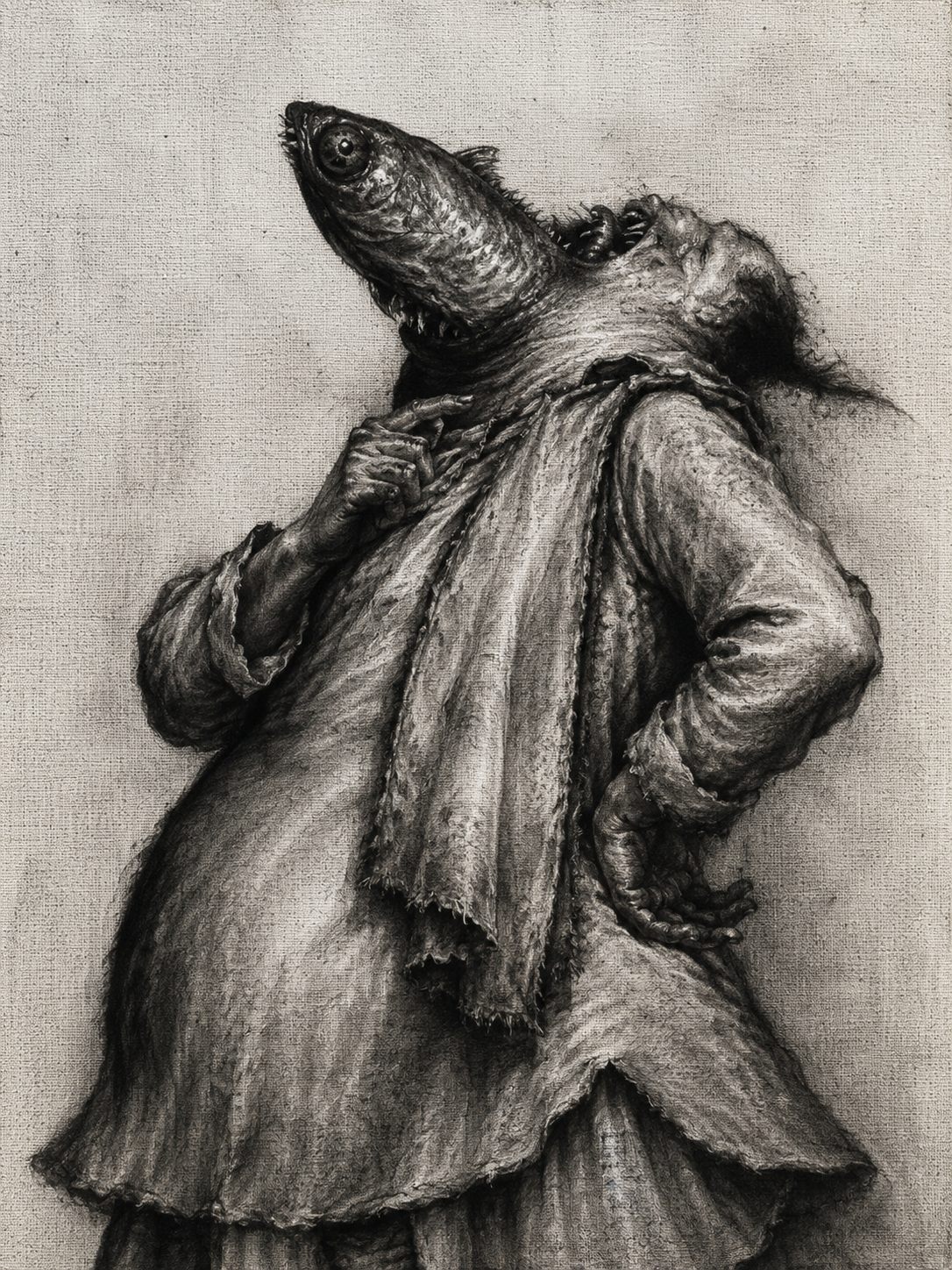
It was stuck in the shallows, wedged between two stones where the sewage pipe met the river. It was the size of a cricket ball and pale yellow, with brown spots like tea stains on a tablecloth. A puffer fish. Priya had seen a picture in her school biology book, but never in the Hooghly. The book said they lived in the Sundarbans, in clean water. This one looked furious. It puffed up, round and indignant, then collapsed with a wet sigh. It did this twice, as if trying to get her attention.
Then she saw the mark.
On its left side, just behind the gill, was a dark patch the shape of a half-moon. Kaku had exactly such a scar, a burn from a rogue Diwali rocket three years ago. He showed it off every year, claiming it looked like a map of India. And on the fish’s tiny dorsal fin, she saw a thin red line. Kaku had cut his finger that very morning on the edge of the newspaper, right before he left.
The fish turned one bulbous eye towards her.
Priya’s stomach did a flip. She told herself she was being stupid. Fish did not have uncles. Uncles did not become fish. But the fish puffed up again, and this time it made a sound like a wet bicycle horn. Kaku’s bicycle horn had sounded exactly like that since he had backed into a cow in Burrabazar and bent the metal.
She looked around. The fishermen were busy coiling rope, their backs bent. A tram clanged past on the Maidan route, sparks flying from the wire. No one was watching. No one had noticed that a man had gone in and a fish had appeared.
“Kaku?” she whispered.
The fish deflated and blew a single bubble that said, unmistakably, yes.
She knew, then. She did not know how, but she knew. The river had taken him and given back this ridiculous, spotted, puffing thing. She felt a lurch of fear, then a fierce, burning sense of injustice. It was not fair. He had promised her a tyre and a grip and a proper ride. He could not be a fish. She would not allow it.
She needed a bucket.
There was a construction site behind the ghat, half hidden by a billboard for a new cinema. Priya ran. Her sandals slapped the hot pavement. Behind a pile of laterite, she found a plastic paint bucket, still wet inside from someone’s lunch dal. She rinsed it three times in the river until it was clean, filled it with river water, and carried it back to the fish.
The puffer fish watched her. She lowered the bucket. The fish did not move. She nudged it with a twig. It puffed up to twice its size, jamming itself firmly between the stones. Priya gritted her teeth. She was not strong enough to lift a stone.
Then she remembered Kaku’s towel. She soaked it in the river and laid it over the fish like a net. The fish seemed to sigh, deflating slightly, as if it understood. She scooped it up in the towel, dropped it into the bucket, and covered the top with her own cotton handkerchief.
It was surprisingly heavy.
She placed the bucket in her bicycle basket. The fish puffed up again, pressing against the plastic sides like a balloon. Priya put the pump on top to hold the handkerchief down. She pedalled away from the ghat, standing up on the pedals because the basket was awkward and the fish was shifting from side to side.
The streets were melting. Tar bubbled on Chowringhee. A dog lay under a tram bench, panting in Morse code. Priya’s throat was dust. She stopped at a railway crossing while a goods train groaned past, carriage after carriage of coal. The fish in the bucket puffed up with each clang of the wheels. Priya put her hand on the handkerchief and whispered, “It’s only a train. Don’t be stupid.”
The train passed. She cycled on.
She passed the sweet shop on Lindsay Street, where the sandesh sat in white rows under a glass dome like sleeping babies. The smell of cardamom and condensed milk made her dizzy. She stopped, dug in her pocket, and bought one sandesh with her twelve rupees. It was warm and crumbly and tasted of home and victory. She ate half in one bite. The fish in the bucket made a small, squeaking sound.
“You’re not getting any,” Priya said. “You got yourself into this.”
But she broke off a crumb and dropped it through the handkerchief. The water went quiet. Then a small, satisfied blup.
She cycled on, grinning.
At the corner of Cornwallis Street, a policeman held up his hand. Priya stopped. He looked at the bucket.
“What’s in there?”
“Science project,” Priya said. “Live specimen. For school.”
The policeman peered at the handkerchief. The fish chose that moment to puff up and squeak against the plastic. It sounded like a broken bicycle horn.
“Hmph,” said the policeman. “Go on, then. Don’t spill it on the road.”
She cycled the last hundred yards with her heart hammering.
Her grandmother’s house was in a lane behind a green gate that stuck in the monsoon. Didima was on the veranda, shelling peas into a brass bowl. She was eighty and saw everything through the crack in her left eyeglass, which she refused to fix because she said it reminded her of the partition.
Priya carried the bucket behind her back. She thought she was being sly. She stepped over the threshold.
“Put him in the rainwater tub,” Didima said, without looking up. “The bucket is too small. He’ll get cramp.”
Priya froze. “Didima—”
“The river lends them back in June, when the heat is cruel. My own brother came back as a hilsa in ’ sixty-two. Took him two days to remember his legs. The water was cleaner then, and people had the patience to wait.” She snapped a pea pod. “Tub. Shade. Now.”
Priya’s mouth opened and closed. She felt the relief of not having to explain, followed immediately by the old, sharp pain of being the youngest. Everyone knew things she did not. It was unfair.
She tipped the fish into the stone tub in the courtyard. It sank, then rose, puffing and deflating in the cool green water. It looked happier. The tub was shaded by a mango tree, and the water was soft from last week’s storm.
“How do we turn him back?” Priya asked.
Didima sucked her teeth. “He must go back where the current runs deep and clean. The old ferry ghat below the bridge. The water there still remembers how to be a river, not a drain. But the gate is locked. The path is overgrown. And it must be done before the evening tram rings six. After that, the river keeps what it takes for another day, and you’ll have to wait until tomorrow.”
Priya looked at the sun. It was past four. The tram from Tollygunge rang six at the bridge crossing. She had perhaps an hour and a half.
She looked at the fish. It was staring at her, or as much as a fish can stare.
“I’m not a coward,” she said.
The fish blew a bubble.
She found an old milk crate and lined it with the wet towel. She filled it with water from the tub. The fish fit inside, puffed up like a prickly ball. It was easier to carry than the bucket. She hugged it to her chest. It smelled of river mud and old paint.
Didima handed her a folded paper. “Two sandesh. For strength. And take this.” She gave her a small torch. “The steps are dark. And Priya—”
“Yes?”
“Don’t drop him. And don’t let the tram conductor see. He’ll think you’re selling seafood without a licence.”
Priya ran.
The lane was crowded with the evening market. A man selling guavas shouted in her ear. A cow blocked the turning, chewing with lazy superiority. She squeezed past, the crate digging into her ribs. The fish puffed up every time a bicycle bell rang. By the time she reached the bridge, her arms ached and her shirt was soaked with river water and sweat.
She stopped a rickshaw puller. “The old ferry ghat. Is it this way?”
The man wiped his forehead. “That path? No one goes there, miss. The steps are broken. My grandfather says a fish-man lives under the bridge and steals umbrellas.”
Priya’s heart thumped. “There’s no fish-man.”
“Suit yourself,” he said, and trundled off.
She passed a cinema hall. The loudspeaker blared film music, all drums and shouting. The fish in the crate deflated suddenly, shrinking to a fraction of its size. Priya clutched it tighter. “Don’t you dare die,” she said. “Not after all this.”
The old ferry ghat was hidden beneath the railway bridge, behind a rusted gate and a wall of thorn bush. A sign said DANGER in three languages. The lock on the gate was new and shiny, put there by the municipality last month. Beyond it, she could hear the river lapping against the old stone steps, quick and secretive.
Priya put the crate down. The fish puffed up again with a wheeze. She rattled the gate. It did not move. She could not climb it with the crate. She could not throw the fish over; the drop was six feet onto broken brick.
She looked at the thorn bush. It was dense, ugly, and full of red ants. Beyond it, she could see a sliver of dark water moving fast.
She thought of the cricket match. She thought of Kaku’s promise. She thought of being the youngest, the one who was always told to wait outside, to play with the younger children, to not ask so many questions.
She pushed the crate through the bottom of the gate, where the mud had washed a small gap. Then she squeezed herself after it. The thorns caught her kameez, her hair, her left calf. She felt the sting, then the wetness of blood. An ant bit her wrist. She did not cry. She crawled through, dragging the crate, until she tumbled out onto the old ferry steps.
The ghat was beautiful. No one had used it for years. The stones were green with velvet moss. The water here was dark and quick, moving in a different direction from the sluggish brown flow above. It smelled of rain and distant hills and something clean.
She set the crate on the bottom step. The fish was still. She lifted the towel.
“Go on,” she said.
The fish did not move.
“It’s deep. It’s clean. It’s what Didima said.”
The fish sank to the bottom of the crate.
Priya felt panic rise in her throat. She had done it wrong. She had been too slow. She had taken the wrong path, or fed him sandesh, or looked at him too long. She was going to fail, and Kaku would be a fish forever, and it would be her fault because she was the youngest and did not know any better.
She sat on the step and kicked the water. A drop splashed into the crate.
The fish twitched.
She kicked again, harder. Water sloshed over the rim. The fish rose, bobbing. It turned in a circle. It looked at her with that one, knowing eye.
Then it puffed up, huge and round and ridiculous, and leaped.
It cleared the edge of the crate and hit the river with a plop that echoed under the bridge like a gunshot. Priya lunged forward, but the water was empty. The fish was gone.
She waited. The sun touched the roof of the bridge. A tram bell clanged somewhere in the distance, six o’clock, mournful and sweet.
The river bubbled.
A hand shot up, grasping the mossy stone. Then a head, plastered with black hair. Then a pair of shoulders, naked and brown, with a half-moon scar on the left side.
Kaku hauled himself onto the step, spluttering and laughing. He looked at Priya. He looked at the milk crate. He looked at the thorn scratches on her leg.
“What a current,” he said.
Priya burst into tears.
He sat beside her, dripping. He did not ask why she was crying. He put his arm around her, cold and smelling of the Hooghly, and squeezed. They sat there until the tram bell stopped echoing.
“I suppose my bicycle is still at Babughat,” he said.
“Yes.”
“And you still have a puncture.”
“Yes.”
He stood up, wobbling slightly. “Then we’d better fetch it. And Priya—”
“Yes?”
“You bought sandesh with your cricket money.”
She stared at him. “How did you—”
He tapped his nose. “Fish remember smells. Very good smells. I could smell that shop from the tub.”
They walked back through the thorn bush, Kaku in his wet lungi, Priya carrying the empty crate. At the sweet shop, he bought her two sandesh, then three, then a whole box because the shopkeeper said he looked like a drowned rat and needed feeding.
By lamplight, in the courtyard, Kaku patched her tyre with glue and a rubber patch from his wallet. The sound of the pump was steady and comforting. Didima brought them tea in clay cups. The moths circled the lamp like tiny planets.
Priya ate her sandesh and watched the bubbles rise in her tea. Tomorrow there would be cricket. But tonight, she had done something. She had been brave. She had not been the youngest. She had carried a fish through the city and won.
Kaku pumped the tyre to full pressure. It held.
“Good as new,” he said.
Priya bounced the ball she had borrowed from the neighbour. It hit the courtyard flagstones with a crack like a bubble bursting. She caught it, one-handed, and ran out into the lane to see if the river had left any other surprises in the warm, dark puddles.
The night was soft, the air smelled of coming rain, and the city was full of things worth finding.
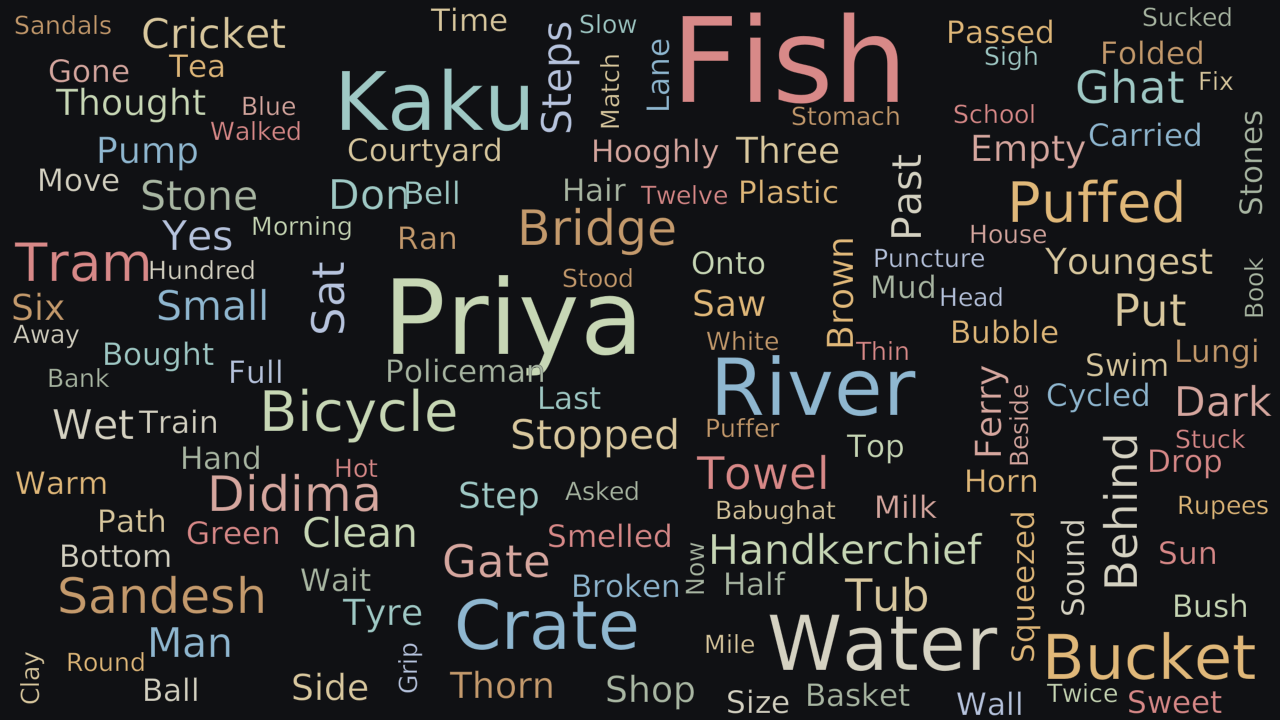
Word Cloud
Related reading
Selected by shared topics and section, with closer publication dates breaking ties.