The Fish That Remembered
Uses the speech voice supplied by your browser or device.

THIS IS A WORK OF FICTION
Anima Pal was arguing over pabda in Gariahat when the first tram bell of the morning rang like a spoon struck against an old tooth.
Rain had come and gone before dawn, leaving the market in its usual democratic condition: fish scales in the gutter, rose petals from yesterday’s puja stuck to the tires of buses, cigarette smoke hanging low over green chillies, and men shouting as if volume might repair the economy. Above the stalls, tram wires sagged in black lines, patient as old veins. Below them, hawkers stood ankle-deep in grey water, defending tomatoes, bras, incense packets, plastic buckets, and imitation foreign shoes from the same splash of municipal indifference.
“Didi, look at this shine,” Haru said, lifting a fish by the gills. “Fresh from the river.”
“Which river?” Anima said.
Haru smiled. He had the smile of a man who had sold the same grandmother three different ancestral brass plates. “In Bengal, all water is connected.”
“That is not a river name.”
“Today you want geography or lunch?”
Anima should have walked away. She cooked for three paying boarders in a crumbling house off Rashbehari, and if she saved fifteen rupees on fish, fifteen rupees existed. Such mathematics had become her religion. Not belief. Religion. Belief was too expensive.
The fish on Haru’s tray lay with their mouths open but their eyes alert, not bright exactly, more insulted. There were rohu, tangra, a small shol with a torn fin, and some lean, silver fish Anima could not name. Their bellies were not cold. When she pressed one, the warmth of it surprised her, as if it had been held under someone’s arm.
“Too cheap,” she said.
“Then pay more. I am liberal.”
Behind her, a schoolgirl in a blue pinafore stepped around a puddle and failed, splashing an old man’s calf. He blessed her entire family with extinction. A yellow taxi coughed. Someone at the tea stall said fish prices had become obscene because Bengalis now bought fish not to eat but to prove they still belonged to a vanished middle class, the way ruined zamindars once polished empty hookahs.
Anima bought two kilos.
By eleven she had cleaned, salted, fried, and curried the fish in mustard paste in the kitchen of Lahiri Lodge, where the walls sweated even in winter and the ceiling fan turned with the moral enthusiasm of a government file. Her boarders were waiting: Benu Babu, retired insurance clerk; Mrinal, who wrote unsuccessful exam guides; and young Paltu, not a boarder but a helper who carried water, peeled potatoes, and pretended not to be hungry.
From the front room, Mrs. Lahiri called, “Less oil for Benu. Doctor said.”
Benu Babu called back, “Doctor said many things. He did not pay rent here.”
They ate at one. At one-fifteen, Benu Babu made a delicate sound, not a cough, not a burp, but a small social apology. He put two fingers to his lips. His eyes watered.
“Bone?” Anima said, already reaching for rice to make him swallow.
Benu shook his head. His throat moved. Something silver appeared between his lips.
The fish came out whole.
It was not the same fried piece Anima had served. It was entire: head, tail, scales, gills opening and closing as though offended by air. Benu bent forward and the fish slipped onto his plate with a wet slap, scattering rice. It flapped once, twice, then launched itself from the plate to the floor and began beating toward the door.
For a moment no one spoke. Calcutta has trained its citizens to make room for almost any inconvenience: a procession, a strike, a goat in a chemist shop, a dead transformer, a cousin arriving unannounced with luggage. But a cooked fish restoring itself inside a pensioner and exiting with purpose was beyond even the city’s generous syllabus.
Then Mrs. Lahiri screamed, “Don’t let it dirty the mat!”
Paltu caught it in a steel bowl. The bowl jumped in his hands.
Benu touched his throat. There was no blood. Only mustard on his chin, and a look of profound personal betrayal.
By evening, fish were coming out all over the para.
A koi emerged from the old appendicitis scar of the tailor on Lake Terrace, opening the line as neatly as a purse clasp. Three mourala dropped from a schoolboy’s ear while he recited multiplication tables. In a bus near Deshapriya Park, a woman felt movement under her blouse and produced, with terrible dignity and the assistance of two strangers and one safety pin, a live tangra from below her collarbone. People telephoned relatives first, then priests, then doctors, then local leaders, proving that even apocalypse observed protocol.
By nightfall, every lane had a bucket.
The fish did not attack. They did not rot. They came out whole, slick, and intent, wherever the body made a weakness. Mouth, nose, tear duct, old cut, vaccination mark, navel, gum. One man claimed a prawn had climbed from his left eyebrow, though Anima suspected whisky had contributed. The impossible has cousins, and exaggeration is always the first to arrive.
All the returned fish moved in the same direction: south and a little east.
“Poison,” Mrs. Lahiri declared, though she had eaten two extra pieces in the kitchen before lunch and now sat with a brass lota pressed to her stomach, making the pained face of a queen whose subjects had become unmanageable.
“It is that cheap fish,” Mrinal said. “Anima bought from Haru.”
“I bought what the market sold.”
“Market sold, but you selected. Selection is character.”
“You write guidebooks nobody passes with,” Anima said. “Don’t teach character.”
That silenced him, but only because the shol he had eaten began knocking inside him. He made a sound like a harmonium being sat upon. A minute later the fish forced its way out through his mouth, larger than the piece that had gone in, black-backed and shining. Mrinal wept without shame.
Anima did not sleep. In the courtyard the captured fish beat against buckets all night. Not wildly. Rhythmically. Like someone knocking from the wrong side of a door.
She had not eaten fish in twelve years except to taste salt while cooking. That was after Bappa.
There are griefs that get narrated because narration flatters them. There are others that sit down in the kitchen and become part of the furniture. Bappa had been eight, clever, irritating, always asking why fish did not blink. One July afternoon he had gone to fly a paper kite beyond the old pond near the closed Basanti Talkies, where promoters had put up tin sheets and promises. He never returned. Some said he slipped into the canal. Some said he boarded a train because children in stories do such operatic things. The police wrote “missing” with a bored pen. Her husband drank for six months and then disappeared into another woman’s ration card.
Anima had kept cooking. Not because she was brave. Rice had to be bought. Kerosene had to be bought. Even mourning, that sacred animal, eats twice a day.
At dawn, Paltu came to the kitchen with news.
“Haru is missing.”
“Since when?”
“Yesterday afternoon. His wife says men came.”
“What men?”
“The kind without names.”
In Calcutta, this was enough description. Men without names did the heaviest work: filling ponds at night, collecting subscriptions for festivals no one enjoyed, standing near building sites with folded arms, explaining to small people that memory was illegal without documents.
Paltu lowered his voice. “Didi, those fish were not from river.”
“Then?”
“From under Aqua Residency.”
Anima knew the place. Everyone knew it. A concrete tower had risen where Basanti Talkies, a pond, and three old houses had once made a damp triangle of shade. The hoarding showed impossible lawns and a child in a helmet cycling under imported clouds. AQUA RESIDENCY: LIVE BESIDE WATER. There was no water beside it. That was the joke, and like most jokes in the city, it had been made by the rich at the expense of geography.
“They dug the parking basement deeper,” Paltu said. “Black water came up. Fish also. Haru bought them at night.”
“From whom?”
He looked at the floor.
“Paltu.”
“I carried two baskets.”
Anima raised her hand, then dropped it. The boy flinched anyway. He was fifteen and already had the habits of someone who expected the world to invoice him for breathing.
“Why didn’t you tell me?”
“Because you needed cheap fish. Because I needed ten rupees. Because everybody needs something.”
There it was: the national anthem without music.
By nine the streets had become a pilgrimage route for fish. Women in nighties stood on balconies holding buckets. Men who had spent lives discussing East Bengal versus Mohun Bagan now discussed whether vegetarianism could operate retroactively. A priest from Kalighat announced that the river goddess was angry. A science teacher from Ballygunge said it was mass hysteria until a bhetki emerged from his nose and ended his press conference.
Anima followed the fish.
Paltu came with her, carrying a burlap sack and a bamboo pole. They crossed Rashbehari under a sky the color of old aluminium. Returned fish slapped along gutters, turned at corners, avoided open drains with the alertness of creatures that had been cheated by drains before. Some had burn marks from frying. Some smelled faintly of cumin. A rohu moved with half its body crisped brown, yet alive, complete, as if digestion had been a rumor invented by stomachs.
At the gate of Aqua Residency, security guards had locked themselves inside their booth. Outside, residents shouted into the air. Buckets overturned. Fish gathered at the metal gate in a shining heap, knocking.
Anima saw Mrs. Lahiri there, sari hastily pinned, face grey.
“You followed?” Anima said.
Mrs. Lahiri looked ashamed, which on her face appeared as irritation. “A fish came out from my old caesarean cut.”
“You told everyone you had no children.”
“I said no surviving children. People hear what keeps them comfortable.”
The admission hung there, too private for the pavement.
Then from behind the gate came a cry.
Haru.
They found him in the half-dug basement, tied to a pillar with nylon rope, his shirt crusted with mud. Beside him lay broken baskets, fish scales, and three men unconscious or pretending to be. The returned fish had covered them up to the chest, not biting, simply pressing, a cold parliament.
“Haru,” Anima said.
He opened one swollen eye. “Didi, I only sold. I did not bury.”
“Bury what?”
He began to cry. Men like Haru cried badly, as if their faces had not been designed for it.
“When they filled the pond, twelve years back, they worked at night. Pump broke. Mud slipped. One child went in. Maybe already dead, maybe calling. We heard. Contractor said no stopping. Rain was coming. Police had been paid. What could we do?”
Anima’s hands went cold.
Paltu whispered, “Didi?”
“What child?”
Haru looked at her then. Really looked. Recognition moved through his face like a rat under cloth.
“I did not know he was yours.”
The basement lights flickered. From a crack in the far wall came the smell of sealed water: pond weed, rusted iron, clay, old offerings, trapped rain. The fish began beating harder at the concrete, not at people now but at the wall itself.
Anima walked to the crack.
Behind it, something hollow answered.
Mrs. Lahiri said, “Don’t touch. Police must come.”
Anima laughed once. It sounded borrowed. “Police wrote missing.”
She picked up a length of iron rod from the mud and struck the cracked wall. Pain ran up her arm. She struck again. Paltu joined with the bamboo pole. Haru twisted against his rope, sobbing apologies to no one useful. Residents shouted from above that the basement would flood, that cars were parked, that maintenance fees were not paid for this nonsense.
The wall broke on the seventh blow.
Black water breathed out.
Not poured. Breathed. It came slowly at first, carrying the smell of a pond that had been made to hold its tongue. Then it rushed around Anima’s ankles, warm as blood left in the sun. Fish streamed through the opening and into it, entering the dark water like words returning to a sentence.
Something red bumped against her foot.
She bent.
A plastic whistle, faded but not broken, tied to a thread.
Bappa’s whistle.
For twelve years she had told herself he had drowned elsewhere, run elsewhere, become elsewhere. Elsewhere is the kindest country invented by the poor. It asks no fees and issues no bodies.
She put the whistle in her mouth, not to blow it but to know if memory still had taste. Mud. Plastic. Mustard. Salt.
A pressure opened in her throat.
Paltu shouted, “Didi!”
Anima leaned forward. From her mouth slipped a tiny fish no longer than her finger, silver and whole. It lay in her palm, carrying in its gills a grain of cooked rice.
She understood then. Not all of Bappa had been buried in that pond. The city had eaten around him, over him, through him. Fish had fed in sealed dark. Men had sold the fish. Families had cooked them with turmeric and salt. Respectable mouths had opened. Bodies had done their soft, obedient work. Calcutta, hungry and embarrassed, had digested the evidence.
But the fish had remembered their shape.
The little fish in her hand beat once. South and east were no longer directions. They were an accusation.
Anima knelt in the basement water and released it through the broken wall. The darkness accepted it. Around her, from residents, guards, helpers, and men without names, more fish began to emerge, quietly now, as if the city had finally stopped pretending surprise.
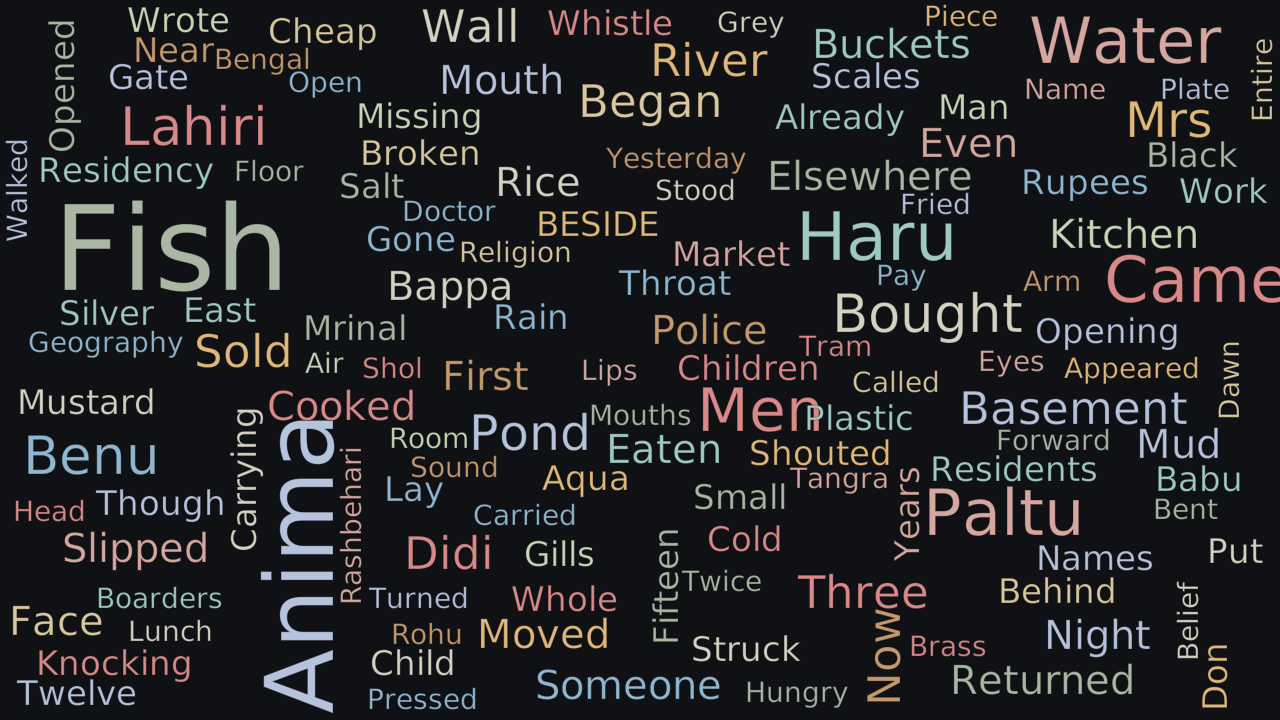
Word Cloud
Related reading
Selected by shared topics and section, with closer publication dates breaking ties.