The Good Boy Hunger
Uses the speech voice supplied by your browser or device.

THIS IS A WORK OF FICTION
The morning after the storm, Bhowanipore smelled of wet dust, frying oil, tuberose garlands, and drains promoted beyond their competence.
At the corner of Harish Mukherjee Road and a lane too narrow for dignity, the tea stall had reopened under a blue plastic sheet. Men stood with their trousers folded at the ankle, arguing about the municipal election, the price of onions, and whether the new building opposite had proper permission or only proper cousins. A taxi went by slowly, yellow paint blistered, horn bleating with the moral exhaustion of a goat. Above the tram wires, crows shook rain from their wings and abused one another like retired schoolmasters.
Anirban Chatterjee stood near the sweet shop, holding a packet of milk and trying not to vomit.
He was forty-three, though relatives still called him “good boy” with the persistence of mold. He had been a good boy at St. Lawrence, a good boy at Presidency, a good boy who touched elders’ feet, returned library books, never shouted at waiters, and apologized when others stepped on him. Even his failures had manners. His depression was not theatrical. It folded clothes, paid electricity bills late but with shame, avoided eye contact with the landlord, and said “I am managing” in a voice so polite it deserved to be slapped.
Inside his chest something was scratching.
“Dada, cha?” asked Montu, the tea-stall owner, already pouring because in Calcutta the body’s needs are decided communally.
“No,” Anirban said.
Montu looked offended. Refusing tea in the morning was not quite criminal but suggested foreign influence.
“You are looking very pale.”
“Acidity.”
“Everything is acidity now. Earlier people had sorrows. Now acidity.”
From the fish market came the metallic chop of boti on board. A woman in a green sari bargained over hilsa as if suing the fish personally. A boy dragged a sack of chicken waste toward the lane behind the market. The sack leaked.
The smell hit Anirban.
Not stink. Not exactly.
Warmth.
Salt.
A hidden sweetness under blood.
His mouth filled so suddenly with saliva that he turned away and spat into the gutter. The milk packet slipped from his hand and burst on the pavement, white running into black rainwater.
Montu laughed. “Bhalo! Even milk cannot tolerate this city.”
Anirban tried to laugh too, because that is what decent people do when something inside them has begun licking its teeth.
He went home through the lane past the old cinema poster wall, where a hero with painted muscles grinned above a notice for private tuition. His family’s flat was on the second floor of a three-storey house that had once been respectable and now survived by remembering it. The staircase smelled of damp cement, incense, and somebody’s boiled cabbage. On the landing, Mrs. Ghosh from the first floor was feeding Marie biscuits to a cat shaped like an accusation.
“Anirban,” she said, “your mother called me last night. You did not open the door.”
“I was sleeping.”
“So much sleep is also not good.”
“So little also not good.”
She smiled without enjoying him. “Your mother worries. You are her only son.”
This fact was produced daily in the building like morning milk.
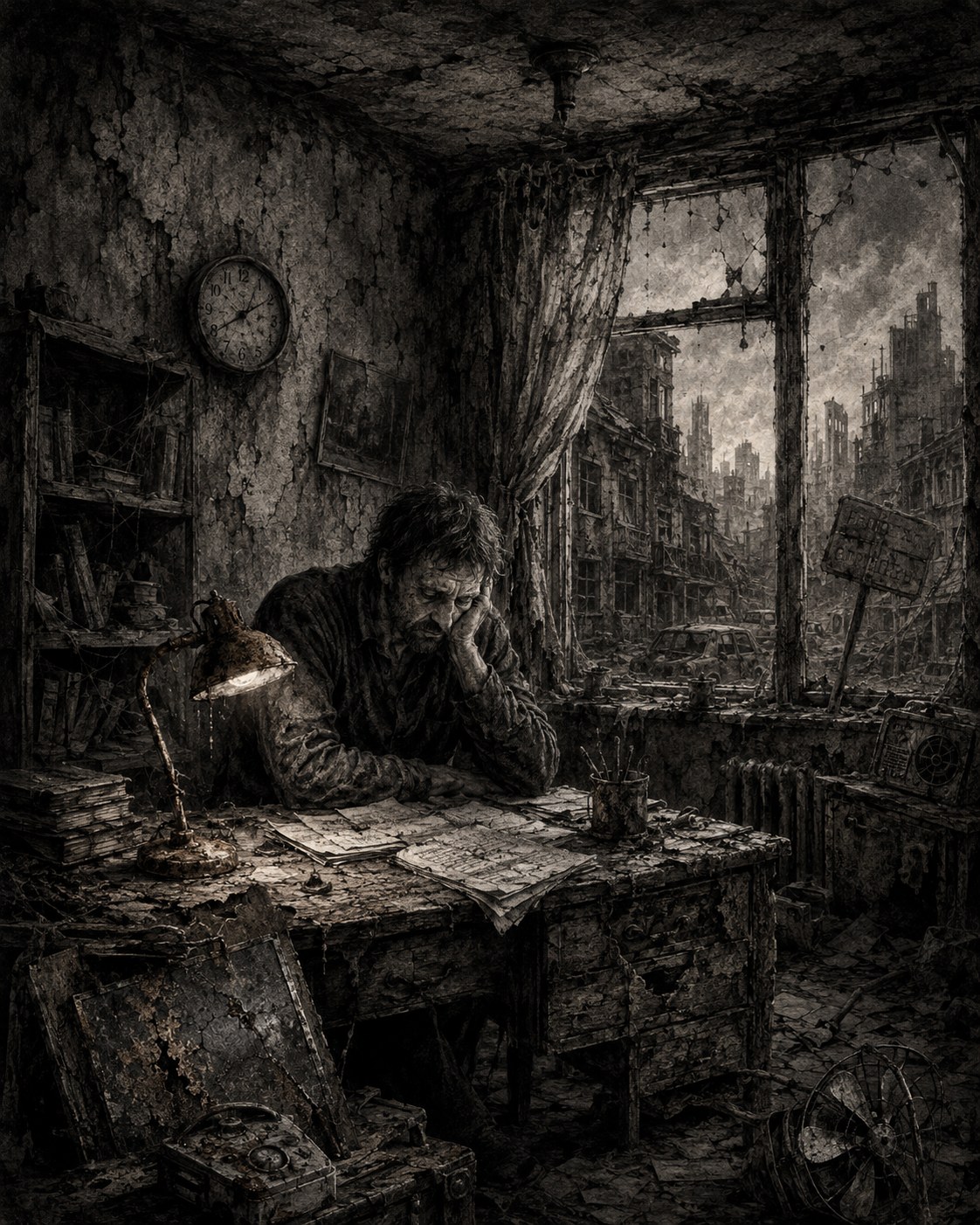
He unlocked the door. Inside, the drawing room stood as his father had left it before dying four years ago: cane sofa, glass-topped table, a bookcase with Bankim, Tagore, tax receipts, and a brown envelope marked IMPORTANT in his father’s careful hand. The ceiling fan rotated with a tired clicking sound. On the wall hung Anirban’s school prize certificate for elocution, framed by his mother after his father’s death, as if English pronunciation might yet save them.
His mother sat in the bedroom, propped on pillows, hair thin and silver, one ankle swollen. Sabitri Chatterjee had once run the house like a railway timetable. Now she ran it by suspicion.
“You went out?”
“Milk fell.”
“You fell?”
“Milk.”
“You look strange.”
“I did not sleep well.”
She watched him. Her eyes had become smaller with age but more exact, like needles after long use. “Did you take your medicine?”
The question entered the room and sat down.
Anirban looked at the bedside table. The amber strip of tablets was gone. The empty foil lay under yesterday’s newspaper. He had swallowed what remained after midnight with water from the blue filter, sitting on the bathroom floor because he did not want to make a mess on the bed. He had chosen the bathroom for its tiles, its drain, its modesty. Even at the edge of death, the Bengali middle class thinks of cleaning.
But death had apparently found the neighborhood inconvenient.
“I took it,” he said.
“How much?”
“As prescribed.”
Sabitri’s fingers tightened on the bedsheet.
He had not meant to survive. That was the shame sitting behind the question, combed and dressed. He remembered the tablets like little moons in his palm. He remembered apologizing aloud to nobody. He remembered his father’s voice from years ago, saying, Good boys don’t make their mothers cry, as if goodness were a municipal tax.
Then he remembered another voice, deeper, closer, from inside the tiles.
Not yet.
He had woken at dawn on the bathroom floor, cold and wet with sweat, his tongue thick, his heart galloping like a horse in a burning stable. His first thought was that he had failed even at this. His second was hunger.
Not hunger for rice, egg, toast, banana, tea.
Hunger with memory in it.
“I will make you muri,” his mother said.
“No.”
“Then toast.”
“No.”
“You have to eat.”
He left before she could see his face change.
In the kitchen, he opened the fridge. Half a lemon. Two green chilies. A steel bowl of dal. Yesterday’s potato curry. He ate with his fingers, cold, standing in the blue light. The dal tasted like wet paper. The potatoes like old socks. He found a packet of raw chicken in the freezer, bought for Sunday, still hard with ice.
His hand closed around it.
The packet came open easily under his nails.
He put the frozen meat to his mouth and bit.
The shock of it ran through him like current. His gums hurt. His eyes watered. He swallowed slivers of ice and flesh, gagging, then bit again with a low sound that did not belong to any good boy from Bhowanipore.
Behind him his mother said, “Anirban?”
He dropped the packet into the sink.
Sabitri stood in the kitchen doorway.
For a second neither spoke. In Calcutta, families can ignore unpaid debt, mental collapse, alcoholism, domestic cruelty, and whole genealogies of humiliation, but raw chicken at seven-thirty in the morning presented a fresh administrative challenge.
“It slipped,” Anirban said.
“From the freezer into your mouth?”
His mother had always been impossible to fool.
He washed his hands. Pink water ran into the sink. The smell rose, and he bent over it like a man hearing temple bells.
“Go lie down,” she said quietly.
“I have to call Dr. Sen.”
“No.”
“I will call.”
“No doctors.”
“Then what? You think I don’t know? You think I slept through the night? I heard you in the bathroom. I heard you crying. I heard the strips. I am old, not dead.”
His shame rose hot and almost human enough to save him. “Ma.”
She held up her palm. “Don’t say sorry. That word has become your occupation.”
From the lane came the cry of the vegetable seller: begun, potol, lau. Ordinary life, that vulgar immortal, continued downstairs.
Sabitri lowered her voice. “Your father also had this.”
Anirban stared at her.
“Not depression,” she said. “That everyone has now. Depression has become like coaching class. I mean this.”
“This?”
She looked at the sink, where a thin piece of chicken skin clung to the steel like a pale ear.
“You should not have taken so many tablets.”
He felt cold. “How do you know?”
“Because the house knows. I know. Your father knew.”
“My father died of a stroke.”
“No.”
Outside, someone’s pressure cooker whistled. Once. Twice. A domestic scream with perfect timing.
Sabitri sat at the kitchen chair because standing had become a negotiation with her bones. “There is an envelope in his bookcase. Brown one. He told me to burn it. I did not.”
“Why?”
“Because wives burn many things. Not everything.”
Anirban went to the drawing room.
The envelope marked IMPORTANT contained no insurance papers, no bank details, no ancestral deed rescued from East Bengal, no respectable disaster. Inside was a small black notebook and a photograph.
In the photograph, his father was young, perhaps twenty, standing in front of the old house before its ground floor was rented to a courier office. Beside him stood Anirban’s grandfather, whom Anirban knew only as a stern man with a moustache and excellent handwriting. Between them was a goat, garlanded.
On the back, in blue ink: For the fasting month. Keep him fed.
The notebook began in his father’s hand.
When the mind falls too low, the old hunger wakes.
Anirban read standing up, then sitting down, then with one hand pressed over his mouth.
It was not a diary exactly. It was a manual written by men ashamed of needing one. His father described “episodes” that came after despair, fever, sleeplessness, grief. In each, the affected man became first sensitive to smell, then unable to tolerate cooked food, then drawn to “warm flesh.” There were instructions. Lock the inner room. Keep raw goat liver in salt. Avoid funerals. Avoid hospitals. Avoid fish markets during rain. Never let the afflicted sleep hungry. Never let him believe he is only mad.
Halfway through, the handwriting changed. His grandfather’s older notes had been copied in. Before that, a great-granduncle. The Chatterjees, it seemed, had carried through history not wealth, not land, not even good cheekbones, but an appetite.
There were old family stories, recast in careful euphemism: a servant girl missing in 1939; a refugee cousin during Partition found “unfit for marriage” and kept in a locked room; a goat sacrificed every new moon though the family had never been particularly religious. The notebook had the stiff politeness of educated Bengali men attempting to discuss monstrosity without using vulgar words.
At the end, in his father’s final entry, the ink trembled.
I have not told Anirban. He is gentle. Perhaps the line has thinned. Perhaps education changes blood. Perhaps not. If he ever reaches for death, death may refuse him. Then hunger will come in its place.
Anirban closed the notebook.
For a ridiculous moment he wanted to laugh. Education changes blood. There was the whole Bengali project, neatly cooked and served: English-medium school, Rabindrasangeet, debating society, fountain pen, moral instruction, and underneath it a thing crouching in the dark, waiting for the good boy to despair deeply enough to open the cupboard.
The doorbell rang.
He nearly screamed.
Mrs. Ghosh stood outside with a steel bowl. “Your mother asked for posto yesterday.”
“Now is not—”
Her eyes moved past him into the flat. “Is she all right?”
“Yes.”
“You are sweating.”
“It is June.”
“It is always June for you people? Move aside.”
She entered without permission, as neighbors in old houses do, carrying entitlement in one hand and posto in the other. Her sari smelled faintly of talcum, fried cumin, and the cat she pretended not to love. Anirban stepped back too quickly. The hunger surged toward the soft place under her jaw.
He gripped the doorframe.
Mrs. Ghosh frowned. “What happened to your mouth?”
He touched his lip. Blood. His own. He had bitten himself.
“Nothing.”
From the bedroom Sabitri called, “Mitali, come.”
Mrs. Ghosh went in. Anirban shut the drawing-room door and stood with his forehead against it, listening to their voices blur.
His jaw hurt.
His teeth felt crowded.
On the table, his father’s notebook seemed to breathe.
He read more.
The afflicted may be restrained by shame for some hours. Then by affection. Then only by feeding.
There was a page of names.
Goat. Chicken. Dog. Rat.
Then, crossed out so hard the paper had torn: human.
Below that, in his father’s hand: If he asks, tell him love is also meat. It is a cruel sentence but true.
Anirban dropped the notebook.
The smell in the flat changed.
Mrs. Ghosh’s voice rose: “Didi, why did you not tell me? Last night also I heard—”
Then silence.
Not ordinary silence, which has fans and utensils in it. A silence with its throat cut.
Anirban opened the bedroom door.
His mother sat upright, eyes wide. Mrs. Ghosh stood beside the bed, looking at the floor.
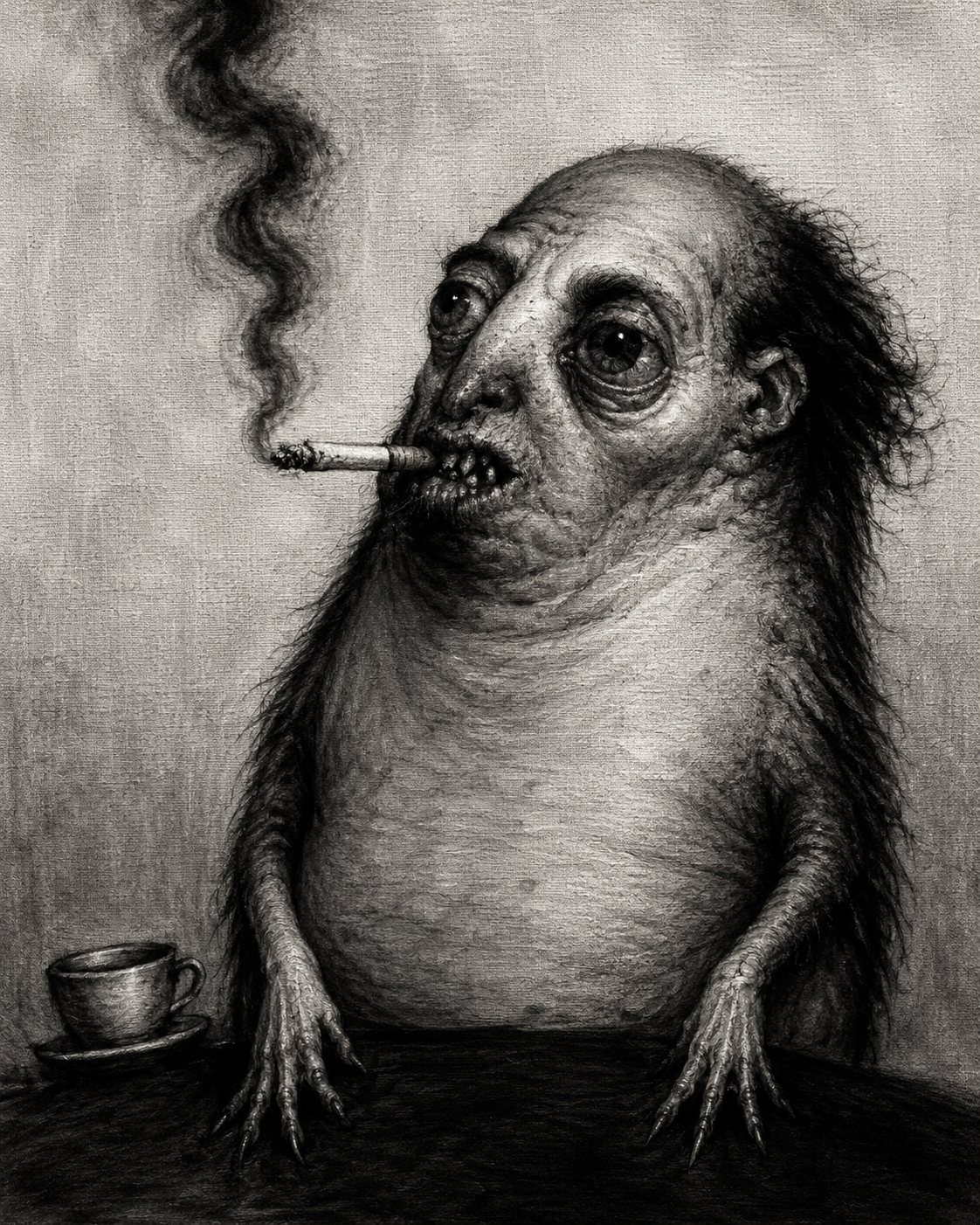
The cat had come in behind her. The fat grey creature lay near the almirah, dead, neck twisted, belly opened by something precise and furious. There was very little blood. That was the worst part. The room smelled of fur and heat and a freshness that made Anirban’s knees loosen.
Mrs. Ghosh made a sound like a child. “Buro?”
Anirban backed away.
“I did not touch it,” Sabitri said.
Her face had changed. Not with fear. With recognition.
The cat’s small pink tongue protruded, absurdly polite.
Mrs. Ghosh turned on Anirban. “What did you do?”
“Nothing.”
“You sick man. You mad—”
Sabitri slapped her.
It was not a strong slap, but it had forty years of neighborhood discipline behind it. Mrs. Ghosh staggered more from insult than force.
“Go home,” Sabitri said.
“My cat—”
“Go home and say a dog came. Say anything. If you make noise, your own son in Salt Lake will have to come here and pretend to care. Do you want that inconvenience?”
It was a cruel shot and perfectly aimed. Mrs. Ghosh’s mouth trembled. Contemporary family life had made everyone vulnerable in the same place: children who left, parents who pretended this was success, loneliness varnished as progress.
She lifted the cat in the end with both hands, weeping silently, and left without looking at Anirban.
When the door closed, Sabitri locked it.
“Ma,” Anirban whispered. “Did I do this?”
“No.”
“Then who?”
She said nothing.
The room tilted.
“You?”
Her eyes filled, not with guilt exactly, but with the exhaustion of someone who had carried a trunk too long and finally set it down on a foot.
“It does not always pass from father to son,” she said. “Sometimes wife catches husband’s hunger. Sometimes mother keeps son’s share.”
“That is nonsense.”
“Good. Keep saying English words. They are strong doors.”
She tried to stand. Her legs failed. Anirban went to help her and stopped because the smell of her skin rose up—medicine, coconut oil, old cotton, salt, warm blood moving under paper-thin flesh.
He stepped back.
Sabitri saw.
For the first time that day, she looked frightened.
“Lock me in,” he said.
“No.”
“Lock me in the storeroom.”
“No.”
“Ma.”
“You think I kept you alive forty-three years to feed you to a storeroom?”
He laughed once, badly. “You didn’t keep me alive. I tried to die.”
“Yes,” she said. “And see what came to object.”
Toward evening the power went out.
Calcutta in a power cut becomes older at once. The building lost its fan-noise, its television quarrels, its refrigerator hum. Rain began again, soft at first, then hard, drumming on tin shades and balcony grills. Somewhere a child recited multiplication tables by rechargeable lamp. Somewhere a man cursed the electricity board with the tenderness of long acquaintance.
Anirban sat on the bathroom floor with the door bolted from outside. His mother had agreed only after he carried every knife, razor, scissors, and screwdriver to her bed. He had also carried the packet of raw chicken and left it outside like an offering.
He could hear her moving slowly in the kitchen.
“Don’t open,” he called.
“I am not a fool.”
“You opened for Baba?”
A pause.
“Once.”
The word came through the door thin as smoke.
“What happened?”
“He cried afterward.”
That frightened Anirban more than any scream.
The hunger rose with the dark.
It was not simple appetite now. It had images inside it. His mother’s wrist. Montu’s tea-brown fingers. Mrs. Ghosh’s soft arm. His own tongue. The city itself seemed made of biteable things: earlobes under umbrellas, schoolchildren’s knees, fishwives’ shoulders, the tender temples of men asleep in buses.
He pressed his palms to his ears.
From the other side of the door came a wet slap.
“Ma?”
No answer.
Another slap. Then a tearing sound.
“Ma!”
“Eating,” she said.
Her voice was thick.
“What?”
“Chicken.”
“Cooked?”
A little laugh. Not hers.
He stood. The bathroom seemed smaller. The bucket, the mug, the cracked mirror, the detergent packet—ordinary objects arranged around an impossible fact. In the mirror his face looked both thinner and swollen, eyes bright, lips drawn back. His teeth were bloody again. He had bitten his own forearm without noticing. The pain was distant. The taste was intimate.
The bolt slid.
He stepped away from the door. “Don’t.”
Sabitri opened it.
She stood in the corridor holding the raw chicken packet. Her mouth was red. Her white hair had come loose. She looked at once ridiculous and majestic, like an old goddess interrupted during lunch.
“I cannot keep it down,” she said. “It wants fresher.”
“Lock the door.”
“I can’t.”
“Lock it.”
“I said I can’t.”
Behind her, the drawing-room window was open. Rain blew in over the bookcase. The brown envelope lay on the table, pages fluttering. A smell came from the stairwell.
Human.
Not one person. Many. The building, the lane, the city stacked and steaming in rain.
Anirban’s body moved before his mind did. He pushed past his mother and slammed the main door shut just as someone knocked.
“Dada?” Montu’s voice. “Your mother called? She said bring mutton liver.”
Anirban turned.
Sabitri was looking at him with horror.
“I did not call,” she said.
The knock came again.
“Dada? Open. Rain is killing me.”
The old black notebook lay open on the table. A line he had missed before seemed now to darken on the page.
When hunger begins to speak in familiar voices, do not trust any summons.
Montu knocked harder. “Dada, your mother is unwell. Open.”
Anirban put his back to the door.
His mother whispered, “It is not him.”
Outside, Montu laughed. Not Montu’s laugh. Too many teeth in it.
Then Mrs. Ghosh’s voice: “Anirban, please. Buro is alive. He came back.”
Then his father’s voice, dead four years, gentle and disappointed: “Open, good boy.”
Sabitri covered her ears.
The door shook.
The hunger inside Anirban answered the hunger outside. It was not a curse in one body. It was a family invitation. A table being laid.
He understood then what his father had hidden and his mother had half-confessed. The Chatterjees had not merely suffered the hunger. They had fed it down the years with substitutes, goats, chickens, neighborhood animals, silence. They had mistaken delay for decency. They had called it management, as respectable people call every slow catastrophe until it eats the furniture.
The final page of the notebook had been stuck to another by damp. He peeled it apart with shaking fingers.
His father’s last message waited beneath.
If it wakes in him, do not feed him. Hunger fed becomes lineage. Hunger starved becomes witness. The afflicted must choose while still able to love. Fire ends the account.
Anirban looked at his mother.
She had read the line before. Of course she had.
“You were supposed to burn it,” he said.
“I was supposed to burn many things.”
The doorframe cracked.
Sabitri stepped toward him. Her mouth trembled. “I could not lose you.”
“I was already lost.”
“No.”
“Yes.”
He took her hand. The hunger roared at the contact. Her pulse knocked against his fingers, small and perfect.
He led her to the balcony.
Below, rain silvered the lane. Montu’s tea stall glowed dimly under its plastic sheet, though no lamp was lit. Figures stood in the rain looking up at the flat. Too still. Too patient. Mrs. Ghosh held her dead cat in her arms. His father stood among them in his old white punjabi, face turned upward, not accusing now. Hungry.
In the drawing room, the door began to splinter.
Anirban picked up the kerosene can kept for the old stove they no longer used. His hands were steady. This surprised him. All his life he had thought courage would feel clean. It felt instead like exhaustion given direction.
“Go to the bathroom,” he told his mother. “Wet towels. Close the door.”
She understood at once.
“No.”
“Ma.”
“No.”
“You said good boys don’t make mothers cry.”
“That was your father’s nonsense.”
“I know.”
He smiled then, and for a second he was ten years old, reciting a poem in polished English while his parents sat in the school auditorium, proud and terrified of fees.
“I am not being good,” he said. “I am being your son.”
The main door burst inward.
What came through was not Montu, not Mrs. Ghosh, not his father, but the shape appetite takes when invited too often: familiar faces stretched around a common mouth.
Anirban struck the match.
For one moment, before the kerosene caught, he saw the final truth clearly. His overdose had not created the monster. It had interrupted the long family arrangement. Death had refused him because something older had already claimed the Chatterjees, feeding politely through generations of silence, surviving on shame, on substitutes, on mothers who could not let sons suffer, on fathers who believed secrets were kindness.
The flame ran across the floor with a soft domestic whoosh, almost cheerful.
Behind him, in the bathroom, his mother was sobbing.
Ahead, the hungry dead opened their arms.
Anirban stepped toward them because the door had to close from inside.
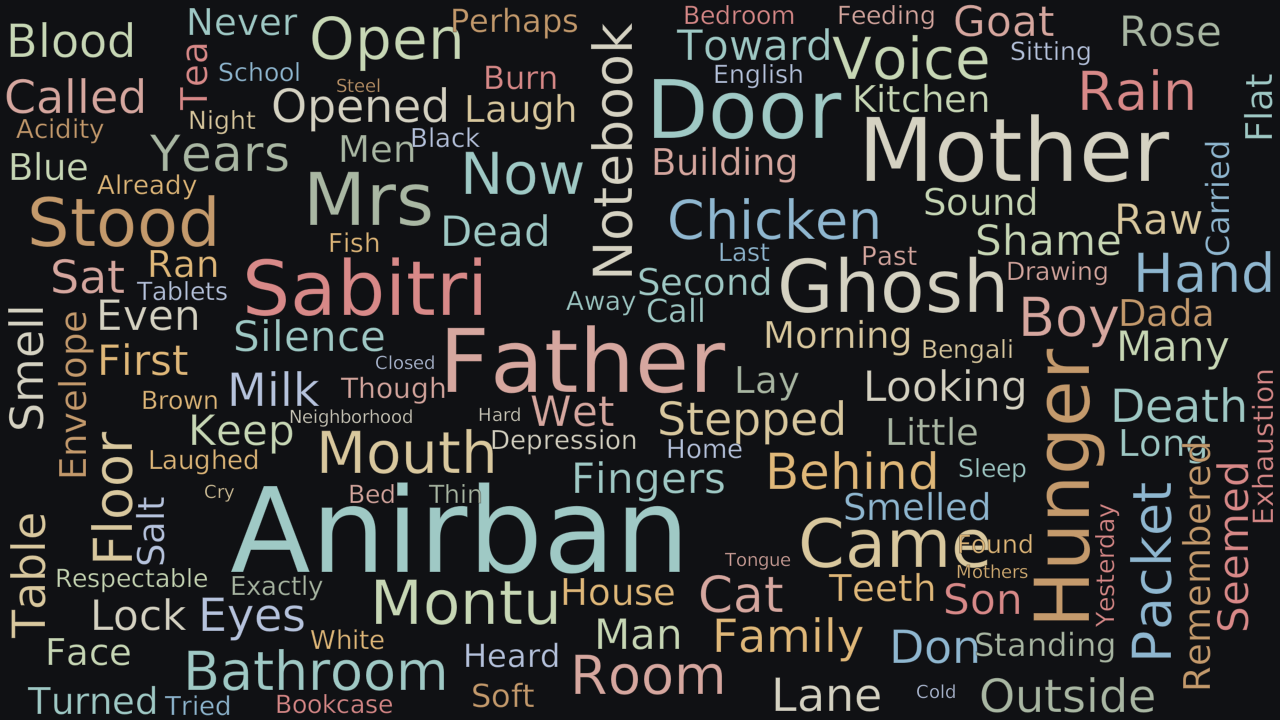
Word Cloud
Related reading
Selected by shared topics and section, with closer publication dates breaking ties.