One Program at a Time
Uses the speech voice supplied by your browser or device.

The photograph contains no monument, celebrity, or event worth troubling a newspaper archive about. It shows a corner of our small apartment in South Sinthee: curtains, a painted wall, a table covered with cloth, a bulky monitor, a computer cabinet, a speaker balanced on top, and a printer waiting below like a household animal that had been told to remain quiet. Yet the photograph has acquired weight. It carries more history than many grand buildings because nearly everyone who made that room possible has either grown old, disappeared, or failed to become the person everyone expected.
My mother chose those curtains. She painted and arranged the apartment with the seriousness that Bengali families once reserved for building a home out of almost nothing. Money was limited, rooms were small, and nothing arrived already coordinated by an interior designer wearing black spectacles and charging the annual income of a schoolteacher. A wall had to be painted by someone. Curtains had to be selected from a shop, carried home, measured, altered, hung, judged, removed, adjusted, and finally accepted. A tablecloth was not decor. It was camouflage for poverty, protection from dust, and an assertion that the household had not surrendered.
My mother is still alive, thankfully. Age has weakened her, as age does without asking permission, but age has not acted alone. My failures have contributed their own sediment. Old people should not have to watch their children become uncertain shadows. They should be allowed the modest comfort of believing the long experiment worked. Instead, she has had to observe me grow older without arriving anywhere recognizable, carrying education, experience, and intelligence around like obsolete railway luggage for a destination where the train no longer stops.
The computer in the photograph belonged to another geological period. I was studying Computer Science and Engineering at Jadavpur University in the middle and late 1990s, when a desktop computer was still a substantial family purchase rather than an object replaced because its camera had acquired one fewer artificial moon mode. My syllabus required Pascal, COBOL, C, and C++, along with the usual academic material that professors delivered as if the machine itself were a minor inconvenience surrounding the theory.
My father bought me a computer more advanced than my meager coursework required. The purchase was not merely technical. It was an investment in prophecy.
He expected something extraordinary from me. In his eyes I was not simply his son with examination marks and an appetite for books. I was Vishnu, or close enough for domestic purposes: capable, destined, perhaps carrying several invisible arms with which I would seize the future while everyone else applauded from the veranda. Fathers can manufacture such myths because children are small and possibility is cheap. The child then grows up and discovers that destiny has no customer-service department.
My father is gone. I did not become extraordinary.
This is where language becomes slippery. I dislike the modern use of the word love. It has been spread across advertisements, restaurant reviews, software products, political slogans, and photographs of sandwiches until it means approximately, “I experienced a pleasant twitch.” But I will use it in the old-fashioned sense, the sense it carried when I was a child and words had not yet been processed into promotional foam.
I love my mother. I loved my father. I love this city and this country, though both can behave like relatives who borrow money, insult your clothes, and then ask why you do not visit more often. I still love people from my past, including some who have forgotten me, some who would prefer not to remember me, and some who now exist only as voices attached to old rooms.
None of this alters the balance sheet.
I failed to become anyone of repute. I accumulated no durable accomplishment large enough to shelter behind. I have no impressive future waiting politely outside. I became what I trained my childhood mind not to become: an ordinary failure.
I apologize for not living up to my expectations or anyone else’s. I offer no dramatic excuse. There was no single villain, no cinematic betrayal, no secret conspiracy conducted by men in tinted cars. Circumstances mattered, illness mattered, money mattered, mistakes mattered, and chance certainly wandered through the premises knocking over furniture. But beneath all explanation sits the embarrassing possibility that I was simply an ordinary person who tried and did not succeed.
The ordinary person without visible achievement has become socially suspicious. He is treated as residue. Modern life does not merely ask whether you are decent, useful, truthful, or kind. It asks for metrics. Where is the title? Where is the company? Where is the funding announcement? Where is the photograph of you pointing at a screen during a conference whose attendees are mostly waiting for lunch?
LinkedIn has perfected this civilization of ceremonial self-congratulation. Every career detour becomes a transformative journey. Every dismissal becomes an opportunity for reflection. Every mediocre executive is humbled and honored to announce that he has accepted the sacred responsibility of becoming Senior Vice President of Strategic Vapors. People congratulate him by the hundred, including several who hope he will soon be eaten by wolves.
I could never make that performance my life’s purpose. An empty existence does not become meaningful merely because it has a polished profile photograph and a paragraph about leadership. A hollow man remains hollow even when endorsed for stakeholder management. Morals, scruples, loyalty, and human value may be poor instruments for career acceleration, but I could never persuade myself that they were therefore unimportant.
This is not a claim of purity. Failure does not automatically make a man virtuous. The unsuccessful can be vain, dishonest, cruel, pompous, and tiresome. Poverty is not sainthood with cheaper shoes. I have my share of defects and probably several surplus ones stored in an upstairs cupboard. But I cannot call a fraud successful merely because the fraud owns better furniture.
So I have resigned myself, at least partly, to a mediocre reality: disappearing from people, institutions, and expectations, somewhere in the shanty boondocks of Calcutta, maintaining a tiny existence that does not photograph well. There is loneliness in this, but also relief. Once the parade has passed without you, there is no need to keep polishing a uniform.
Still, I continue.
One post at a time. One program at a time. One idea carried a little farther than yesterday. These are not achievements that will cause former classmates to lean back in astonishment. No magazine will place me on a cover beneath the words VISIONARY REDEFINING THE FUTURE. The future has endured enough redefining.
But a small effort matters because it keeps the machinery from seizing. A paragraph written today establishes that I was here today. A program completed proves that my mind can still take an abstract thought, break it into instructions, and make a machine obey. These are humble acts, but survival is largely composed of humble acts performed without applause.

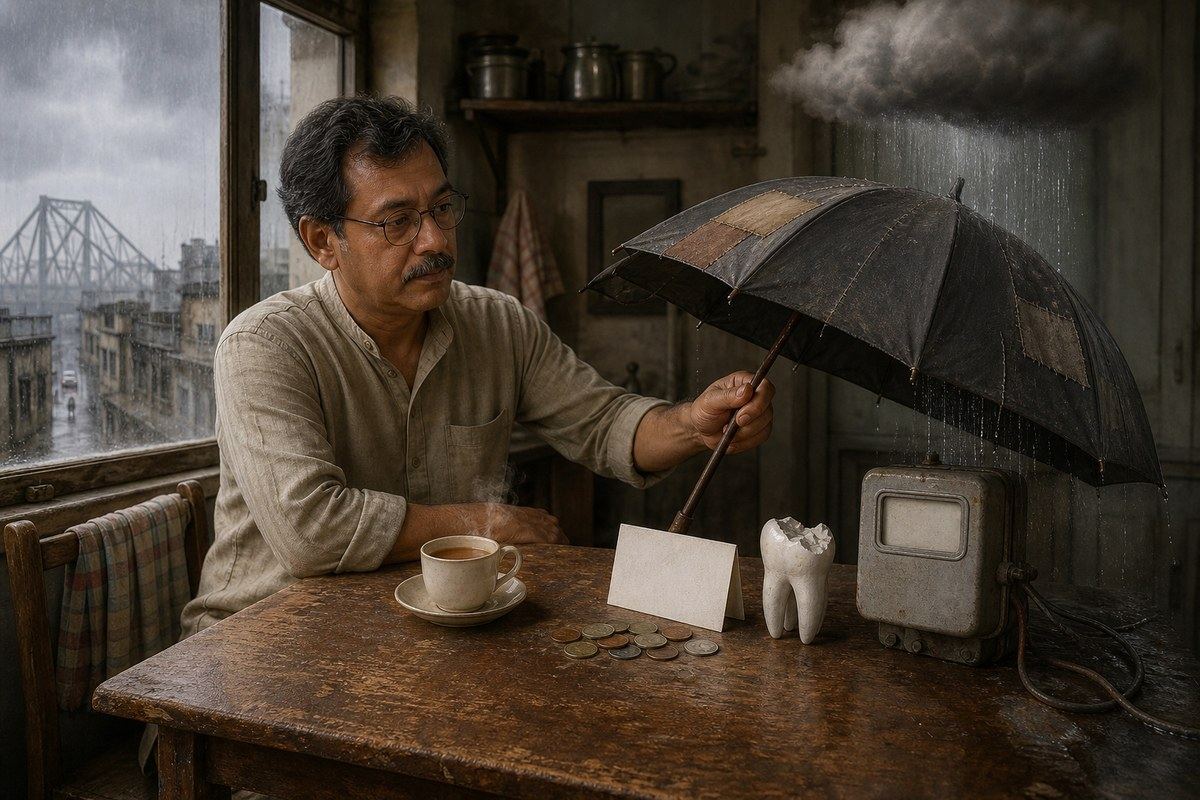
My persistence resembles the Howrah Bridge against a hellscape of a red setting sun: old, overburdened, unglamorous, and still carrying traffic. The bridge does not ask whether the people crossing it admire its emotional resilience. It holds. Buses grind across it, taxis honk, pedestrians hurry, the river moves below, and the iron continues doing the work for which it was built.
Perhaps that is enough.
The photograph preserves a room assembled by people who believed in me. My mother’s curtains remain gathered on both sides of a doorway. My father’s computer sits on the table, large and hopeful. Somewhere beyond the frame is the young man I was, preparing for a future that did not occur.
I cannot repair that future. I cannot return the investment with the extraordinary life my father imagined or give my mother the peaceful old age I wanted her to have. I cannot manufacture achievement retrospectively by changing the nouns in my biography.
I can only work with what remains.
One thought. One small effort. One post. One program.
An ordinary Bengali man in an ordinary life, living alone, trying to exist—and, for another day, succeeding at least in that.
Word Cloud
Related reading
Selected by shared topics and section, with closer publication dates breaking ties.