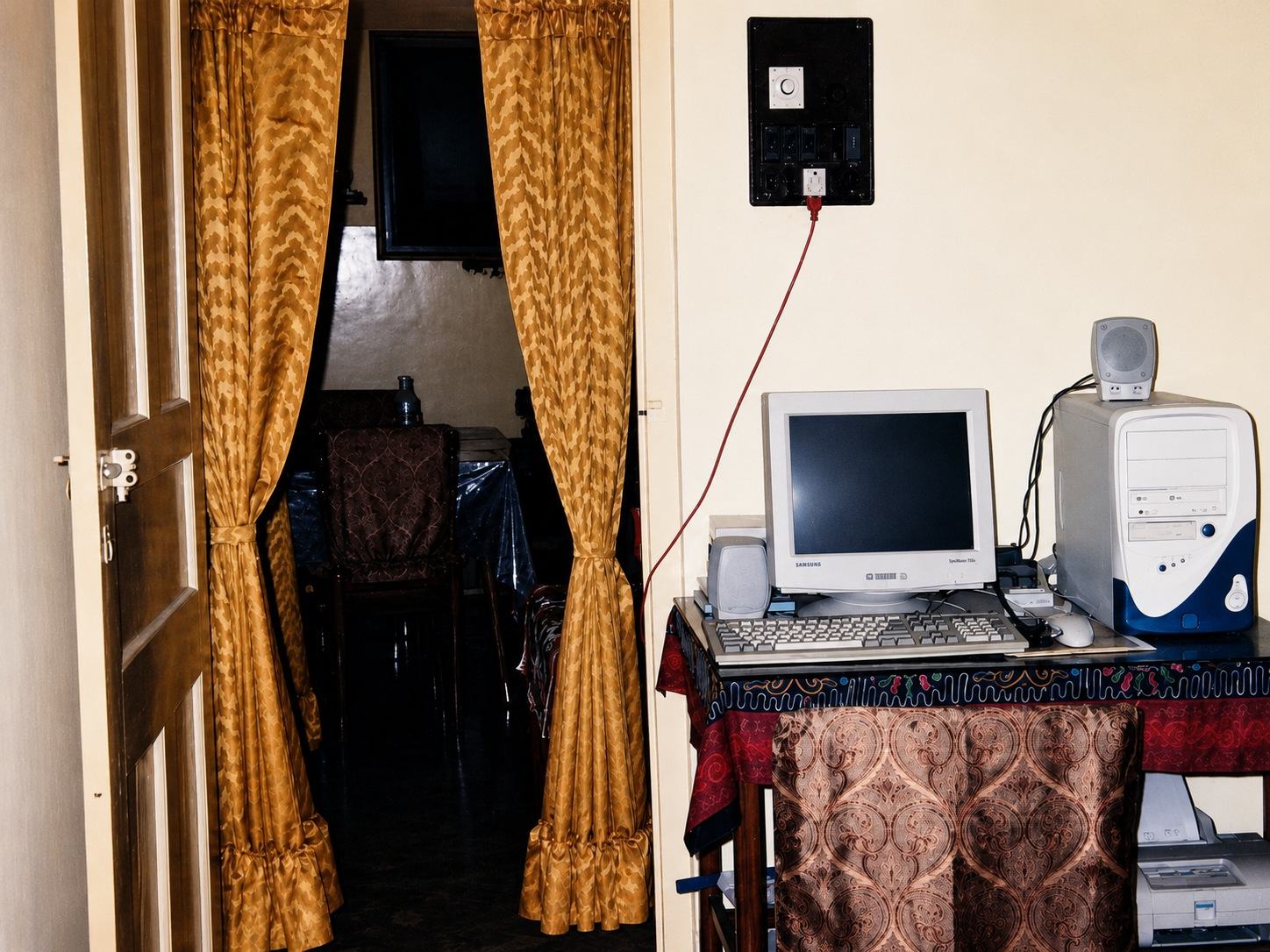
Chronic Traumatic Nihilism From Calcutta
Uses the speech voice supplied by your browser or device.

Acronyms expanded in this post:
- AI: Artificial Intelligence. software that generates, classifies, predicts, summarizes, or acts on patterns in data.
- IT: Information Technology. the practice of building, operating, and supporting computing systems.
Chronic traumatic nihilism is what happens when life does not break you theatrically, with thunder, violins, and a suitable black umbrella, but keeps tapping the same cracked tile every morning until the whole floor learns to sound hollow.
This is not the glamorous nihilism of European philosophers with magnificent beards and enough leisure to despise existence between coffee and correspondence. This is not the adolescent nihilism of black T-shirts, unread Nietzsche, and one heroic cigarette behind the school building. This is the working nihilism of the middle-aged middle-class Bengali who has seen too much collapse without enough catastrophe to be dignified by it. It arrives not as a doctrine but as a habit of interpretation. The phone rings, and before picking it up, the mind has already drafted the bad news. The doorbell rings, and the body stiffens as if the postman has personally come to audit one’s failures. Some people call this negativity. They are fortunate. They still believe moods are decorative curtains and not load-bearing walls.
The phrase sounds grander than the thing itself. Chronic because it repeats. Traumatic because repetition is not harmless merely because it is ordinary. Nihilism because meaning, after enough small humiliations, begins to look like a luxury item imported by people who have not recently stood in a pharmacy calculating whether relief can be bought in strips of ten tablets or five. From inside the condition, one does not say, “I reject metaphysical value.” One says, “Ki hobe?” What will happen? What is the point? Who cares? Who will help? Which queue is this now? The Bengali version is shorter, better, and more poisonous.
Calcutta is a fine laboratory for this state of mind because the city itself has mastered the art of continuing after several historical nervous breakdowns. It does not fall. It leans. It sweats, coughs, negotiates, lectures, blocks the drain, writes poetry, loses power, misplaces files, and then asks for exact change. The middle class here lives inside a museum of postponed repairs. Old houses stand like retired barristers in damp vests. Tramlines remember an empire nobody can afford to maintain. The tea shop philosopher explains geopolitics while owing money to the biscuit tin. Everything carries evidence of former ambition and current improvisation. To grow older here is to learn that decay is not the opposite of life. It is one of its administrative departments.
For a middle-aged middle-class Bengali, especially one with bipolar disorder [a mood condition in which episodes of depression, elevation, agitation, energy, sleep disturbance, and judgment can move with frightening force], nihilism is not merely an idea. It can become an atmosphere. During depression, the mind develops a talent for documentary filmmaking. It edits every failure into a single continuous reel and screens it privately at three in the morning. During elevation or agitation, reality may briefly appear negotiable, even conquerable, like a corrupt clerk who can be shouted into movement. Then the bill arrives. Biology, history, money, shame, family expectation, and civic absurdity sit at the same table, each insisting it ordered nothing but will not split the cost.
The cruel thing about bipolarity is not only mood. Mood is the poster. The machinery behind it is more intimate. Sleep becomes a treaty with the gods. Energy becomes unreliable currency. Confidence may be genuine one day and counterfeit the next. Memory becomes prosecutor, witness, and unreliable stenographer. Regret comes with excellent documentation. In a society that still treats mental illness as either weakness, drama, or a family embarrassment to be hidden behind the good curtains, the bipolar Bengali must become both patient and public relations department. One must suffer, explain the suffering, apologize for the inconvenience, deny the worst interpretations, and still remember to behave respectably when relatives arrive with sweets and surveillance.
The middle class adds its own slow acid. It teaches aspiration without insulation. It says education will save you, but not always. It says English will save you, but only if spoken with the correct mixture of confidence, usefulness, and market timing. It says talent will save you, while quietly forwarding the job to a nephew. It says dignity matters, then prices dignity above your monthly income. The poor are denied comfort openly. The rich buy exits. The middle class is given awareness without sufficient escape. That is a special punishment. You can understand the trap in three languages and still be trapped.
Chronic traumatic nihilism begins when the mind notices that effort and outcome are not relatives. They occasionally meet at weddings, nod politely, and return to separate addresses. A person studies, works, behaves, waits, adapts, migrates, returns, starts again, watches technology eat one ladder after another, watches younger people become cheaper, faster, shinier, more algorithmically acceptable, and eventually the old moral machinery starts making a grinding sound. The nursery rhyme version of life says that sincerity plus effort produces improvement. The adult version says that sincerity plus effort produces paperwork, medical bills, and the opportunity to be told you should have networked better.
In Calcutta, even despair must stand in line.
The non-obvious injury is not that life is difficult. Everyone knows that, even the cheerful. The injury is that after repeated reversals, the mind stops trusting sequence. Cause and effect become suspicious characters. You do the right thing and something still breaks. You rest and feel guilty. You work and fall ill. You speak honestly and become inconvenient. You stay silent and become complicit. You hope and are punished by hope’s unpaid invoice. Eventually the psyche develops what might be called defensive meaninglessness. It refuses to invest too deeply in any promise because investment has previously behaved like a pickpocket.
This is often mistaken for laziness, cynicism, or bad attitude. It may look like all three from outside. From inside, it is closer to scar tissue. Scar tissue is not pretty, but it is not imaginary. The person who says “nothing matters” may not actually believe nothing matters. He may believe too many things mattered, and each extracted a tax. Love mattered. Work mattered. Parents mattered. Reputation mattered. Health mattered. Art mattered. Country mattered. The bill came itemized. Nihilism, then, is not absence of value. It is value after repeated concussion.
Bengali culture complicates this because it is simultaneously sentimental and savage. It can produce songs of unbearable tenderness and social judgments sharp enough to shave a goat. It will quote Tagore at breakfast and quietly measure your income by lunch. It loves books, exams, fish, debate, diagnosis, and moral commentary. It can recognize melancholy when sung, but not always when it is sitting unwashed in the next room unable to answer WhatsApp messages. The culture has a rich vocabulary for sorrow as literature and a poorer one for sorrow as maintenance problem. We can admire suffering when it rhymes. We become less generous when it misses deadlines.
Add middle age, and the matter darkens. At twenty-five, failure is tragic but still photogenic. At fifty-one, failure grows administrative. It has folders. It has prescriptions. It has dental neglect, blood reports, aging parents, fading contacts, obsolete skills, and friends who have either prospered, disappeared, died, or become motivational on LinkedIn. The body, once a donkey of loyal stupidity, begins issuing legal notices. The knees vote against stairs. The gums secede. Sleep becomes a temperamental landlord. Desire remains, but now with terms and conditions. Even ambition, that noisy fellow, lowers his voice before entering the room.
Then comes the modern insult: artificial intelligence [AI, software systems that can generate, classify, summarize, predict, and act on patterns in data] arriving not as a clean technological future but as another instrument in the old orchestra of inequality. The confident use it to become more confident. The mediocre use it to become more professionally upholstered. The ignorant use it as fog machine and megaphone. Those who already understood things may use it as tool. Those who understood little may use it as costume. Knowledge arbitrage, always present in India like damp in the wall, has received a powered exoskeleton. The man who once pretended to know Excel now pretends to command civilization through prompts. The mask has become cheaper, and the market, being the market, often applauds the mask before checking whether there is a face behind it.
For someone already prone to despair, this is not merely annoying. It is metaphysical comedy with broken glass in it. You spend decades learning that knowledge is slow, exacting, humiliating, corrigible, and earned through error. Then a new public culture forms in which speed imitates mastery, fluency imitates thought, and everyone appears to be emerging from behind a digital burqa, perfectly lit, perfectly phrased, and possibly empty. The bipolar mind, already sensitive to inflation and collapse, sees in this a cruel parody of itself: grandiosity everywhere, depression nowhere acknowledged, correction treated as hostility, and confusion dressed as strategy.
Yet the danger is not AI. The danger is pretending that tools can compensate for undeveloped minds, broken institutions, cowardly families, predatory markets, and a society allergic to admitting ignorance. A hammer can build a table or smash a thumb. But if the carpenter is drunk, the workshop is corrupt, the wood is stolen, and the customer wants a palace by Friday, the hammer is not the philosophical center of the problem.
Chronic traumatic nihilism persists because it is socially reinforced. The individual is told to be resilient, but the system remains casually sadistic. The citizen is told to be hopeful, but governance behaves like a rumor. The worker is told to upskill, but the market wants youth at discount. The patient is told to seek help, but care is expensive, stigmatized, patchy, and often delivered with the bedside warmth of a railway enquiry counter. The family says it supports you, but mostly supports the version of you that does not disturb furniture. The city says it loves culture, but lets artists, teachers, clerks, patients, and aging professionals rot quietly as long as they do not block traffic.
There is another layer, uglier. Many people do not want the wounded to recover too much. A damaged person is useful if he confirms the family mythology, the social hierarchy, the office gossip, the neighborhood theory of merit. Recovery is disruptive. It asks who benefited from the collapse. It asks why help was withheld. It asks why cruelty wore the costume of advice. A chronically injured mind may internalize the verdicts of its surroundings until nihilism becomes a kind of loyalty to the people who diminished it. One continues their work privately. One becomes one’s own small committee of contempt.
But the condition is not destiny. It only feels like destiny, which is one of its better tricks.
The first practical rebellion is precision. Do not call every wound a philosophy. Some despair is biochemical. Some is economic. Some is loneliness. Some is untreated illness. Some is humiliation stored in the body. Some is the ordinary grief of aging in a country where the middle class is praised in speeches and squeezed in practice. To name these separately is not self-help decoration. It is intellectual hygiene. A muddy diagnosis produces muddy action. If the sink is leaking, the answer is not a seminar on water. If the mind is cycling through dangerous lows and reckless highs, the answer is not moral scolding. If the job market is structurally hostile to older workers, the answer is not another inspirational quote with a sunrise behind it.
The second rebellion is to reduce the size of meaning. Grand meaning may be unavailable. Fine. Use smaller denominations. Meaning can be a repaired paragraph. A clean blood test. A paid bill. A tolerable morning. A page read slowly. A song that does not lie. A friend who does not convert your suffering into content. A doctor who listens. A walk through Gariahat where the fish smell, honking, bargaining, sweat, cheap plastic, expensive fruit, and human absurdity all announce that the world is not good, exactly, but it is still excessively present. Nihilism hates the specific. It prefers fog. Specificity is a matchstick.
The third rebellion is to stop confusing mood with verdict. A depressed mind speaks with the authority of a High Court judge and the evidence standards of a drunk astrologer. It says always, never, nothing, everyone, finished. These are not thoughts. They are weather reports pretending to be scripture. The task is not to become cheerful on command, which is an obscene request, but to introduce procedural doubt. Perhaps the mind is right. Perhaps it is ill. Perhaps it is tired. Perhaps it is narrating from a chemical ditch. The sentence “I feel that life is pointless” is more accurate, and therefore less tyrannical, than “life is pointless.” The small grammar matters. It puts a railing beside the well.
The fourth rebellion is work, but not the fake holy work sold by productivity merchants. I mean bounded work. Work with edges. A thing done because it can be done, not because it will redeem the species. Write the paragraph. Fix the file. Learn the concept. Clean the table. Make the call. Take the medicine if medicine has been prescribed. Sleep as if sleep were infrastructure, because for some minds it is. Refuse the heroic plan when the modest repeatable plan will do. The middle-aged brain, especially after trauma, does not need more motivational fireworks. It needs voltage stability.
None of this produces a clean solution. That must be admitted, otherwise we are back in the temple of fraud. Some injuries do not disappear. Some families do not become wise. Some markets do not become fair. Some illnesses require lifelong management. Some losses cannot be repainted as lessons without insulting the dead parts of oneself. There are months when survival itself is undignified, boring, expensive, and faintly comic, like trying to keep a ceiling fan alive by praising it. A realistic philosophy must leave room for this. Otherwise it becomes another policeman.
But chronic traumatic nihilism has one weakness. It depends on totalization. It wants every bad event to mean the same thing. It wants the unpaid bill, the failed career turn, the bipolar crash, the corrupt politician, the AI fraud, the family insult, the toothache, and the leaking ceiling to merge into one black administrative stamp reading: rejected. The countermeasure is not optimism. Optimism is too pink and often too stupid. The countermeasure is differentiation. This hurts, but it is not that. This failed, but it is not everything. This person betrayed me, but not all persons are this person. This city is decaying, but decay is not the only verb it knows.
A Calcutta perspective helps here because the city, despite all evidence, continues to specialize in partial continuance. Nothing is entirely repaired. Nothing is entirely abandoned. A para club can be ridiculous and still organize help during a flood. A decaying bookstall can contain a universe. A bitter old man can still know the exact line of a song that makes the afternoon pause. A tea glass can be both unhygienic and medicinal to the soul. This is not romance. Romance is dangerous when applied to poverty, illness, or neglect. But it is evidence against total darkness. Even broken systems leak light, though not enough and not on schedule.
The middle-aged middle-class bipolar Bengali does not need to become a motivational emblem. He does not need to prove that suffering made him noble. Suffering often makes people tired, suspicious, irritable, funny in unfortunate ways, and very knowledgeable about pharmacies. That is less marketable but more accurate. What he needs, perhaps, is a philosophy stern enough to face the damage and modest enough not to counterfeit redemption. He needs treatment where treatment is needed, money where money is needed, companionship where companionship is needed, and solitude where people have become mosquitoes with opinions. He needs fewer slogans and more working systems. So does the city. So does the country.
The final insult of nihilism is that it claims to be sophistication when often it is exhaustion wearing spectacles. The final defense against it is not belief in some grand cosmic purpose, which may be unavailable, unbelievable, or simply none of our business. The defense is craft. The craft of living one hour without turning it into a referendum on existence. The craft of reading without scrolling away from one’s own mind. The craft of knowing when the brain is ill and when the world is. The craft of refusing fraudulent hope while still making tea. The craft of saying, with no heavenly compensation counter in sight, that this life is damaged, absurd, unfair, biologically treacherous, socially rigged, and still the only workshop currently open.
So one continues. Not because everything matters. Not because nothing does. But because the distinction itself must be protected from the swamp. In Calcutta, that may be enough for one morning. And some mornings, one morning is not a small unit. It is the whole republic.
Related Posts
Word Cloud
Related reading
Selected by shared topics and section, with closer publication dates breaking ties.