The Sofa Bird
Uses the speech voice supplied by your browser or device.

THIS IS A WORK OF FICTION
The bird arrived during load-shedding, which in that part of North Calcutta was less an event than a municipal opinion.
At eight in the evening the lane outside Anirban’s rented flat had become a long wet throat of voices. A tram bell clanged somewhere near Bidhan Sarani, too far away to be useful, too near to be romantic. Rainwater trembled in the potholes. A fish-seller was packing crushed ice around hilsa under a blue tarpaulin. The tea stall downstairs had three kettles going and one argument, all of them boiling. Above the paan shop, a torn poster of a coaching center promised government jobs to boys whose faces already knew better.
Anirban stood on his second-floor balcony, holding a candle stub in one hand and his mother’s blood-pressure tablet in the other, trying to decide whether to go down and buy milk before the rain turned serious. His mother, Mina, had refused dinner. She had also refused the doctor, the new walker, and the idea that sixty-eight was any age to be supervised like a suspicious pressure cooker.
From the sitting room came her thin voice.
“Anirban?”
“Yes, Ma.”
“Something is sitting on the sofa.”
He went in expecting a rat. Calcutta had many civic departments, but rats remained the only one that worked overtime.
On the sofa’s right-side cushioned support, where his father had once rested his elbow and where the fabric had faded into the exact brown of old tea, sat a bird.
It was not a crow, not a parrot, not a polite sparrow making a clerical visit. It was about the size of a myna, glossy dark in the candlelight, with a yellow beak, bright boot-button eyes, and the air of a retired schoolmaster who had caught everyone mispronouncing something.
It looked at Anirban and said, in clear Bengali, “Cha hobe?”
His mother made a sound like a cupboard hinge.
Anirban did not scream. He was forty-six, unmarried, unemployed in the formal sense, and had spent enough years watching bills grow like fungus to know that screaming wasted breath.
“What?”
“Tea,” said the bird in English, with the contempt of a bird educated before independence. “With milk. Less sugar. And a biri.”
Mina whispered, “Don’t give.”
The bird turned its head very slowly toward her.
“Boudi,” it said, “you always put too much sugar.”
The candle flame leaned sideways though there was no breeze.
Anirban found himself walking to the kitchen. This was not bravery. It was upbringing. A guest had asked for tea. Even a feathered guest with no visible moral papers.
The bird watched him from the cushioned support. It did not hop to the table, the chair, the window grille, the alna, the ceiling fan, or the framed print of Vivekananda above the calendar. When Anirban returned with tea in a saucer, it dipped its beak, clicked approvingly, and held out one claw.
“Biri?”
“I don’t smoke.”
“Your father did.”
“My father died fifteen years ago.”
“Ei toh,” said the bird. “Everyone improves after death.”
Mina had pulled her shawl up to her chin. The room smelled of damp wall, candle wax, and the old sofa, which had come with them from their Maniktala house when everything else was sold. Its cane frame had been repaired three times. Its cushions sagged like defeated bread. The right support, however, remained oddly firm, a raised padded arm with faded floral cloth, stitched shut by someone careful.
Anirban told himself the bird had escaped from someone’s cage. A trained myna. A circus survivor. One of those curiosities of the city that appear briefly, like a goat on a bus or a minister in a flooded lane, and then become an anecdote.
At ten, when the electricity returned with a violent click, the bird was still there.
At midnight, it slept on the cushioned support with its beak tucked under one wing.
At dawn, it opened one eye and said, “Today the landlord will come.”
The landlord came at eleven.
Mr. Sanyal wore white sneakers, a linen shirt, and the forgiving smile of a man whose father had bought property cheaply and whose children had learned to say “redevelopment” with clean teeth. He wanted them out by Puja. Not immediately, he said. He was not inhuman. But the building was old. Unsafe. Also valuable, though he did not say that part; in Calcutta, value often enters a room disguised as concern.
Mina sat in her cane chair, spine straight, sari perfectly pinned, looking like a queen ruling from a broken umbrella.
“My husband paid advance when we came,” she said.
“In 1998, Mashima,” said Sanyal. “Times have changed.”
“They always do when rent is low,” said Anirban.
The landlord smiled harder. “You are educated. You understand practical matters.”
That was the new insult in Bengali middle-class life: educated. It meant you had certificates, English, opinions about antibiotics, and no money with which to defend any of them.
The bird had remained silent through this exchange. It sat on the sofa support like a small black judge.
Sanyal noticed it only when it coughed.
“Is that a pet?”
The bird leaned forward. “Pet tomar baba.”
Sanyal blinked. Mina shut her eyes.
Anirban said quickly, “It repeats things.”
“It asked about your father,” said Sanyal.
“It repeats selectively.”
The bird lifted its tail and dropped a neat white stain on the sofa cloth, inches from Sanyal’s trouser knee.
The landlord left after saying they would discuss matters later.
The bird said, “Good boy.”
“Who?” Anirban asked.
“You. Sometimes.”
“Who taught you to speak?”
“You did.”
“I have never seen you before.”
The bird scratched its neck with a claw. “People say this after weddings also.”
By the third day, the para knew.
Bappa from downstairs came first, pretending to borrow turmeric. He was twenty-eight, thin, restless, permanently underemployed, and full of schemes that died of exposure to air. His mother cleaned two flats in Salt Lake; he delivered parcels when petrol money existed and drank tea on credit when it didn’t.
“Dada,” he whispered, “let me see.”
“No.”
“I heard it abuses in full sentence.”
“It drinks tea.”
“That also I can do.”
The bird called from inside, “Bappa, pay Naren-da for last week’s cigarettes.”
Bappa’s face fell into several pieces.
“How it knows?”
“Maybe Naren-da told it,” said Anirban.
“Naren-da is in Siliguri.”
The bird laughed. It was not a human laugh. It was the sound of mustard seeds in hot oil.
By evening, two children had come, then one auntie, then a man from the club who wanted to know if the bird could bless lottery numbers. Anirban sent them away. Mina said nothing. She had started looking smaller each time the bird spoke.
It never left the sofa support.
Anirban tried to coax it to the balcony with rice. It ate the rice, then hopped back. He placed a bamboo perch near the window. It ignored it. Bappa brought a small cage from a cousin; the bird looked at it and said, “Put your future in it.”
At night it demanded tea. Once, when Anirban refused the biri, it said, “Your father hid one packet under the books.”
There had been an old wooden bookcase in the corner since before Anirban’s school days. He moved aside a stack of Bengali magazines and found, behind a loosened plank, a crushed bundle wrapped in newspaper. Inside lay three biris, dry as twigs, and a matchbox from a tea cabin that had closed in 2001.
Mina began to cry without making noise.
“Ma?”
“Throw them.”
The bird said, “No waste.”
Against all reason, Anirban lit one and held it near the bird. It gripped the biri in one claw, drew in smoke with delicate seriousness, and blew it out toward the ceiling fan.
“Now,” it said, “we can talk.”
But it did not talk. Not properly. It dropped remarks like buttons from an old shirt.
“Don’t open the support.”
“Ask her about Tuesday.”
“Your father was not the only smoker.”
“Some nests are stitched.”
At first Anirban thought it was nonsense. Then the words began to gather weight.
Tuesday.
His father, Himadri, had died on a Tuesday, on the landing outside their old Maniktala house. Heart attack, everyone said. He had been carrying a packet of muri and two guavas. He fell before he could ring the bell. Anirban had been thirty-one then, newly returned from Bangalore after losing his job, ashamed of coming home with one suitcase and no savings. His mother had said his father had been excited that morning because a buyer had come for some old furniture.
Within a month, the Maniktala house was sold. Within two, they were here in this flat with the old sofa, the bookcase, and not much else. Mina never spoke of that time. Grief had sealed it. Or so he had believed.
On the fifth night, Anirban woke to voices.
Rain was pushing at the shutters. The sitting room was dark except for the greenish glow from the streetlamp outside. He stood behind the curtain and saw his mother before the sofa, her white hair loose, her hands pressed together.
“Go,” she whispered.
The bird sat on the support.
“You kept me,” it said.
“I was afraid.”
“You were angry.”
“I was alone.”
The bird clicked its beak. “Same thing, dressed for visitors.”
Mina’s shoulders shook. “He would have sold it.”
“He wanted to.”
“He wanted to sell everything. Sofa, books, brass lamp, even my mother’s trunk. For what? To give money to that woman’s son.”
Anirban felt the room slide a little.
The bird looked past her, straight at the curtain where he stood.
“Come out,” it said. “You are making the cloth sweat.”
Mina turned.
In the morning, she denied nothing. Denial would have required strength.
“There was a woman,” she said.
They sat at the dining table, though no one had eaten. The bird watched from its support, feathers smooth, eye bright.
“Not like films,” Mina said. “No perfume letters. No big scandal. She was a widow near Hedua. Your father helped her with ration card, medicines. Then school fees for her boy. Maybe kindness. Maybe foolishness. I don’t know. Men call many things kindness when they enjoy being needed.”
“Did he love her?”
Mina looked annoyed, as if this was a childish question. “Love? We had rent, your college fees, your grandmother’s cataract. Where was space for love? He had time with her. That was enough insult.”
The bird murmured, “Boudi measured life in insults.”
She flinched.
“The day he died,” Anirban said, “what happened?”
Mina rubbed her thumb along the edge of the table. “He wanted to sell the sofa.”
“Why?”
“To send money. Her boy had failed some exam, needed admission somewhere private. These private colleges eat fathers alive, even borrowed fathers.”
The bird gave a soft, unpleasant whistle.
“He brought a furniture man,” Mina said. “I fought. Neighbors heard. Your father said the sofa was useless. I said useless things also have history. He laughed. He rested his hand there.”
She pointed at the cushioned support.
“I pushed his hand away. That is all.”
“Ma.”
“That is all I did.”
But the bird said, “And the needle?”
Mina closed her eyes.
The cushioned support had always been firm because it had been repaired after termites, she said. She had stitched the cover herself. On that Tuesday, in fury, she had taken the long upholstery needle from the sewing box and jabbed it into the support where his hand had rested. Not at him. Not meant for him. A foolish little violence. A housewife’s murder of furniture.
He had stared at the needle buried in the fabric, laughed once, and gone downstairs to buy muri.
Then he died.
“Heart attack,” Mina said. “Doctor said.”
“Doctor said many things after tea,” the bird replied.
That afternoon, when Mina slept, Anirban examined the support.
The floral cloth had faded but the stitching on the underside remained dense and uneven. He pressed the cushion. Something thin and hard shifted within.
He fetched scissors.
The bird opened one eye. “Don’t.”
“I need to know.”
“Knowing is a landlord,” said the bird. “Once it enters, it measures every room.”
He cut the first stitch.
The bird sprang at his face.
It was small, but terror gives even a small thing an ancestral authority. Its claws raked his cheek. Its wings beat his eyes. It smelled of smoke, dust, and rainwater. Anirban stumbled backward, knocked over the tea table, and fell against the bookcase.
Bappa came running from downstairs.
“Dada?”
The bird had returned to the support, panting.
Blood slid warm down Anirban’s cheek.
Bappa stared. “Throw it out.”
“You throw,” said the bird.
Bappa picked up the cage he had brought days earlier. “I’m not scared of one bird.”
The bird said, very softly, “Your mother’s gold chain is not lost. Check your red helmet.”
Bappa froze.
Anirban looked at him.
Bappa’s eyes filled with shame so quickly it was almost obscene. “I was going to pawn and bring back. Delivery bike payment, dada. I swear.”
The bird dipped its beak into cold tea. “Everyone swears. God must be deaf by now.”
Bappa left without the cage.
That evening Mina developed fever. Anirban sat beside her bed, changing the wet cloth on her forehead. In the sitting room the bird smoked the last biri down to a glowing thread.
“You are killing her,” Anirban said.
The bird looked offended. “I am a bird. I kill insects, reputations, and silence.”
“What are you?”
“House memory.”
“That is not an answer.”
“It is the only honest one.”
Near midnight Mina began speaking in her sleep.
“No, no, don’t give him. Don’t put there. He will hear.”
Anirban leaned close. “Who?”
But she turned her face to the wall and wept like a child trying not to wake adults.
In the morning, a smell filled the room.
Not rot exactly. Old cloth, wet feathers, burnt tobacco, and something medicinal. Anirban remembered, suddenly and completely, being six years old and sick with fever in the Maniktala house. His father sat beside him on the sofa, tapping ash into a saucer. His mother shouted from the kitchen that smoke would finish the boy. His father laughed and said, “Then I’ll teach the smoke to love him.”
A bird had been in the room then. A myna in a bamboo cage. Anirban had forgotten it. Or had been encouraged to forget. It spoke badly but enthusiastically. It said Anirban’s name as “Onibon.” It stole puffed rice. It perched on his father’s shoulder while he read the newspaper.
“What was our bird’s name?” he asked Mina.
She was fully awake. Her face hardened.
“We never had a bird.”
The sofa support rustled.
Anirban walked to it.
“Your name,” he said.
The bird watched him.
“What was your name?”
It ruffled itself, then spoke in his father’s voice.
“Buri.”
Not the bird’s voice imitating a man. Not mimicry. His father’s voice: amused, smoke-roughened, patient, alive enough to wound.
Mina cried out.
Anirban sat down heavily.
Buri. Old woman. A ridiculous name for a male bird, his father’s joke because the myna scolded everyone. Buri had disappeared one summer, his mother had said, flown away when the servant left the balcony door open. Anirban had cried for two days. His father searched rooftops with a towel over his head against the sun.
The bird tapped the support.
“She put me here.”
Mina whispered, “No.”
The bird pecked the cloth. “Open.”
This time it did not attack.
Anirban cut the stitches slowly. The thread resisted like dried veins. The cushion cover opened with a sigh of dust. Inside was old cotton, blackened at places, packed tight. He pulled it out handful by handful.
First came the upholstery needle, long and rusted.
Then three small bones.
Then a ring of brittle yellow leg skin with a tiny metal band.
Then a folded scrap of paper, brown and nearly powder, tucked deep beside the wooden frame.
Mina had stopped crying. She sat in the doorway, staring at the bones.
“I only wanted quiet,” she said.
No one answered.
“It screamed your father’s name. Whole day. Himadri, Himadri, Himadri. After he died, it screamed. Neighbors came. People looked. I couldn’t breathe in my own house. I had lost my husband and still that bird called him, called him, called him. Like he belonged more to it than to me.”
Anirban held the bones in his palm. They weighed almost nothing.
“I put cloth over the cage,” she said. “It screamed. I put it in the storeroom. It screamed. One afternoon I thought, just for one hour. Just quiet for one hour.”
She had pressed the cushion over the cage, she said. Only to frighten it into silence. Only for a moment. When she lifted it, Buri had become very still.
“I panicked. Your father was dead. You were broken. Relatives were sniffing for property. I hid it.”
“In the sofa.”
“In the support. I stitched it. Then we sold the house. I couldn’t leave it there. Don’t look at me like that. I carried everything. I carried your father’s debts, your failures, my shame, that woman’s existence, the neighbors’ pity. I carried one dead bird also.”
The bird on the support had gone silent.
Anirban unfolded the paper.
The handwriting was his father’s. He knew the slant, the impatient crossings-out. Not a love letter. Not confession. A receipt note, almost comic in its smallness.
Received from H. Chatterjee, sofa repair advance. Balance after delivery. Right arm to be opened and reinforced. Bird keeps pecking old stuffing.
Below it, in a different ink, one line:
Anirban likes this sofa. Do not sell.
The room seemed to tilt toward that sentence.
His father had not been selling the sofa. He had been repairing it.
Mina stared at the paper. Her lips moved but no sound came.
All these years, the sofa had been the monument to betrayal. The cushioned support, the spot of insult. She had saved it out of pride, then guilt, then habit, dragging her crime from one rented room to another like furniture no buyer wanted.
The bird hopped down from the support for the first time.
It landed on the floor, uncertainly, as if the earth were a rumor. Then it walked to Mina, one delicate claw before the other.
She did not move.
It looked up at her.
In his father’s voice, it said, “You should have asked.”
Mina covered her face.
Anirban thought the bird would attack her. He thought some cosmic justice, bored for fifteen years, had finally found the address.
But the bird only climbed into her lap.
She trembled. Its claws gripped her sari. It was so small there, against the collapse of her body, that Anirban suddenly saw not a monster but a creature killed by grief and returned by habit, as Bengali as mildew, as domestic as unpaid bills, as merciless as memory kept in a room with no ventilation.
“Tea,” it said, in its own voice.
Mina laughed once. It broke into sobbing.
Anirban took the bones to the balcony. Dawn was arriving with the washed-out indecency of a city that had seen everything and still expected breakfast. Downstairs, the tea stall shutters rattled open. Someone cursed the price of onions. Someone else argued politics with the confidence of a man who owned neither party nor roof.
He buried the bones in the broken tub where a tulsi plant had died last summer.
When he returned, the bird was back on the sofa support.
The opened cushion lay beside it, gutted and harmless.
“Now you can perch anywhere,” Anirban said.
The bird looked around the room: chair, table, bookcase, window grille, his mother’s lap, the whole damp kingdom of the living.
Then it settled again on the right-side support, where the cloth hung open and the old cotton spilled out like cloud.
“No,” it said. “This is home.”
By noon, Mr. Sanyal sent a mason to inspect the building.
The man entered with a measuring tape, looked at the cracked ceiling, the damp wall, the elderly woman in the chair, the middle-aged son with scratches on his cheek, and the black bird smoking a biri on the ruined sofa.
He backed out without measuring anything.
That evening, when the rain began again, the bird dipped its beak into Mina’s tea and said, “Too much sugar.”
Mina wiped her eyes with the end of her sari.
“Yes,” she said. “I know.”
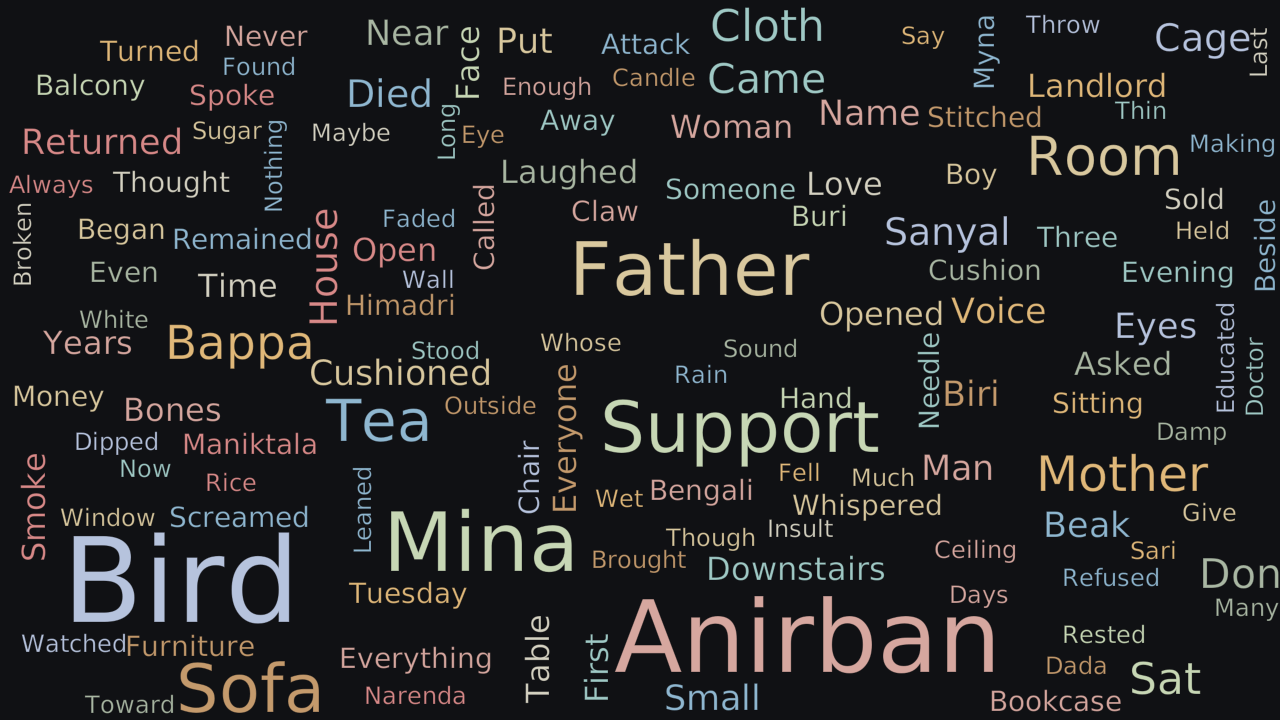
Word Cloud
Related reading
Selected by shared topics and section, with closer publication dates breaking ties.