Oxygen in a Box
Uses the speech voice supplied by your browser or device.

The blog is not a career move. It is a small window opened in a room where the air has started to take things personally.
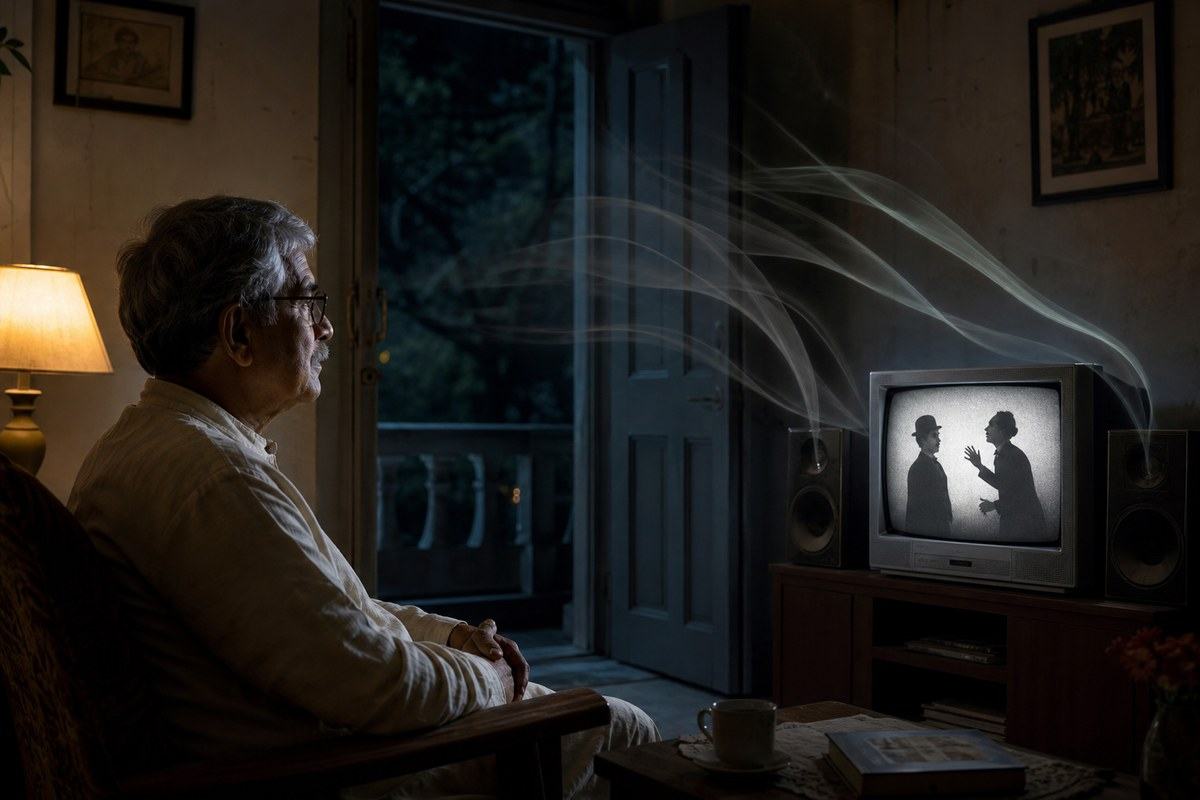
The room smells of old brick, boiled rice, damp towel, electric dust, mosquito coil memory, and that special Calcutta landlord cement which looks as if it was mixed by a man who had lost faith in both architecture and humanity around 1987. Nothing here is dramatic in the film sense. No thunder. No violin. No handsome hero looking into rain. Just a middle-aged Bengali man in a rented concrete box, knees muttering, belly conducting local politics, tea cooling beside the laptop, and a head full of thoughts too long for WhatsApp, too complicated for family, too useless for earning money, and too noisy to be left alone inside the skull.
This is the first problem.
No one to talk to.
Not nobody in the poetic sense. Nobody in the practical sense. Nobody who has the time, stamina, curiosity, or foolishness to sit and hear one aging fellow explain why depression feels like a pressure cooker with a broken whistle, why nationalism often smells like a drain with a flag stuck in it, why AI has made human handwriting look suddenly prehistoric, and why a man who once crossed oceans now measures his day by tea, tablets, electricity, rent, rice, and whether the water smells faintly like a civic crime.
People are busy.
They have jobs, spouses, children, EMIs, cholesterol reports, school WhatsApp groups, old parents, devotional forwards, electricity bills, enemies to flatter, reels to watch, and plastic containers to buy in sets of six. Humanity may have invented calculus, vaccines, radio telescopes, and the double-decker sandwich, but most afternoons it is still defeated by lunch, traffic, and one missing phone charger.
So the thoughts pile up.
At first they behave well. They stand in a queue. A little memory here. A little worry there. A sentence about America. A sentence about Calcutta. A small philosophical itch. A medical anxiety wearing rubber slippers.
Then the queue breaks.
One thought elbows another. One old school memory from North Calcutta jumps the line. One failed ambition from America starts arguing with one unpaid invoice from India. One mathematical idea about probability slips on one childhood smell of exercise books, rainwater, and old wooden desks. A political irritation begins shouting near the tea stall of the mind. A memory of mother arrives carrying a cloth bag. Then depression comes, late but confident, like a local party worker who knows no one will stop him.
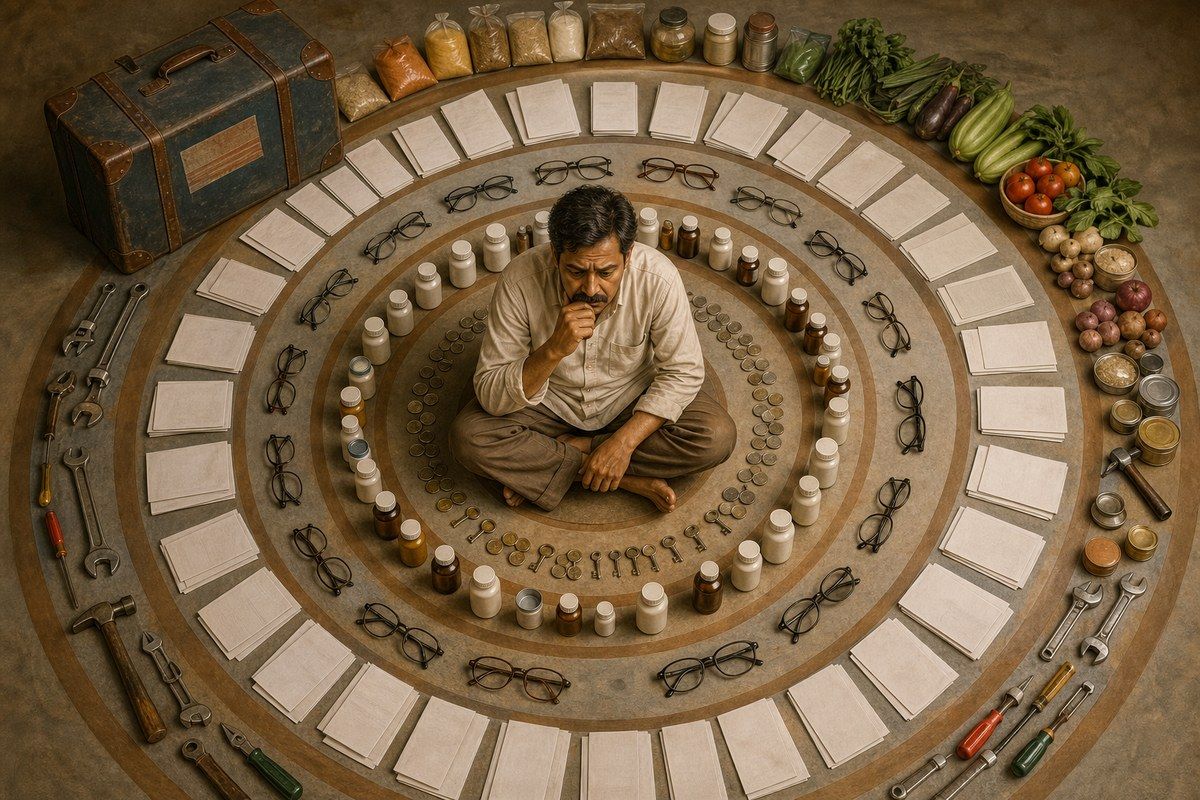
Suddenly the brain becomes Sealdah station during a strike.
Everyone is me.
Everyone is carrying luggage.
Nobody knows which train is coming.
And if I do not put these thoughts somewhere, something inside begins to suffocate.
I do not mean publish in the grand modern sense. Not build a brand. Not optimize engagement. Not manufacture content, that terrible word that makes a human soul sound like toothpaste squeezed into a marketing sink. I mean put them somewhere the way one puts a bucket under a leaking roof. The bucket does not solve the monsoon. It merely prevents the bed from becoming a pond.
The blog is that bucket.
No, better.
The blog is oxygen.
A rusty oxygen cylinder in the corner with a cracked valve and a handwritten label saying: breathe, you ridiculous man, breathe.
Outside, the city continues in its usual manner, which is to be ancient, crowded, clever, wounded, sentimental, corrupt, funny, magnificent, and badly wired. Somewhere a bus conductor is shouting as if the fate of civilization depends on three more passengers entering through a door already occupied by elbows. Somewhere a man is buying fish with the suspicion of a forensic pathologist. Somewhere a child is learning English grammar from a teacher who has not forgiven the British but still respects the semicolon. Somewhere a political poster peels off a wall in the humidity, like ideology developing a skin disease.
And inside this rented room, in the shanty boondocks of the city, sits one man thinking about medicine, mathematics, depression, politics, America, failed companies, old schools, machine learning, money, loneliness, aging, and whether life is sometimes nothing more than a badly trained model making confident predictions from terrible data.
This should be funny.
It is funny.
It is also not funny, which is how truth often arrives in Bengal, sweating, late, and carrying an umbrella with one broken rib.
The strange thing is not that I write. The strange thing is that a city can contain millions of people and still manufacture loneliness with such precision. Switzerland makes watches. Calcutta makes a kind of loneliness that ticks inside the chest and occasionally asks whether the gas cylinder will last the month.
There was once the old English-medium machinery. WWA Cossipore English School. St. Xavier’s Park Street. Then America for fifteen years. These things did not make me grand. Let us not begin polishing our own medals like a retired uncle after two pegs and one complaint about the younger generation.
But they left behind one peculiar injury.
Sentences.
Long sentences. Restless sentences. Sentences with one foot in Bengal and one foot in America, one elbow in a library, one knee in a rented room, carrying colonial dust in the cuffs, fluorescent American office light in the teeth, and a great deal of Calcutta irritation in the digestive tract.
This is not style in the decorative sense. It is the scar tissue of education, exile, loneliness, illness, books, and long practice.
Then AI arrived, as if the universe felt the joke required a second floor.
First they told us machines would do the dull work and free human beings for art. The machines would lift the sacks of grain, sweep the floor, calculate the tax, assemble the spreadsheet, and leave us to become poets, painters, philosophers, dancers, sitar players, gardeners, lovers, whatever fantasy was being sold that week by men in expensive shoes standing beside slides with rounded fonts.
Lovely.
Now the machine writes poems, paints pictures, composes songs, drafts letters, makes fake intimacy at industrial speed, and the human being who spent forty-five years becoming strange enough to produce one sentence with a limp and a smell of old rain is told, with a knowing smile, “This must be AI.”
This is a new humiliation.
Not a large one, perhaps. No one is invading Poland. But it is elegant in its stupidity. It is like being accused of using a calculator because you still remember the multiplication table of 17.
A man writes from his scars, and someone says software.
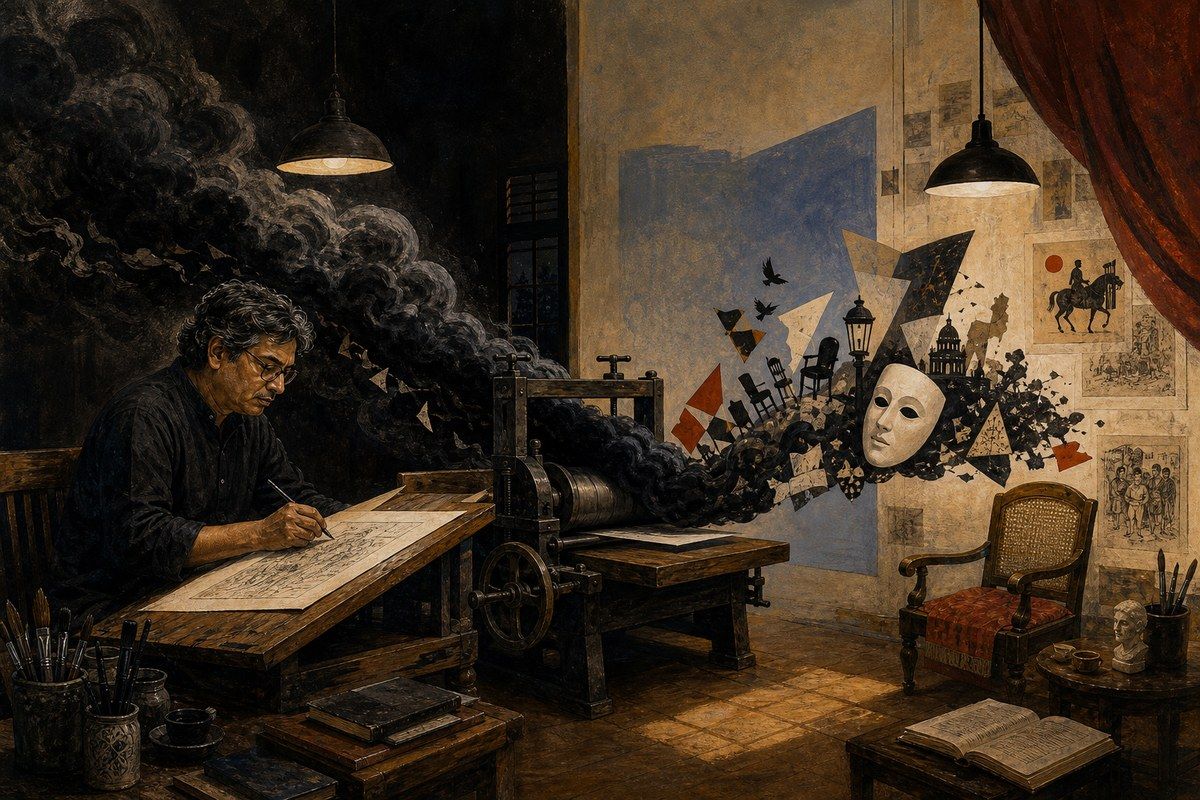
A man draws a strange little creature from the damp storeroom of his own skull, and someone says generated.
A man sends a WhatsApp message with three clauses, one joke, one bitter aftertaste, and one slightly old-fashioned turn of phrase left over from Calcutta schooling, and someone thinks, ah, chatbot.
The old proof has been eaten by the new fraud.
Earlier, if you wrote oddly, people thought you were odd. This was not ideal, but it was at least accurate. Now if you write oddly, people think you have outsourced your oddness to a server farm.
Especially in India.
Especially in Calcutta, where some people still cannot easily believe that a broken, middle-aged Bengali man living in a concrete afterlife near the edge of the city can write English unless some digital clerk from California is pumping grammar into his hand.
But there is no magic here.
There is only old education, some books, some exile, some illness, some loneliness, some unpaid electricity of the brain, some anger, some memory, some tea, and the terrible Bengali disease of wanting to explain even when no one has asked.
The brain is a slum with a university inside it.
Sometimes the professor is drunk.
Sometimes the drains overflow.
Sometimes a theorem floats past a banana peel.
Still, class is going on.
Because very few people visit the blog, which is both insult and relief, there is no stampede. No editor in trousers knocks at the door asking where the Bengali comic strip is. No publisher asks about audience segmentation. No algorithm stands behind me with a bamboo stick demanding daily output. No gentleman in spectacles says we need more SEO-friendly vulnerability by Thursday.
Good.
Let it be slow.
Let the Bengali comic strips come late, if they come at all. Let the sketches sit in the corner like skinny dogs. Let the blog remain a small tea stall on a road nobody properly maps.
Somebody may stop there by mistake.
That is enough.
One student. One unemployed man. One lonely woman. One middle-aged fellow hiding from his own family. One overeducated failure. One person in a small town with a mind too feverish for the life provided. One person who cannot explain what is eating them from inside because no one gave them the vocabulary.
They may read one page and feel one degree less alone.
Not healed.
Let us not become ridiculous.
But less alone.
That is something. In a world where everyone is selling cures, memberships, courses, apps, prophecies, coaching, supplements, enlightenment, political certainty, and premium spiritual detergent, even one honest sentence is a small municipal miracle.
A sentence can be a handrail.
You may still fall down the stairs.
But for one second, there was something to hold.
Money, of course, enters here like the universal auntie. It always arrives uninvited and asks why you are not more practical. Why did you not become richer? Why are you sitting in this room with thoughts? Can thoughts pay the gas-cylinder man? Can metaphors buy dental implants? Can one paragraph repair a leaking tap? Can wit negotiate with the landlord? Can melancholy recharge the inverter?
No.
Obviously no.
I am not noble.
Please.
I have envied money with the sincerity of a diabetic staring at rosogolla. I have wanted comfort, air-conditioning, clean water, quiet walls, a decent bed, medical certainty, dental implants, a chair that does not feel like punishment, and enough money to stop calculating life like a pharmacist cutting tablets in half.
But money was never the only god. If it had been, I would have arranged myself differently. I would have polished my antennae, laminated my ethics, learned the correct corporate noises, laughed at the right people’s jokes, and become one more well-groomed cockroach under a fluorescent sink.
Instead I became this.
A tenant with a laptop.
A one-man waiting room.
A skull with a leaking tap.
A blog nobody asked for, written in the oxygen debt of a life that did not fit inside the forms provided.
And perhaps that is the only honest answer. The blog exists because the life could not digest itself. It had to burp somewhere.
There is another small matter.
A craft does not die only when machines can imitate it. It begins dying when people stop caring whether the imitation and the original are different.
That is the more frightening thing.
Not that AI can produce fluent language. It can. Not that it can produce images, songs, summaries, and little polished pellets of synthetic charm. It can. The danger is that after enough synthetic language floods the room, everyone begins to smell synthetic. Even the human.
The age is suspicious because it is guilty.
Everybody knows the machine is cheating, so everybody suspects the man.
That is how rot spreads: first into tools, then into trust, then into the face sitting across from you, until even pain looks copy-pasted.
Still, I type.
Not because the world is waiting. The world is busy selling itself a newer, shinier packet of nonsense. Somewhere people are discussing artificial superintelligence while actual human intelligence is stuck in traffic behind a broken auto. Somewhere a billionaire is promising the future while a middle-class man in Kolkata is checking whether the water filter service fellow has finally replied. Somewhere a politician is speaking of national greatness while ordinary people are comparing electricity bills like wartime telegrams.
History moves.
The fan turns.
The tea cools.
The blog waits.
And I write because inside this damp skull, thoughts keep breeding in the dark. If I do not open one small window, the room fills with carbon dioxide, dead philosophy, stale anger, and the smell of unsaid things.
Maybe no one reads.
Maybe one person does.
Maybe that one person reads while sitting under a slow fan, or in a train, or beside a sleeping parent, or after a bad day in an office where the tube light has the emotional range of a tax notice. Maybe they think, for a moment, yes, this is also how a mind can feel. Not pretty. Not inspirational. Not fit for a framed quote. But real.
That is enough.
A match lit in a latrine is still light.
Small light.
Impolite light.
But light.
So I will keep typing into the rectangular glow, not as a hero, not as a brand, not as a content creator wearing the false teeth of optimism, but as one aging Bengali man trying to keep the air moving in a rented room.
And if someday they find me sitting upright near the laptop, tea fossilized beside me, face wearing the final expression of a man who wanted to say one more thing, I hope the page is still open.
Not for fame.
Not for proof.
For air.
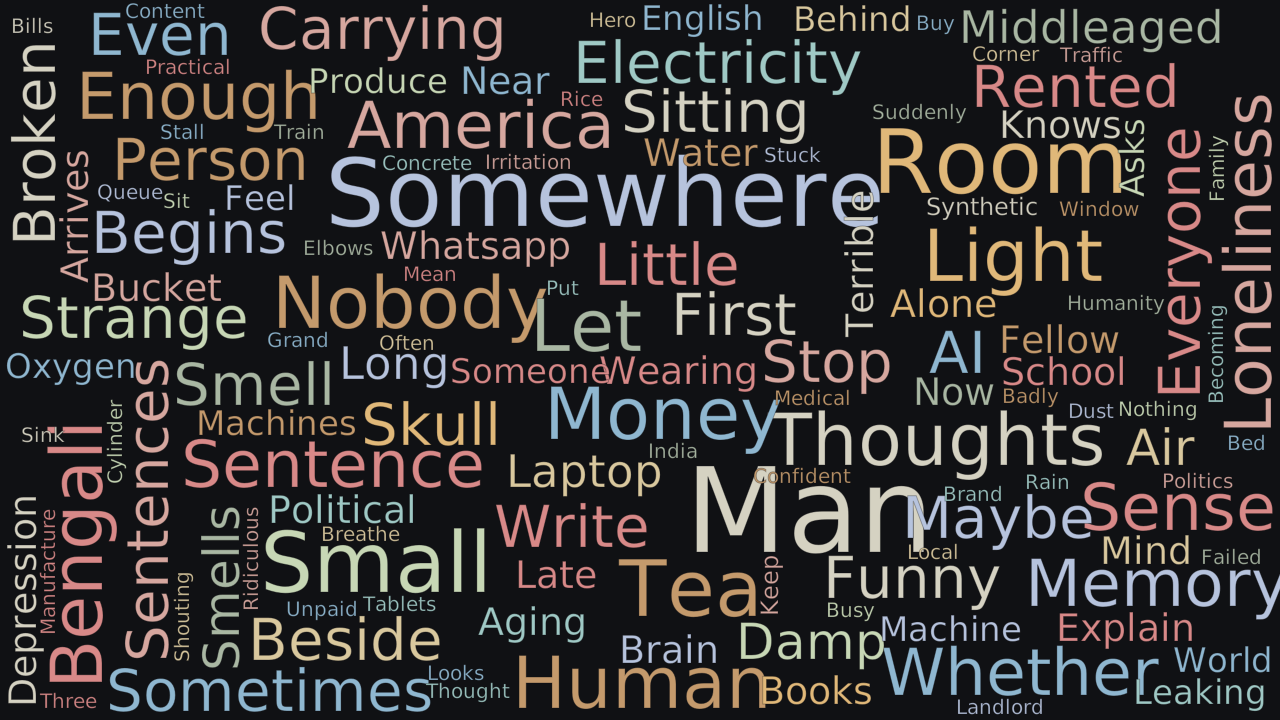
Word Cloud
Related reading
Selected by shared topics and section, with closer publication dates breaking ties.