The Static in the Room
Uses the speech voice supplied by your browser or device.

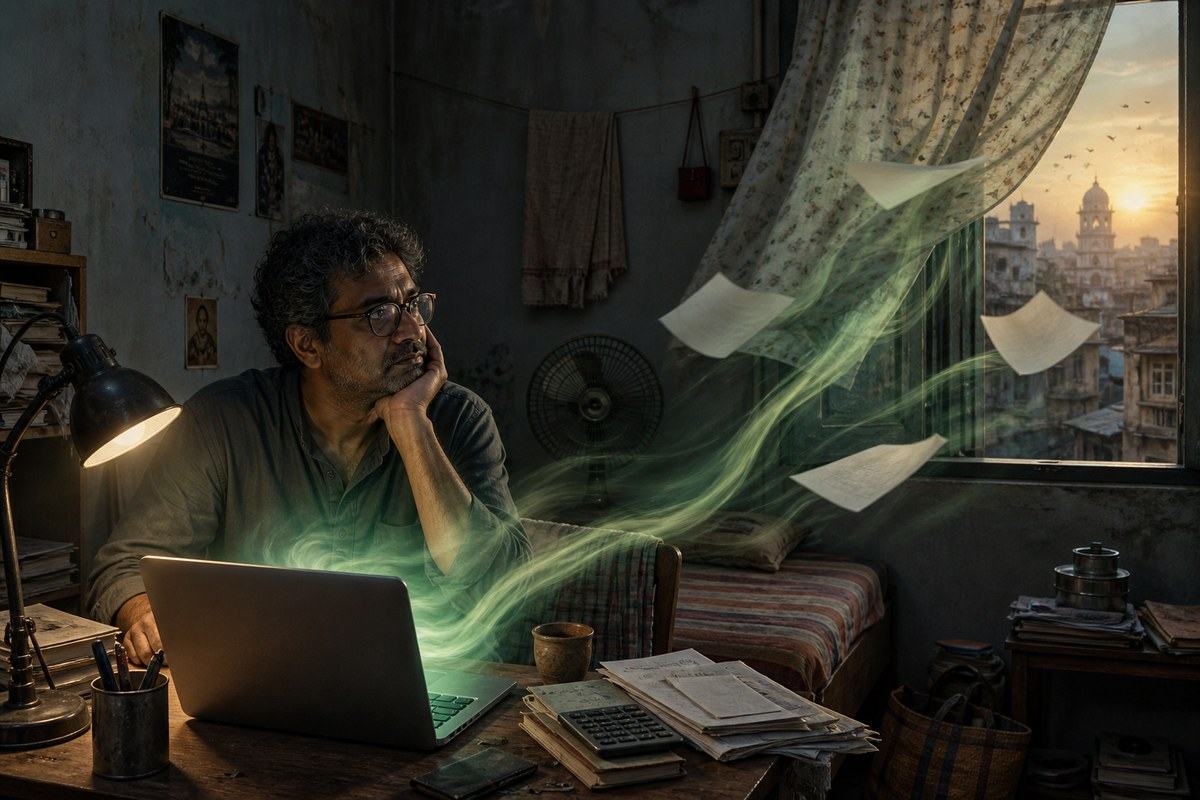
Some days my life feels like an old television after the broadcast has ended, that grey-white buzzing snow filling the screen, and one tired man sitting in front of it, not watching, not thinking, not even properly suffering, just unable to get up and turn the thing off.
That man is me, more often than I like to admit.
There is a particular kind of depression that people misunderstand because it does not arrive wearing a black cape and announcing itself like a villain in a bad Bengali serial. It does not always weep. It does not always tear its shirt dramatically near the staircase. It simply removes taste from the world. Rice becomes fuel. Tea becomes hot brown fluid. The phone becomes a small glowing mosquito. Morning becomes an administrative error.
And still the fan turns.
This is the humiliation of it. Life continues with the manners of a clerk. The gas cylinder must be checked. The electricity bill waits with folded arms. The tap leaks. The neighbor’s pressure cooker whistles with the confidence of a minor political leader. Somewhere a vegetable seller is shouting at the universe about potatoes. Calcutta, that old magician with dust in its hair and paan-stain on its sleeve, goes on producing traffic, gossip, heat, prices, elections, puja committees, stray dogs, and men who argue about the nation while blocking the lane with their scooters.
Meanwhile, inside my flat, the music has stopped.
Not metaphorically in the pretty greeting-card sense. I mean the inner tune, the small private orchestra that tells a man to bathe, shave, call someone, finish work, step outside, buy bananas, laugh at nonsense, plan next month, believe next year may not be a badly wrapped parcel of the same old misery. That little orchestra has packed up its instruments and left without even saying where it parked the van.
So I sit.
I do not have much meaningful work. That sentence looks small, like a matchbox, but open it and there is a whole burned warehouse inside. Work is not only money, though please do not believe any saintly nonsense about money not mattering. Money matters very much when rent knocks, medicine costs, teeth decay, laptops age, and the month stretches like an old rubber band. Work also gives the day a spine. It says, do this and something will move. Pull here and a bell will ring somewhere.
Without that, the day becomes soft and shapeless. Like muri left in rain.
You wake. You stare. You think too much. You move too little. You make tea, or fail to make tea, which in Bengal is almost a constitutional breakdown. You check messages. You avoid messages. You remember who you were. You compare him to the present specimen sitting in a faded room like a government file nobody wants to open.
Then comes the treadmill.
Not the gym kind. That at least suggests health, ambition, and people in expensive shoes. Mine is an anhedonic treadmill, a machine that does not improve the body, does not burn fat, does not produce character, and does not even offer a towel. It only moves the day under your feet while you remain in exactly the same place. Wake, eat, worry, delay, regret, sleep badly, repeat. A fine modern invention. If Calcutta Corporation ever needs a model for useless motion, I am available at a reasonable consulting rate.
I know this is not what most readers want when they stumble into a blog. They want a useful essay, a clever opinion, some technology, some politics, a clean joke, a paragraph that behaves itself. Instead they find a middle-aged Bengali man in the outskirts of Calcutta opening the lid of his skull and saying, “Here, have a look, but mind the wiring.”
Naturally, many will run.
People are frightened of mental illness, especially when it refuses to be inspirational. They like the after-photo. The survivor with neat hair. The person who says, “I hit rock bottom, then I discovered purpose, discipline, and green smoothies.” Very good. Lovely. May their smoothies always be correctly blended.
But some minds do not follow that cinema script.
Some minds are not climbing a mountain. They are trapped in a room where the tube light flickers and the door opens only inward. Some days the achievement is not transformation. It is brushing your teeth. It is answering one message. It is not saying the cruel thing your mind says about you every morning with the punctuality of the Sealdah local.
I can only see through the skull I have. That is the whole tragic comedy.
And my skull is not exactly a newly serviced instrument. It is old, moody, chemically unreliable, and prone to producing dark weather without consulting the Meteorological Department. It has carried me through childhood, America, healthcare systems, databases, offices, airports, marriage, divorce, return, collapse, survival, and now this strange flat-bound half-life where even going downstairs can feel like applying for a visa.
You may think hiding means I love being alone.
Not quite.
I hide because normal life often asks for a voltage I do not have. Outside the flat there are people. This is already a serious problem. People have faces, questions, plans, opinions, shirts with collars, family functions, successful cousins, casual invitations, and the terrible habit of saying, “Come, just come, what is there?” as if stepping into the world were like picking up a biscuit.
For some of us, it is not a biscuit.
It is a small expedition involving bathing, dressing, pretending, speaking, smiling, paying attention, hiding panic, hiding failure, hiding the smell of long sadness, and returning exhausted from a trip that healthy people would not even count as an event. They go to the pharmacy and come back with tablets. I go to the pharmacy and return like a minor explorer from a hostile continent.
So I remain indoors.
Not nobly. Please remove all violins from the room. This is not a hermit’s cave in the Himalayas. This is a lower-middle-class flat in Calcutta with ordinary dust, ordinary plastic buckets, ordinary unpaid worries, and the ordinary embarrassment of not having become what one was supposed to become. A man of fifty-one is not given the generous stupidity of youth. At twenty-two you can call confusion “potential.” At fifty-one, confusion has cholesterol.
And yet memory is a cruel archivist.
I remember being useful. That is the thorn. I remember work, travel, thinking clearly, solving problems, explaining difficult things, sitting in offices in the United States, looking at data, fighting with systems, crossing cities, making plans. I remember having a life that at least looked like it had handles. Now the handles have come off, and I am left carrying the box by pressing it awkwardly against my stomach.
The oddest loss is not happiness. Happiness was never a permanent tenant anyway. It came, it left, it forgot to pay maintenance.
The deeper loss is wanting.
Anhedonia steals the appetite for life without necessarily killing the body. This is why it is so difficult to explain. The world is still there. Books are still there. Music is still there. Food, people, films, work, news, sunlight, rain, all present and marked attendance. But they stop calling your name. They stand behind glass. You can see them. You remember that once they mattered. You may even speak intelligently about them. But the hand does not reach.
This is where outsiders make their favorite mistake. They say, “Do something you enjoy.”
Excellent advice, except the enjoyment department has been closed for renovation since approximately 2009 and no contractor is answering the phone.
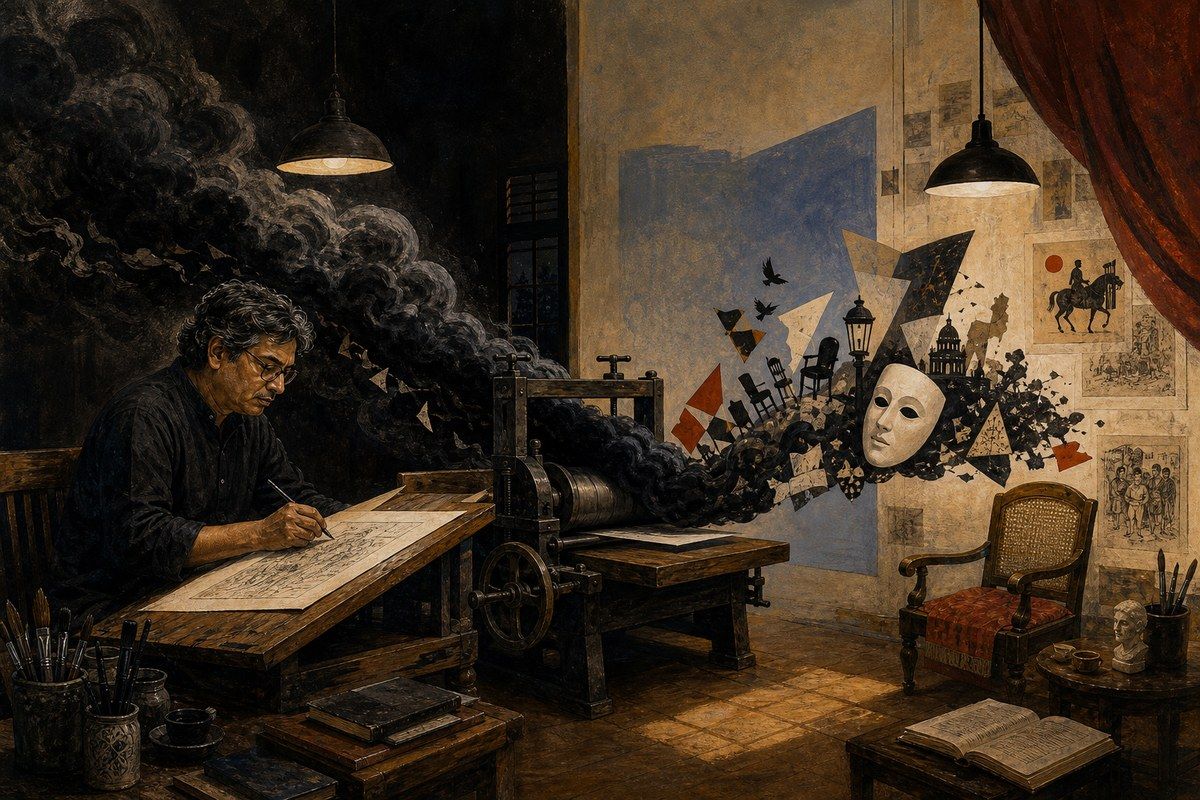
Still, I write.
Not because writing saves me in any grand way. I distrust grand claims. They usually arrive wearing polished shoes and carrying an invoice. Writing does not cure the room. It does not pay any bills. It does not restore youth, health, confidence, lost years, lost teeth, lost chances, or the small animal brightness that once lived in the chest.
But writing gives the static a shape.
That is not nothing.
A sentence is a thin wire across the dark. Some days I hold it with two fingers. Some days I drop it. Some days I write one paragraph and feel like a man who has moved a cupboard by half an inch. Ridiculous, yes. But the cupboard moved.
Maybe this is why I keep posting these things even though they are not cheerful and may frighten the accidental visitor. Perhaps somewhere there is another person sitting in another room, in Dum Dum, Behala, Barasat, Siliguri, New Jersey, Birmingham, wherever human beings are quietly malfunctioning behind doors, and he thinks he is the only one staring at the snow on the screen.
He is not.
That does not fix him. I will not insult him with decorative hope. But it may reduce the loneliness by one grain, and sometimes one grain is the difference between drowning and keeping the nose just above water.
I do not want to be alone. That is the thing people get wrong.
I hide because I do not know how to carry my darkness into ordinary daylight without spilling it on the floor. I hide because the world is loud, and my inside is louder. I hide because the music has ended in me, and when people are dancing, a silent man becomes a problem even to himself.
Still, the fan turns.
The city mutters.
The kettle waits.
And somewhere in the grey-white static, if I look long enough, a sentence flickers once, like a small match in a large room.
Word Cloud
Related reading
Selected by shared topics and section, with closer publication dates breaking ties.