The Water Remembers
Uses the speech voice supplied by your browser or device.

THIS IS A WORK OF FICTION
By half past six in the morning, before the sun had properly committed itself to the day, Calcutta had already begun the great public business of being irritated.
At the crossing near Belgachia, buses nosed into one another with the hopeless intimacy of goats in a pen. A tea stall beside the broken pavement exhaled steam, milk, ginger, cheap tobacco, and that particular optimism which lasts until the first unpaid bill. Men in faded shirts stood with glass tumblers pinched between their fingers, discussing cricket, the price of onions, the corruption of councillors, and the permanent uselessness of everyone younger than themselves. Above them, tram wires sagged like old nerves. Political posters peeled from a damp wall: faces smiling with the waxy forgiveness of undertakers.
In the lane behind the government diagnostic center, where rainwater had made a greenish settlement inside a pothole, Partha Bhowmik arrived carrying two plastic bags and the dignity of a man who had long ago mistaken resentment for intelligence.
He was forty-one, though his face had gone past that number and returned by a harder route. His hair was thinning at the temples. His spectacles were always sliding down his nose, so that he seemed permanently to be looking over the top of the world at some stupidity beneath his notice. In one bag he had luchi and alur dom wrapped in yesterday’s newspaper. In the other he had nothing that should have been carried in a plastic bag.
The security guard, Hari, lifted his chin.
“Late again, Partha-da.”
“Six thirty-two is not late.”
“Sir came at six.”
“Then Sir is early.”
Hari laughed, because the poor learn to laugh at the moods of men slightly less poor than themselves.
Inside, the diagnostic center had the morning smell of phenyl, damp files, old paint, and refrigerated fear. Patients waited on plastic chairs, clutching prescriptions with both hands as if the paper might float away and take their disease with it. A child coughed into his mother’s sari. An elderly man slept with his mouth open. Somewhere a printer stuttered. Somewhere a woman asked whether fasting sugar counted if she had taken one biscuit at midnight.
Partha walked past them with professional invisibility.
For fourteen years he had worked in pathology without being called a pathologist. He prepared samples, cleaned instruments, labeled slides, maintained machines, carried trays, corrected the spelling mistakes of junior doctors who now called him “Bhowmik” without looking up. He knew the color of bad blood. He knew the smell of old pus. He could identify panic in a patient before the patient knew it himself.
What he did not have was a degree that mattered anymore.
In his father’s time, a clerkship could raise a family, marry off daughters, install a ceiling fan, buy a Godrej almirah, and leave behind a pension that smelled faintly of mothballs and respect. In Partha’s time, respect had gone app-based. Degrees bred degrees like mosquitoes. Coaching centers promised rank, rank promised career, career promised air-conditioning, and somewhere between promise and power cut, a man like Partha disappeared.
He had tried to rise.
Three times he had applied for senior technical supervisor. Three times the post went elsewhere. Once to a boy from Salt Lake whose uncle knew a deputy director. Once to a woman with a foreign certificate and the calm cruelty of people who say “team culture.” Once, most recently, to Nilotpal Sen, twenty-nine, beard trimmed, shoes spotless, who said “workflow optimization” as if he had discovered fire.
Nilotpal’s first order had been to reorganize storage.
“Old habits are dangerous,” he told Partha in front of two interns.
Partha smiled so politely that one intern looked away.
That morning, he went to the back laboratory, unlocked the cold cabinet, and stood for a moment in the blue-white hum. On the counter lay the scheduled dispatch sheet for municipal safety verification—routine testing materials, sealed reagents, indicator cultures, disinfectant comparison kits. A dull assignment. One packet would go by courier to a central potable water processing facility, part of the city’s broad, leaky circulatory system, where old pipes ran under newer ambition.
Partha had signed for such dispatches a hundred times.
Calcutta ran on trust in small signatures. A clerk stamped. A driver carried. A guard waved. A junior officer initialed. The city moved because everyone assumed someone else had checked.
He opened the second plastic bag.
The contents were packed plainly, without drama. No skull mark. No villain’s instrument. Just small sealed containers, labels rewritten with the careful hand of a man who had spent half his life making lies look administrative.
He had not created monsters, he told himself.
Monsters wore authority passes and sat in conference rooms.
He had merely encouraged what already existed. He had watched ordinary organisms become stubborn. He had watched treatment fail. He had seen patients return with the same infection wearing a harder face. He had read enough to understand what complacency could breed. He had also read enough to know exactly where not to write things down.
No one would notice at first.
That was the beauty of the city. Calcutta noticed everything late, then discussed it forever.
At eight fifteen, Nilotpal entered with coffee from the mall kiosk two stops away.
“Bhowmik, dispatch done?”
Partha did not look up.
“Done.”
“Good. And today please clear the old incubator room. Audit next week.”
“Of course.”
Nilotpal paused by the door. “You took home keys last night?”
“To open early.”
“You’re not senior staff.”
Partha turned then, and the look he gave Nilotpal was mild, almost affectionate.
“No. I am not.”
By afternoon the rain came. Not proper monsoon rain, only a rehearsal: low clouds, a theatrical smell of drains, sudden silver threads against the grilled windows. Delivery riders in plastic ponchos leaned into the wet like insects. Outside the diagnostic center, a man selling cheap umbrellas shouted, “Last piece! Last piece!” with the conviction of a prophet who knew the world was mostly weather and bad planning.
Partha ate his lunch alone behind the sample storage room.
On his phone, messages came and went. His wife, who had returned to her parents in Krishnanagar two years earlier, sent a photograph of their son’s school fee notice without comment. His landlord sent a reminder. His mother called twice from Dum Dum; he did not answer. She would only ask whether he had eaten, and that question had become unbearable because it still expected him to be someone’s child.
At four, the city’s water drank what he had sent it.
At five, Partha stood in the corridor and felt nothing.
This disappointed him.
He had expected thunder perhaps, not outside but within. A black flowering. A thrill fit for the revenge he had carried so long it had become a second skeleton.
Instead he felt only acidity.
On the metro home, packed between a college boy watching reels without headphones and a woman guarding a sack of vegetables with her feet, Partha noticed an advertisement for a private hospital. WORLD-CLASS CARE, it said above a photograph of a smiling doctor whose coat had never known a government sink.
At Shyambazar, the train doors opened. Hot human air rolled in.
A girl beside him whispered to her friend, “Dada smells like lab.”
Partha kept his face still.
That night, the first fever began in a small flat near Tala, though no one called it first. A schoolteacher named Ruma Saha felt a chill while correcting geography notebooks. By ten she was vomiting. By midnight her husband was searching online and finding ten diseases, eight remedies, and one video explaining that all illness came from angering Saturn.
In a lane off Amherst Street, a retired postmaster complained of stomach cramps and told his son not to waste money on a doctor.
In a gated tower near EM Bypass, a software engineer blamed sushi.
In a bustee beside the railway line, two children cried for water and then refused it because it smelled wrong, though their grandmother slapped them gently and said water had no smell, only imagination.
By morning the hospitals began to fill.
Not dramatically. Not yet. Calcutta did not collapse like a film city, with explosions and a violin. It developed queues.
Queues outside emergency doors. Queues at pharmacies. Queues for tests. Queues for admission. Queues to ask where the queue began. Autos carried limp bodies through rain-wet traffic. Ambulances wailed without moving. A man outside R.G. Kar shouted at a guard until his own legs buckled. A nurse in a private hospital washed her hands so often the skin cracked between her fingers, then went back to touching strangers because fear was not an exemption from duty.
News channels took until evening to become excited.
UNKNOWN GASTRO-FEVER OUTBREAK?
WATERBORNE PANIC?
CITY CIVIC BODY DENIES FAILURE.
By then, Partha had developed a headache.
He sat in his one-room flat near Dum Dum Park, curtains drawn, watching the television on mute. His mother lived two lanes away in an older building whose staircase had grown too steep for her knees. He had promised to visit Sunday. It was Thursday.
His phone rang.
Ma.
He stared at the name.
It rang until it stopped.
Then it rang again.
He switched the phone face down.
On screen, a reporter stood outside Medical College, rain plastering her hair to her cheek. Behind her, families pressed against the gate. One man held up a prescription as if cameras could convert paper into treatment.
Partha turned up the sound.
“Authorities say there is no need for panic,” the reporter shouted, which in India meant panic had already passed through several departments and obtained informal approval.
The first deaths were announced as “comorbid complications.” By the second day, the phrase lost its usefulness. There were too many bodies and not enough nouns.
Symptoms varied. Fever. Bloody stools. Renal failure. Strange neurological decline in some. Eyes going yellow in others. Severe dehydration. Shock. The old went quickly. The young resisted with terrible effort. Some improved, then worsened in a way that made doctors look at one another across beds with the silent professional hatred of mystery.
The city became intimate with plastic.
Plastic IV lines. Plastic water bottles. Plastic gloves. Plastic sheets. Plastic chairs occupied by relatives who had not slept. Plastic bags carrying medicines, bananas, reports, urine samples, clothes damp with sweat. Outside hospitals, tea sellers did brisk business because grief, like bureaucracy, requires caffeine.
By the third day, schools closed. Offices advised remote work, as if remote work were a civic shelter and not a privilege with broadband. Water tankers became objects of devotion and suspicion. People boiled water until kitchens steamed like cheap saunas. Apartment WhatsApp groups grew hysterical.
“Use packaged water only.”
“Which brand safe?”
“My cousin in Health Dept says avoid all tap.”
“Fake message. Don’t spread.”
“Forwarded as received.”
“Government hiding deaths.”
“Opposition conspiracy.”
“Please recommend hospital bed.”
In the middle-class imagination, disaster was always something that could be managed by the correct contact number. Then the numbers stopped working.
Partha went to work on the fourth day because absence would be noticed.
The diagnostic center had changed. The waiting room was no longer irritated; it was animal. People leaned against walls. Someone had vomited near the stairwell. Hari the guard wore two masks and a tulsi bead around his wrist.
“Partha-da,” he said, eyes wet above the mask. “My daughter has fever.”
Partha nodded.
“Which test?”
“All.”
Inside, Nilotpal moved quickly from counter to counter, his face pale, his kiosk coffee forgotten. He had not slept. It made him look younger, almost human.
“We are overloaded,” he said. “No mistakes today. No old politics. Please.”
Partha heard the plea buried inside the instruction.
All morning he labeled samples. Names passed under his hands. Saha. Dutta. Ali. Singh. Mondal. Two-year-old. Seventy-eight-year-old. Pregnant. Diabetic. Unknown. Unknown. Unknown.
At noon, his mother’s neighbor called.
“Partha? Where are you? Your ma is sick. Very sick. She has been calling.”
The corridor seemed to tilt.
“What symptoms?”
“What symptoms? Come and see. She is asking for you.”
He left without informing Nilotpal.
The lanes near his mother’s building were slick with rain and panic. A vegetable seller had covered his produce with blue tarpaulin. A political slogan on the wall—WE ARE WITH THE PEOPLE—had begun peeling at the word PEOPLE. Upstairs, his mother lay on a narrow cot beneath a calendar of Goddess Kali. Her hair, once sternly black, was loose and silver on the pillow. Her eyes found him and filled not with accusation but relief, which was worse.
“You came,” she whispered.
He sat beside her. Her palm was dry and hot.
“Why didn’t you call me earlier?” he said.
She gave the smallest smile.
“I did.”
There are moments when truth does not arrive as revelation. It arrives as bad lighting. The same room, the same furniture, the same damp wall, and suddenly everything is visible in a cheaper, crueler bulb.
He tried to get an ambulance. None came. He called contacts he had not spoken to in years. One said beds were unavailable. Another said try a nursing home in Barasat. A third did not answer.
At last he carried his mother down two flights with the help of the neighbor’s son and put her into an auto whose driver demanded double and then, seeing the old woman’s face, said nothing and drove.
The hospital did not take her.
Nor the next.
At the third, they put her on a stretcher in a corridor near an overflowing bin and a poster about hand hygiene.
His mother survived until dawn.
Just before the end, she opened her eyes and said, very clearly, “Don’t drink the water from your flat. It tastes of iron.”
Then she died with one hand still gripping his sleeve.
For six hours Partha sat beside her body because the paperwork had become a country of its own. Around him, people begged, cursed, prayed, fainted, bargained. A man in a good shirt slapped a ward boy and was beaten by three relatives of another patient. A priest chanted into a phone for a family trapped outside the gate. Somewhere a child laughed, a high bright sound caused by fever or shock, and it traveled down the corridor like something looking for a room.
Partha did not weep.
Grief, when it came, found no entrance. The house was already occupied by terror.
By the fifth day, the official death count was a lie so large it had become architecture. The real count lived in burning ghats, hospital corridors, closed shutters, unanswered phones, and the sudden absence of noise from flats where televisions had been left on.
Calcutta did not become silent. It could not. But its sound changed.
No para gossip at night. No boys playing cricket under headlights. No puja committee loudspeaker testing an amplifier three months early. Even the crows seemed to caw from farther away.
Partha returned to the diagnostic center after cremating his mother because he had nowhere else to put himself.
Nilotpal found him in the old incubator room.
“You should go home,” he said.
Partha laughed once.
Nilotpal looked at him carefully. “What did you do?”
The question was quiet.
Partha’s mouth went dry.
“What?”
“You heard me.”
Outside the small grilled window, rainwater ran down the wall in dark veins.
Nilotpal stepped in and closed the door.
“I checked the dispatch sheet. You signed the municipal packet. I checked storage logs. I checked the camera gaps. You think because this place is broken, nothing records? Broken things record badly, not never.”
Partha stared at the old incubators, their glass doors reflecting two men in a narrow room.
“You don’t understand.”
“No,” Nilotpal said. “I don’t. Help me.”
The absurdity of that phrase nearly made Partha smile. Help me. After years of correction. After “not senior staff.” After old habits are dangerous.
“You all wanted clean systems,” Partha said. His voice sounded far away and educated, as if giving an answer in an interview. “Efficient systems. Audit-friendly systems. You think rot lives only in poor lanes and old cabinets. Rot is the system. I only—”
Nilotpal struck him.
Not hard enough to injure. Hard enough to stop language.
For a moment they stood like schoolboys after the first forbidden blow.
Then Partha said, “My mother is dead.”
Nilotpal’s face changed.
So did the room.
The lights flickered. The old building groaned, or something in the pipes did. From somewhere below came the sound of water rushing though no tap had been opened.
Nilotpal whispered, “What was in it?”
Partha closed his eyes.
“I don’t know anymore.”
That was the first honest thing he had said in years.
Because there was something he had not accounted for, something not in journals, not in storage logs, not in the tidy fantasies of revenge. The city had mixed his act with itself: old pipes, illegal connections, stagnant tanks, monsoon overflow, private pumps, civic denial, apartment filters, temple offerings, hospital drains, bottled-water fraud, fear, rumor, boiling, hoarding, thirst. He had released a match into a room already full of gas and then pretended to be the fire.
The floor trembled.
Nilotpal grabbed the door handle. It would not open.
From the drain beneath the sink came a smell Partha knew from childhood: pond mud in summer, iron railings after rain, old blood on a coin.
The sink coughed.
A thin thread of dark water rose from the drain, not falling upward exactly but remembering the way up. It thickened, gathered, and hung in the air like a rope. Inside it were tiny pale flecks that might have been foam, or rice, or teeth.
Nilotpal backed away.
“What is this?”
Partha thought of his mother’s last words. It tastes of iron.
The water touched the floor without spreading. It moved toward him with the slow confidence of something that had all the drains in the city behind it.
On the counter, his phone lit up.
Unknown number.
Then another.
Then twenty.
All at once every phone in the room began to vibrate: his, Nilotpal’s, the dead intern’s old handset in a drawer, the landline on the wall, devices forgotten in coat pockets. The sound was not ringing. It was bubbling.
Nilotpal whispered a prayer.
Partha did not. He had believed himself too modern for gods and too clever for ghosts. But Calcutta is an old place for a man to make a new sin. Under its flyovers and metro pillars, beneath gated towers and diagnostic centers and coaching institutes, under slogans and sewage and ambition, there are older account books than law.
The dark water reached his shoes.
It was cold.
In it he saw faces, not floating, not accusing, only passing through: Hari’s daughter, the schoolteacher, the postmaster, a boy from a bustee, his mother, thousands more, millions perhaps, though numbers had lost their human edges. They did not speak. They did not need to.
Partha looked at Nilotpal.
“Open the door,” Nilotpal said.
Partha almost told him he was sorry. But apology seemed too small, a coin placed before a flood.
The water climbed him like memory.
By the seventh day, when the worst had passed into statistics and rumor, officials found the old incubator room clean. Not disinfected. Clean in the impossible way of river stones. No containers, no logs, no fingerprints, no bodies. Only two pairs of shoes stood side by side on the floor, filled neatly to the brim with clear water.
For weeks afterward, people in north Calcutta said the tap sometimes coughed before dawn and produced, for one second, water warm as a living palm. Then it ran clear again.
And in certain old buildings, where the balconies cracked and the tanks sweated under black plastic lids, mothers began telling their children not to waste water, not because water was precious, but because water remembered who had touched it.
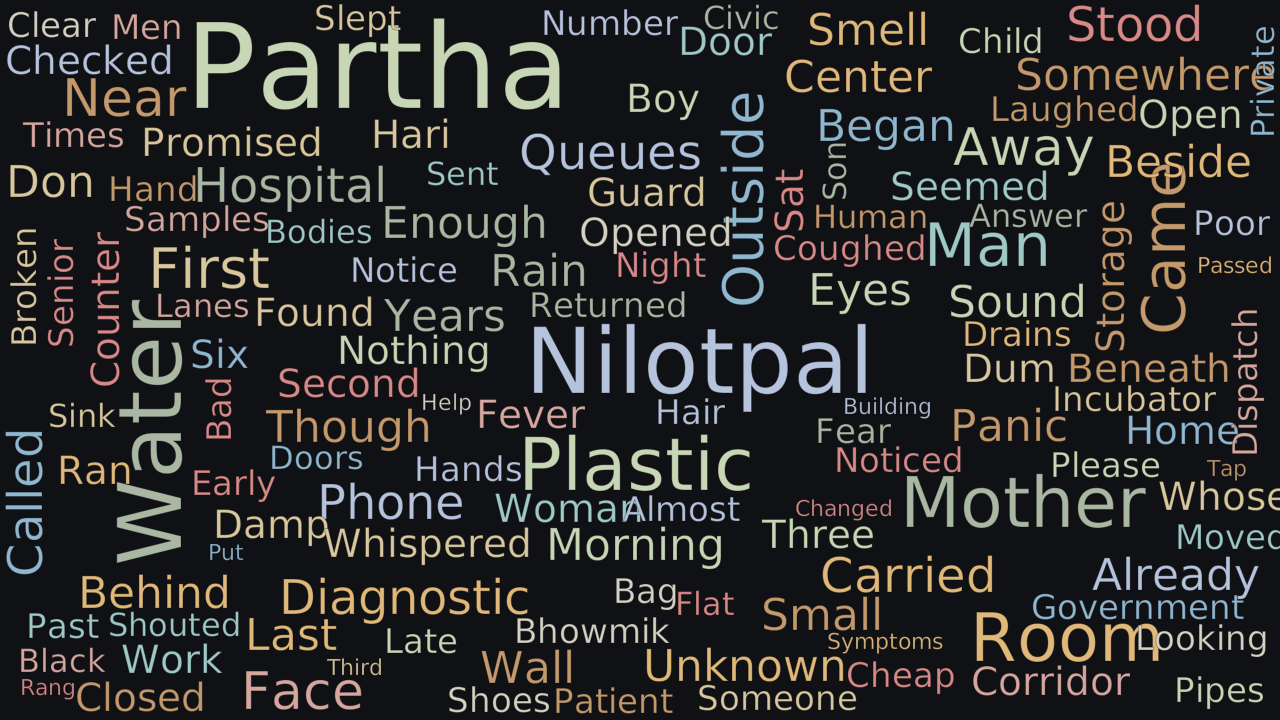
Word Cloud
Related reading
Selected by shared topics and section, with closer publication dates breaking ties.