Cockroach Season
Uses the speech voice supplied by your browser or device.

THIS IS A WORK OF FICTION
On the afternoon Nilotpal Sanyal collected the wrong bottle, rain had been falling on Calcutta with the steady administrative contempt of a government department.
It came down on tram wires and torn political posters, on the yellow taxis idling like tired beetles near Sealdah, on the wet backs of delivery riders hunched over their phones under flyovers, on the glass towers where people said “wellness ecosystem” with straight faces, and on the older houses whose balconies leaned over the lanes like elderly relatives listening through the wall.
At the tea stall outside the Mukundapur neuro-clinic, the rainwater had made a brown canal of the gutter. Cockroaches, flushed from somewhere offended and ancestral, moved along the bricks with a confidence Nilotpal envied. They were not running. They were proceeding.
“Dada, your cold-chain item,” said the courier, balancing a white foam box on the stall counter between two glasses of tea.
Nilotpal signed with a hand that had recently begun to disobey him. His signature came out like a small earthquake.
The courier did not notice. Nobody noticed much in Calcutta unless it was useful gossip. The tea seller noticed the box, the clinic logo, the educated man’s clean but old shirt, and the tremor in his fingers. His eyes stored these facts for later distribution.
“Medicine?” he asked.
“Fish,” Nilotpal said.
This was not clever, but illness had reduced his social imagination. Once he had sold pharmaceutical software to clinics in Salt Lake and could say things like “patient engagement platform” while keeping his face arranged in the optimistic manner required by modern fraud. Now he was forty-two, unemployed, and had inherited from his father a hunting song in the blood: Huntington’s disease, the doctor had said, as if naming an old British district.
His father had first dropped cups, then forgotten words, then danced unwillingly through the rooms of their Maniktala flat until neighbors stopped visiting. There was no dignity in such dancing. There was only the body losing a long argument with its own instructions.
Nilotpal had married late and badly, which in Bengali middle-class terms meant not that his wife was bad but that time had entered the marriage before hope did. Mili taught English at a coaching center near Gariahat, correcting essays by boys who believed “therefore” was a decorative item. She had wanted a child. Nilotpal had wanted a future in which he did not become his father in slow public installments.
So they had sold her gold bangles, taken a loan from her brother, and entered the gray velvet cave of private medicine, where the chairs were soft, the consent forms were long, and miracles came with GST.
Dr. Raka Lahiri’s clinic occupied the sixth floor of a new building still smelling of cement and ambition. Raka was precise, unsmiling, and young enough to make older patients suspicious. She had trained abroad. The receptionist said this as Bengalis once said “ICS,” as if foreign exposure disinfected mortality.
“It is not a cure,” Raka had told them. “It is an experimental gene-silencing protocol. We are trying to reduce mutant huntingtin expression. Compassionate access, not a formal trial.”
Mili had asked, “What are the risks?”
Raka had folded her hands. “Immune reaction. Liver inflammation. Neurological worsening. Unknowns.”
Unknowns, in that room, sounded like a manageable subscription plan.
The bottle was small, amber-colored, and sealed under the clinic’s blue label: HTT-SILENCE / Patient ID NS-47 / Dose: four sublingual drops nightly. Keep refrigerated. Do not shake.
That night there was a power cut at 9:13.
The flat breathed heat.
Their building in Beliaghata had once belonged to one family and now contained seven, each living in a carved-up portion of former importance. The staircase smelled of damp, incense, frying onion, and the melancholy of old wood. From the lane came the whine of a generator, two dogs disputing empire, and a woman shouting into her phone that no, she had not received the gas cylinder, did the man think she was sitting there for romance?
Nilotpal held the bottle near the window. The label had bubbled slightly from rain. Beneath its edge he saw another color, green, like a second label. He thought of peeling it back, then did not. There are many doors one does not open because one is tired.
He placed four drops under his tongue.
The liquid was cold, faintly bitter, with a taste like pond water and metal.
“Anything?” Mili asked.
“Only science,” he said.
“For once let science behave.”
It did, at first.
By the third morning, his fingers were steadier. By the fifth, the twitch in his shoulder had softened. By the seventh, he could pour tea without spilling and Mili cried silently at the stove, pretending the steam had entered her eyes.
Nilotpal began walking again. Not far. To the corner market, where fish scales shone on boards and the vegetable sellers slapped water over coriander. The city seemed newly sharpened. He could hear individual slippers in the lane, the tick of a ceiling fan in the next room, the private chewing of termites in a doorframe.
The cockroaches were loudest.
At night, behind the kitchen cabinet, they made a dry, intelligent music.
“Pest control again,” Mili said, seeing him sit upright in bed.
“No,” he said.
“What no?”
“They’re talking.”
She looked at him for a long moment. In marriages under pressure, one learns to distinguish jokes from symptoms. “Nil?”
“They are moving behind the tiles.”
“All cockroaches move behind tiles. That is their address.”
But his mouth had filled with saliva.
The first one came during another power cut. Calcutta went black in layers: first the tube light, then the refrigerator’s hum, then the neighbor’s television, leaving behind the insect orchestra and the distant announcement from the metro line, ghostly and useless.
Mili had gone downstairs to ask whether the whole building was out. Nilotpal stood in the kitchen, barefoot on gritty mosaic.
A cockroach emerged near the drain.
It paused, antennae writing cursive in the dark.
Nilotpal bent forward.
His tongue struck the floor before he understood it had moved.
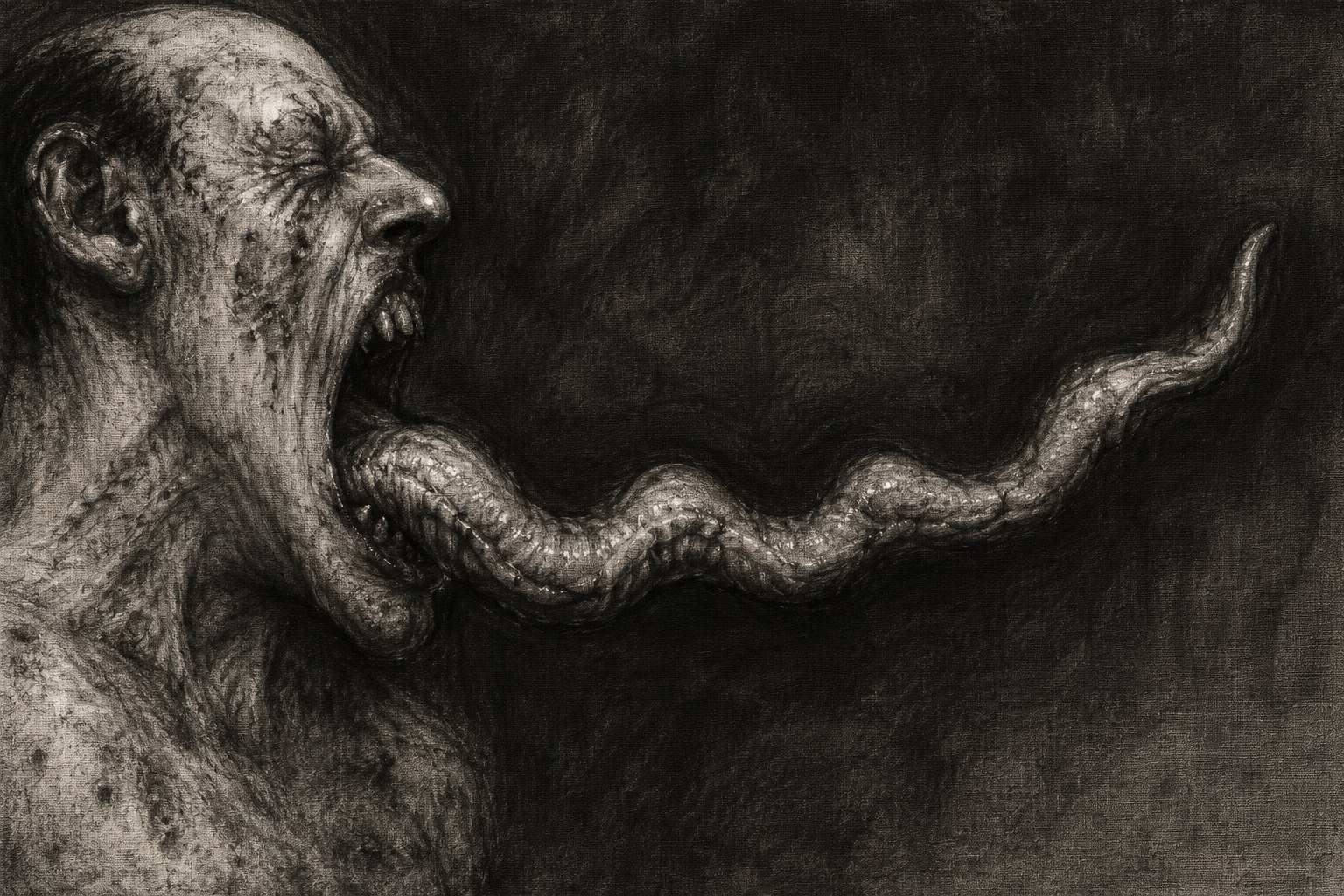
It unrolled from his mouth, long, wet, and muscular, slapped the insect, adhered, and snapped back.
There was a hard, bitter crack between his teeth.
Then sweetness.
Then a warmth of such private satisfaction that he gripped the sink and almost wept.
When Mili returned with a candle, he was washing his mouth.
“What happened?”
“Vomited.”
“Again?”
“Yes.”
“There is nothing in the sink.”
“I cleaned it.”
The lie stood between them, dripping.
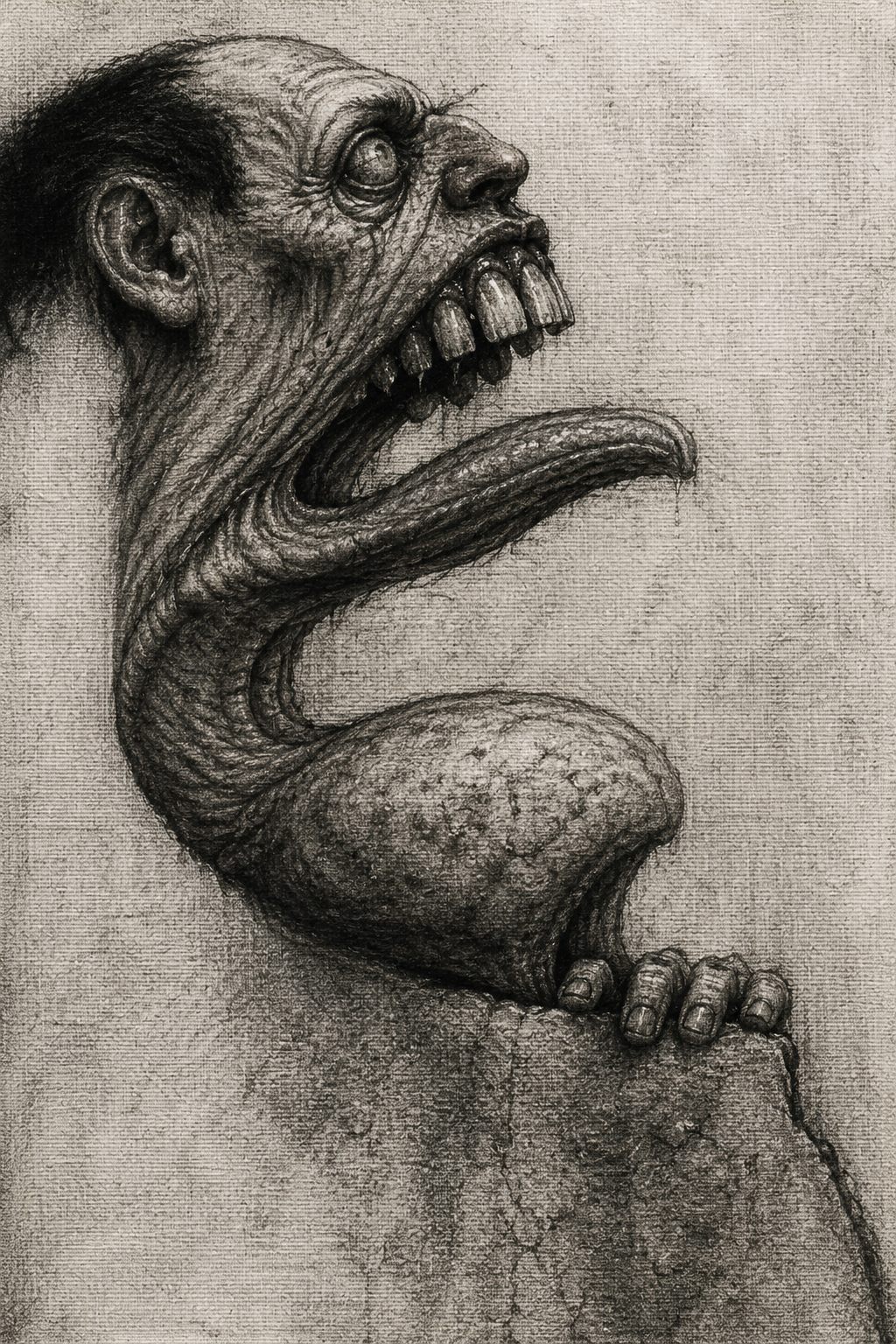
The next morning, his throat had a loose pouch beneath the jaw. His skin had become cool and slightly slick at the wrists. Tiny raised spots appeared along his cheeks. He shaved and nicked one; the blood was pale, diluted, wrong.
Mili saw the marks at breakfast. She put down her cup.
“We are going to the clinic.”
“No.”
“Then I am calling Dr. Lahiri.”
“No.”
She stared at him with the exhausted fury of someone who had already mortgaged dignity and was now being asked to surrender common sense. “You are becoming ill in a new way. That is not improvement.”
“I am better.”
“You ate a cockroach last night.”
The sentence, once spoken, seemed to embarrass the room.
Nilotpal looked at her. “You saw?”
“I heard. I hoped I was mad.”
Outside, the para was beginning its morning parliament. Someone complained about municipal water. Someone praised a nephew in Canada. Someone said the new gated tower had no soul but very good parking. This was the new city: app-based life floating over old para surveillance, everyone ordering privacy through phones while three balconies monitored the delivery.
Mili lowered her voice. “Show me.”
“No.”
“Show me, Nil.”
Because he still loved her, and because shame eventually becomes boring even to the ashamed, he opened his mouth.
The tongue lay folded inside like an animal pretending to sleep.
Mili made no sound. That was worse than screaming.
At the clinic, Raka Lahiri examined him after clearing her schedule with frightening speed. She touched his throat pouch, looked into his eyes, photographed the tongue, and asked three times whether he had taken any other medication, supplement, herbal product, protein powder, or street drug.
“Street drug?” Mili said. “He barely goes to the street.”
Raka ignored her. “Bring the bottle.”
Mili produced it from her bag, wrapped in a hand towel with two freezer packs. Raka peeled back the blue label with a scalpel.
Underneath was a green one.
RANA-9 ADHESION VECTOR / Lab Model: Urban Omnivore / Non-human use only.
The room seemed to become smaller.
Raka said nothing for too long.
“What is that?” Mili asked.
“A mislabeled research sample.”
“What research?”
“Not clinical.”
“What research?”
Raka’s face tightened. “A platform based on amphibian regenerative pathways and adhesive tongue proteins. It was for animal modeling. There has been a storage error.”
Nilotpal laughed once. It came out as a soft croak.
Mili turned on him. “Why are you laughing?”
Because the worst thing had happened and taken away suspense. Because his hands were steady. Because his father had never eaten cockroaches but had spent three years becoming less human anyway, and no one had called that a storage error.
Raka said, “You need admission. Isolation, blood work, imaging, immunosuppression. We must notify—”
“No,” Nilotpal said.
“You do not understand the danger.”
“No, doctor. I understand danger. What I don’t understand is billing.”
Raka looked away.
That was when Mili understood the shape of the trap. Admission meant forms, committees, perhaps newspapers, perhaps denial, certainly cost. Their debt would grow teeth. Respectability in Calcutta was not virtue; it was the skill of keeping catastrophe behind a curtain while neighbors discussed your electricity bill.
“Will you reverse it?” Mili asked.
Raka did not answer quickly enough.
They left.
For three days Nilotpal stayed inside the flat.
He slept in the bathroom because the tiles were cool. He placed a bowl of water beside him and dipped his fingers in it. His tongue grew stronger. He caught cockroaches from behind the stove, from under the shoe rack, from the crack near the bathroom pipe. Each one arrived in his mouth like a small sealed packet of purpose.
Mili stopped cooking fish.
The smell upset him.
On the fourth evening, Bhola from the tea stall came upstairs carrying milk packets for the neighbor and paused at their half-open door.
“Dada is not well?” he asked Mili.
“Fever.”
“Fever makes sound?”
“What sound?”
“Like frog. At night.” He smiled, not cruelly. Curiosity in Calcutta often dressed itself as concern. “Rainy season, what to do?”
Mili shut the door.
That night she searched Nilotpal’s phone while he slept in the bathroom, throat pulsing gently. She found the photos he had taken of the consent form. Page after page. Initials. Signatures. Paragraphs written in the dead English of institutional innocence.
Then one line, near the bottom: Patient consents to inclusion in adaptive vector response registry in the event of non-standard phenotypic expression.
Below that, Nilotpal’s signature.
She woke him by turning on the light.
“You knew there was some other study.”
He blinked, pupils wide and horizontal.
“I knew there were unknowns.”
“This is not unknown. This is frog.”
He sat up slowly. His limbs had changed, not in shape exactly, but in intention. He folded now instead of sitting. “They said my case might qualify future patients. They gave a discount.”
“A discount?”
He said nothing.
“How much?”
“Forty percent.”
Mili put her hand over her mouth, not from horror but arithmetic. Forty percent was their marriage now. Forty percent had sat beside her at dinner and asked for more dal.
“You sold your body without telling me.”
“I was trying to save it.”
“You were trying to save me from watching?”
He looked at the floor.
That answer was old. Older than disease. Men had been hiding disasters from women since the first unpaid loan, the first lost job, the first medical report folded into a shirt pocket. Not out of strength. Out of vanity with a fever.
The phone rang.
Dr. Raka Lahiri.
Mili answered on speaker.
“Mrs. Sanyal, listen carefully. Do not bring him to the clinic. There are people from the company asking questions.”
“What company?”
A pause. “The sponsor.”
“You said clinic research.”
“I said what I could say.”
Nilotpal leaned closer. His throat worked.
Raka’s voice dropped. “The bottle was not supposed to reach him. Or perhaps it was. I don’t know anymore. There are other reports.”
“Other frogs?” Mili said, almost calmly.
“Other patients. Different cities. Different vectors. A man in Pune with keratin growth. A woman in Noida metabolizing plasticizer compounds. Two cases here.”
“Here where?”
“Do not let him leave the flat at night.”
Nilotpal smiled.
It was not a human smile, but it was not entirely animal either. It contained embarrassment, hunger, and something like peace.
“Doctor,” he said, “why cockroaches?”
Raka was silent.
“Doctor?”
“The vector seeks resilient protein sources and urban pathogen reservoirs. Cockroaches were not a side effect. They were the target model.”
Mili sat down.
Outside, rain began again, tapping the balcony grill. From the lane came the smell of wet dust, drains, frying batter, cheap incense before a household god, diesel from a stalled taxi. Somewhere a puja committee was testing lights months too early, because Bengalis can be late for work but never for spectacle.
Nilotpal crawled to the balcony.
Mili followed. “Come inside.”
Below, the lane glistened. A delivery rider argued with the building guard. A boy from the coaching center hurried under a file held over his head. Bhola’s tea stall steamed under blue plastic. The city carried on, heroic in the way a leaking boat is heroic if nobody can afford a shore.
Then Nilotpal heard it.
Not cockroaches.
Tongues.
Soft wet strikes from the dark openings of the lane. From the drain beside the tea stall. From the broken ground-floor window of the abandoned house opposite. From somewhere high in the gated tower beyond the old cinema poster, where a rich man’s balcony garden trembled though there was no wind.
Once.
Twice.
Many times.
Little sounds of capture.
Mili heard them too. Her face changed.
A message appeared on Nilotpal’s phone from an unknown number.
DO NOT PRESENT AT CLINIC. HOME MONITORING ACTIVE. YOUR RESPONSE IS WITHIN EXPECTED RANGE. PAYMENT CREDIT INITIATED.
Below it was a bank notification.
The amount was large enough to clear the loan.
Mili looked at the screen, then at her husband crouched in the balcony rain, his altered throat shining, his mouth closed carefully around the long patient secret inside him.
“Nil,” she whispered, “what did you sign?”
But he was listening past her now, toward the whole wet city, where behind walls and cabinets and polished modular kitchens, the ancient brown survivors were coming out, and something newly made in men was waiting lovingly to receive them.
Word Cloud
Related reading
Selected by shared topics and section, with closer publication dates breaking ties.