The Voice Under the Loudspeaker
Uses the speech voice supplied by your browser or device.

THIS IS A WORK OF FICTION
By the time Nirmal reached the crossing at Gariahat, the godman’s voice had already entered the bones of the city.
It came from the temporary pandal beside the old cinema hall, where peeling posters of heroic men with impossible hair flapped in the evening damp. Tram wires made black scratches above the road. Buses coughed blue smoke. A tea stall hissed under a tarpaulin, its kettle speaking more truth than most men, and a boy in a torn Argentina jersey ran between taxis selling plastic packets of incense. The whole crossing had become one large, sweating ear.
“Come, children,” the voice said.
Nobody should have heard it clearly through that traffic. Not with the autos honking like insulted geese, not with the fish seller shouting hilsa rates, not with a policeman blowing a whistle as if he were trying to kill a mosquito at the far end of history. Yet the words arrived untouched.
“Come close. God does not shout. God enters.”
A woman beside Nirmal dropped her bag of coriander. The leaves spread over the wet pavement like a small green accident. She bent to pick them up, then stopped, one hand hovering over the ground.
Nirmal felt it too.
A pressure below hearing.
Not sound, exactly. More like the memory of thunder under a bed.
He was forty-four, thin from irregular meals, an electrician by trade and a worrier by inheritance. In better years he had rewired flats in Lake Gardens where people apologized to their dogs in English. Now he took whatever small jobs came: fans, pump motors, illegal extensions, switches that spat blue sparks during rain. He had come to Gariahat that evening to buy two meters of copper wire on credit from a shopkeeper who disliked him with professional consistency.
Instead he found himself standing before a godman in saffron silk.
The man sat on a raised platform beneath a banner: BABA SHABDANANDA, THE LIVING VOICE OF GOD. He was broad-faced, clean-bearded, and handsome in the way of men who know where the light is falling. Around his neck hung rudraksha beads as large as plums. His eyes were half shut. His mouth barely moved.
Still the voice rolled out.
“Your fear is not yours. It is sin speaking from inside your blood.”
An old man began to cry.
Nirmal’s stomach tightened.
Fear, he knew, had many practical causes: rent, unpaid school fees, a wife leaving after eight years of polite disappointment, a mother’s framed photograph gathering dust because you could not afford flowers. Fear did not need sin. Fear had excellent paperwork.
Beside the platform, two young men in white kurtas managed the crowd. One was tall, with oiled hair and the quick suspicious eyes of a ticket checker. The other was shorter and kept smiling at people as if he forgave them for being poor.
“Donation line this side,” the tall one called. “Special blessing after offering.”
A woman pushed forward carrying a sick child. Baba Shabdananda lifted two fingers without looking at her.
“Do not weep,” the voice said, enormous and intimate. “The child’s fever is the shadow of doubt.”
The woman fell at his feet.
Nirmal saw something then.
When Baba lifted his hand, the saffron sleeve slipped back. Under the fold, near the elbow, a small black wire flashed and vanished.
Nirmal stared.
He knew wire the way a fish knows water. This was not a sacred thread. This was insulated cable, thin, matte, expensive.
A hand caught his arm.
“Dada,” said a girl’s voice. “You also hearing the stomach-drumming?”
She was twenty maybe, sharp-faced, hair cut short, with a cloth bag full of stapled pamphlets. Nirmal had seen her before near the tram depot, arguing with a priest about drainage.
“Not stomach,” Nirmal said. “Low frequency.”
The girl’s eyes sharpened. “You’re technical?”
“Electrician.”
“Then come tomorrow.”
“Where?”
“To expose him.”
This was how trouble arrived in Calcutta: not with dramatic thunder, but through a young person using the word expose as if the city were not already lying naked under a leaking roof.
Her name was Mili Banerjee. Her father, she said, had given Baba Shabdananda half the retirement money he had received from a small printing press that had closed after fifty-six years, a death more Calcutta than cholera. The godman had promised to remove “ancestral blockage.” The only blockage removed was from the family bank account.
“Police?” Nirmal asked.
Mili laughed without humor. “Baba blesses police families also. Politicians too. Yesterday he cured one councillor’s nephew of laziness.”
“That is a miracle.”
“He has a private session tomorrow night. My father is going. He will give our last gold bangle. I need proof.”
Nirmal looked at the stage again.
The godman’s voice thickened.
“There are insects among us,” it said. “Men of doubt. Men who measure God with pliers.”
For one ridiculous second, Nirmal thought Baba was looking at him.
Then the low pressure deepened, and a child screamed.
The crowd swayed. Not forward, not back. Downward somehow, as if everyone had remembered an old shame at once.
That night, in his one-room flat near Bansdroni, Nirmal could not sleep. The ceiling fan clicked like a cautious lizard. Rainwater knocked in the drainpipe. From the next building came television laughter, thin and canned.
He took apart an old transistor radio and pretended it was useful work.
His ex-wife, Ananya, had once said he could fix anything except a conversation. She had not said it cruelly. That had made it worse. Cruelty gives you something to hate. Sad accuracy simply sits in the room.
He thought of Baba’s hidden wire.
He thought of Mili’s father selling the last bangle.
At midnight, when the neighborhood generator started, a vibration moved through the floor. Nirmal froze.
“Come close,” whispered something below the generator’s growl.
He stood up so fast the chair fell.
There was no voice. Only rain, fan, generator, and a rat inside the wall making private arrangements.
Still, he did not sleep.
The next evening, Mili met him behind the pandal near the old cinema’s locked side gate. The lane smelled of frying batter, wet cardboard, urine, and devotion. Three enormous loudspeakers were tied to bamboo poles with coir rope, their mouths aimed at the traffic like artillery. Behind the stage, a tarpaulin covered a table of equipment.
“Can you look?” Mili asked.
Nirmal peered through a gap.
There was a battery pack, a small mixing unit, two black rectangular amplifiers, and something else in a cloth pouch. Not cheap. Not local jugaad either. The arrangement was clever. The public speakers carried the audible sermon. But a separate line ran under the carpet toward the platform.
“Body speakers,” Nirmal whispered.
“What?”
“Tiny neodymium drivers, maybe hidden in his chest strap or sleeves. Close-field sound. Makes voice seem to come from him even when his mouth hardly moves.”
“And the stomach-drumming?”
“Sub-bass. Maybe below twenty hertz. You don’t hear it. You feel it.”
“Can it frighten people?”
Nirmal hesitated. “Sound can do many things. Nausea, unease, pressure. Fear is not a switch. But in a crowd, with suggestion—”
He stopped.
Baba’s tall assistant had appeared at the end of the lane.
“Mili-di,” the man said. “Baba has called you.”
“I didn’t ask.”
“Baba does not wait for asking.”
Nirmal stepped in front of her before he had time to calculate whether courage was affordable. “She is with me.”
The assistant smiled. His name, Mili had said, was Prabal. He had once failed two competitive exams and then discovered the quicker civil service of religion.
“Then you also come.”
They were taken through the rear flap of the pandal.
Inside, the air was cooler. Incense fought with electrical heat. Baba Shabdananda sat before a steel tumbler of coconut water, his saffron robe loosened at the neck. Up close, Nirmal saw the small swell beneath the cloth at his collarbone. A harness.
Baba opened his eyes.
Without the public voice, he sounded ordinary. Almost bored.
“You are the electrician.”
Nirmal said nothing.
“You have doubt.” Baba smiled. “Good. Doubt is a goat. Faith is the knife.”
Mili snapped, “Give back my father’s money.”
“Your father came with a burden. I gave him release.”
“You gave him a receipt?”
Baba laughed. Prabal did not.
Nirmal looked at the table beside the platform. On it lay a small screwdriver set, imported batteries, a roll of black tape, and a cracked leather diary tied with red thread.
The diary had an old brass clasp.
Baba followed his gaze.
“You like machines,” he said softly. “Machines are innocent. Men are not.”
Then the voice changed.
Not louder.
Lower.
It entered Nirmal’s chest and pressed on an old bruise in memory.
“You left your wife because you were small,” it said.
Nirmal’s mouth went dry.
Mili looked at him, confused.
“You let love become a room with no air,” said the voice beneath the voice. “You watched her pack. You said nothing. You are still saying nothing.”
Nirmal staggered back.
Baba’s lips had not formed those words properly. Yet the words were exact enough to wound.
“Stop,” Nirmal whispered.
Mili grabbed his wrist. “He asked people about you. That’s all. Someone told him.”
But nobody there knew Ananya.
Nobody knew the particular shape of that shame, the chair by the door, the blue suitcase, the way Ananya had waited for him to say one generous sentence and he had found only silence, that loyal family disease.
Baba leaned forward.
“Come tomorrow before dawn,” he said in his normal voice. “There will be a cleansing for chosen souls. Bring no police, no friends. Bring your doubt. It has a smell.”
They were pushed out into the lane.
Mili was furious. Nirmal was cold.
“He frightened you,” she said. “That means we are close.”
“No,” Nirmal said. “That means something is wrong.”
“Wrong is why we came.”
He nearly told her to leave it. Let her father lose the bangle. Let the city continue its daily trade: money for hope, hope for humiliation, humiliation for another man’s dinner. Contemporary Bengal had made a cottage industry of respectable desperation. Degrees on walls, unpaid bills in drawers, sons in Bengaluru, daughters in Canada, parents in dim rooms watching godmen promise what government, family, and the market had all failed to deliver.
But Mili’s hands were shaking.
“My mother wore that bangle,” she said. “After she died, Baba told my father her soul was trapped in the metal.”
That decided him.
Not bravery. Irritation.
Calcutta people will tolerate cosmic injustice for centuries, but touch a dead mother’s bangle and suddenly even an electrician with arrears becomes an army.
Before dawn, the city was a wet animal.
Nirmal returned alone with his tool bag. He had told Mili to wait near the tea stall, which of course meant she followed him from a distance with the offended dignity of youth.
The pandal was almost empty. A few devotees slept on mats. Incense smoke hung in unmoving layers. At the rear, Prabal smoked a cigarette and spoke quietly with the smiling assistant.
Nirmal slipped behind the old cinema gate, climbed a rusted drainpipe, and entered through a broken ventilator he had noticed the previous evening. It was foolish, painful, and undignified. His left knee made a sound like old furniture.
Inside the rear enclosure, he opened the cloth pouch.
The device was beautifully made. A compact sub-bass transducer, battery-powered, connected to a directional amplifier. Another line ran to Baba’s hidden body speakers. There was also a throat microphone, thin as thread, and a second input marked with a strip of red paint.
Nirmal frowned.
The red line did not connect to any microphone.
It ran under the carpet, across the platform, and down through a hole in the wooden boards.
He lifted the carpet.
Beneath the stage was a shallow pit. Old cinema cellars, he guessed. Many buildings in Calcutta had hidden stomachs: storage rooms, coal spaces, smugglers’ cupboards, wartime shelters, family secrets with brickwork.
A smell rose from below.
Damp cloth. Metal. Something like milk gone bad.
He lowered himself into the pit.
His torch beam found walls black with fungus. Old film reels lay in rusted tins. Broken seats. A poster of a heroine with silverfish eating her smile. In the far corner stood a wooden cabinet, its doors tied shut with copper wire.
The red cable entered it.
From inside came a faint vibration.
Nirmal cut the wire.
The vibration stopped.
Then something behind the cabinet breathed.
He dropped the torch.
In darkness, a voice spoke in his mother’s tone.
“Nirmal, have you eaten?”
He began to cry before he could stop himself.
His mother had died three years earlier after a long illness that had reduced both of them to their most helpless versions. In the last week she had asked that question again and again, even when she could no longer swallow water. Have you eaten? The Bengali mother’s final theology.
“Nirmal,” the dark said. “Why did you sell my bangles?”
“I had to,” he whispered. “For medicine.”
“For silence,” it said. “You bought silence.”
The cabinet doors trembled.
Above him, footsteps crossed the stage.
A match flared. Baba Shabdananda stood at the pit opening, looking down.
“I told you machines are innocent,” he said.
“What is in there?”
Baba sighed, like a man inconvenienced by truth. “The first voice.”
Prabal appeared beside him. “Come up.”
Nirmal did not move.
Baba’s face hardened. “Do you think I created God with batteries? Fool. I found Him. The cinema closed twenty years ago. I rented the hall for meditation camps. At night, from below, the dead spoke. Not ghosts. Not one person. All of them. Fear, guilt, hunger, last words, unpaid debts. A great under-voice. I only gave it a throat.”
The cabinet knocked once.
Mili’s voice shouted from above, “Nirmal-da!”
Everything happened quickly then.
Prabal turned. Mili struck him with a bamboo pole stolen from the donation queue. It was not elegant, but history rarely is. The smiling assistant ran. Baba lunged for the amplifier controls. Nirmal climbed up, seized the red cable, and pulled.
The cabinet below shrieked.
Not loudly.
Deeply.
The pandal shook. Sleeping devotees woke and began to moan. Outside, dogs howled. The loudspeakers crackled though no one had switched them on.
Baba grabbed Nirmal by the throat. For a holy man he had excellent grip.
“You don’t understand,” Baba hissed. “People need command. Without fear they scatter. I gather them.”
“You rob them.”
“I give shape to what already owns them.”
The sub-bass rose.
The bamboo poles rattled. A crack opened along the stage boards. From below came many voices braided into one: mothers, clerks, children, creditors, lovers, teachers, all speaking the same private sentence to each listener.
Mili stood frozen.
Her face changed.
“Ma?” she whispered.
Baba smiled through blood at his lip. “See?”
Nirmal knew then how the thing fed. Not on faith. On the moment after recognition, when longing made a person obedient.
He took the screwdriver from his bag and drove it into the amplifier’s battery casing.
White sparks spat.
The sound punched outward.
The three big loudspeakers exploded one after another, throwing paper cones and hot wire into the dawn. The pandal lights died. For one breath, the city went silent.
Then the cabinet under the stage burst open.
No creature climbed out.
That would have been easier.
Instead, the silence filled with every sound Calcutta had swallowed and pretended not to hear: women crying behind bathroom doors, fathers counting coins, boys rehearsing English interview answers under their breath, old men calling children who had emigrated and would not return, lovers deleting letters, patients bargaining with pharmacists, tenants lying to landlords, landlords lying to themselves, the entire middle class scraping dignity from an empty tin.
The voice had never been God.
It was the city’s shame, trapped under an old cinema, amplified by a fraud until it learned performance.
Baba fell to his knees. “Speak through me,” he begged. “I am your vessel.”
The darkness answered in his own ordinary voice.
“No. You are only a loudspeaker.”
The stage collapsed beneath him.
When police arrived, there was no pit. Only broken boards, burnt equipment, and Baba Shabdananda lying unconscious with his mouth packed full of damp black fungus. Prabal had vanished. The donation boxes were empty, though whether by miracle or management nobody could say.
Mili found her father near the tea stall, clutching the gold bangle in his fist. He claimed her mother had appeared and slapped him.
“Good,” Mili said, crying. “She always had sense.”
Nirmal walked home after sunrise because he had no taxi money and because the city looked different when one had heard its underneath. Gariahat resumed itself with insulting speed. Tea boiled. Buses shouted. Men argued over change. A poster of Baba was already being torn down by a boy who would sell the bamboo later.
At home, Nirmal opened the tin trunk under his bed. Inside were old bills, a wedding photograph, and one letter from Ananya he had never answered.
He read it at the table.
Then he took out paper and wrote, slowly, badly, honestly. Not to win her back. Not to cleanse anything. Only to make one small wire connect where he had once left silence.
When he finished, the room was quiet.
Almost.
From the dead transistor on the shelf came a soft crackle, though there were no batteries inside.
A low voice, patient as damp, said his name.
Nirmal folded the letter, sealed it, and did not answer.
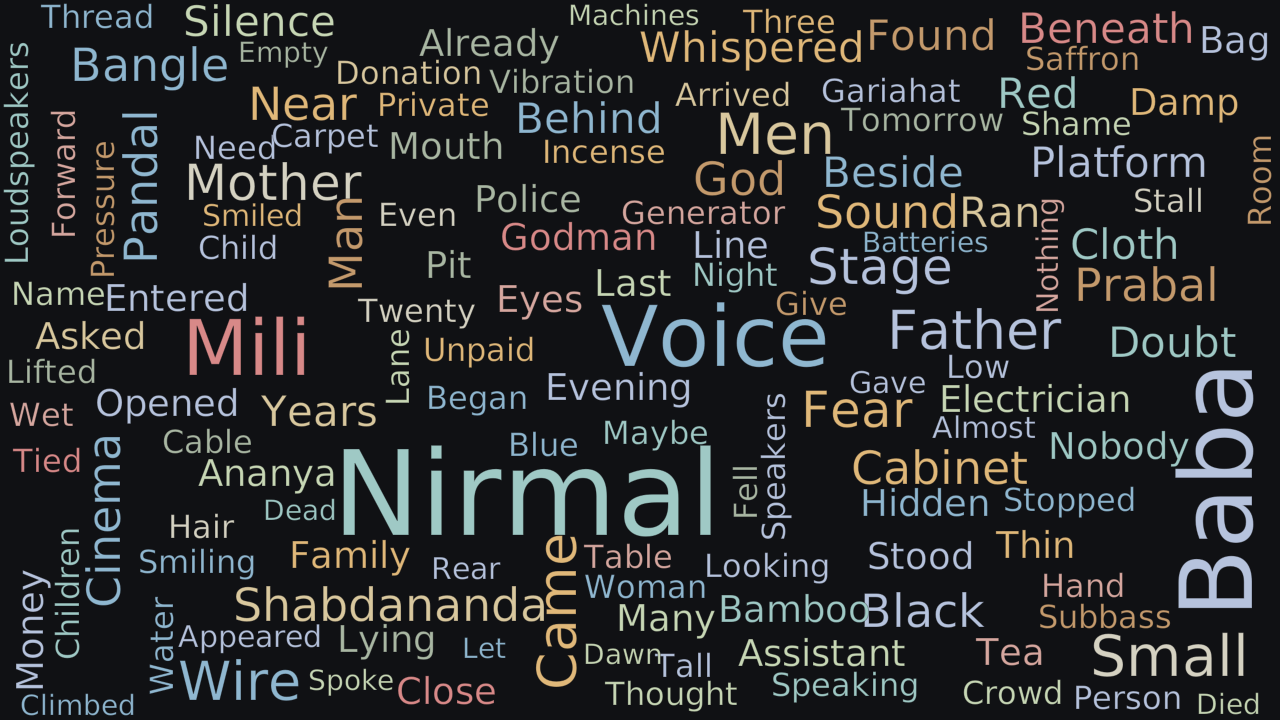
Word Cloud
Related reading
Selected by shared topics and section, with closer publication dates breaking ties.