Three Heads for Migraine
Uses the speech voice supplied by your browser or device.

THIS IS A WORK OF FICTION
By eight in the morning, Rashbehari Avenue had already begun behaving like a punishment invented by a municipal god with a migraine.
Buses coughed black phlegm near the crossing. A tram wire hummed above the tea stall where men in office shirts drank boiling cha from thumb-sized glasses and discussed, with equal authority, cholesterol, China, cinema, and the collapse of civilization. Rainwater from the night before lay in dark, greasy commas along the curb. A delivery rider, helmet hanging from one elbow, argued with a sweet-shop owner over an address that existed on Google Maps but not, apparently, in creation.
On the wall beside them, under old posters for a coaching center promising government jobs to exhausted young men, a new advertisement had appeared overnight.
SPLITTING HEADACHE?
TRINOCET-MR
RELIEF IN THREE MINUTES.
The model in the poster was a handsome Bengali woman with impossible skin and a palm pressed to one temple, as if pain were merely an elegant thought. Beneath her, in English and Bengali, came the warning in print so small it looked like a legal disease.
Dr. Arka Sen noticed it because he noticed all drug posters. Once, in another life, he had designed hospital dashboards in Texas where medication errors appeared as red dots on clean screens. In Calcutta, the red dots had become people, bills, relatives asleep on hospital floors, and chemists selling prescription drugs with the cheerful freedom of a fish market.
He stood at the tea stall with his canvas bag tucked under one arm, sweating through his shirt before the day had properly begun. He had returned to the city six years earlier to care for his mother and to become, by slow humiliating increments, a freelance medical data consultant for nursing homes that paid late and pharmaceutical companies that paid exactly enough to make refusing them feel theatrical.
The tea seller, Bappa, slid a glass toward him.
“Doctorbabu, new medicine. Very fast. My cousin took. Headache gone.”
“You have a cousin for every drug,” Arka said.
“This cousin is genuine.”
“None of your cousins are genuine.”
Bappa grinned, showing teeth reddened by paan. “You people make the medicine, then you insult us for eating it.”
That was the trouble with Calcutta. Even the tea sellers could locate hypocrisy like a seasoned radiologist.
Arka did not make medicines. He arranged numbers around them. Two months earlier he had taken a contract from Asterion LifeCare, a new pharmaceutical firm operating out of a glass building near Sector V, where the air-conditioning was cold enough to preserve regret. His assignment was modest: build an adverse-event dashboard for Trinocet-MR, their new over-the-counter migraine tablet. Cheap. Fast. Aspirational. For the clerk who could not miss work, the mother who could not lie down, the delivery boy who could not afford pain, the student whose exam did not care about the skull’s weather.
The first strange case arrived that afternoon at Kalighat Metro station.
A woman began screaming on the platform. At first people assumed a phone had been stolen. That was the city’s preferred explanation for public distress: theft, heat, politics, or domestic matter. Then the crowd widened.
She was sitting near the yellow line, her office bag still on her lap, both hands clamped to her head. A young man filmed her. Another shouted for water. The announcements continued overhead in three languages, cool and useless.
Arka was on his way to a nursing home audit near Hazra when the station staff pushed through the crowd. He saw only a glimpse before a security guard blocked the view.
The woman’s hair was moving.
Not shaking. Not fluttering. Moving outward.
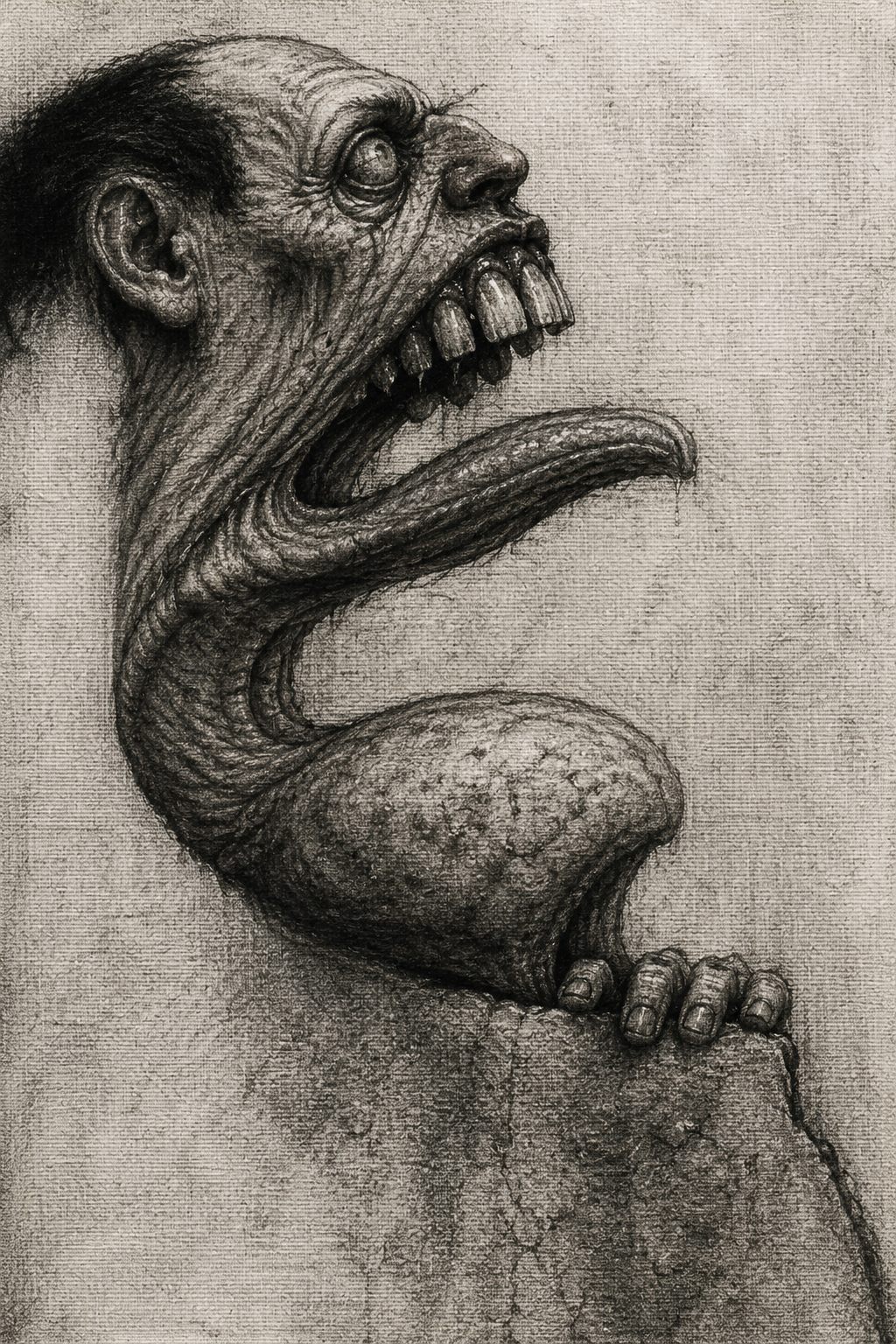
The scalp at her temples rose in two wet mounds. Her face stretched with a silence too large for screaming. Then, with a sound like a ripe jackfruit being forced open, two new faces unfolded from either side of her skull.
For one second the platform became absolutely quiet.
Then all three mouths began to scream.
By evening, the video had spread across WhatsApp groups, Instagram reels, news channels, and the private family networks where panic traveled faster than ambulances. The woman was identified as a bank employee from Behala. Her name was Priyanka Dutta. She had complained of a splitting headache before boarding the metro. Someone claimed she had bought Trinocet-MR from a pharmacy outside Kalighat. Someone else claimed the video was AI. Someone’s uncle, naturally, knew the real story.
At Deshapriya Park, a retired schoolteacher developed two additional heads while sitting in a plastic chair under a peeling balcony, reading Anandabazar. In Ultadanga, a taxi driver’s skull divided in traffic, and the two new heads immediately began abusing each other in language so specific that several passengers later admitted it sounded exactly like North Kolkata. At a private hospital near Mukundapur, a teenage boy taking Trinocet for exam headaches sprouted a left head that recited physics formulas and a right head that wept for his girlfriend.
The city did not stop. Cities never do. They merely make room for the impossible and complain about the inconvenience.
By nine that night, Asterion called Arka.
The man on screen was Prabal Sanyal, vice president of medical affairs, though his face had the soft, obedient caution of a man who had spent his life agreeing upward.
“Arka, we need your dashboard live tonight.”
“It is live.”
“We need deeper filtering.”
“Filtering what?”
“Noise.”
“There are twelve reported cranial bifurcation cases in Kolkata hospitals.”
“Alleged cases.”
“Prabal, their heads split.”
“Not split. Please avoid that word. The regulator will ask whether there was actual separation. There was not. We are saying cranial expansion syndrome.”
Arka laughed once, badly. “You are naming it already?”
“There is hysteria. Competing brands are amplifying. Social media is not evidence.”
“Neither is denial.”
Prabal lowered his voice. “Listen. You and I are both Bengalis. We understand drama. Someone faints in metro, fifty people make Mahabharata. Send me a report showing no causal signal yet.”
“Is there no signal?”
“That is what we are asking you to establish.”
Outside Arka’s window, the evening rain had started again, thin and dirty, tapping the grilled balcony like fingernails. In the building opposite, a mother shouted multiplication tables at a child. Somewhere an inverter beeped during a power cut, one of those small modern sounds of middle-class panic. Electricity had become like respectability: everyone pretended to have backup.
“I will send what the data shows,” Arka said.
Prabal smiled with professional sadness. “Data shows what it is asked properly.”
Arka ended the call.
His mother, Bela Sen, called from the next room. “Arka? The fan stopped.”
“I know, Ma. Power cut.”
“My head is aching again.”
He went to her room with his phone torch. She lay under a thin cotton sheet, hair silver against the pillow, her blood pressure machine on the table beside a framed photograph of his father. The room smelled of talcum powder, old books, and the faint medicinal sweetness of eucalyptus oil.
“Did you eat?” he asked.
“You ask like hospital nurse. I am your mother.”
“That is why I ask.”
“My head is breaking.”
“Don’t say breaking.”
“Why? Will it obey English?”
He checked her medicine strip. Paracetamol. Amlodipine. Nothing new. Still, his hand trembled.
Bela watched him. “On TV they are showing people with three heads.”
“Don’t watch TV.”
“Then what to watch? Your face? That also looks like bad news.”
He smiled despite himself. She had been a literature teacher once, feared by boys who thought poetry could be survived by memorizing summaries. Age had thinned her, but not softened the blade.
“Promise me you won’t take any headache medicine from outside,” he said.
“I am old, not foolish.”
“In Calcutta that distinction is not always visible.”
She turned toward the window. Rain blurred the city into trembling sodium light. “When your father had headaches, he used to tie a wet gamchha around his forehead and sit quietly. People knew how to suffer then.”
“They also died quietly.”
“Yes,” she said. “Now they die with app notification.”
By midnight the dashboard showed thirty-seven cases.
Arka stared at the data until the numbers lost obedience. Almost all had purchased Trinocet-MR from small pharmacies or medicine counters. Most described “splitting headache” before ingestion. Onset ranged from two to seven minutes. No deaths. No reversals.
The new heads were alive.
That was the horror no one wanted to say plainly. They were not tumors. Not swelling. Not hallucination. Each additional head had eyes, tongue, teeth, saliva, independent expression, and speech. CT scans from three hospitals showed the skull had not cracked but reorganized, bone flowing outward like obedient clay. Neural tissue had proliferated along impossible pathways, branching from the original brain yet forming partial autonomies.
Permanent, one surgeon wrote in a note leaked from SSKM. No known anatomical basis for reversal.
At 2:15 a.m., a file arrived anonymously in Arka’s email.
SUBJECT: YOU BUILT THE LID.
No body. One attachment.
Inside were trial records from a Phase II study conducted in a low-cost research unit near Barasat. Trinocet’s active compound had a name Arka had not seen in the public documents: tripartin mesylate. It was listed as a neurovascular modulator intended to interrupt migraine signaling across trigeminal pathways.
But the internal notes were stranger.
PATIENT 07 REPORTED “THREE PAINS SPEAKING.”
PATIENT 11 EXPERIENCED FACIAL DUPLICATION DURING SEVERE STRESS EPISODE.
PATIENT 14: RIGHT AUXILIARY FACE EXPRESSED MEMORIES DENIED BY PRIMARY.
The trial had been halted, then restarted under revised criteria. The adverse events were recoded as psychiatric dissociation, conversion disorder, cultural somatization.
At the bottom was a memo signed by Dr. Ishani Roy, chief scientific officer.
In high-shame populations, migraine appears to function as a containment architecture. Tripartin disrupts containment. Result is not random growth but partitioned self-manifestation. Suppression of signal recommended until market uptake sufficient to establish therapeutic necessity narrative.
Arka read the last sentence several times.
Therapeutic necessity narrative.
There it was, polished and poisonous. Modern India had learned to put English shoes on old cruelties and send them walking through air-conditioned corridors.
His phone rang.
Unknown number.
“Dr. Sen?” said a woman.
“Yes.”
“This is Ishani Roy.”
He stood up so abruptly his chair struck the wall.
“You sent the file?”
“No. But I know who did.”
“Did you know?”
A pause. “Yes.”
The word was neither confession nor apology. It was a door opened onto a room already burning.
“You released it.”
“It was released because pain is a market,” she said. “And because people like you make dashboards that can be interpreted safely.”
“People like me?”
“Don’t pretend innocence. You built Asterion’s reporting thresholds. Three cases in one district before red alert. Ten before escalation. Thirty before mandatory regulator notice. Elegant work.”
“I built standard pharmacovigilance logic.”
“You built delay.”
He wanted to deny it, but denial needs a little space to stand in. He had known the thresholds were generous. He had known small signals would vanish into categories. India was excellent at disappearance. A boy disappears into exam coaching. A woman disappears into marriage. A father disappears into medical debt. A side effect disappears into “not statistically significant.”
“Why call me?” he asked.
“Because the medicine is doing what it was designed to do.”
“To split heads?”
“To separate what the headache holds together. Migraine is not only vascular. In many patients it is a locked room. One head for duty. One for rage. One for terror. We gave them architecture.”
“You gave them deformity.”
“We gave form to what was already there.”
This was how monsters spoke now, he thought. Not with thunder. With grant vocabulary.
On College Street the next morning, under a sky the color of boiled tin, Arka met the person who had sent the file.
Her name was Mili Basu, twenty-six, junior clinical coordinator, formerly of Asterion, currently unemployed. She wore a blue kurta and carried a cheap umbrella decorated with cartoon bears. Her nails were bitten down to the quick.
They sat in a café where students had been smoking, arguing, and not buying enough food since before independence. Outside, bookstalls sweated under plastic sheets. A tram moved past slowly, like a memory refusing eviction.
“I copied everything before they locked me out,” Mili said.
“Why send it to me?”
“You were in the memo chain.”
“I never saw these trial notes.”
“No. But you saw enough.”
The accusation landed cleanly because it was not dramatic. He had seen enough. Missing data. Odd category names. Too much eagerness. But in a city where everyone was one medical bill away from begging relatives in family WhatsApp groups, moral clarity was a luxury item, like imported cheese.
“My mother needs care,” he said, hating himself immediately.
Mili looked at him with something worse than anger. Recognition.
“My father drove an auto,” she said. “Stroke last year. I took this job because salary came on time.”
There they were, two educated Bengalis in a cheap café, each carrying a parent like an unpaid loan. Calcutta’s old middle class had not collapsed dramatically; it had been shaved down invoice by invoice, tuition by tuition, diagnostic scan by diagnostic scan, until dignity itself became a recurring expense.
“Why now?” Arka asked.
Mili swallowed. “My brother took it.”
She opened her phone.
The photograph showed a young man sitting on a hospital bed with three heads. The middle one stared ahead in exhausted shame. The left one smiled with childish delight. The right one glared so fiercely that Arka felt accused through the screen.
“He had headaches since school,” Mili said. “Coaching, exams, no job, my father’s medicines, all that. After the split, the left head keeps saying he wants to draw cartoons. The right head says he wants to burn our house. The middle head begs them to shut up.”
“Can surgery help?”
“No surgeon will touch. Too vascular. Too integrated. Also we have no money.”
A television mounted above the café counter showed a news panel. A politician blamed foreign conspiracy. A spiritual healer claimed three heads represented divine imbalance. A corporate doctor recommended calm. The anchor used the phrase “head multiplication crisis” with visible pleasure.
Then the screen cut to a live shot from Gariahat.
A crowd had gathered around a pharmacy. Police pushed against metal shutters. Someone had painted KILLER TABLET on the wall. Beside it, another hand had written in red: GIVE MORE. MY OTHER HEADS ARE WAITING.
Mili saw it too. “Some people want it now.”
Of course they did. By afternoon, black-market strips of Trinocet-MR were selling at ten times the price. Not everyone feared division. In a city where one head had to earn, obey, smile, remember, forget, marry, endure, send money, touch feet, and pretend not to be lonely, two extra heads began to sound, to some, like manpower.
In Burrabazar, porters joked they could bargain with one head while calculating with another. In Salt Lake, a startup founder posted that “multi-head cognition may redefine productivity.” In a puja committee group, someone proposed a three-headed Durga theme before being scolded for bad taste, then privately praised for innovation.
The first permanent patients were discharged because hospitals needed beds.
Priyanka Dutta returned to Behala wearing three loose scarves. Her left head laughed at neighbors. Her right head recited office passwords. Her middle head said nothing at all.
Arka spent the next two days building a public dossier. He and Mili verified trial records, pharmacy batches, hospital admissions. Rain fell, stopped, gathered itself, fell again. The city smelled of wet concrete, drains, frying oil, and fear. At night the power failed twice, and each time Arka sat in the dark with his laptop battery dying, listening to his mother breathe in the next room.
On the third evening, Asterion sent him a termination letter and a legal notice.
On the fourth, Prabal called again.
“You are making a mistake,” he said.
“Good. I was due.”
“Think practically. Even if you leak, they will blame misuse. Counterfeit supply. Heat. Stress. Bengali overreaction.”
“Bengali overreaction grew two heads?”
“You know how narratives work.”
“Yes. I helped build one.”
Prabal sighed. “Arka, we are not villains. There are patients reporting improvement. Severe migraine gone. Depression reduced. Some new heads are expressing suicidal thoughts before primary patients act on them. Do you understand the clinical value?”
“Do you hear yourself?”
“Do you hear the city? Everyone is already split. We only made it visible.”
That night, Bela’s headache returned with such violence that she vomited into a steel bowl.
Arka knelt beside her bed, wiping her mouth, his dossier open on the laptop behind him. Her skin was clammy. Her blood pressure was high. No ambulance would arrive quickly in the rain. The lanes were flooded ankle-deep.
“Hospital,” he said.
“No.”
“Ma.”
“No hospital. Last time they kept me in corridor and charged for monitoring.”
“You need a doctor.”
“I need my head to stop.”
He gave her prescribed medicine, cold cloth, darkness. She moaned through it. The inverter died. The room sank into wet heat.
At 1:30 a.m., when the rain had become a solid thing, his phone flashed.
Mili: Upload scheduled 6 a.m. Multiple mirrors. Sleep if you can.
He did not sleep.
At 3:05, he heard his mother speak.
Not call. Speak.
The voice came from her room, but it was not hers.
“You always run when the bill comes.”
Arka froze.
Another voice answered, thin and bitter. “He learned from you.”
Then his mother’s own voice, frightened: “Who is there?”
He reached her door and could not enter.
The emergency torch lay on the floor, casting light upward. Bela sat on the bed with her white hair loose over three faces. The central face was hers, twisted with terror. The left face was younger, almost beautiful, the mother from photographs before marriage, eyes bright with all the books she had not yet surrendered. The right face was not his mother.
It was his father.
Not exactly. The bone was wrong, the skin drawn from her, but the expression was unmistakable: that tired, evasive gentleness Arka had loved and despised. The man who had died owing money to three relatives and one pharmacy. The man whose migraines had darkened entire afternoons. The man who had said, near the end, “Don’t tell your mother everything.”
Arka gripped the doorframe.
“Ma,” he whispered. “What did you take?”
The central head wept. “Nothing. I swear.”
The left head laughed softly. “Liar.”
The father-head turned to Arka. “Check your bag.”
He did.
In the front pocket of his canvas bag, beneath old prescriptions and a folded legal notice, lay a blister strip of Trinocet-MR. Three tablets missing.
He remembered the tea stall. Bappa sliding the glass. The advertisement. The small free sample strip given weeks earlier by Prabal’s sales team, tossed into his bag and forgotten. His mother, practical as hunger, must have found it during the afternoon, when he was at College Street deciding to save the city in public because he had failed in private.
The father-head said, “You wanted proof.”
“No,” Arka said.
The left head smiled. “You wanted punishment.”
The central head begged, “Make them stop.”
But there was no making them stop. That was the first thing the permanent patients learned. The new heads slept badly, interrupted meals, revealed old affairs, unpaid debts, childhood humiliations, tendernesses buried too deep to be useful. They were not demons. Demons would have been simpler. They were witnesses.
At dawn, the dossier went live.
By noon, the courts intervened. By evening, Trinocet-MR was banned. By the next week, Asterion denied wrongdoing, blamed counterfeit distribution, announced patient support, and quietly moved assets through subsidiaries. Dr. Ishani Roy disappeared from India. Prabal Sanyal joined a consultancy. Mili’s brother became briefly famous, then inconvenient, then poor again.
The city adapted, because adaptation is not wisdom; often it is merely exhaustion wearing shoes.
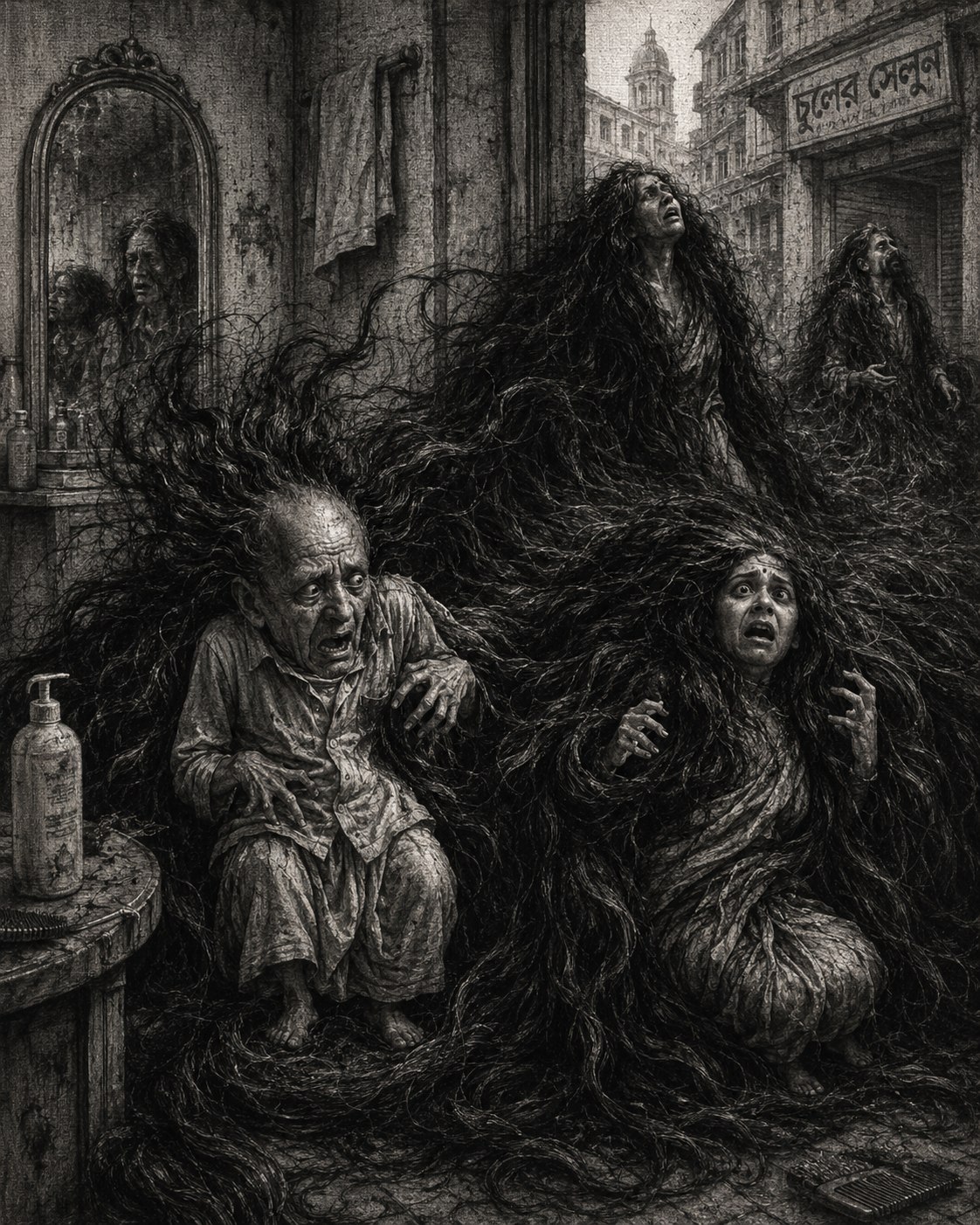
Three-headed people began appearing in buses, in hospital queues, on balconies, at ration shops, in Puja pandal concept art, in coaching-center jokes. Tailors designed wider collars. Barbers charged triple. Families discovered new forms of embarrassment. Some patients were abandoned. Some were worshipped. Some got jobs on television. Most simply continued, which was the most Calcutta thing of all.
Bela lived.
That was mercy. That was punishment.
In the evenings, Arka sat beside her while rainwater gathered on the balcony and metro announcements floated faintly from the main road. The central head watched serials. The left head read poetry aloud in a voice that made him ache. The father-head stared out at the city and said very little.
One night, during a power cut, Arka apologized.
To which head, he did not know.
His mother’s central face closed its eyes. The young left face kept reading. The father-head turned toward him with an expression almost kind.
“Don’t worry,” it said. “We have always been here.”
And in the dark window behind them, reflected over the rain-smeared lights of Calcutta, Arka saw his own face held still between two empty spaces, waiting.
Word Cloud
Related reading
Selected by shared topics and section, with closer publication dates breaking ties.