The Pharmakon of Woodlice
Uses the speech voice supplied by your browser or device.

The morning arrives not with light but with a taste, that particular metallurgical tang of a mouth that has spent eight hours fermenting its own bacterial flora into something resembling the floor of a tannery where small mammals have expired in droves, and I lie there, supine, contemplating the pharmaceutical architecture of my hypothalamus as one might contemplate the structural integrity of a termite-ridden howdah, which is to say: with the resigned expertise of a man who has paid for his education in sleeplessness and the particular, viscous variety of despair that collects in the lower intestines like unprocessed grief.
The pills.
Ah, the pills.
They come in colors that have no names in any decent language, these little oblate spheroids of synthetic equanimity, these compressed powders of manufactured tranquility that promise to smooth the cortical ridges of a mind that has been, since approximately age nineteen, engaged in a civil war of such baroque complexity that the Hundred Years’ War looks like a playground scuffle over a marbles dispute. I swallow them, as I have swallowed them for decades, and wait for the soporific majesty to descend—that chemical curtain of faux-opiatic calm that drapes itself across the synapses like a damp muslin cloth over a cadaver’s face. Dignified, perhaps. But the corpse remains a corpse, and the rot continues its patient, evangelical work beneath.
It is, I must tell you, a deception of the most elegant and vicious sort, this polypharmaceutical theater, this new-age snake oil distilled into milligrams and micrograms and measured out by physicians who have read the DSM the way a priest reads a missal: with faith rather than comprehension. The calm arrives, yes. A kind of glazed, aquarium serenity where the mind floats behind thick glass, observing the world through a refractive index of lithium and lamotrigine and whatever else the alchemists have brewed in their stainless steel crucibles. But—and here is the crux, the nub, the very testicular center of the matter—the irritation persists. The irritation persists, gestating in some dark fold of the limbic system like a larval wasp in a paralyzed caterpillar, waiting.
Waiting.
For the half-life to decay.
For the blood serum levels to drop.
For the synthetic veil to tear.
And then, oh then, the unfurling. The vegetative eruption. The return of the repressed with a ferocity that makes the initial irritation seem like a gentle colonic irrigation by comparison. It comes back amplified, distorted, a feedback loop of affective distortion that turns the volume of existence up to eleven and then snaps the knob off in its teeth. I have seen, in these moments, the color of sound and heard the texture of hatred. I have understood, with a clarity that no amount of psychoactive intervention can provide, that the medication does not cure the wound. It merely applies a topical anesthetic while the gangrene spreads in the dark.
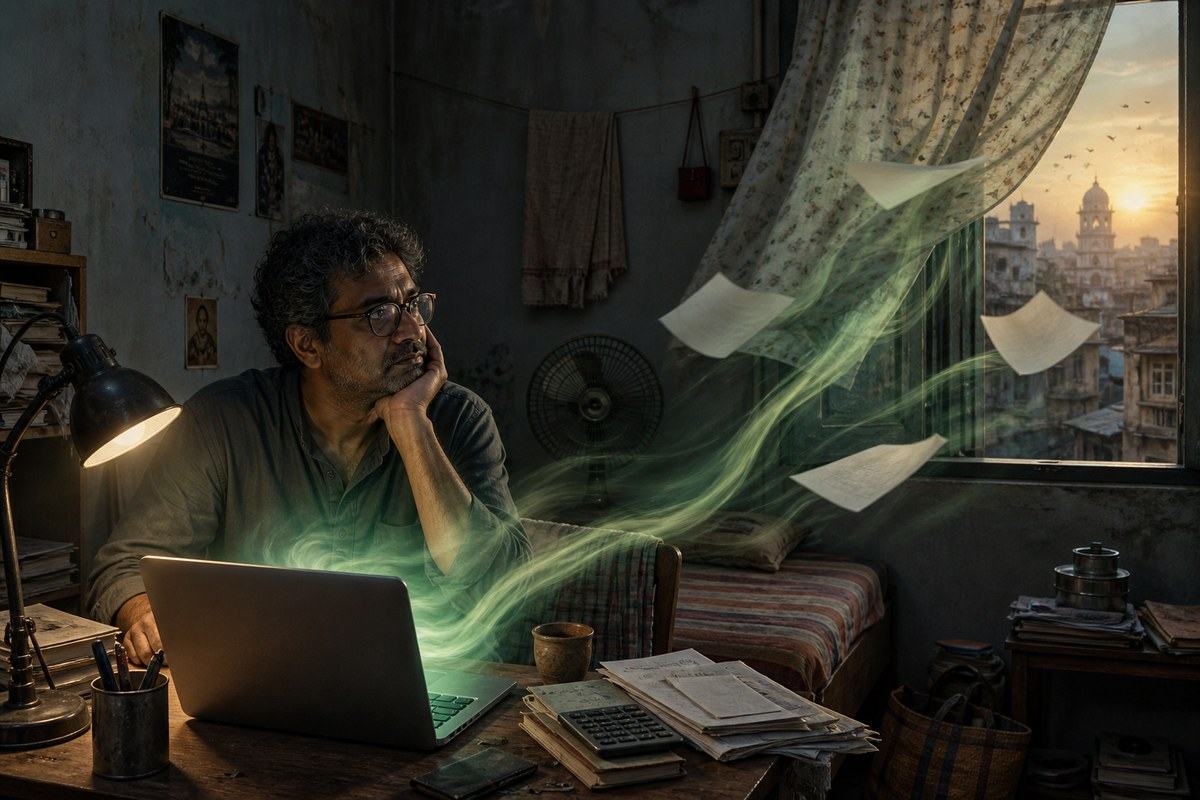
Which is why, at fifty-one, having exhausted the pharmacopeia’s patience and my own, I have retreated. Not in any romantic, Thoreauvian sense, because I am not a transcendentalist and I do not trust nature any more than I trust the pharmaceutical-industrial complex, and certainly not in any way that would invite the reader to picture me in a pastoral setting with a journal and a quill, because that would be a lie of the most vulgar and actionable sort. I have retreated into the hermetic, the bibliophilic, the aggressively solitary, where the only voices are those of the dead, and the dead, bless their inert hearts, do not ask you how you are feeling or suggest that you try yoga.
Books.
Books, I tell you, are the superior analgesic.
They do not come with a patient information leaflet warning of suicidal ideation in adolescents. They do not require titration. They do not lose efficacy after six weeks and leave you, at three in the morning, staring at the ceiling with the distinct sensation that your skull has been filled with a swarm of angry hornets that have been fed a diet of pure caffeine and existential dread. A book—take, for instance, Bill Bryson, that affable, bumbling, terrifyingly erudite wanderer through the byways of science and history, or Natalie Angier, that precise, witty, exuberant anatomist of the natural world whose sentences sparkle with the hard, gem-like flame of accurate observation—does not seek to alter your neurochemistry. It seeks to accompany it, to match its frequency, to say: I see you, you magnificent, broken tuning fork, and I will vibrate at your pitch until the resonance becomes bearable.
This is not a prescription.
I am not encouraging anyone to abandon their lithium carbonate and take up the complete works of popular science, though, between you and me and the lamppost, Andy Behrman’s Electroboy has done more for my depressive episodes than any SSRI ever concocted in a New Jersey laboratory. That memoir of manic excess and electroshock redemption, that glittering, crashing, pharmacologically saturated narrative of a man who flew too close to the sun on wings of amphetamines and credit card fraud, serves as a mirror and a warning and a strange, perverse comfort. I am not encouraging anyone to be a hermit if they’re in my shoes. I’m just saying this is where I am. Here, in this particular longitude of solitude, where the only thing more reliable than the monsoons is the certainty that my brain will, at irregular but inevitable intervals, attempt to secede from the union of my body and establish itself as an autonomous, hostile nation-state.
The scientists, meanwhile, have been busy. They have built a silicon chip that writes DNA with electricity and water-based enzymes, a portable God-machine for the age of miniaturization, as if what we needed was not less information but more, encoded in the very nucleotides of our being, a future where your genome is updated like a software patch and your melancholy is a bug to be debugged in version 2.4. And elsewhere, under the sodium-vapor streetlights that turn our nights into a perpetual, sickly amber, woodlice are caught in death spirals, thousands of them, circling and circling in a light-polluted ecstasy of self-destruction, their tiny isopod brains unable to process the artificial radiance, their bodies locked in a fatal choreography of confusion and exhaustion.
I read this and I laugh. A laugh that starts in the diaphragm and ends somewhere in the vicinity of the spleen, because it is too perfect, too grotesquely apt: the image of small creatures, seeking only the dark and the damp, driven to annihilation by a light they were never meant to see, spinning in circles until they die of their own bewilderment. It is, if you will permit a moment of uncharacteristic poetic license, the most accurate metaphor for the bipolar condition under modernity that I have yet encountered, and I have encountered many, having spent the better part of three decades collecting metaphors the way other men collect stamps or venereal diseases.
And the rattlesnakes, too, have been in the news. The myth of the baby rattlesnake—that juvenile serpents are more dangerous because they cannot control their venom—has been debunked by researchers who found that the young can, in fact, meter their poison quite precisely, while the adults, being larger and more confident, simply inject more. I find this unaccountably comforting, this revelation that danger is not the province of the inexperienced but of the mature, the fully grown, the established; that the world is not made perilous by the small and the new but by the large and the entrenched, by the institutions and the diagnoses and the medications that have been around so long they have become invisible, unquestioned, as natural as breathing or as the slow, arterial calcification of the heart.
I do not hate this.
Let me be precise, because precision is the only courtesy I have left to offer: I do not hate this life, this solitary, book-lined, chemically intermittent existence in the shanty boondocks of a city that was old when the British were still figuring out how to boil water for tea. Calcutta, that great, wheezing, consumptive metropolis, with its architecture of recurrence and its motifs of decay and its endless, patient attention to the granular textures of suffering—Calcutta does not ask you to be happy. Calcutta asks you to endure, and in that endurance, there is a kind of perverse, anti-heroic dignity that no pill can synthesize and no therapist can invoice.
The solitude gives me space. Not the space of a garden or a retreat or any of the other anodyne, Instagram-ready geometries of wellness, but the space to not need, the negative capability of wanting nothing from the world and offering nothing in return, a closed system of entropy where the only transaction is between eye and page, between the diseased bipolar cortex and the dead author’s preserved intention. Sometimes the numbing is necessary, and I take the pills, those little compressed tablets of artificial twilight, when the alternative is not madness but something worse: the clarity of seeing too much, the hyper-awareness that turns every social interaction into an autopsy and every glance into a biopsy.
But mostly, I read.
I read Bryson and I read Angier and I let their sentences unspool in my mind like the long, serpentine, self-interrupting arguments they are, the subordinate clauses piling up like the layers of a diseased epidermis, the main clauses delayed until the reader has forgotten what he was waiting for, which is, of course, the point. The manic energy finds its mirror in the baroque excess of the prose; the depressive collapse finds its echo in the long, patient sentences that seem to go nowhere and yet arrive, inevitably, at the precise coordinates of despair. It is a homeopathy of style, a cure by similarity, and it works, after a fashion, the way a tourniquet works: it does not heal the wound, but it keeps you from bleeding out on the carpet.
And so I am here, at fifty-one, with my books and my intermittent compliance and my mouth that tastes, each morning, like the floor of a battery farm, and I am not redeemed and I am not cured and I am not, heaven forfend, grateful. I am simply present, in all my swollen, cynical, grotesquely inflated particularity, a man whose mind is a streetlight and whose thoughts are woodlice, circling and circling in the amber glow of a synthetic calm that will, I know, with the certainty of astronomical prediction, wear off and leave me spinning in the dark.
But not yet.
Not yet.
There is a page left to turn, and in the turning, a small, temporary, utterly sufficient defeat.
Word Cloud
Related reading
Selected by shared topics and section, with closer publication dates breaking ties.