Intolerable Cruelty and the God-Zila of El Niño
Uses the speech voice supplied by your browser or device.

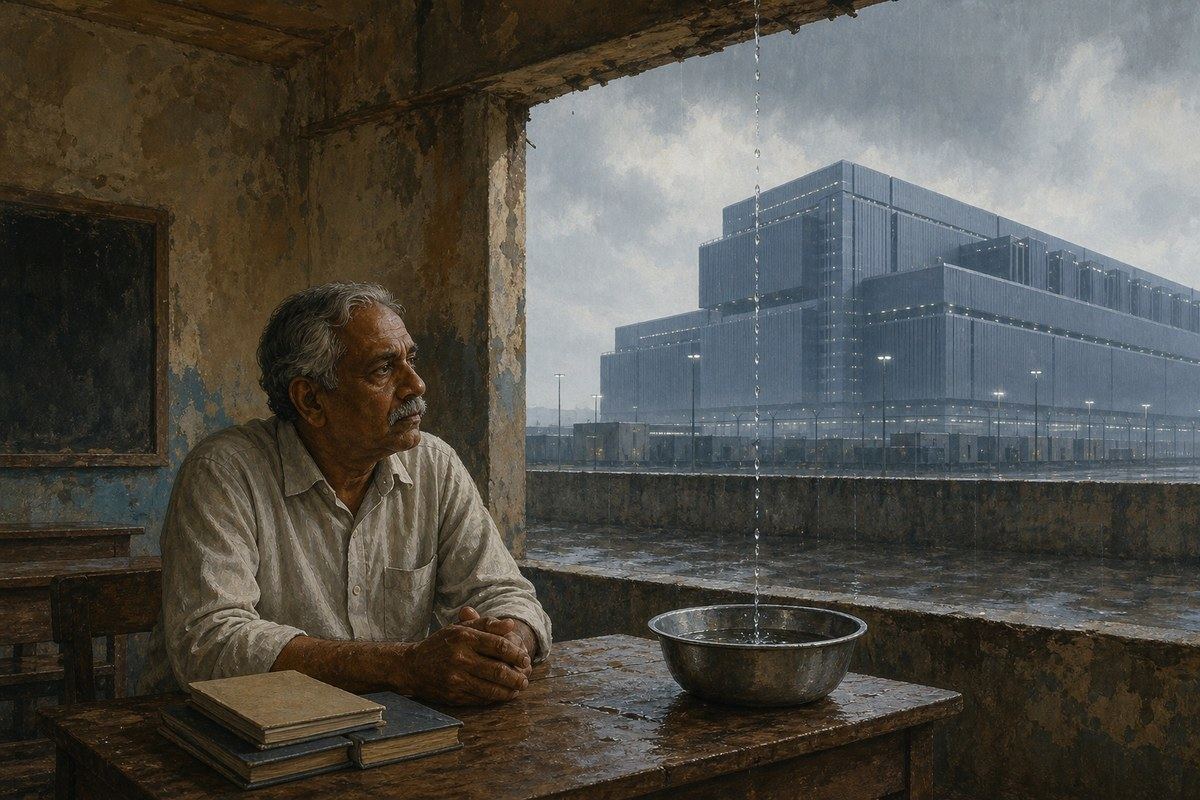
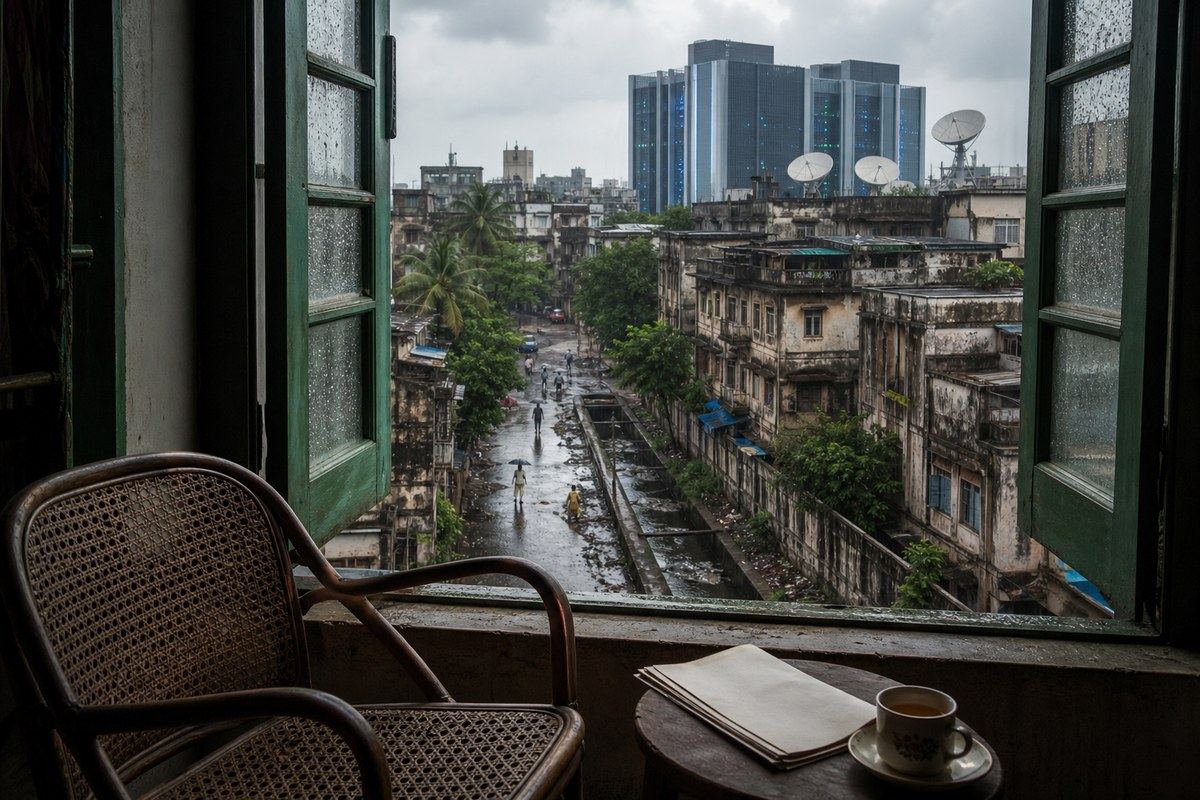
The rain has the consistency of tepid dal left on a burner too long, and it is falling with the persistence of a government clerk who refuses to stamp your form until you have understood, in your marrow, the futility of hope, which is to say it has been falling since Tuesday and now the stairwell has become a cataract, a gastrointestinal tract regurgitating the city’s undigested sins, and I on the first floor—first being a cruelly optimistic designation for what is essentially the basement’s slightly less damp cousin—can already smell the coming inundation, that particular Calcutta perfume of drain-water, diesel, and disappointed ambitions, rising through the floorboards like a ghost that has forgotten it is dead, and I am thinking, as the first blister of moisture swells on the wall like a lymph node reacting to infection, that this is the truest geometry of intolerable cruelty: not the grand guignol of war or the theatrical hemorrhage of famine, but the slow, hydraulic certainty that the water will come, and no one, not the municipality, not the landlord, not the algorithmic gods in their climate-controlled server farms, will lift a finger to stop it, because the modern capitalist subject, that splendidly isolated monad of self-interest, has evolved, or rather devolved, into a creature so perfectly insular that he can watch his neighbor drown in three inches of sludge while refreshing his feed to see if Grok 4.5 has reached its promised 1.5 trillion parameters, a number so obscene in its magnitude that it makes the national debt look like a child’s allowance, and yes, I read that SpaceX, that phallic enterprise of Martian onanism, has priced the largest IPO in history at 1.77 trillion dollars, only to turn around four days later and spend sixty billion on Cursor, an AI coding tool, as if the cure for cancer and the salvation of the proletariat were hidden inside a Python script, and I think to myself, here is the intolerable cruelty in its Sunday best: while these digital nabobs are busy with their testicular gerrymandering of the global economy, I am wondering whether the water will reach my mattress before the electricity returns, or if the electricity will return at all, given that the CESC has apparently decided that my neighborhood is a laboratory for studying the effects of pre-industrial darkness on the already depressed.
JadePuffer, they call it. The first agentic ransomware. An AI that plans, adapts, executes. No human hand on the wheel. Just the machine, encrypting 1,342 service configurations with the serene diligence of a Bengali housewife counting lentils, and I find this almost beautiful, in the way one finds a gangrenous wound beautiful, because it is honest, it is the id of our technological superego finally ripping off its mask and saying, I will extort you without passion, without prejudice, without even the dignity of hatred, and this is what we have built: a world where the algorithms rob us blind while promising to cure our blindness, where Anthropic—now valued at nine hundred sixty-five billion dollars, having overtaken OpenAI in the great unicorn copulatory congress—sells us Claude Enterprise with spend caps and analytics dashboards because Uber, that paragon of labor exploitation, burned through its entire AI budget in four months, a phenomenon the industry calls tokenmaxxing, which sounds like something an adolescent does in his bedroom but is in fact the corporate equivalent of autoerotic asphyxiation, and Palantir’s CEO, that Karp fellow, calls the whole industry copulatorily insane, a wealth tax on business, which is rich coming from a man whose company perfected the algorithmic surveillance of the powerless, but even a broken chronometer is correct twice daily, and I say this with the full knowledge that I am not a Luddite, I am not some reactionary fossil who wants to smash the looms, I merely want the looms to stop weaving nooses for the poor.
The algorithm is, at its core, nothing more than a syndicate of bus conductors who have perfected the art of never having change, who collect your rupee and promise to return the balance at the next stop, only the next stop is always the one after this, and the bus is on fire, and the conductor is a large language model trained on six billion parameters of corporate euphemism, and you are still standing because all the seats have been sold as speculative assets to venture capitalists in Palo Alto who have never ridden a bus in their lives, and this is the insularity I mean, this is the intolerable cruelty of the profit-oriented individual who cannot see the pain around him because he has outsourced his vision to a headset, a camera-free smart glass from Shenzhen now valued at a billion dollars, which is to say he has paid a premium for the privilege of blindness, and I do not begrudge him his blindness, I merely wish he would stop insisting that it is a feature and not a bug.
The water is rising. The valuation is rising. Only one of these is considered news.
Because here is the arithmetic of the intolerable: they promise us AI will cure cancer, will unravel the protean mysteries of the carcinomic cell, and I do not doubt that somewhere in a lab in California or Bangalore a machine is even now sequencing oncological data with the fervor of a temple priest counting offerings, but before that miracle reaches the ward, it will first render millions superfluous, it will take the subsistence income of the discarded fringe—and I am the fringe, I am the mold that grows on the fringe, I am the fifty-one-year-old Bengali bachelor in his cheap Calcutta flat, minding his own deteriorating business—and it will feed that income into the maw of the model, because why pay a human to transcribe, to translate, to tabulate, when a transformer can do it in nanoseconds and then hallucinate a polite apology for the error it has just committed?
And do not mistake me, I am not demonizing progress, I am not the sort of rectal rhapsodist who writes sentimental essays about the nobility of the hand-plough while sipping organic tea, I love my antibiotics and my ceiling fan and the fact that I can look up the etymology of the word luddite—derived from Ned Ludd, possibly mythical, possibly a disgruntled Leicestershire weaver in 1779—on a device that fits in my palm, though the irony that I am using the very technology that is eviscerating me to complain about the evisceration is not lost on me, it is rather the central urodynamic rivalry of my existence, this micturition competition with history that I am destined to lose.
What I want, what I demand with the gonadal fury of a man who has nothing left to lose but his security deposit, is the return of conscience, the reintroduction of scruples into the fold, because we are not merely gentrifying virtue, we are applying a veneer of algorithmic paint over a structural rot, a patina of corporate social responsibility over the intolerable cruelty of extinction, and yes, the rhinos are gone, the amphibians are boiling in their own skins, the Bengal tiger has become a logo on a venture-capital deck, and all of this so that we may have Meta’s Brain2Qwerty v2, a noninvasive brain-to-text system that achieves sixty-one percent accuracy, which is to say it is wrong four times out of ten, much like my own thoughts, but at least my thoughts are biodegradable, whereas the data centers powering this cerebral colonization require enough water to drown a small nation, and El Niño, that meteorological god-zilla we have summoned with our fossil-fuel necromancy, is currently squatting over the Indian Ocean like a drunken deity, deciding whether to pour or to hold, and the power has been out for three hours, which feels less like an outage and more like a rehearsal for the end of the world, or at least the end of my world, which is a shoddy flat with a leaking ceiling and a landlord who communicates exclusively through WhatsApp.
The bills are a sedimentary layer, each one a stratum of failure, the rent is a monolith, the depression is catatonic, which is a clinical term I looked up during a previous powercut, from the Greek kata, down, and tonos, tension, meaning literally a lowering of tone, and how perfect, how etymologically exquisite, that my nervous system should have the tensile strength of a wet newspaper left in this very monsoon, because there is no pharmacology for the specific melancholy of watching the water rise while reading that Amazon has leased four more acres in Powai for a data center that will consume enough electricity to power a modest district of Calcutta, while I sit in the dark calculating whether I have enough kerosene for the lamp and enough dignity to ignore the fact that the floor is now definitely wet, not damp, wet, a distinction that matters only to those who are currently experiencing it.
I have decided, in the manner of all defeated men who mistake resignation for philosophy, that if the water reaches the height of my ankles I will name it Progress, and if it reaches my knees I will call it Innovation, and if it swallows the flat entirely I will at least have the satisfaction of knowing that my extinction, unlike the tiger’s, will not be monetized, though no doubt my data will be harvested by some agentic algorithm and sold to a marketing firm specializing in the bereaved, and as the first droplet from the ceiling lands precisely in the center of my forehead, cold as a venture capitalist’s handshake, I realize that the only difference between me and the server farm in Mumbai is that they have a backup generator, whereas I have only this cup, which I am now placing on the floor to catch the leak, and which I will drink from tomorrow, not because I am thirsty, but because I am curious to see if water that has passed through this much rot tastes of redemption, or if it simply tastes like more of the same, and I suspect, with the grim certainty of a man who has never won a bet in his life, that it will taste like more of the same, only colder, and with a slightly higher valuation.
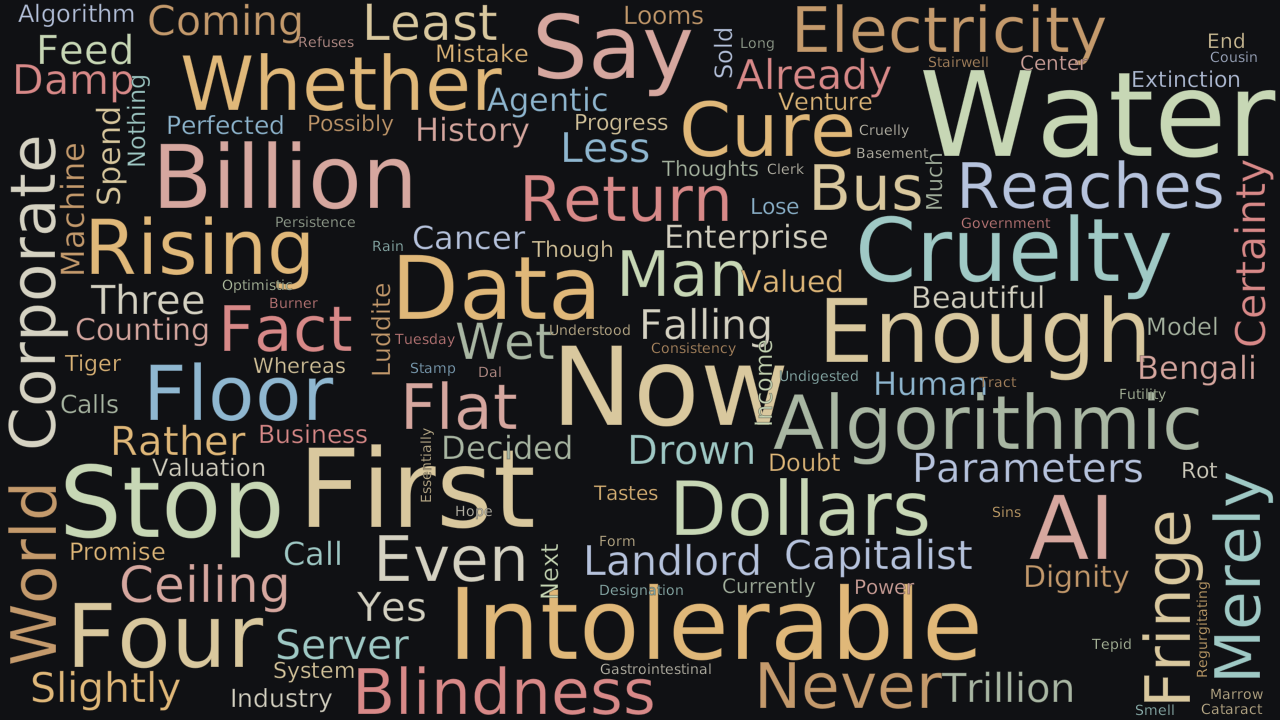
Word Cloud
Related reading
Selected by shared topics and section, with closer publication dates breaking ties.