The Slow Dribble of My Irrelevance
Uses the speech voice supplied by your browser or device.

The copper taste of preemptive regret pools under my tongue like the Hooghly’s annual offering of industrial phosphorescence, and I am staring at this rectangular little Judas in my palm telling me that Amazon, that bookseller-turned-Behemoth, is currently attempting to raise twenty-five billion American dollars—not rupees, not cowrie shells, not the tear-stained IOUs of my generation—through a bond sale, the proceeds of which shall be hurled into the insatiable maw of artificial intelligence infrastructure, which is to say, warehouses full of sweating silicon in Kentucky and Virginia and other places where the air conditioning costs more per annum than the GDP of my entire municipal ward, and I think, with the slow-building horror of a man who has just discovered his own flatulent fugue echoing in a crowded tramcar, that we have finally achieved the perfect inversion: software, that once-ethereal mist of pure logic that scaled on the cheap labor of caffeinated boys in basements, has now metastasized into a hardware-greedy colossus that devours electricity and capital with the same unthinking avidity that a starving mongrel applies to a discarded mango kernel on Chowringhee.
Twenty-five billion. I counted the zeros twice. My thumb trembled.
And Microsoft! Sweet, bloated Microsoft, that great white whale of Redmond, has just harpooned three thousand two hundred of its own gaming employees—twenty percent, they say, of the Xbox division—because the margins were three to ten times lower than “comparable businesses,” which is corporate Sanskrit for “we need more money to feed the GPU god,” and so the studios Compulsion and Double Fine and Ninja Theory are being flung overboard like so much bilge water while the ship turns its prow toward “flagship franchises,” which is to say, Call of Duty and Halo, those twin monuments to digital slaughter, because nothing says “the future of human intellect” like selling simulated murder back to teenagers at a markup, and I ask you, I genuinely ask you, where in this calculus of carnage is the room for a fifty-one-year-old man with a face like a punched papaya and a bank balance that couldn’t finance a decent kati roll?
Nowhere. The answer is nowhere, and it arrives with the soft inevitability of a bladder’s oration against a hot aluminum wall.
Meanwhile, the universities—the old, money-making, credential-manufacturing cartels—are trembling like jelly in an earthquake, because if a large language model can now produce the same vapid, five-paragraph effluvium that passes for a bachelor’s thesis in business administration, then what, pray tell, is the value of the debt-bloated degree? The proof, that sacred scrap of parchment that once hoisted the lower-middle-class up the first rung of a functional, oxygenated life, is now about as valuable as a tram ticket from 1987, and yet the machine, the great grinding infrastructure machine, demands ever more capital, ever more power, ever more of the earth’s crust ripped open to feed data centers that hum like the collective anxiety of a generation that has been told, repeatedly, that it is obsolete.
Meta, that digital Colossus of Menlo Park, is now reportedly considering renting out its excess compute resources—imagine, if you will, a man who has built a hundred-bedroom mansion he cannot afford to heat, and so he begins subletting rooms to strangers who may or may not be running JadePuffer ransomware on his grandmother’s dialysis machine—and this after projecting one hundred forty-five billion dollars in AI infrastructure spending by the end of this year of our Lord 2026, a figure so grotesquely swollen it makes the national budget of my entire subcontinent look like the spare change one finds in a rickshaw seat; and Musk, that mercurial progenitor-prodding parasite, has folded his xAI into SpaceX, rebranding it with all the subtlety of a rectal renaissance, as if the answer to terrestrial artificial intelligence was somehow to launch it into orbit, presumably so it can more efficiently ignore the plight of ugly old men in shanty slums while it perfects the art of conversational advertising for Mars colonists who haven’t been born yet.
And the Chinese, the ever-practical Chinese, have released GLM-5.2 at one-sixth the cost of the American closed-architecture monstrosities, which should, in a rational universe, collapse the market like a punctured lung, but instead the venture capitalists continue to shovel other people’s money into the furnace because the premise, the fundamental theological premise of this era, is that high upfront Capex—capital expenditure, for those who prefer their economic trauma in Latinate syllables—will eventually yield returns, except the returns are dribbling forth with the maddening irregularity of an alimentary canal’s revenge after a bad batch of street-side phuchka, and the only ones getting rich are the landlords of Kentucky data centers and the bond traders of Manhattan.
But oh, the pundits care, they care so deeply, with the performative empathy of a televangelist at a funeral, about the young and the nubile and the pretty, about how AI will disrupt the internships of the smooth-skinned and the TikTok-famous, how the great algorithmic wave will crash upon the shores of their curated selfhood and wash away their influencer dreams, and there are panels, conferences, TED-talks-as-psychological-warfare, all devoted to the trauma of the twenty-two-year-old content creator whose brand-deal prospects have been savaged by a chatbot; yet when it comes to the ugly old man, the fifty-one-year-old rectal relic in a third-world slum, whose only crime was being born too early to code in Python and too late to die with dignity in a pensioned profession, the silence is absolute, a silence so profound it has its own gravitational pull, a black hole of indifference into which my entire demographic is being steadily, politely, bureaucratically compressed.
Etymologically, “compute” derives from the Latin computare, to reckon, to settle accounts, and I find this bitterly amusing because the only accounts being settled are those of the shareholders, while the rest of us are left to reckon with the debris; the word “algorithm” itself traces back to al-Khwarizmi, that ninth-century Persian mathematician who gave us algebra, that noble science of balancing equations, and now his legacy has been hijacked to serve the most grotesque imbalance of wealth and attention in human history, a system that requires, as the World Economic Forum might say, a “multi-stakeholder approach,” by which they mean “find more suckers to hold the bag when the Capex bubble voids its micturition symphony all over the balance sheets.”
Education, that old proof-of-life, that first rung, that ladder out of the municipal ditch, is being dismantled not by neglect but by “optimization,” by the cheerful assertion that a language model can tutor a child in calculus, which is true in the same sense that a vending machine can perform surgery: technically possible, spiritually catastrophic, and likely to leave you with an infection. The proof—the degree, the diploma, the certificate of having suffered through four years of institutionalized boredom—was never about the knowledge, you see, it was about the signaling, the grim social semaphore that told an employer “this one can endure paperwork,” and now that signal is being jammed by a trillion-parameter static, and the employers, those great algorithmic cowards, would rather hire the machine than endure the inconvenience of a human aging past forty.
My spine hurts.
But look! Anthropic has signed a nineteen-billion-dollar lease in Kentucky! Nineteen billion! For a building! A building full of electricity and regret! TeraWulf, formerly a crypto-mining operation—that most glorious of all twenty-first-century alimentary apocalypses—has pivoted to AI infrastructure, because why let a perfectly good energy-guzzling warehouse go to waste when you can repurpose it to generate slightly different hallucinations? And Microsoft, not content with eviscerating its gaming division, has launched Frontier Company with two and a half billion dollars to help enterprises “adopt AI,” which is corporate theology for “teach the middle managers how to ask the oracle for PowerPoint slides,” and the enterprises will pay, oh yes, they will pay, because the alternative is admitting that they have spent the last decade building a house of cards on the assumption that software was infinitely scalable and now discover that it requires the power grid of a small nation to run a customer-service chatbot that still cannot tell the difference between “return my order” and “return my faith in late capitalism.”
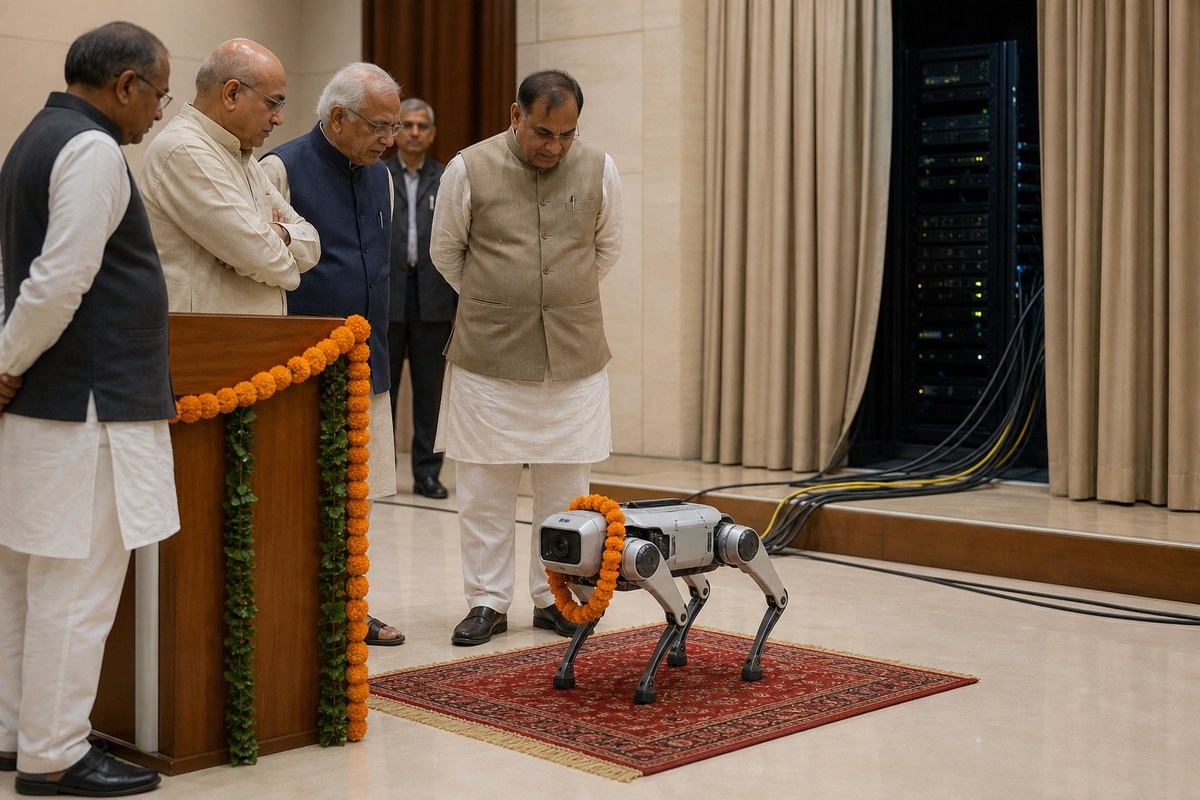
And my own country, bless its desperate heart, has just commissioned its third semiconductor plant in Gujarat, as if the path to dignity lies in assembling the very chips that will render our grandchildren unemployable, a kind of techno-colonial Stockholm syndrome where we celebrate the machinery of our own obsolescence with ribbon-cuttings and nationalist press releases, while the Hooghly continues its slow, brown, indifferent peristalsis past the Howrah Bridge and I sit here, a punched papaya of a man, calculating whether I can afford both my blood pressure medication and the data recharge that allows me to read about my own irrelevance in real time.
The young are warned. The young are coddled. The young have their social media bans and their mental health panels and their trillion-dollar lawsuits against Meta for addicting them to the dopamine drip, and I do not begrudge them this, I do not, except to note that the penalty sought is one point four trillion dollars, a sum that, if distributed among every fifty-something discarded by the new economy, might buy us each a decent funeral and a half, but instead it will vanish into the same administrative ether that consumes all large numbers, and the pretty youth will continue to be pretty and young and the subject of think-pieces, while I, and those like me, will continue to be the unphotographed background noise, the human equivalent of buffer overflow, the excess population that the algorithm politely rounds down to zero.
I just belched, and for one treacherous second, the sound was indistinguishable from a server fan kicking into high gear, and I thought, there it is, my contribution to the cloud: one hot, wet, biological exhalation of carbon and disappointment, uploaded straight to the void, no Capex required.
P.S. Infrastructura: from the Latin, literally “a building underneath.” They have built a universe underneath us, and the rent is due in compute cycles we will never possess.
Word Cloud
Related reading
Selected by shared topics and section, with closer publication dates breaking ties.