The Churning of the Lesser Fluids
Uses the speech voice supplied by your browser or device.

There is a viscous, opalescent slick of rice starch congealing at the bottom of my cooker, and I am staring at it with the kind of religious intensity one usually reserves for the final moments of a cricket match or the discovery of a new mole. The Samudra Manthan, that magnificent Hindu fever dream of cosmic churning, produced fourteen ratnas, a poison so lethal it could unmake creation, and finally—after what must have been an eternity of bureaucratic delay—the Amrita, the nectar of immortality, which the devas promptly hoarded like a consortium of Silicon Valley executives with stock options. But here is the thing nobody tells you in the sanitized, Amar Chitra Katha version of this mythology: the asuras, the nagas, the yakshas, the rank-and-file celestial proletariat—most of them never got a drop. They stood there, tentacles and fangs and all, watching the gods quaff eternity while they were left with the dregs, the foam, the scum, the lesser fluids. And I am telling you this because at fifty-one, standing in a rented flat in the decaying suburban sprawls of South Calcutta, wearing a black sando genji that has absorbed that leftover resentful Texas sweat and Bengali humidity, I understand those asuras in a way that makes my chest ache with a peculiar, unnameable solidarity.
The rice starch, I should clarify, is not merely rice starch. It is a viscous, gelatinous testament to my domestic incompetence, a translucent membrane that clings to the aluminum basin like a disappointed lover. I cooked the rice at 11:47 AM because I had a Zoom call with Mister J at midnight (again this is work related so I am making stuff up) which is noon in whatever godforsaken timezone he inhabits now—Austin, I think, or maybe Houston, the distinction matters about as much as the difference between one type of institutional despair and another. Mister J, my sole remaining umbilical cord to the American economy, a man whose emails arrive with the irregularity and emotional warmth of a tax notice, had sent me a message at 3:14 AM my time: “Need the deck by EOD.” EOD. End of Day. Which day? Whose day? The day of a man who sleeps in a bed he owns, in a house with a mortgage, in a country where the president is currently threatening to bomb Cuba because, apparently, the seventy-eight-year-old itch for imperial conquest has not yet been sufficiently scratched? Or my day, which begins when the afternoon light slants through the rusted window grilles of this flat and ends when I realize I have been staring at the same paragraph of a PDF about cloud migration strategies for forty minutes without processing a single word?
I poured the new tea—loose leaf, Assam, bought from Amazon.in—into a steel tumbler that once belonged to my father, or perhaps my grandfather, the provenance lost in the general entropy of inherited objects. The tea was too hot, as it always is, because I boil water in a pan like a peasant, like a refugee from the nineteenth century, like a man who has not yet reconciled himself to the electric kettle, that modest appliance of modernity which I refuse to purchase on principle, though the principle itself has become so obscured by time and indifference that I can no longer articulate it. Something about resistance. Something about not letting the machines win. Something about the dignity of watching water bubble and steam in a thin aluminum vessel, a process that takes a minute and forty-three seconds, time during which I can stare at the wall and contemplate the precise texture of my own irrelevance.
The rice starch has begun to separate, I notice, into distinct phases: a clear, amber supernatant and a cloudy, particulate precipitate. This is science. This is chemistry. This is the second law of thermodynamics asserting itself in my kitchen, in my life, in the slow, inexorable dissolution of everything I have ever believed myself to be. I remember, with the clarity of a traumatic flashback, a graduate seminar at the University of Texas at San Antonio in 2000, where a professor with the cadaverous pallor of a man who had not seen sunlight since the Reagan administration explained entropy as “the measure of a system’s thermal energy per unit temperature that is unavailable for doing useful work.” I wrote it down. I underlined it. I thought, at twenty-something-then, that understanding this concept would inoculate me against the kind of aimless, spiraling despair that I had observed in my father, in his brothers, in the general male population of North Calcutta-South Sinthee, that geographic and psychological zone where ambition goes to decompose. I was wrong. Understanding entropy does not prevent it. It merely allows you to name the process by which your life becomes unlivable.
Mister J’s email (again, I am making this up, but it shows you the skeleton of frivolity in jobs nowadays) when it finally arrives at 2:37 AM, contains no greeting, no punctuation, no human warmth. “deck needs rework focus on cost optimization slide 7 is weak.” Slide 7. The cost optimization slide. I spent four hours on that slide, four hours of my life that I will never retrieve, four hours during which I could have been reading Proust, or learning to play the harmonium, or simply lying on my unmade bed staring at the water-stained ceiling and contemplating the infinite regress of my own failures. Instead, I researched cloud egress fees. I compared AWS and Azure pricing models. I made a chart. A chart! With colors! With gradients! With a legend! And Mister J, in his infinite wisdom, in his Austin-Houston-American wisdom, has deemed it weak. Weak. The word hangs in the air like a malediction. I am weak. My slides are weak. My rice is overcooked. My tea is too hot. My sando genji is soaked with the sweat of a man who has not bathed in three days, who has not shaved in two weeks, who has not left this flat in forty-eight hours except to retrieve a packet of Wai Wai noodles from the kirana store downstairs, where the boy—he cannot be older than nineteen, he has the smooth, unlined face of someone who has not yet been disappointed by the world—looks at me with a mixture of pity and revulsion that I have come to recognize as the default human response to my presence.
I should mention the news. I should mention that the world continues to turn, that empires continue to rise and fall, that the President of the United States—whose name I will not speak aloud because it feels like summoning a demon, like performing an incantation that might actually work—has announced his readiness to attack Cuba, a country that has done nothing to him, a country that poses no threat, a country that exists primarily as a repository of American neuroses about communism, cigars, and the 1960s. “I’ll be the one that does it,” he said, with the petulant grandiosity of a toddler who has finally been allowed to push the button on the elevator. And I read this, at 4:15 AM, on my phone, in bed, wearing my black t-shirt and my whatever-pattern cheap boxers, and I laughed. Not because it was funny, but because the alternative was to weep, and I have wept enough for one lifetime, I have wept in airport bathrooms and in rental cars and in the parking lots of H-E-B supermarkets in Texas where the fluorescent lights hummed with a frequency that seemed calibrated to induce existential dread. I have wept for love that curdled, for careers that evaporated, for the slow, grinding realization that I was not special, not talented, not destined for anything other than this: a rented flat, a rice cooker, a pan of boiling water, a Mister J who sends emails at 3:14 AM.
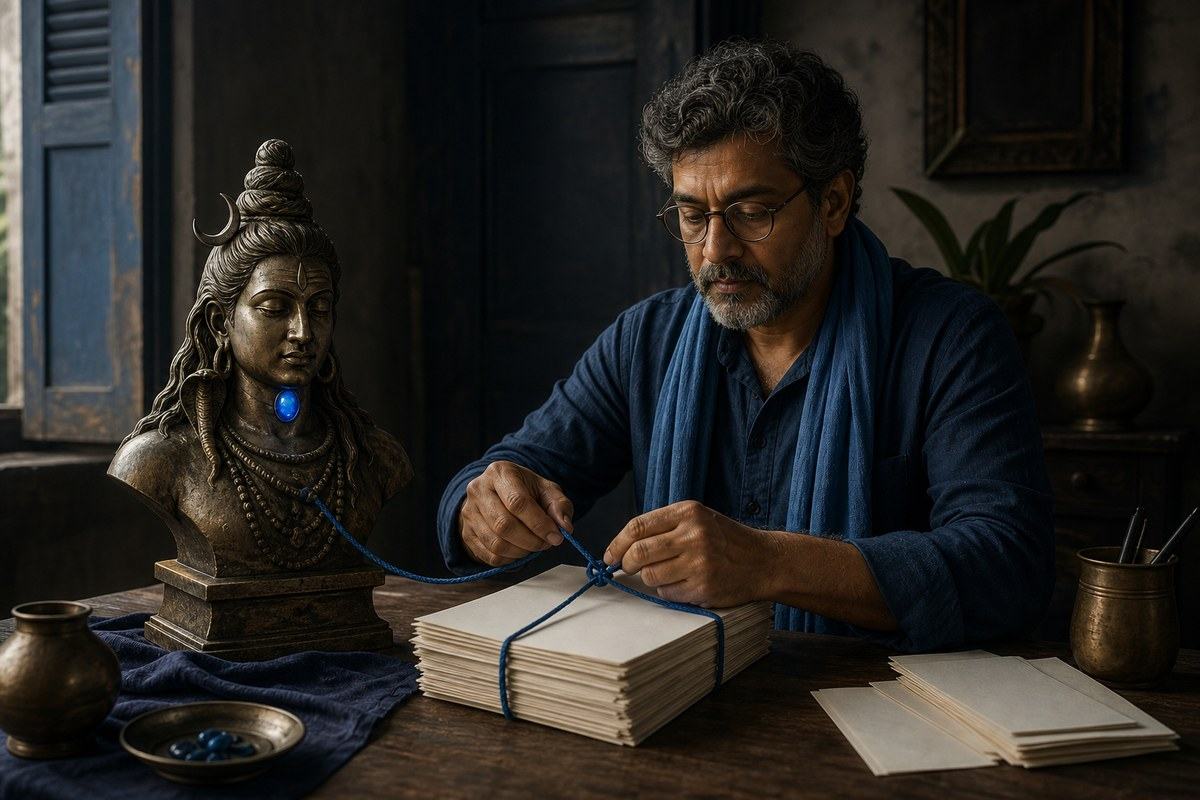
The Samudra Manthan, if we are being precise—and I insist on precision, even in my derangement, perhaps especially in my derangement—was not a single event but a process. The devas and asuras wrapped the serpent Vasuki around Mount Mandara, using him as a churning rope, and they pulled, back and forth, back and forth, for a thousand years. A thousand years! Can you imagine? I cannot get through a single afternoon without wanting to claw my own face off, and these mythological beings churned an ocean for a millennium, producing first a poison, then various treasures, then the nectar, then the inevitable betrayal when Vishnu, in the form of Mohini, distributed the Amrita only to the devas, leaving the asuras to howl with rage and thwarted desire. The poison, by the way, was called Halahala, and it was so potent that Shiva had to drink it to save the universe, turning his throat blue in the process—Neelakantha, the blue-throated one. I think about this often. I think about the fact that the churning produced poison first, that the first fruit of cosmic labor was not nectar but death, that the universe had to be saved by a god willing to swallow toxicity so that others might live. I think about this and I wonder: who is going to swallow my poison? Who is going to turn blue-throated for me? The answer, of course, is no one. There is no Shiva in this flat. There is only me, and the rice starch, and the tea that has gone cold in the steel tumbler, and the email from Mister J that I have not yet answered because I cannot think of a way to say “I will rework slide 7” that does not also contain, encoded in its subtext, a scornful scream.
I am an atheist, I state that repeatedly for the record, in each post, though the record is maintained by no one and read by no one and exists only in the hypothetical archive of my own self-documentation. I do not believe in gods, in karma, in reincarnation, in the cosmic justice that the churning myth implies. But I believe in the metaphor. I believe in the image of the ocean being agitated, of the serpent being used as a tool, of the mountain sinking and Vishnu taking the form of a turtle to support it. I believe in the labor, the endless, Sisyphean labor of trying to extract something valuable from the brackish, undifferentiated mass of existence. And I believe, with the fervor of a man who has nothing else to believe in, that most of us are asuras in this story. Most of us will stand on the shore of the churned ocean, watching the gods drink immortality, while we are left with the lesser fluids: the sweat that pools in the small of my back during the Calcutta summer, the rainwater that leaks through the ceiling during the monsoon and collects in a bucket that I empty every six hours, the cheap cooking oil that I use to fry an egg because I cannot afford olive oil, the medicine that I take for a blood pressure that fluctuates like the stock market, the tea that I drink not for pleasure but for the caffeine, the stimulant, the chemical lie that tells my brain I am capable of completing the Sisyphean slide 7.
The egg, I should mention, was a disaster. I cracked it into the pan—same pan, the aluminum one, the one that has seen a thousand eggs and a million disappointments—and the yolk broke, spreading across the surface like a yellow bruise, like a small sun dying in a galaxy of cheap oil. I ate it anyway. I eat everything anyway. I have no standards, no principles, no dietary restrictions other than the ones imposed by poverty and laziness. I am a man who will eat a broken egg at 3:00 AM while reading about the President’s desire to bomb Cuba, while composing an email to Mister J that begins with “Hi J, thanks for the feedback” and ends with “Best regards,” the entire correspondence a masterclass in emotional suppression, in the art of pretending that one is a functional professional rather than a fifty-one-year-old man in a black sando genji who has not brushed his teeth since morning and cannot remember if morning was yesterday or the day before.
JD Vance, I read, is in Switzerland, attending peace talks between the US and Iran. JD Vance, the Vice President, the author of a memoir about Appalachian poverty that I have not read and will not read, a man whose face has the smooth, unblemished quality of someone who has never been truly hungry, never been truly afraid, never stood in a kitchen at 3:00 AM staring at a broken egg and wondering if this is what the rest of his life will look like. The peace talks are happening at the Burgenstock, a luxury hotel complex overlooking Lake Lucerne, which is exactly where I would choose to negotiate the end of a war, if I were the kind of person who negotiated wars, which I am not, because I am the kind of person who negotiates with Mister J about the strength of slide 7. The Iranians, apparently, walked out in protest at one point, which strikes me as the only reasonable response to American diplomacy in the year 2026, a year that feels like a fever dream, a hallucination, a timeline that branched off from reality sometime around 2016 and has been accelerating toward absurdity ever since.
I should go out. I should leave this flat, this cell, this hermitage of despair, and walk the streets of Calcutta, which is always Calcutta to me, never Kolkata, never that sanitized, postcolonial rebranding that feels like a city trying to forget itself. I should walk to the tea stall on the corner, the one where the chaiwallah makes his tea with condensed milk and enough sugar to induce diabetes in a small village, and I should sit on a plastic stool and watch the traffic, the hand-pulled rickshaws, the Ambassador taxis that still somehow exist, the general chaos of a city that refuses to be orderly, that refuses to be modern, that persists in its own magnificent dysfunction. But I do not go out. I do not go out because the effort of putting on pants, of combing my hair, of presenting a face to the world that does not scream “I am a man who has given up,” feels insurmountable. It feels like climbing Mount Mandara. It feels like churning an ocean. It feels like a task for gods, not for me, not for this brittle, burnt, bruised Bengali man who rents a cheap flat in the boondocks and cooks rice in a cooker and boils water in a pan, instead, I pop two 400mg Brufen tablets to numb the headache.
The rice starch has dried now, forming a thin, translucent film on the aluminum surface. I will have to scrub it off later, with the rough side of a sponge and a paste of Vim and water, a task that I will postpone until the film becomes opaque, until it becomes a crust, until it becomes a geological layer that future archaeologists might excavate and analyze, concluding that this flat was inhabited by a man of simple habits and profound despair. I think about the archaeology of my own life, the layers of failure and aborted ambition that lie beneath the surface, the graduate degree that led nowhere, the marriage that dissolved like a sugar cube in tea, the fifteen years in Texas that left me with an accent that no one in Calcutta can place and a sense of displacement that no geography can cure. I am a palimpsest, a manuscript written over and over until the original text is illegible, until the parchment itself begins to disintegrate. I am the asura who never got the nectar, who stood on the shore and watched the gods drink, who went home to his cave or his flat or his rented room and made tea and stared at the wall and wondered what the point of everything was.
The point, I suppose, is that there is no point. The point is that the churning continues, that the ocean is never fully churned, that the nectar is always just out of reach, a shimmering promise on the horizon that recedes as you approach it. The point is that Mister J will send another email, and I will send another deck, and the rice starch will congeal again, and the tea will go cold again, and the President will threaten to bomb another country, and JD Vance will attend another peace talk, and the world will continue its slow, grinding rotation around a sun that does not care whether any of us live or die. The point is that I am here, in this flat, in this moment, wearing a black sando genji and whatever-pattern cheap boxers, staring at a film of dried rice starch and contemplating the precise molecular structure of my own insignificance.
And yet. And yet. There is a mosquito in the room. I can hear it, a high, whining frequency that cuts through the ambient hum of the refrigerator and the distant traffic and the general white noise of existence. It is searching for blood, for sustenance, for the nectar that will allow it to lay eggs and continue the cycle of life that has no purpose other than continuation. I could kill it. I should kill it. I have killed a thousand mosquitoes in this flat, swatted them against the wall, crushed them between my palms, left their smeared remains as tiny monuments to my own petty violence. But I do not kill this one. I let it whine. I let it circle. I let it land on my arm, on the thin, papery skin that covers veins that carry blood that has seen fifty-one years of disappointment, and I watch it probe, I watch it insert its proboscis, I watch it drink. It is a small thing, this mosquito, a nuisance, a pest, a creature of no consequence. But in this moment, in this flat, in this life of lesser fluids and unchurned oceans, it is the only thing that wants something from me. It is the only thing that finds me nourishing.
I do not swat it. I let it drink its fill, and when it flies away, bloated and sluggish, I feel a strange, perverse tenderness toward it, this tiny vampire that has taken my blood and will probably die before morning, crushed by a newspaper or poisoned by a coil or simply exhausted by the effort of being alive. I feel tender toward it because I understand it. I understand the hunger, the need, the relentless, biological imperative to keep going, to keep churning, to keep hoping that the next drop will be nectar, even when every drop before it has been poison, or sweat, or tea, or rice starch, or the cold, metallic taste of a steel tumbler at 4:00 AM.
The email to Mister J sits open on my laptop, a blank space where a response should be. I type: “Hi J, thanks for the feedback. I’ll rework slide 7 with a stronger focus on cost optimization and have it to you by EOD.” I read it. I delete it. I type it again, word for word, because there is no other way to say this, because language has failed me, because all language is a form of lying, a way of pretending that we are not, all of us, standing on the shore of a churned ocean, waiting for a nectar that will never come. I hit send. The email disappears into the void, into the cloud, into the great digital Samudra where millions of messages churn every second, where the gods of Silicon Valley distribute their own version of immortality to those who can afford it, while the rest of us make do with Gmail and PowerPoint and the occasional mosquito bite.
I pour another cup of tea. The water in the pan is already boiling, has been boiling for a few minutes, has reduced by half, has become a concentrated, bitter essence of whatever minerals and impurities lurk in the Calcutta municipal supply. I do not care. I pour the loose leaf Assam into the steel tumbler, I add the boiling water, I watch the leaves unfurl like the tentacles of some deep-sea creature, like the serpent Vasuki wrapping himself around Mount Mandara, like the fingers of a man who has spent too long typing emails to people he will never meet. I wait. I always wait. Waiting is the only constant, the only religion, the only practice that has not abandoned me. I wait for Mister J’s reply. I wait for the tea to steep. I wait for the monsoon. I wait for the rice starch to dry so I can scrub it off. I wait for the nectar. I wait for the poison. I wait for something, anything, to change.
The mosquito has landed on the wall above the stove. It is motionless, its abdomen distended with my blood, a small, dark comma against the peeling paint. I look at it. It looks at me, or seems to, though mosquitoes do not look, they sense, they detect, they navigate by heat and carbon dioxide and the chemical signatures of mammalian desperation. I raise my hand. I could kill it now, with a single, swift motion, a slap that would leave a red smear and a tiny, crumpled corpse. I do not. I lower my hand. I pick up my tea. I drink it, burning my tongue, scalding my throat, feeling the heat spread through my chest like a small, internal sunrise, like the first, false promise of a day that will be exactly like the day before.
Outside, the Calcutta morning is beginning, or perhaps it is afternoon, time has become elastic, a rubber band stretched to the point of snapping. The traffic is honking, the crows are cawing, the general cacophony of a city that has never learned to be quiet is asserting itself through the rusted window grilles. I finish my tea. I set the tumbler down. I look at the rice cooker, at the dried starch, at the mosquito on the wall. I think about the Samudra Manthan, about the churning, about the poison and the nectar and the thousand years of labor that produced both. I think about the asuras, standing on the shore, watching the gods drink, feeling the salt spray on their faces, knowing that they had been used, that their labor had been exploited, that the system was rigged from the start. I think about them, and I think about me, and I think about Mister J, and I think about the President who wants to bomb Cuba, and I think about JD Vance in Switzerland, and I think about the mosquito that has my blood in its belly, and I think: this is it. This is the churning. This is the ocean. These are the lesser fluids. And the nectar? The nectar is a story. The nectar is a myth. The nectar is something told by people who had servants, by people who never had to boil their own water, by people who never stood in a kitchen at 4:00 AM wondering if the rest of their life would look exactly like this.
I pick up the sponge. I scrub the rice starch. It comes off in flakes, in scales, in tiny, translucent shards that catch the light like the scales of a fish, like the scales of the serpent Vasuki, like the scales of whatever creature I have become in the process of living this life. The mosquito flies away, or falls, or dies—I do not see. I am focused on the aluminum basin, on making it clean, on removing the evidence of my own existence, one layer at a time, one scrub at a time, one day at a time, until there is nothing left but the metal, the bare, unadorned metal, which reflects my face back at me: unshaven, unwashed, unloved, unlovely, a fifty-one-year-old man in a black sando genji who has just sent an email about slide 7 and is now scrubbing a rice cooker in the morning while the world burns and churns and waits for a nectar that will never come.
The basin is clean. I rinse it. I set it aside to dry. I look at my hands, at the wrinkles, at the veins, at the small scars and discolorations that map a life of minor accidents and major failures. I think about Shiva, about Neelakantha, about the blue throat that swallowed poison to save the world. I do not have a blue throat. I have a throat that burns with cheap tea and unspoken rage. I do not save worlds. I save PowerPoint presentations. I do not churn oceans. I churn words, emails, decks, the endless, Sisyphean documents that justify my continued existence to a man named J who lives in a different timezone.
I go back to the laptop. I open the deck. I navigate to slide 7. I stare at the cost optimization chart, at the colors, at the gradients, at the legend that explains nothing and reveals everything. I delete it. I start over. I make a new chart, with different colors, with a different gradient, with a legend that says the same thing in different words. This is my churning. This is my ocean. This is my poison and my nectar, indistinguishable from each other, mixed together in a ratio that only I can taste. I work. The sun rises, or sets, or does something in between. The mosquito is gone. The tea is gone. The rice starch is gone. I am still here. I am always still here. And Mister J’s email, when it comes, will say “looks better” or “needs more work” or nothing at all, and I will respond, or I won’t, and the churning will continue, because that is what oceans do, that is what serpents do, that is what asuras do, that is what I do, in this flat, in this city, in this life of lesser fluids and deferred nectar, waiting for something that I know, with the certainty of a man who has read too much and experienced too little, will never arrive.
P.S. — The mosquito was found dead on the windowsill at dawn, its abdomen still swollen, its legs curled inward like quotation marks around a sentence that was never finished. I swept it into the dustpan with the rice starch flakes and the tea leaves and the general detritus of a life that produces nothing but waste, and I threw it all into the bin, where it will rot, where it will decompose, where it will become, in time, indistinguishable from everything else that has ever been discarded by everyone who has ever waited for nectar and received only the dregs. The bin is full. I will empty it tomorrow. Or the day after. Or never. The churning, after all, never truly ends. It merely changes form, from ocean to rice cooker, from serpent to mosquito, from god to man to whatever I am now, standing in a kitchen at 5:00 AM, wearing a black sando genji, staring at a full bin and an empty life and the faint, persistent hope that the next email, the next cup of tea, the next sunrise, might finally, mercifully, be the one that tastes like immortality.
P.P.S. References: The Samudra Manthan myth is from Hindu mythology, specifically the Vishnu Purana and the Bhagavata Purana, though my understanding of it is filtered through a childhood of Amar Chitra Katha comics and a graduate education that proved spectacularly useless. The entropy definition is from a thermodynamics textbook I no longer possess. The President’s statement about Cuba is from a news report dated May 22, 2026. JD Vance’s presence in Switzerland is from a news report dated June 21, 2026. The US-India trade deal was announced in February 2026. Everything else is mine, unfortunately, including the rice starch, the mosquito, and the general atmosphere of cosmic disappointment.
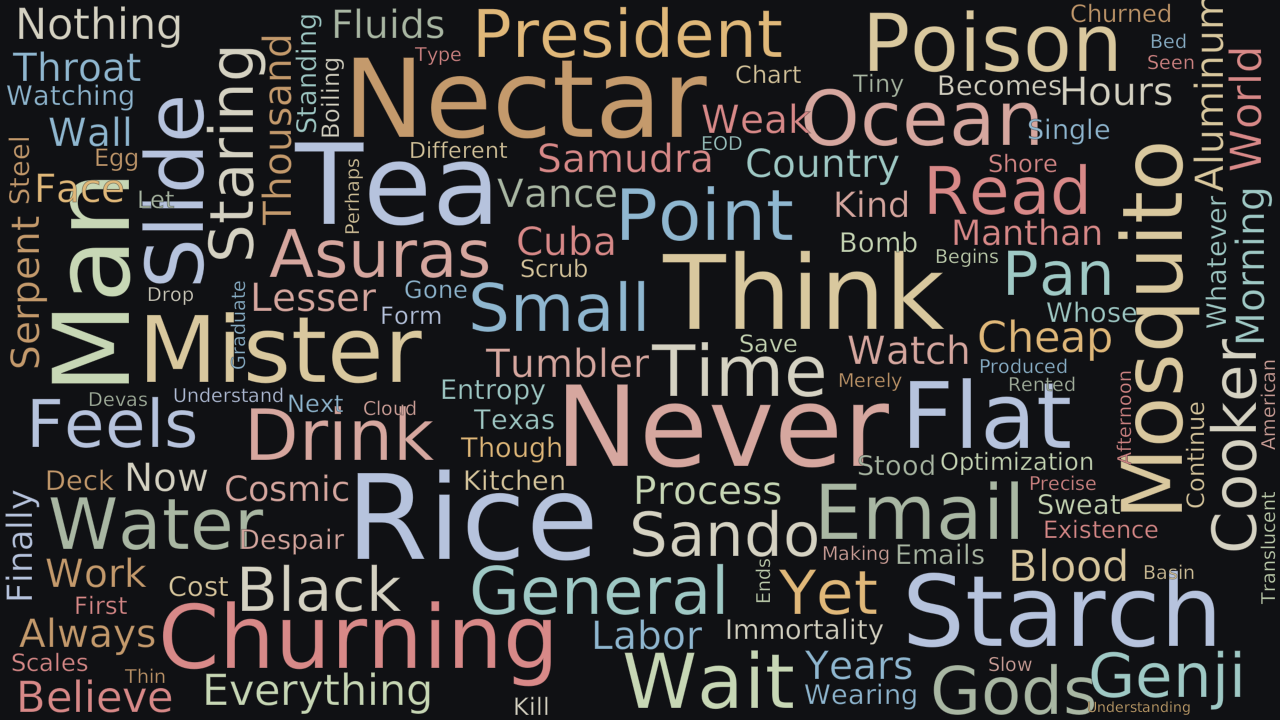
Word Cloud
Related reading
Selected by shared topics and section, with closer publication dates breaking ties.