Sharper Teeth
Uses the speech voice supplied by your browser or device.

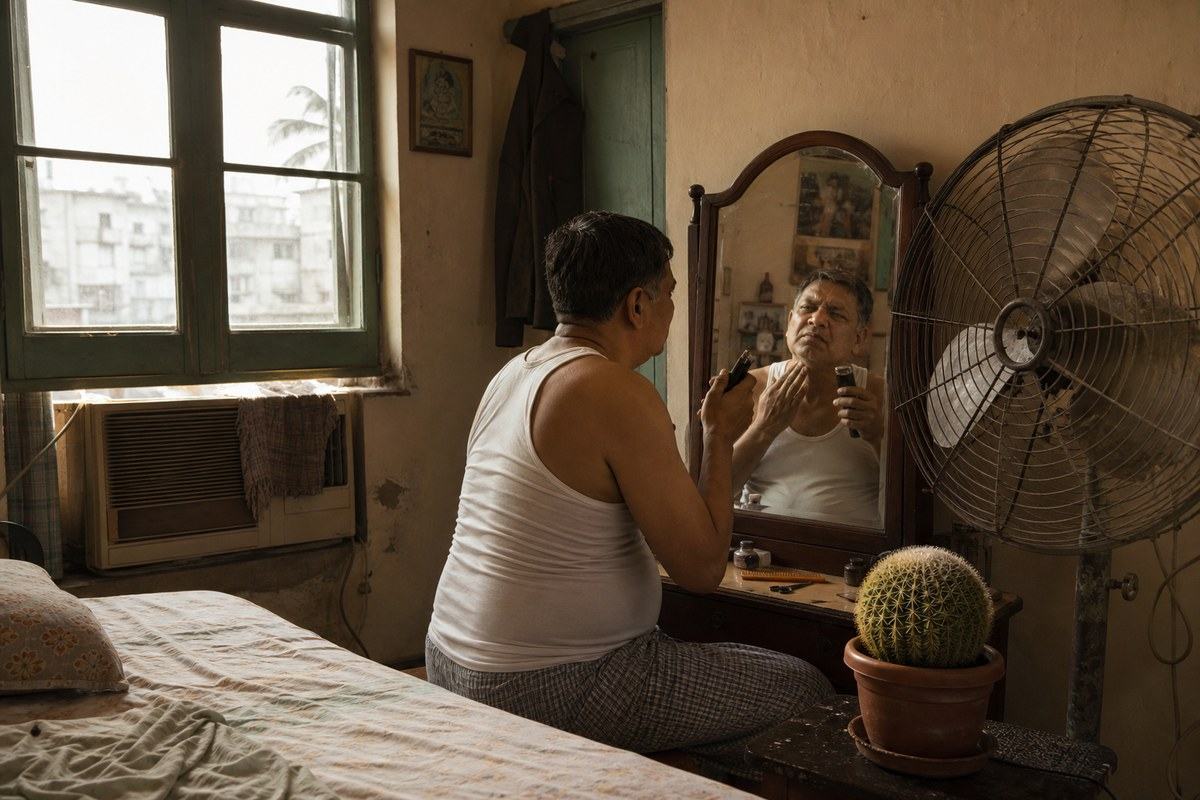
The bathroom mirror at three in the morning is a treacherous, unforgiving slab of silvered glass, and there, staring back at me, is a man whose left nostril harbors a hair so prodigiously black and curled that it resembles, with horrifying exactitude, the severed leg of a spider that has drowned in a puddle of cheap aftershave, and I stand there, toothbrush frozen mid-air, contemplating whether this follicular abomination is a sign of impending mortality or merely the universe’s way of reminding me that even my own face is conspiring to become grotesque without my permission, and then I remember, with the sudden, stomach-dropping clarity of a man who has just realized he left the gas on, that today is June 23rd, 2026, and Elon Musk is now, officially, according to the financial necromancers and the ticker-tape priests, the world’s first trillionaire, a figure so obscenely swollen with zeros that it makes the GDP of my entire ancestral homeland look like the spare change rattling in a beggar’s tin cup, and I laugh, a sound like a drain unclogging, because here I am, a fifty-one-year-old canceled, bruised, burnt, brittle, bitter Bengali man from Calcutta, standing in a rented flat in some city that is not Calcutta, staring at a spider-leg nostril hair and contemplating the Lotka-Volterra equations, those beautiful, murderous differential duets that describe how a wolf devours a rabbit and how the rabbit, in its panic-breeding, keeps the wolf fat, and I think, with the manic, glittering intensity of a man who has read too many books and understood too few of them usefully, that we have gotten the entire fable ass-backwards.
For millennia, we preened. We hunted. We domesticated. We controlled. We were the wolves, or so we told ourselves in our cave paintings and our corporate mission statements and our LinkedIn profiles that glow with the phosphorescent self-regard of people who have convinced themselves that sending emails is a form of conquest. We assumed, with the serene, unexamined arrogance of a species that named itself Homo sapiens—wise man, the cheek of it, the absolute, unmitigated, testicular audacity of it—that we sat atop the food chain, apex predators, the ones who decided which species lived and which became handbags. The fox ate the rabbit. The wolf ate the deer. The human ate everything, including, eventually, the future. But here is the thing about equations, those cold, unblinking, indifferent strings of symbols that do not care about your feelings or your mortgage or your pathetic, trembling hope that maybe, just maybe, this year will be different: they describe what is, not what you wish were true, and what is true, what has been true since some sharp-dressed, smooth-talking, probably-a-psychopath merchant in Mesopotamia first decided that labor could be bought with barley and then with silver and then with digits on a screen, is that capital has always been the wolf, and we, the workers, the toilers, the ones whose backs ache and whose eyes blur and whose children ask for things we cannot afford, have always been the rabbit.
The rabbit wakes up. The rabbit has always woken up. The rabbit wakes up to the dew-soaked grass and the sound of birds that will also be eaten, eventually, by something larger and more patient, and the rabbit thinks, in its rabbity, limited, but not entirely stupid way, that today is a day for nibbling clover and perhaps, if the mood strikes and the hormones surge, for making more rabbits. The rabbit does not know that the wolf has been watching. The wolf is always watching. The wolf is a patient, calculating, fur-covered algorithm of hunger, and the wolf does not hate the rabbit—that is the crucial, devastating, soul-crushing detail that we keep missing in our melodramas and our science fiction potboilers—the wolf does not hate the rabbit any more than a spreadsheet hates the number it devours. The wolf is simply doing what wolves do, what they have evolved over millions of years to do with exquisite, terrifying efficiency: eat. And now, on this twenty-third day of June in the year 2026, with the World Cup roaring across North America like a drunken, vuvuzela-blasted fever dream and Pope Leo XIV releasing encyclicals warning about AI like a nervous grandmother clucking over a newfangled toaster, the wolf has evolved. The wolf has not grown larger claws or sharper eyes or a more terrifying howl. No. The wolf has acquired sharper teeth. The wolf has acquired, in the form of artificial intelligence, a set of mandibles so precisely engineered, so algorithmically optimized, so devastatingly efficient at separating the productive from the superfluous, that the rabbit does not even realize it is being consumed until it is already inside the stomach, being dissolved by gastric acids that smell faintly of server farms and quarterly earnings reports.
I am not saying anything new. I am not saying anything that Marx did not say, in his beard-tangled, Germanically convoluted, endlessly footnoted way, or that the Luddites did not say with their hammers and their broken looms and their necks stretched by the hangman’s noose, or that the factory workers of Calcutta, sweating in the jute mills of the Raj, did not say with their tuberculosis-racked lungs and their fingers bleeding from the unforgiving fibers. But saying something true and saying something heard are two different species of utterance, and the truth, the grotesque, unvarnished, pus-oozing truth, is that we keep pretending the wolf is the machine, the AI, the chatbot, the algorithm, the neural network that writes poetry that is better than mine and does it in 0.003 seconds while I sit here, staring at a nostril hair and wondering if I have enough money for groceries next week. We keep pretending that if we just regulate the AI, if we just put some guardrails on the machine, if we just make sure the robot has an off switch and a friendly face and maybe a union card, then everything will be fine, then the rabbit can go back to nibbling clover in peace, then the wolf will become a vegetarian and maybe write a Substack about mindfulness.
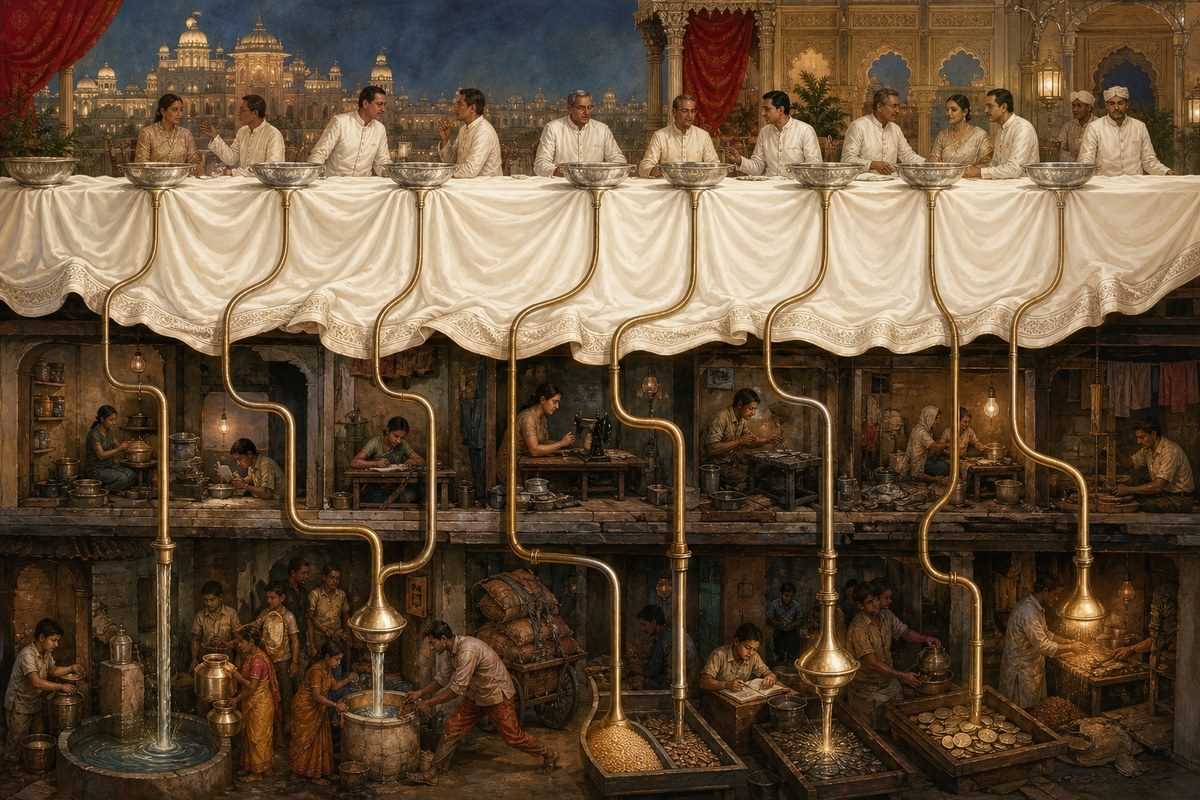
But the wolf is not the machine. The wolf is capital. The wolf is the insatiable, ravenous, metastasizing demand for return on investment, for quarterly growth, for the endless, cancerous compounding of wealth that does not know satiety, that does not possess a stomach that says “enough,” that does not have a conscience or a nostril hair or a mother in South Sinthee who needs medical assistance. The machine—the AI, the algorithm, the chatbot that replaces the customer service worker, the code that replaces the paralegal, the generative model that replaces the graphic designer, the autonomous system that replaces the truck driver—the machine is merely the evolutionary adaptation. It is the sharper tooth. It is the better claw. It is the wolf’s response to a world where the rabbits have, through centuries of struggle and unionization and the occasional, bloody revolution, made themselves slightly harder to catch. The rabbits organized. The rabbits demanded weekends. The rabbits wanted healthcare. The rabbits had the temerity to age and get sick and need pensions. And so the wolf, being a wolf and not a fool, invested in better teeth. The wolf invested in silicon and electricity and the beautiful, terrifying mathematics of machine learning, and now the wolf can catch rabbits faster, cheaper, and with none of the messy, sentimental, human complications that come with employing actual, breathing, nostril-hair-growing people.
I think of Lotka and Volterra, those two mathematicians, Alfred Lotka the chemist and Vito Volterra the Italian polymath, and I imagine them in their respective studies, scratching out their equations on blackboards or in leather-bound notebooks, probably unaware that they were writing the operating manual for the twenty-first century. Lotka, born in 1880 in Lemberg, which is now Lviv in Ukraine, a city that has known more wolves than rabbits in recent years, and Volterra, born in 1860 in Ancona, Italy, a man who lived through fascism and who refused to take an oath of loyalty to Mussolini and was consequently stripped of his professorships and his honors, a man who understood, in his bones, what it means to be prey. Their equations are deceptively simple, a pair of coupled nonlinear differential equations that describe the rate of change of predator and prey populations, and they oscillate, these equations, they cycle, they produce these beautiful, sinusoidal waves of boom and bust, rabbit population exploding, wolf population following, rabbits overgrazed, starving, collapsing, wolves starving, collapsing, rabbits recovering, and on and on, an eternal, grinding, Malthusian waltz that looks, if you graph it, like a heartbeat, like the EKG of a world that cannot stop eating itself.
But here is the sick joke, the punchline that makes you want to vomit into your own hands: in the human version of this equation, the wolves do not starve when the rabbits collapse. The wolves have figured out how to store rabbits. The wolves have offshore accounts. The wolves have stock buybacks. The wolves have tax havens and lobbyists and senators on speed dial. The wolves have, in short, decoupled their survival from the health of the rabbit population, which means the equations no longer oscillate. They trend. They trend in one direction, and that direction is down, down into the gutter, down into the gig economy, down into the zero-hours contract, down into the “we’re letting you go but it’s not personal, it’s just the algorithm,” down into the world where a trillionaire can exist in the same temporal frame as a man who cannot afford to fix his own teeth, let alone contemplate the philosophical implications of his own obsolescence.
I am not a Luddite. I want to be clear about this, as clear as the pus from a lanced boil, because I know how these conversations go, I know the accusations that will be hurled, the labels that will be slapped on my forehead like price tags at a discount supermarket. I am not afraid of technology. I am not afraid of the machine. I am afraid of the wolf that owns the machine. I am afraid of the capital that deploys the machine not to solve problems, not to cure diseases, not to explore the stars or write better poetry or understand the quantum mysteries of the universe, but to eliminate the cost of labor, to render the rabbit obsolete, to make the worker so unnecessary that the very concept of a “worker” becomes an archaeological curiosity, like a flint arrowhead or a VHS tape. The machine is not the enemy. The machine is a tool, a lever, a sharper tooth, and tools do not have morality. Hammers do not decide whether to build a hospital or crush a skull. Hammers wait for the hand that wields them, and the hand that wields the AI, the hand that signs the checks and owns the servers and controls the data, that hand belongs to the wolf, and the wolf is hungry, and the wolf has never, in the entire blood-soaked, profit-margined history of capitalism, been anything other than hungry.
And yet, and yet, and yet—here is where the bipolarity kicks in, here is where the manic crests over the depressive trough like a wave of toxic, glittering, amphetamine-fueled optimism—I cannot help but marvel at the sheer, grotesque, baroque beauty of it all. The World Cup is happening right now, as I write this, across the United States and Canada and Mexico, forty-eight teams, the biggest tournament in history, and I imagine the stadiums, those colossal, concrete-and-steel cathedrals of spectacle, filled with people who have paid exorbitant, dynamically-priced, algorithmically-optimized amounts of money to watch other people kick a ball, and I think, with a kind of horrified admiration, that this is what we do, this is what humans do when we are not being consumed: we play, we watch, we cheer, we drink overpriced beer and sing songs about nations that do not exist in any meaningful way except on a football pitch and in the fevered imaginations of people who need something to belong to. And SpaceX, that glorious, phallic, Musk-helmed monument to the human desire to escape our own gravity, just had its IPO, raising seventy-five billion dollars, valuing the company at one point seven seven trillion, making its CEO the first trillionaire in human history, and I think, with the manic glee of a man who has stared too long into the abyss and found it mildly amusing, that we are living in a science fiction novel written by a committee of venture capitalists and diagnosed by a psychiatrist who has given up.
The Pope, Pope Leo XIV, whoever the hell that is, just released an encyclical, Magnifica humanitas, forty-two thousand three hundred words, warning about AI and its risks to workers, and I want to find this man, this pontiff, this wearer of funny hats and speaker of dead languages, and shake his hand, because at least someone with a platform is saying what should be obvious to anyone with a functioning frontal cortex and a passing acquaintance with the concept of dignity. But then I remember that the Catholic Church has been warning about things for two thousand years, and the things they warned about—poverty, greed, the exploitation of the poor—have persisted with the grim, unrelenting persistence of a bacterial infection, and I wonder if an encyclical is just another form of nostril hair, something that grows and curls and is ultimately plucked and discarded without changing the fundamental architecture of the face.
I think of Calcutta, my city, my beautiful, broken, cholera-and-chaos city, where the Lotka-Volterra equations play out not in abstract mathematical space but in the streets, in the markets, in the jostling, sweating, shouting crowds that surge and recede like tides of flesh. In Calcutta, the predator and prey are not species but classes, not wolves and rabbits but owners and owned, and the sharper teeth are not silicon chips but the endless, grinding, bureaucratic machinery of a system that extracts labor like a dentist extracts a rotten molar: with violence, with anesthesia that never quite works, and with the absolute certainty that the patient will be charged for the privilege of the pain. I think of the hand-pulled rickshaws, those anachronistic, Dickensian, muscle-powered vehicles that still exist in some parts of the city, and I think of the men who pull them, their spines curved like question marks, their lungs black with exhaust, their hands calloused into leather, and I think of the Uber that replaced them, the algorithm that calculates the fare and the route and the driver’s rating, and I wonder if the rickshaw puller, panting in the humid, particulate-thick air, feels any nostalgia for a time when the predator at least had to look you in the eye before it ate you.
The etymology of the word “predator” is from the Latin praedator, meaning plunderer, robber, from praedari, to make prey of, and it shares a root with “prey,” which comes from the Latin praeda, meaning booty, plunder, and both words carry that ancient, unshakable connotation of theft, of taking what is not yours by force or cunning or the simple, brutal logic of power. And “capital,” that innocuous-sounding word we throw around like confetti at a wedding, comes from the Latin capitalis, meaning of the head, and it originally referred to the head of cattle, the principal wealth of ancient societies, the thing you counted and hoarded and sacrificed and eventually, inevitably, ate. Capital is the head. Capital is the cattle. Capital is the thing that gets counted while the counter remains invisible, uncounted, unaccounted for, a rabbit in a field of numbers that do not include its name.
And AI, artificial intelligence, that shimmering, seductive, terrifying mirage of cognition without consciousness, the word “artificial” itself from the Latin artificialis, meaning made by art or skill, from ars, art, and “intelligence” from the Latin intelligentia, understanding, comprehension, from intelligere, to understand, to perceive, to choose between, and the whole phrase is a beautiful, grotesque oxymoron, a made thing that understands, a crafted cognition, a golem of code and electricity that does not dream or fear or love or hate but that can, with terrifying precision, replace the dreaming, fearing, loving, hating human who used to do the job. It is not the wolf. It is the tooth. It is not the predator. It is the claw. It is the evolutionary adaptation that makes the ancient, endless, grinding hunger of capital more efficient, more bloodless, more deniable, more able to say, with the serene, unblinking innocence of a spreadsheet cell, “it is not personal, it is just optimization.”
I am tired. I am so tired. I am tired in my bones, in my marrow, in the spaces between my neurons where the dopamine used to dance and now just sits, sullen and unresponsive, like a guest who has overstayed their welcome. I am tired of pretending that this is a debate, that there are two sides, that we can have a civilized conversation about whether or not the rabbit should be eaten while the wolf is already licking its chops. I am tired of the pundits and the thought leaders and the TED Talkers and the LinkedIn influencers who speak in the smooth, frictionless language of “disruption” and “innovation” and “the future of work,” as if the future of work is something that happens to other people, as if the gig economy is a lifestyle choice, as if being replaced by an algorithm is a form of liberation rather than a slow, dignified, digitally-administered execution. I am tired of the grotesque, pornographic optimism that infects every conversation about technology, the insistence that every new tool is a gift, every new efficiency a blessing, every new displacement an opportunity for reinvention, as if reinvention is something you do between Uber rides and food delivery shifts and trying to figure out if your health insurance covers the medication that keeps you from driving your car into a wall.
And yet, and yet, and yet—the manic returns, it always returns, like a bad penny or a recurring infection or a relative who shows up unannounced and eats all your food—I find myself laughing, a harsh, barking, donkey-like sound that echoes off the bathroom tiles and the mirror that shows me the spider-leg nostril hair and the face that grows older and more bitter and more beautifully, defiantly, irredeemably human with every passing second. I laugh because the absurdity is too vast to be contained by mere despair. I laugh because Lotka and Volterra, in their equations, assumed that the predator and prey were different species, that the wolf ate the rabbit and the rabbit did not, in turn, eat the wolf, but we are humans, we are the only species that has figured out how to be both predator and prey simultaneously, how to consume and be consumed in the same breath, how to be the CEO and the laid-off worker, the investor and the evicted tenant, the wolf wearing a rabbit costume and the rabbit sharpening its own teeth in secret.
The rabbit wakes up. The rabbit wakes up on June 23rd, 2026, and the rabbit checks its phone, that glowing, rectangular, dopamine-delivery device that is also a surveillance apparatus and a job application portal and a reminder that the world is burning in a dozen different places and that Elon Musk is now worth more than the GDP of most countries and that the World Cup is happening and that durian prices in Malaysia have crashed to seven pesos each because of oversupply and that a typhoon named Francisco is intensifying somewhere in the Pacific and that the Pope has written forty-two thousand words about AI and that an ICE agent shot a Venezuelan immigrant through a door and claimed self-defense and that the United States attacked Iranian radar sites and that Israeli troops captured a medieval castle in Lebanon and that three people were killed in a school shooting in Tacloban and that the world is, was, and always will be a grinding, devouring, beautiful, disgusting, unrelenting machine of appetite and despair.
The rabbit wakes up. The rabbit looks in the mirror. The rabbit sees a nostril hair that looks like a spider’s leg. The rabbit plucks it. The rabbit bleeds, just a little, a single crimson bead that wells up and falls, a tiny, insignificant, human sacrifice to the god of vanity and mortality. The rabbit goes to work, or tries to, or discovers that work has been automated, optimized, algorithmically eliminated, and the rabbit sits in the dark, in the humid, insect-buzzing dark of a Calcutta summer or the air-conditioned, soul-crushing dark of a rented flat in a city that is not Calcutta, and the rabbit thinks, with the desperate, flickering, last-gasp ingenuity of a species that has survived ice ages and plagues and wars and the invention of the nuclear bomb, that maybe, just maybe, the wolf has made a mistake.
Maybe the wolf, in its endless, ravenous, quarterly-report-driven hunger, has forgotten that rabbits breed. Rabbits breed exponentially. Rabbits breed in burrows and basements and back alleys and in the spaces between the lines of code where the algorithm cannot see. Rabbits breed ideas. Rabbits breed resistance. Rabbits breed the kind of chaotic, ungovernable, beautifully human mess that no neural network, no matter how many parameters it has, can fully predict or control. The wolf has sharper teeth, yes. The wolf has AI, yes. The wolf has capital, yes. But the wolf does not have the one thing that the rabbit has, the thing that makes the rabbit worth eating in the first place: the wolf does not have the capacity to be surprised.
And so the rabbit wakes up. The rabbit wakes up and looks at the world, at the trillionaires and the encyclicals and the World Cup and the typhoons and the school shootings and the crashing durian prices and the automated job rejections and the nostril hairs and the spider legs and the blood, and the rabbit does the only thing a rabbit can do when faced with a wolf that has evolved to eat not flesh but employment, not bodies but roles, not lives but livelihoods. The rabbit laughs. The rabbit laughs a laugh like a drain unclogging, like a donkey braying, like a fifty-one-year-old canceled, bruised, burnt, brittle, bitter Bengali man from Calcutta laughing at the sheer, monumental, cosmic absurdity of being alive in a world that wants to eat you but hasn’t quite figured out how to swallow.
The rabbit laughs, and in that laugh, there is no redemption, no moral, no tidy arc, no uplift, no hope, no despair, nothing but the raw, unfiltered, grotesque, hilarious, defiant sound of a creature that knows it is prey and laughs anyway, because what else is there to do when the wolf has sharper teeth and the grass is still green and the sun, that indifferent, nuclear, hydrogen-burning bastard, is still rising over a field where the rabbits are breeding and the wolves are counting their money and the equations keep grinding and the world, in all its diseased, distressed, Calcutta-context glory, keeps turning, keeps eating, keeps being exactly what it has always been: a place where the predators write the rules and the prey write the poems, and sometimes, just sometimes, the poems are sharp enough to draw blood.
P.S. No references needed. The blood on the bathroom sink is reference enough.
Word Cloud
Related reading
Selected by shared topics and section, with closer publication dates breaking ties.