Nostril Hairs and the Tainted Calcutta Summer
Uses the speech voice supplied by your browser or device.

Acronyms and Notes:
4K — Ultra-high-definition video resolution, mentioned here only as a symbol of modern visual excess, not as a technical topic.
My nostril hairs have begun behaving like a private railway network, and one day, if current trends continue, I may step out of bed, trip over one of them, and die in my own room like a tragic Bengali prince defeated by facial vegetation.
This is what unemployment gives you. Not leisure exactly. Leisure is when a man has savings, good knees, a clean balcony, and a wife who says, “Have some tea.” This is different. This is the poor man’s laboratory. No grant money. No white coat. No assistant named Rebecca. Only one aging Bengali male in the southern fringe of Calcutta, inspecting his body like a landlord inspecting a crumbling house after monsoon.
There is one white hair in my right nostril. One. It stands apart from the rest with suspicious confidence, like a tiny foreign consultant sent to reorganize a department that was already functioning badly but emotionally. The other hairs remain black, disorderly, and local. They do not like this intruder. I can tell. A man living alone learns to read small politics.
The moustache is also attempting a comeback. Not a full one. Let us not lie. One side is growing with goonda enthusiasm. The other side has gone into committee review. If you saw it from a distance, in weak light, after cataract surgery, you might say, “Ah, there goes a villain from an old Bengali film.” From closer range, it looks more like two dying hedges separated by municipal neglect.
But the face is only the front office.
The rest of the body has its own departments, each more badly governed than the last. Some forests remain thick. Some districts have thinned. Some seasonal produce continues to appear without invitation. Age does not arrive like a noble guest wearing a shawl. Age arrives like a damp wall. First one patch. Then another. Then one morning you realize the whole house smells faintly of surrender.
And then comes the heat.
Calcutta heat is no longer the heat of childhood. Childhood heat had character. It had mangoes sweating in cane baskets, mothers shouting from kitchens, school holidays, power cuts, and the faint promise that by evening something might improve. We suffered, yes, but we suffered inside a known universe. The sun was rude, not homicidal.
This new heat is different.
It sits on the city like an overweight police inspector. It does not move. It does not negotiate. The air becomes thick, used, annoyed. Buses cough. Dogs sleep under parked scooters with the seriousness of philosophers. Crows open their beaks and look personally betrayed. The ponds turn green. The drains exhale. Even the walls seem to be thinking, “Enough now.”
People say each summer may be one of the last ordinary summers. I do not know. I am not a climate scientist. I am only a man who opens the door at noon and feels the city hit him in the chest like a wet sack of boiled rice.
That is evidence enough for the lungs.
When I was little, I had whooping cough. My mother remembers it as a near-death episode. I remember almost nothing, which is the advantage of being the child in a family disaster. The child forgets. The mother keeps the burnt ledger wrapped in old cloth. She says antibiotics saved me. Perhaps they did. Perhaps that little bacterium took one look at me and left behind a mortgage on the lungs.
Now, at fifty-one, the mortgage is being collected.
I can be sitting in a room full of air and still feel that none of it is available for breathing. It is a strange thing to explain. The air is there, like money in a rich uncle’s account. Technically present. Practically useless. Unless the second-hand air conditioner is running, my chest begins to behave like a locked shop during a strike.
That machine is not an air conditioner. It is a small, rattling republic. It wheezes, grumbles, leaks occasionally, and still keeps me alive with more honesty than most institutions. I bought it used, which is to say I adopted another man’s climate compromise. It hangs on the wall like a tired saint, blowing cold air with the moral urgency of a nurse in an underfunded ward.
I know I am lucky.
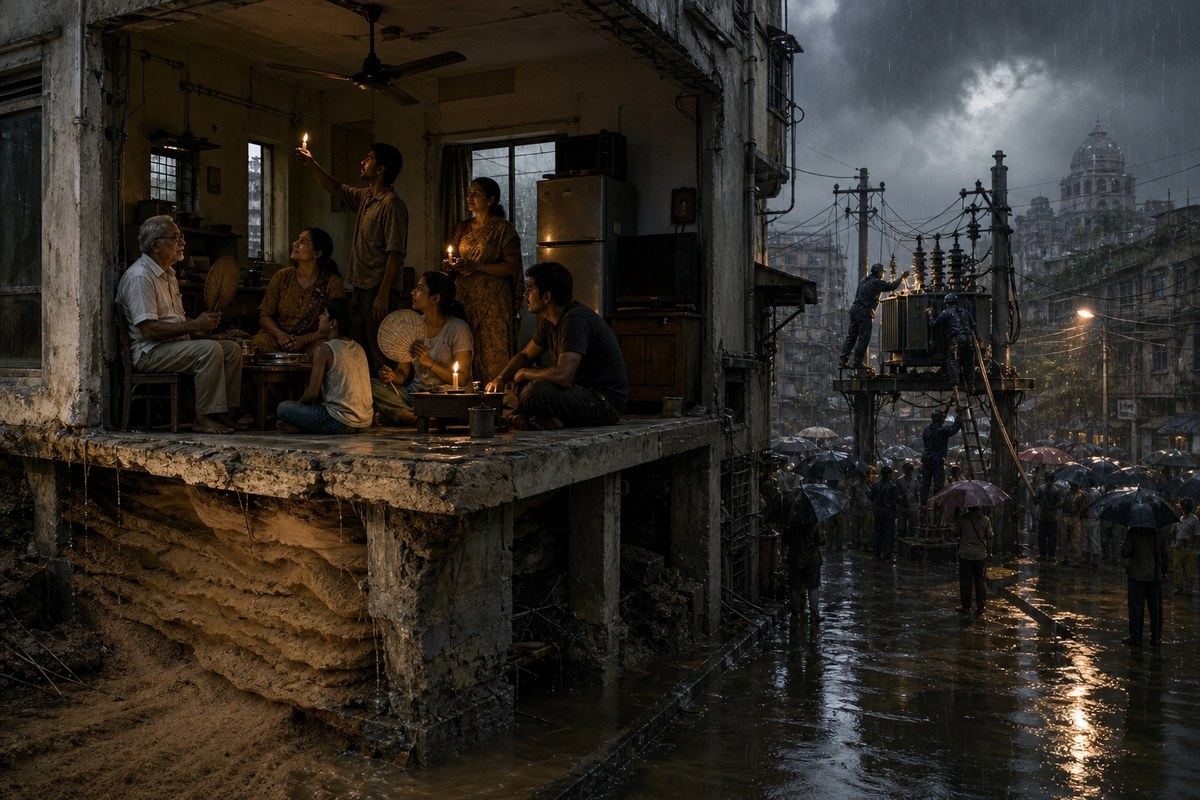
That sentence must be said, or the whole thing becomes vulgar self-pity. I have a cement roof. I have electricity most of the time. I have a machine that cools the air. Many people in this city face the same heat under tin sheets, tarpaulin, cracked asbestos, plastic, prayer, and the stubbornness of the poor. Their rooms become ovens with calendars. Their children sleep in air that has been chewed by traffic, drains, generators, and political speeches.
So I cannot complain.
Naturally, I complain.
This is Calcutta. Complaining is not weakness here. It is a respiratory function. We complain about the heat, the rain, the price of fish, the stupidity of leaders, the neighbor’s drilling machine, the app delivery boy blocking the lane, the old man clearing his throat like a damaged trumpet, the new flyover, the old pothole, the vanished pond, the rising rent, and the fact that the tea has become too pale because even milk has started behaving like a luxury item.
Meanwhile the news keeps arriving like bad weather with graphics. Wars elsewhere. Elections everywhere. Artificial intelligence eating office work like chanachur. Young people making videos in which they appear confident enough to sell shampoo to the moon. Billionaires building rockets. Poor people building excuses to live one more month. The world has become a circus where the clowns own the tent.
And here I am, examining nostril hair.
Do not laugh too quickly. This is the proper scale of middle age. Young men think life is destiny. Old men know life is maintenance. Cut the nails. Pay the bill. Check the sugar. Avoid the heat. Answer the mother gently. Distrust the politicians. Keep the air conditioner alive. Do not fall in the bathroom. Do not believe every pain is cancer, though it might be. Do not believe every hope is foolish, though it probably is.
My mother still thinks I should get a job, get married, have children, and settle down.
This is touching. Also insane.
She says it with the sincerity of someone suggesting I buy potatoes. As if wife, children, career, stability, respectability, and future are items available from a small shop near the bus stand. “Give me half a kilo of domestic success, not too expensive, and please remove the rotten ones.”
She is old now. Older than I can bear to think about. Her health is not good. Yet in her mind I remain young, slightly lazy, badly organized, but still recoverable. Mothers preserve old versions of their children the way people preserve wedding saris in trunks. The cloth may no longer fit the world, but who has the cruelty to throw it away?
I cannot explain to her that the staircase has collapsed.
The world she imagines still has ordinary steps. Study, job, marriage, child, school admission, refrigerator, blood pressure, retirement, grandchildren, framed photograph, funeral. A sad enough sequence, but at least a sequence. Mine became a broken lane. One turn went into illness. Another into lost work. Another into migration and return. Another into consulting income that arrives like a nervous pigeon. Another into a body that has begun resigning from committees without notice.
And desire?
Ah, desire.
Once it was a loud fellow. Shameless, unemployed, full of slogans. Now it behaves like a retired clerk who hears his name called and pretends to be asleep. The old machinery has acquired a comic dignity. Modern temptation may arrive polished, bright, and acrobatic in 4K, but the blood supply reads the proposal, adjusts its spectacles, and says, “Noted. No action required.”
This is one of life’s quieter humiliations. Not tragic enough for poetry. Too funny for silence. The world can offer an entire digital palace of fantasy, and the body replies with a yawn from the basement.
Still, the body has not lost all artistic ambition.
It produces, from time to time, a tainted lower-room weather. Not mere wind. Please. This is more ancestral. More civic. A sour, musical, politically unstable vapor from the underground parliament. Some days it is soft and devotional, like a harmonium heard through a wall. Some days it is sharp enough to strip paint. Some days it carries the full biography of lunch.
The Bengali stomach is not an organ. It is a press conference.
I have often thought such vapor should be released ceremonially in front of our leading politicians. Not as violence. No, no. As public feedback. A citizen’s emission. A constitutional smell. Let the great men and women of power, who speak so sweetly from stages while the drains overflow and the city melts, receive one honest message from the lower republic.
Religious frauds may also qualify, though one must be careful. They would probably bottle it, chant over it, rename it cosmic fragrance, and sell it to the faithful in three sizes.
This is the advantage of being an atheist in Calcutta. You save money on miracles. You can spend it on electricity.
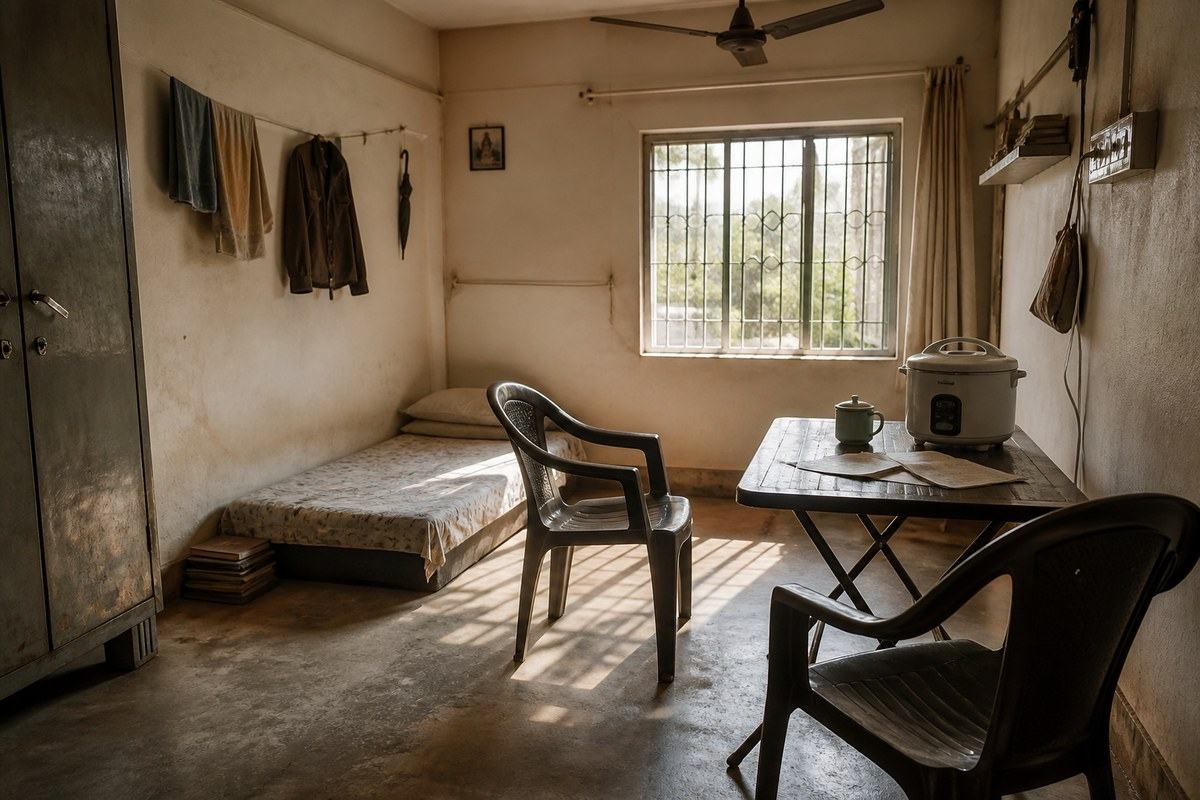
By late afternoon the room becomes dim in that particular Calcutta way, not romantic, just tired. The lane outside fills with small sounds. A pressure cooker whistles. Someone drags a plastic chair. A child recites homework in a voice full of resentment. A scooter coughs itself into motion. A woman bargains with a vegetable seller as if negotiating a ceasefire. Somewhere a television anchor screams about the nation. The nation, as usual, refuses to improve.
I sit under the rattling machine and consider my remaining ambitions.
They are modest.
Breathe comfortably.
Write a little.
Eat without regret.
Sleep without panic.
Keep my mother from worrying more than necessary.
Avoid becoming completely ridiculous before dinner.
This last one is difficult. The nostril hairs are working against me.
The heat keeps rising. The city keeps adjusting. That is what cities do before they fail. They normalize injury. Yesterday’s emergency becomes today’s inconvenience and tomorrow’s lifestyle. First you buy a fan. Then a cooler. Then an air conditioner. Then an inverter. Then a bigger bill. Then you stop going out at noon. Then you stop expecting the sky to be kind. One day you realize survival has become an appliance problem.
There is the catch.
A life can shrink without announcing itself. Not with drums. Not with a judge. It shrinks by degrees. One cancelled walk. One missed friend. One avoided phone call. One more summer spent indoors. One more plan postponed until the weather improves, the money improves, the mind improves, the body improves, the world improves.
The weather does not improve.
The money salutes and disappears.
The mind does what it can.
The body files extensions.
The world, that old fraud, sends breaking news.
So I return to the small things. The white nostril hair. The half-built moustache. The second-hand air conditioner. The afternoon tea. The smell of the lane after someone throws water on hot dust. The little comedy of a body that has lost much but still insists on producing scandal from the basement.
Perhaps this is not dignity.
Perhaps dignity is overrated.
Perhaps the real art is to remain alive without becoming too impressed by one’s suffering. To look at decay and say, “Yes, yes, I see you. Stand in line.” To laugh before the heat finishes its sentence. To lower expectations so far that even a functioning switch feels like grace, though not divine grace, just the ordinary human kind: wire, bill, repairman, and luck.
Outside, Calcutta continues to cook in its own fumes.
Inside, the air conditioner trembles like an old witness.
The white nostril hair stands guard.
And somewhere deep in the lower ministry, a tainted bulletin is being prepared for public release.
If the City of Joy survives that, it may yet survive anything.
Word Cloud
Related reading
Selected by shared topics and section, with closer publication dates breaking ties.