Clinical AI Needs A Shadow Architecture First
On this page
Quick Answer
A clinical AI model is only the visible part of a care system. Safe use also requires representative data, external and temporal validation, workflow integration, human review, monitoring, audit trails, escalation rules, security, governance, and accountable ownership.
Key Terms
- Clinical AI
- Shadow Architecture
- External Validation
- Model Monitoring
- MLOps
- Human Factors
Frequently asked questions
What is shadow architecture in clinical AI?
It is the surrounding safety system a model needs: data governance, validation, workflow design, human review, monitoring, audit logs, escalation, security, training, regulation, and accountability.
Is model accuracy enough for safe clinical AI?
No. A model can be accurate yet late, noisy, biased, poorly calibrated, clinically useless, or harmful in a local workflow. External, temporal, subgroup, and clinical-utility evaluation are also needed.
Why must clinical AI be monitored after deployment?
Patient populations, devices, documentation, workflows, and clinical practice change. Monitoring detects drift and supports recalibration, incident response, retraining, rollback, or retirement.
Uses the speech voice supplied by your browser or device.

The alert appears before anyone can admire the algorithm.
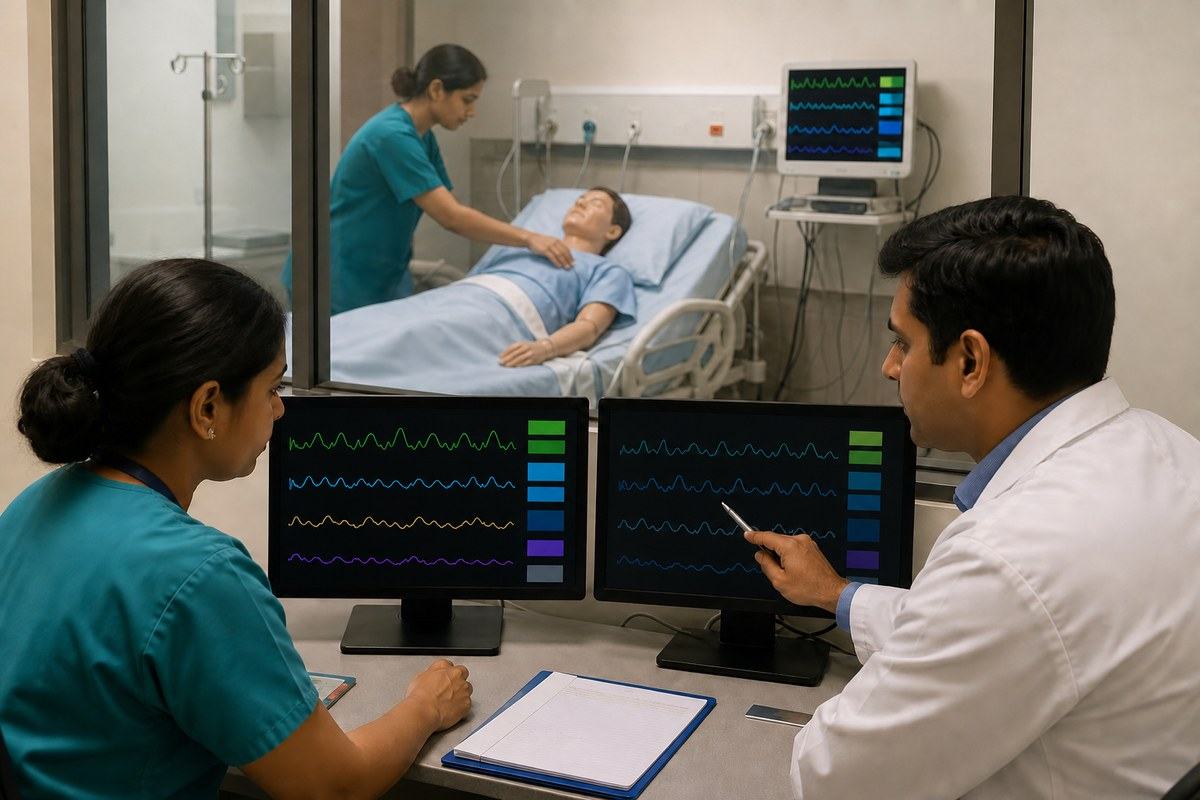
It is just a line in a work queue, a small flag in a clinical screen, a quiet suggestion that an image deserves another look or a patient needs closer attention. There is no dramatic machine in the room. No metallic voice. No glowing intelligence. In a Calcutta diagnostic center, or a rural American emergency department, or a large hospital with polished floors and tired staff, the first contact with AI will often look like something disappointingly ordinary: a message, a score, a risk label, an extra box on an already crowded screen.
That ordinariness is the danger.
People like to talk about the model. The model has the glamour. The neural network finds the lesion. The classifier predicts deterioration. The language model summarizes the record. The image system marks a shadow. The venture slide says transformation is coming.
But the model is only the visible object.
What matters more is the invisible structure around it: the validation, regulation, governance, data quality, monitoring, workflow design, accountability, consent, security, training, and cultural adaptation that decide whether the model becomes a clinical tool or a quiet hazard.
I think of this as shadow architecture.
What The Shadow Holds
Shadow architecture is everything that must exist before clinical AI can be trusted near real care.
It includes data governance, privacy rules, validation protocols, human review, model monitoring, EHR integration, regulatory pathways, liability frameworks, escalation rules, audit logs, bias checks, documentation standards, user training, patient communication, and the boring committees that keep large systems from behaving like enthusiastic amateurs.
A bridge is not only the span over the river. It is soil testing, load calculation, inspection, maintenance, traffic rules, drainage, emergency planning, and the accumulated knowledge of how bridges fail. Clinical AI is similar. The model is the span. The shadow architecture is why people can cross without thinking about every bolt.
The point is not to make doctors stop thinking.
The point is to make the system safe enough that doctors can think about the patient instead of the hidden failure modes of a software product.
Trust in medicine is not decorative. It is infrastructure. A patient may never know whether an algorithm contributed to a radiology worklist, a risk score, or a documentation summary. But someone must know. Someone must have tested it. Someone must be watching whether it drifts. Someone must be responsible when it is wrong.
Without that, AI is not intelligence entering care. It is uncertainty entering through the side door.
The Cast Is Larger Than The Demo
Clinical AI cannot be built by AI researchers alone.
Regulatory scientists at the FDA, EMA, Health Canada, and other agencies have to decide how to evaluate software that may change over time. Traditional medical devices were easier to imagine: a fixed object, a fixed mechanism, a known intended use. AI systems, especially learning systems, behave differently. They may be updated, retrained, tuned, or monitored against new data. Regulation has to handle motion.
Clinical informaticists translate between medicine and computation. They know that an AUC of 0.95 can be useless if the output arrives at the wrong time, in the wrong screen, after seventeen clicks, or in a form no clinician can act on. AUC, area under the receiver operating characteristic curve, is a performance measure. It is not a workflow.
Data engineers build pipelines that must be secure, reliable, standardized, and flexible. They deal with the actual material of healthcare data: EHR records created for billing and care, scanned documents, inconsistent codes, lab values with different reference ranges, identifiers that do not match, and notes full of shorthand.
Ethicists and patient advocates ask who is left out, who is harmed by false positives, who is harmed by false negatives, who benefits from early detection, who can access follow-up, and whether consent means anything when a machine participates silently in a decision.
Hospital administrators must fund the invisible work: monitoring, governance, integration, testing, review boards, incident response, model retirement plans. These rarely look exciting on a budget sheet. They are also where safety lives.
Clinicians have to use or ignore the tool under pressure. Patients provide the bodies, histories, outcomes, and risks from which the systems learn.
The AI researcher is one character in the room, not the room itself.
Why We Needed It Before We Named It
Medicine has needed shadow architecture since the first hospital system digitized anything.
But the urgency sharpened in the 2010s, when deep learning began showing striking performance in image tasks. Deep learning means artificial neural networks with many layers that can learn complex patterns from large datasets. Around 2016, systems trained on retinal photographs demonstrated strong performance detecting diabetic retinopathy. Similar excitement spread through radiology, pathology, and clinical prediction.
The headlines celebrated the algorithm.
The hard question was what to do with a working algorithm.
How should it be validated outside the training institution? How should it enter the EHR? Who is responsible if a physician follows it and it is wrong? Who is responsible if a physician ignores it and it was right? How does the system explain itself? How often must it be rechecked? What happens when patient mix changes, machines change, documentation habits change, or a new scanner produces slightly different images?
The FDA had to develop software-oriented frameworks, including Software as a Medical Device, or SaMD. In 2017 and afterward, these frameworks kept evolving. For adaptive AI, the FDA has explored the idea of predetermined change control plans, where developers specify expected model changes and how those changes will be validated. That is a practical answer to a difficult problem: if every update requires full premarket review, useful systems stagnate; if updates are unconstrained, safety becomes a slogan.
This is the bridge being built while people are already crossing.
Where It Appears
Clinical AI is not one thing.
In diagnostic imaging, models detect pulmonary nodules on CT, fractures on X-ray, intracranial hemorrhage on non-contrast head CT, or suspicious patterns in mammograms. Imaging is attractive because the data is already digital and pattern recognition is a natural strength of deep learning.
In pathology, whole-slide imaging allows algorithms to count mitoses, grade tumors, or detect morphological patterns associated with molecular markers. A field long tied to microscopes becomes computational without becoming simple.
In clinical decision support, models estimate sepsis risk, readmission probability, deterioration, or likelihood of benefit from a care pathway. This is messier than imaging because the data arrives through workflows, timestamps, notes, labs, orders, and missingness. The noise is not accidental. It is part of the system.
Natural language processing extracts structured facts from clinical notes, summarizes histories, suggests documentation, or searches for concepts buried in text. Medicine produces enormous amounts of text. It also hides meaning there.
Drug discovery uses generative models for molecular design, protein work, and trial optimization. Operational AI touches scheduling, bed management, staffing, supply chain, and resource allocation.
Each use case needs its own validation and governance. An image classifier is not a sepsis predictor. A documentation summarizer is not an autonomous diagnostic system. A scheduling model is not a pathology model. Their risks differ. Their users differ. Their failures differ.
The phrase “AI in healthcare” is convenient. It is also dangerously broad.
Failure Is Not Theoretical
Software has harmed patients before.
The Therac-25 radiation therapy machine in the 1980s caused fatal overdoses because of software and interface failures, including race-condition behavior. The lesson was not that software must stay out of medicine. The lesson was that medical software fails in ways people do not always see until harm has already happened.
More recently, widely deployed prediction systems, including sepsis models, have faced serious criticism after external examination showed poor performance, bias, or limited usefulness in practice. Deployment is not validation. A model used in a hospital is not automatically a model that works for that hospital.
False negatives can miss dangerous conditions. False positives can create unnecessary procedures, anxiety, cost, and overload. Biased training data can produce tools that work well for groups well represented in the data and poorly for others. A system trained in one hospital may fail in another because the patient mix, scanner, EHR, workflow, or documentation culture is different.
The danger is not only that AI will be wrong.
Humans are wrong too.
The danger is that AI can be wrong with institutional authority, at scale, inside workflows that make disagreement difficult.
The Layers
The data layer comes first.
Medical AI is trained on health data, and health data is abundant but uneven. EHRs were not designed primarily for research. They serve care, billing, compliance, operations, and documentation. Notes are free text. Codes may reflect reimbursement as much as biology. Lab values vary by institution. The same patient may appear under slightly different identifiers across systems. Some groups are overrepresented. Others are missing or semantically thin.
The shadow architecture here includes access rules, audit trails, encryption, role-based controls, consent where appropriate, and governance that defines who may use data, for what purpose, under what oversight. It also includes standardization pipelines. HL7 FHIR, DICOM, and HL7 messages help systems exchange information. FHIR handles many clinical data resources. DICOM is central for medical imaging. HL7 v2 still moves huge volumes of messages.
Data quality assessment matters as much as volume. Are values accurate, complete, timely, representative, and comparable? Are rare conditions visible? Are missing fields random, or do they reflect access and workflow? Synthetic data, federated learning, differential privacy, homomorphic encryption, and secure multi-party computation all try to let institutions collaborate or protect privacy without careless exposure. None are magic. All are part of the toolkit.
The model development layer must go beyond standard machine learning metrics. Accuracy, precision, recall, F1 score, and AUC are useful, but clinical validation also needs external validation on other institutions, temporal validation on later data, subgroup analysis, and clinical utility studies. A model can be accurate and useless if it does not change decisions, arrives too late, or recommends what clinicians already know.
Human-AI interaction design is part of safety. Alert fatigue can make clinicians ignore even important warnings. Explanations must be useful, not decorative. Confidence and uncertainty must be communicated. The output must appear at the point of decision, not hidden in a tab no one opens.
Version control and monitoring are essential. Models drift. Clinical practice changes. Patient populations shift. New devices alter inputs. Documentation habits change. A model needs performance monitoring, calibration checks, retraining rules, retirement criteria, and incident response.
The regulatory layer must balance caution and adaptation. SaMD frameworks, risk categories, premarket review, post-market surveillance, and change control plans all belong here. The law has to understand that an AI model is neither a pill nor a stethoscope.
The deployment layer is where elegant systems often suffer. EHR integration can require months of negotiation and custom work. Major vendors dominate the market and are not always easy to customize. Training must go beyond button-clicking. Clinicians need to know what the tool does, what it does not do, when to trust it, when to override it, and how to report failure.
The ethical and social layer asks the questions code cannot close. Who is excluded? Who is over-alerted? Who is under-detected? Does the patient need to know AI contributed? What counts as informed consent? How will the workforce change? Who benefits from automation, and who becomes more closely monitored by it?
The Tools Beneath The Tools
The shadow architecture depends on technologies that are not always labeled as AI.
EHRs, PACS, and health information exchanges make clinical data digital and movable. Cloud computing makes large-scale model training, image processing, and real-time serving possible. Privacy-preserving methods allow collaboration under constraint. Interoperability standards give systems common languages. MLOps, meaning machine learning operations, brings engineering discipline to deployment, monitoring, updating, rollback, and retirement.
Regulatory science and health policy research matter too. They study how to evaluate emerging technologies, how to design incentives, and how to balance innovation with public safety. Human factors engineering and cognitive science matter because clinical AI is used by tired humans in complex systems, not by idealized rational agents floating in a white paper.
The less glamorous pieces may decide whether the glamorous piece survives contact with care.
What We Misunderstand
AI will not simply replace doctors.
It will change what clinicians do, but medicine is not only pattern recognition. It is judgment, communication, prioritization, uncertainty, and responsibility. A model can see a pattern. It cannot carry the whole covenant of care.
Accuracy is not enough. An accurate model can be clinically useless, badly timed, unfair, too noisy, too expensive, or harmful through overdiagnosis. Utility depends on context and counterfactual: what would have happened without it?
The main barrier is not always technology. Often it is governance, validation, integration, liability, training, monitoring, and trust. Compute can be purchased. Trust has to be built.
Regulation does not simply stifle innovation. Good regulation makes adoption possible by creating confidence. Patients and clinicians will not accept clinical AI at scale without some assurance that the system has been tested, monitored, and governed.
The most uncomfortable truth is that clinical AI is already being deployed while the shadow architecture remains incomplete. The gap between what should exist and what does exist is where risk accumulates.
The second uncomfortable truth is that the shadow architecture will never be complete. Medicine changes. Software changes. Society changes. The work is permanent.
The Patient Does Not Need A Demo
The patient does not care about neural networks.
The patient cares whether the person in charge is competent, attentive, accountable, and honest about uncertainty. The patient cares whether the tool helps or quietly rearranges risk. The patient cares whether a flagged result leads to timely care, whether a missed result is caught, whether bias has been tested rather than denied.
Clinical AI will not be judged only by model performance. It will be judged by the integrity of its surroundings.
In Calcutta, a bridge can look solid from the road while the underside tells another story: water marks, exposed reinforcement, patched concrete, the small signs that decide whether a structure is merely standing or actually safe. Clinical AI has an underside too. Most people will never see it. That does not make it less important.
The alert remains on the screen. A clinician glances at it, then at the patient, then back at the record. Somewhere behind that small moment should be a chain of validation, monitoring, governance, and responsibility strong enough to bear the weight of trust.
If that chain is missing, the machine should wait.
Healthcare IT consulting
Working through a difficult clinical data or interoperability problem?
I advise on HIE and EHR architecture, HL7/FHIR interoperability, clinical data migration, terminology, analytics, and AI data readiness.
Word Cloud
Related reading
Selected by shared topics and section, with closer publication dates breaking ties.