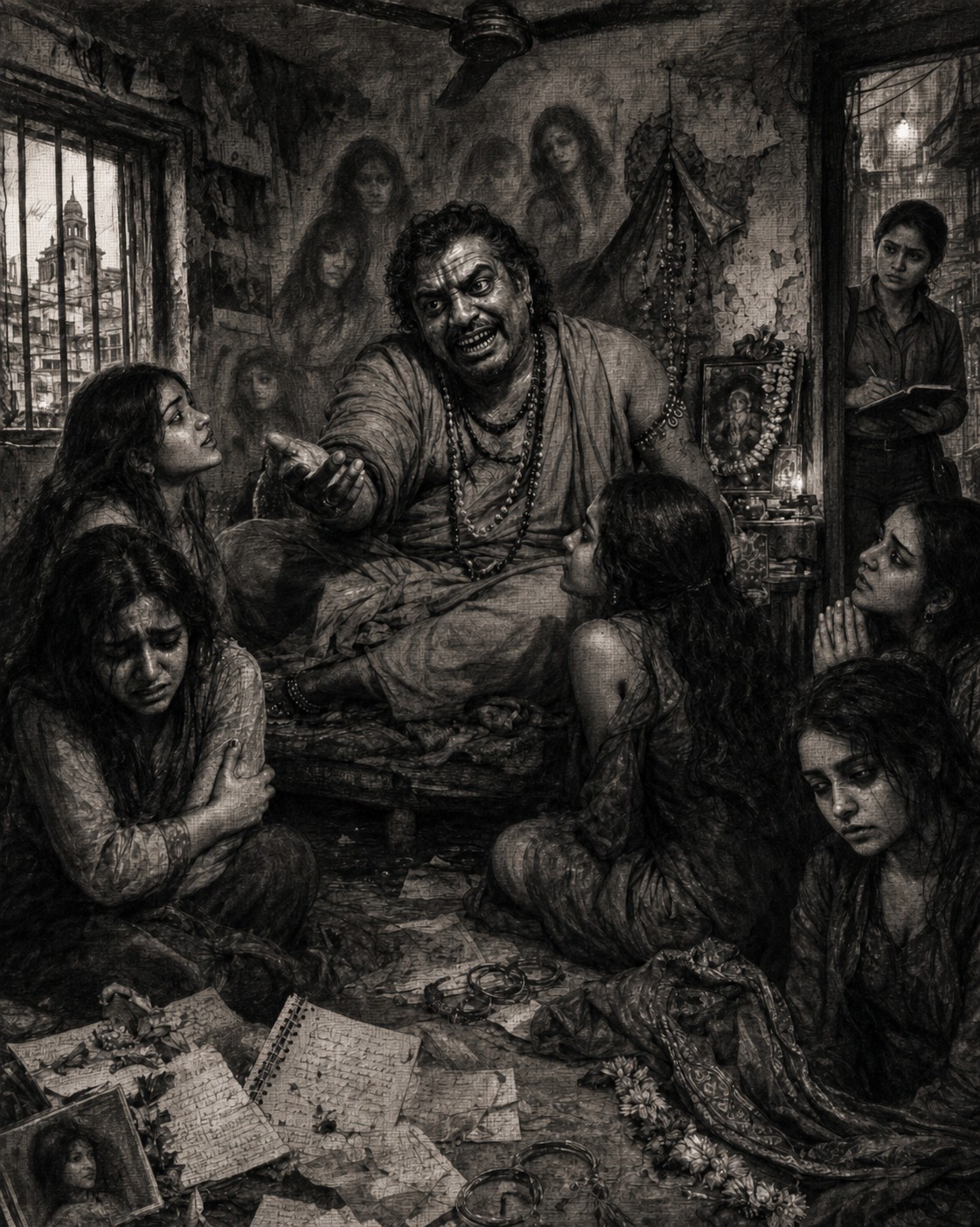
Blood Sugar
Uses the speech voice supplied by your browser or device.

THIS IS A WORK OF FICTION
Rini’s tiffin carrier came back smelling of fish, but she had packed luchi and alur dom.
She stood outside Flat 3B with the wrong carrier in both hands. It was steel, round, and warm. A smear of mustard oil shone on the lid. Her own carrier had a red ribbon tied to the handle because three people in the building had the same size carrier and one person, namely Bappa from 2A, could not read labels even when they were large enough for buses.
This carrier had no ribbon.
It had a drop of something sticky on the side.
Rini wanted only one ordinary thing: her own lunchbox back before school reopened on Monday. If she returned without it, Ma would say, “How does a child lose a tiffin inside her own building?” and Rini would have no answer except, “By living among confused people.”
The door of 3B was always shut.
Behind it lived Arjun-da, though nobody called him da to his face because nobody saw his face. He had not stepped outside in three years, said the aunties. He ordered food every evening. He paid through a crack in the door. Delivery boys came down the stairs pale and quiet, as if Flat 3B had swallowed their jokes.
Rini knocked.
Nothing.
She knocked again.
“Wrong flat,” said a voice from inside.
“You do not know that yet,” Rini said.
There was a pause.
“You are the girl from 2C,” the voice said. “You had mango pickle at lunch and you are carrying fish curry.”
Rini looked at the carrier. “How do you know?”
“Too much mustard oil. Too little patience.”
The chain rattled. The door opened a crack. One eye looked out. The eye was tired and clever. Around it was a large cheek, a dark hallway, and the smell of old books, medicine, and rice.
“I am looking for my tiffin,” Rini said. “It has a red ribbon.”
“Your tiffin is upstairs,” said Arjun.
“How do you know?”
“It tastes worried.”
Rini considered running away. Then she remembered Ma’s face if the tiffin was lost. She stayed.
“Tiffins do not taste worried,” she said.
“This building disagrees.”
The door began to close.
“Wait!” Rini pushed the wrong carrier forward. “If mine is upstairs, whose is this?”
Arjun did not touch it. His eye sharpened.
“Mitali’s,” he said softly.
“Who is Mitali?”
“My mother.”
That was when Rini heard a faint clatter from above. Not a normal clatter. A small metal sound, then a bump, then someone whispering, “Shh!”
Arjun heard it too. His hand tightened on the door.
“Go home,” he said.
“Not without my tiffin.”
“This is not your matter.”
“My tiffin is literally in the matter.”
Another sound came from upstairs. A child’s cough. Then silence.
Arjun opened the door wider.
He was very large, larger than any person Rini had stood so near. His hair was untidy. His kurta was clean but old. He held the door as if the hallway might rush in and knock him over.
“Do not stare,” he said.
“I am not,” Rini said, though she had been.
“You are.”
“Only because you said my tiffin tastes worried.”
Something like a smile moved over his face and disappeared.
“Come,” he said. “Slowly.”
Flat 3B was dim even in the afternoon. Newspapers stood in piles. A computer screen glowed blue on a desk. Beside it was a plate of untouched rice. Rini noticed three jars of sugar on a shelf, all labelled in careful handwriting: white, brown, emergency.
“Why emergency sugar?” she asked.
“For people whose sweetness falls too low.”
“People have sweetness?”
“Blood sugar,” said Arjun. “A kind of fuel in the blood. Too much is trouble. Too little is also trouble.”
“How do you know if it is too little?”
He tapped his tongue. “I can taste it.”
Rini waited for him to laugh. He did not.
“You taste people’s blood?”
“Not like a vampire in bad cinema. I taste clues. Through walls, doors, sometimes air. Sweetness. Salt. Fear. Fever. Lies, if they are very fresh.”
“That is disgusting.”
“Yes.”
“And useful.”
“Also yes.”
Arjun looked towards the ceiling. “There are three children upstairs in 4A. One is hiding. One is frightened. One is getting faint.”
Rini knew 4A. It belonged to Mrs Banerjee, who gave music lessons and had a grandson named Neel who always carried glucose biscuits because of a medical problem nobody was supposed to make fun of.
“Neel,” Rini said. “His sugar drops sometimes.”
Arjun nodded. “It is dropping now.”
The ordinary lost tiffin suddenly became much less ordinary.
They went into the hallway. Arjun paused at his own doorway. His breathing became loud.
“You have not come out in three years?” Rini asked.
“Who told you?”
“Everyone.”
“Everyone is too many people.”
“Today only one is asking.”
He looked at her. “Do not be kind in that sharp way. It is confusing.”
“Then walk.”
He stepped out.
The hallway did not explode. The green paint did not peel from shock. The old lift did not start working, which proved it was not a magical day in every respect. Arjun gripped the railing and followed Rini up the stairs.
On the landing between floors, old Mrs Gomes opened her door. “Arjun?”
He froze.
Rini said quickly, “Aunty, emergency.”
“What emergency?”
“Tiffin emergency.”
Mrs Gomes accepted this at once. In Calcutta, food containers had caused many serious situations.
On the fourth floor, the door of 4A was half open. From inside came a whisper.
“I told you not to take it!”
“It was only a joke!”
“He looks funny when he gets scared.”
Rini pushed the door. “Hello?”
Three boys stood near the dining table. Neel sat on the floor, pale and sweaty, with his schoolbag in his lap. Beside him was Rini’s tiffin carrier, red ribbon and all. A packet of glucose biscuits lay on top of a cupboard, just out of reach.
The tallest boy, Ronit, tried to look bored. “Why are you here?”
“For my tiffin,” Rini said. “And because Neel looks like curd left in the sun.”
“He is acting.”
Arjun entered behind her.
The boys stopped being bored.
Arjun did not shout. He only looked at Neel.
“He needs sugar,” he said.
Ronit swallowed. “We were going to give the biscuits back.”
“When?” Rini snapped. “After he turned into furniture?”
Neel gave a weak laugh, then leaned his head against the wall.
Arjun crossed the room faster than Rini expected. His hands shook, but they were gentle. He took the biscuit packet from the cupboard, opened it, and gave one to Neel.
“Small bites,” he said. “Then water.”
Rini fetched water from the kitchen. It tasted faintly of the metal jug. Neel drank. Colour returned to his lips, slowly.
“I did not steal your tiffin,” he whispered to Rini.
“I know.”
“Ronit swapped them because he said my lunch was boring.”
Ronit looked at the floor.
Rini opened her tiffin. Inside were two luchis, folded like tired moons, and alur dom with a red oil ring. Neel’s eyes followed the food.
“Share,” said Arjun.
“It is mine,” Rini said automatically.
Arjun raised one eyebrow.
Rini sighed and tore a luchi in half. “Fine. But he gets the smaller half because justice.”
Neel grinned.
They sat on the floor and ate. Arjun did not eat, but he watched as if the sight fed something in him. Mrs Banerjee returned from the market halfway through and nearly dropped a bag of tomatoes.
“Why is my grandson on the floor? Why is Arjun here? Why is Ronit looking like a wet school sock?”
Everyone answered at once.
The story came out in pieces. Ronit and the other boys had swapped tiffins after music class. They had hidden Neel’s biscuits to make him chase them. Then Neel had gone pale and shaky, and the joke had stopped being a joke. They had not known what to do. So they had done the worst thing children and grown-ups both do when ashamed.
They had waited.
Mrs Banerjee hugged Neel first and scolded him second for not calling. Then she scolded Ronit with such exactness that Rini almost felt sorry for him.
“Say sorry,” Rini whispered.
Ronit muttered, “Sorry.”
“To Neel, not to your own shoes.”
Ronit looked up. His ears were red. “I am sorry. I thought it would be funny.”
Neel looked at the empty biscuit wrapper. “It was not.”
“I know.”
That was the first useful thing Ronit had said.
Then everyone looked at Arjun.
He was standing near the door, one hand on the wall. His face had gone grey.
“Too many tastes?” Rini asked quietly.
He nodded.
“Then come down.”
“I cannot.”
“You already came up.”
“Down is different.”
“Down has tea.”
This was a strong argument.
By the time they reached the second-floor landing, half the building knew. Mrs Gomes had told the milkman, who had told the guard, who had told a delivery boy, who was now staring at Arjun as if he were a festival idol made of nervousness.
Arjun shrank back.
Rini stepped in front of him. “Move. He saved Neel.”
“I only tasted something,” Arjun said.
“You walked upstairs,” Rini said. “That is more than tasting.”
Mitali, Arjun’s mother, stood at the doorway of 3B. She was small, white-haired, and holding a kitchen towel twisted in both hands.
“Arjun,” she said.
He looked ashamed. “I came out.”
“I can see that.”
“I did not faint.”
“I can see that too.”
For a moment they only looked at each other. Then Mitali opened her arms. Arjun bent down and let his mother hold him in the hallway, in front of everyone. Nobody laughed. Even Ronit had the sense to be still.
Later, because Calcutta turns fright into snacks when possible, Mrs Banerjee made lime water and puffed rice with mustard oil, onion, and green chilli cut very small. Neel was given proper food and another biscuit. Rini got her tiffin back. Ronit was made to wash all three carriers.
Arjun sat on a plastic chair near the open door of 3B. The chair complained, but held.
“What does the building taste like now?” Rini asked.
He considered. “Less frightened. More onion.”
“And me?”
“Curious. Bossy. A little hungry.”
“That is not a special power. Everyone knows that.”
He laughed then. It was rusty, but it worked.
When evening came, Arjun walked down to the tea stall for the first time in three years. Rini went with him, carrying emergency sugar in her pocket because it felt official. The lane smelt of frying batter, wet dust, and tram wires warming in the dusk. People stared, then pretended not to stare, which was the Calcutta way of being polite and nosy at the same time.
At the stall, Arjun ordered tea.
“How much sugar?” asked the tea seller.
Arjun looked at Rini. Rini looked at Neel, who had come down with his grandmother and was holding his biscuit packet like a medal.
“Enough,” Arjun said. “Not too much.”
The tea seller nodded solemnly, as if this were wisdom.
Rini took a sip from her own small clay cup. The tea was too hot and too sweet. It burnt her tongue in the ordinary way. She liked it.
Arjun lifted his cup and looked at the lane, the balconies, the water tank, the people carrying their hidden sweetness and trouble around inside them.
“Can you taste the whole city?” Rini asked.
“A little.”
“Is it horrible?”
He thought for a while. “It is noisy. Bitter in places. Too sweet in others. But not horrible.”
“What is it, then?”
Arjun smiled, and this time the smile stayed.
“Alive,” he said.
On Monday, Rini took her tiffin to school with the red ribbon tied twice as tightly. Inside were luchi, alur dom, and two glucose biscuits she did not need but carried anyway. She also wrote ARJUN-DA KNOWS on a small paper slip and tucked it under the lid. In Calcutta, adventures often began with a missing lunchbox. It seemed sensible to be prepared.
Word Cloud
Related reading
Selected by shared topics and section, with closer publication dates breaking ties.