The Geometry of Absence
Uses the speech voice supplied by your browser or device.

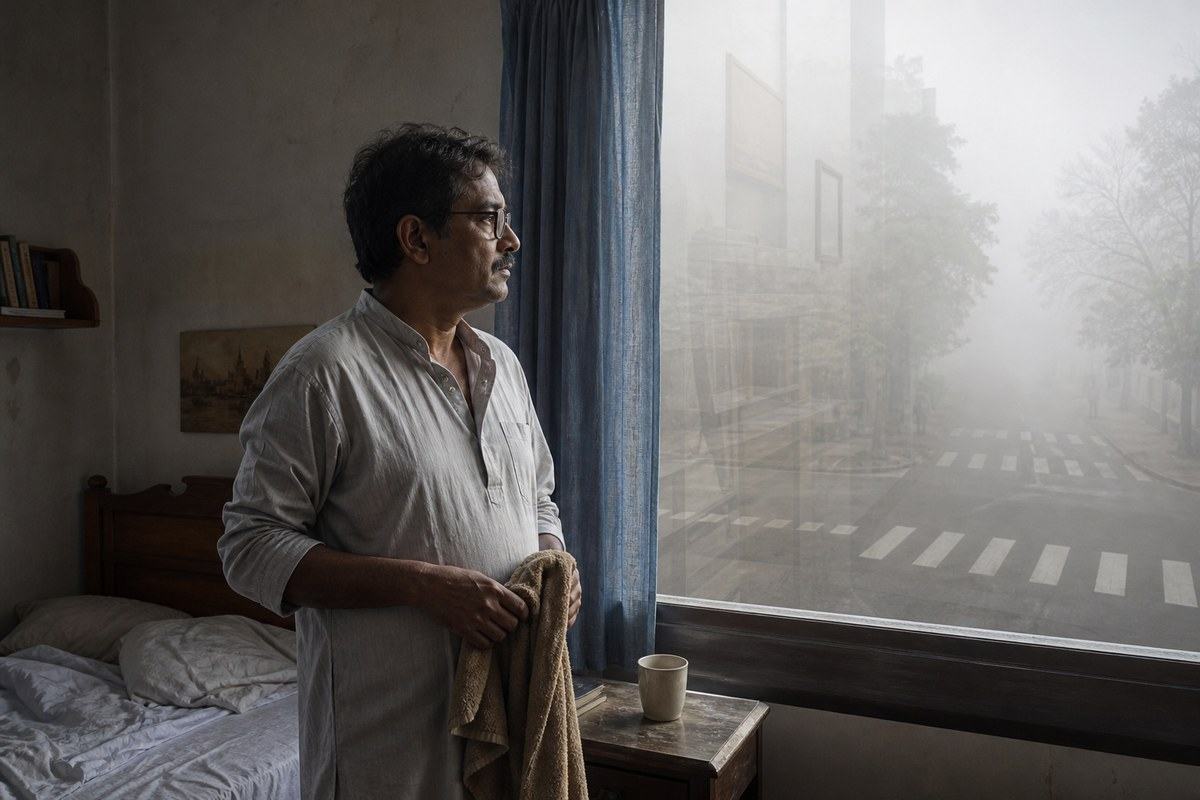
The ceiling fan in my study turns with the lethargic indifference of a bureaucrat processing paperwork on a Friday afternoon, each rotation a small, humid triumph against the June air that presses against the windows like a creditor demanding entry. I have been watching it for eleven minutes, which is not meditation but merely the neurological equivalent of a screensaver, the brain’s default mode network flickering on while the prefrontal cortex takes a cigarette break. Outside, somewhere in the labyrinth of Calcutta that I have navigated for a few years now, the city performs its eternal choreography of density—rickshaws threading through traffic with the precision of antibodies, the Metro rumbling beneath Park Street like a mechanical bowel movement, and somewhere in Taratala, the wreckage of a warehouse still fresh from its collapse four days prior, concrete and rebar forming a grotesque origami of municipal incompetence. Five dead. Eighteen trapped. The Chief Minister suspending construction until July 31, as if calendars could contain catastrophe. I read this in the morning paper over tea that had grown cold, and felt the familiar sensation of living in a city where the infrastructure of trust collapses with slightly less fanfare than the infrastructure of concrete.
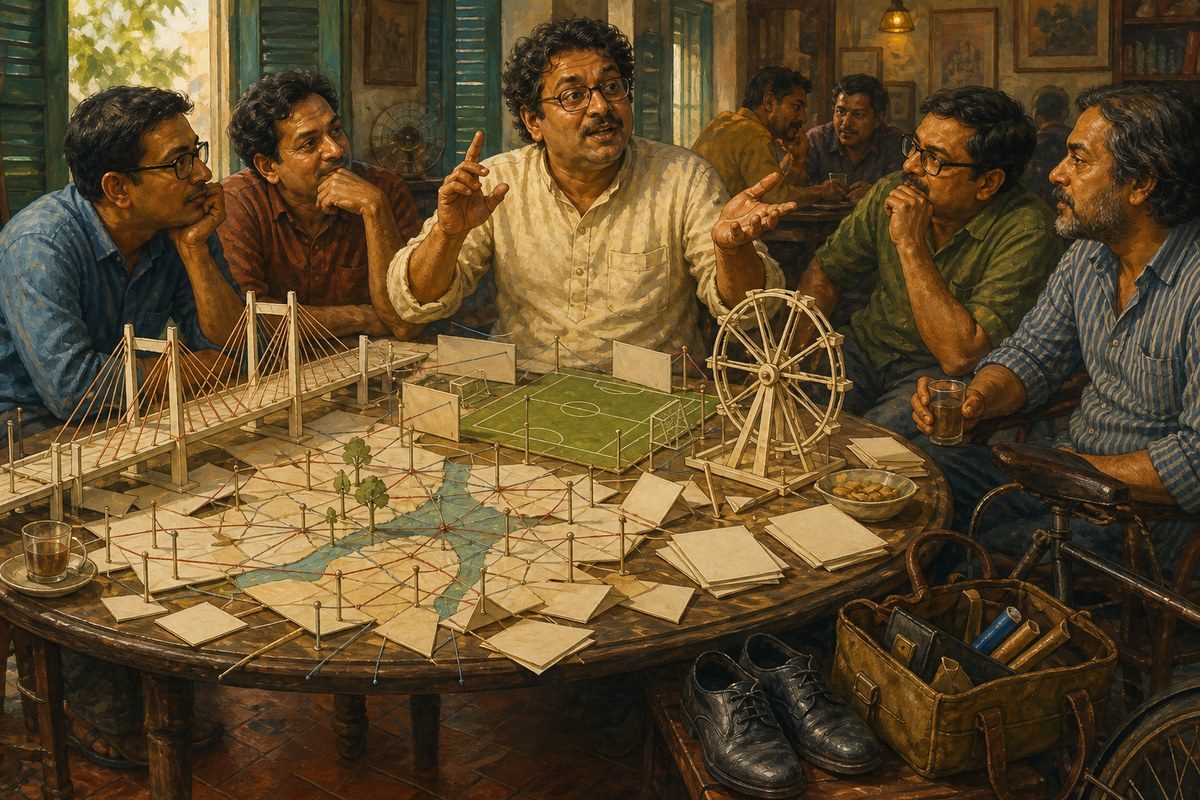
I am not at the scene. I am never at the scene. This is not virtue or cowardice but arithmetic: the probability of my presence at any given catastrophe is inversely proportional to the number of people already gathered there. The mathematics of crowds has always fascinated me, not in the abstract way of a sociologist who publishes papers with titles like “Emergent Behavior in Urban Congregations,” but in the visceral, stomach-level understanding of someone who has spent too many evenings in rooms where the oxygen depletes faster than the conversation. There is a critical threshold, I have observed, in any Bengali assembly—a tipping point that Malcolm Gladwell might have written about had he grown up in a middle-class Calcutta flat instead of Ontario. Three people constitute a conversation. Four is still manageable, a quadrilateral of discourse where each vertex can maintain eye contact without chiropractic intervention. But five? Five is where the geometry shifts. Five is where alliances form, where the room divides into acute and obtuse angles, where someone is always speaking and someone is always waiting to speak and someone is always wondering why they came.
This is not paranoia. This is topology.
I learned this lesson not in Calcutta, where the density of humanity makes such observations as obvious as humidity, but in the antiseptic corridors of American cities where Bengali congregations attempt to replicate the adda culture of College Street in the fluorescent-lit community centers of Texas, for instance. I remember, with the crystalline precision of trauma, a Diwali gathering in a suburb of San Antonio where the room held perhaps thirty people, and the fractal pattern of their arrangement revealed itself to me with the slow horror of a developing Polaroid. The Gujaratis had claimed one corner, a dense cluster of saffron and gold, their children running in tight orbits like electrons bound by strong nuclear force. The South Indians occupied another quadrant, their conversations flowing in the melodic cadences of Tamil and Telugu, a unified front of cultural coherence. And the Bengalis? The Bengalis were distributed across the room like a gas expanding to fill its container, no two molecules maintaining proximity for more than a few minutes before the repulsive forces of incompatible opinions drove them apart. I watched a man in his fifties, a professor of something something at a state university, extricate himself from a conversation about Tagore with the surgical precision of someone removing a splinter, only to find himself cornered by a woman who wanted to discuss property prices in Salt Lake. His eyes, I noticed, had the glazed desperation of a fish that has discovered too late that it is swimming in air.
The ABCDs—American-Born Confused Desis, that charming acronym that manages to be simultaneously affectionate and condescending—moved through this landscape with the practiced invisibility of wildlife photographers, their iPhones held at chest height, capturing evidence of cultural performance that they would later dissect in group chats with the anthropological detachment of Margaret Mead observing Samoan adolescents. They were not confused, I realized. They were simply fluent in a language of belonging that their parents had never fully learned, the dialect of optional participation. They could enter and exit these gatherings at will, their passports to other identities stamped and valid. I envied them their mobility, their capacity to be present without being implicated, to observe without the obligation of performance.
But I was not an ABCD. I was something worse: a voluntary exile who had chosen to return, a man who had tasted the thin air of individualism and found it breathable but flavorless, who had come back to Calcutta not because he belonged but because he could not bear the alternative. The NRI gatherings were my purgatory, a liminal space where I was neither fully immigrant nor fully native, where my accented Bengali marked me as foreign and my foreign manners marked me as pretentious. I attended them out of a sense of obligation that I could never fully articulate, a debt to a community that I had never asked to join and could not bring myself to leave. I would stand in kitchens—always kitchens, the sacred hearth of diasporic reproduction—holding a plate of lukewarm biryani and listening to conversations about real estate appreciation in Whitefield, Bangalore, or the latest political catastrophe in Kolkata, and I would feel the loneliness that only comes from being surrounded by people who are supposed to understand you.
There is a particular quality to loneliness in crowds, a density of absence that physicists might measure in kilograms per cubic meter of unmet expectation. It is different from the loneliness of solitude, which has the clean edges of a geometric proof, the satisfying closure of a syllogism. Solitude is a choice, or at least a negotiation, a treaty signed between the self and the void. Crowd-loneliness is an occupation, a hostile takeover of the emotional infrastructure by forces that claim legitimacy but deliver only static. I would leave these gatherings with a headache that felt like the physical manifestation of cognitive dissonance, my temples throbbing with the accumulated pressure of unspoken thoughts and suppressed disagreements. I would drive home through streets named for trees that had never grown there, past strip malls that sold the simulacra of authenticity—“India Sweets & Spices,” “Bengal Bazaar”—and I would wonder what I was trying to prove, and to whom, and whether the proof would ever be accepted.
The stratification of these gatherings operated on axes that were invisible to the casual observer but glaringly apparent to anyone who had spent enough time studying the ethnography of their own discomfort. Age was the first and most brutal divider, a tectonic plate shift that separated the silver-haired custodians of cultural memory from the middle-aged executors of practical maintenance from the young who were still deciding whether the inheritance was worth the tax. Gender performed its ancient choreography, women gathering in kitchens and living rooms to discuss the logistics of reproduction—children, marriages, the care of aging parents—while men colonized the periphery, the driveways and backyards, to discuss the abstractions of production: markets, politics, the theoretical futures of nations they no longer inhabited. I would drift between these zones like a particle in a cloud chamber, leaving trails of awkwardness in my wake, neither fully welcomed nor explicitly excluded, merely tolerated with the weary patience of a host whose guest list has grown beyond their capacity for genuine hospitality.
And always, beneath the surface of these interactions, ran the current of comparison. Who had bought a house in which suburb. Whose child had gained admission to which university. Who had maintained their Bengali with what degree of purity, who had allowed it to atrophy into a kitchen language, a tongue for commands and endearments but not for philosophy. I would watch these competitions with the anthropological interest of a field researcher, noting the micro-expressions of envy and superiority, the calibrated modesty of the successful, the defensive aggression of the struggling. It was exhausting in a way that physical labor never is, a fatigue that settled in the marrow rather than the muscle, a depletion of the social self that required days of solitude to replenish.
I do not attend these gatherings anymore. I do not attend any gatherings, if I can help it. My plural has atrophied, shrunk to the point where it can only accommodate the non-human or the entirely imaginary. I have my books, which do not argue. I have my routines, which do not judge. I have the cat that wandered into my flat three years ago and has remained, an independent contractor of affection whose terms I have learned to accept without negotiation. And I have the city itself, Calcutta, which contains multitudes without requiring me to join them.
This is not a retreat from the world so much as a strategic withdrawal, a recognition that the energy required to maintain the performance of belonging exceeds the energy available for the actual work of living. I think sometimes of the concept of “social thermodynamics,” a phrase I encountered in a paper on network theory that I read at three in the morning during one of my periodic bouts of insomnia. The idea, as I imperfectly understand it, is that social systems operate according to principles analogous to those governing heat and energy transfer: relationships require input to maintain, and the entropy of any social network increases over time unless active work is performed to reduce it. The NRI gatherings were, in this framework, high-entropy environments, systems so far from equilibrium that maintaining them required enormous inputs of emotional labor, performative goodwill, the constant production of small talk as a form of heat dissipation. I could not sustain it. My social battery, to use the contemporary metaphor, was not merely depleted but corroded, its capacity permanently diminished by years of overuse.
What remains is not emptiness but clarity, the kind of clarity that comes from removing the noise of competing signals. I can hear the fan now, its rotation a steady white noise that does not demand interpretation. I can hear the distant honking of traffic, the mechanical breathing of the refrigerator, the cat’s paws on the tile floor. These sounds do not judge me. They do not require me to be cheerful, or interesting, or appropriately Bengali. They simply are, and in their simple existence they offer a model of presence that I find increasingly preferable to the exhausting complexity of human interaction.
I think of the warehouse in Taratala, the one that collapsed under the weight of its own flawed design. The metaphor is almost too obvious, the building that could not bear the load it was asked to carry, the structure that failed because its foundations were compromised from the start. But I resist the temptation to make myself the hero of this analogy, the wise man who escaped before the collapse. I was not wise. I was merely tired. I was tired of being the beam that bent under distributed loads, tired of the micro-fractures that accumulated with every social interaction, tired of pretending that the structure was sound when I could feel it swaying beneath my feet.
The city continues without me, as cities do. The Metro trains run their underground circuits, the rickshaws weave their patterns through the traffic, the political machines grind their gears in preparation for the next shift in power. I read about it in the paper, I observe it from my window, I participate in it when participation is unavoidable—the grocery store, the bank, the occasional professional obligation. But I no longer seek the crowd. I no longer believe that density equals connection, that proximity equals intimacy, that the absence of solitude is the presence of community.
There is a word in Bengali, “ekla,” which means alone but carries connotations that English cannot quite capture. It is not merely the state of being solitary but the condition of being singular, of existing as one in a world that is configured for multiples. Rabindranath Tagore wrote of “ekla cholo re”—walk alone—and the phrase has been appropriated by so many motivational posters and graduation speeches that its original urgency has been diluted into platitude. But I think of it differently now. Not as a call to heroic individualism, not as the romantic solitude of the misunderstood genius, but as a practical acknowledgment that some paths are too narrow for company, that some journeys can only be made by one because the terrain does not permit side-by-side walking.
My path has narrowed. I do not regret this. The regret, when it comes, is for the years I spent trying to widen it, trying to accommodate passengers who were never fully committed to the destination, who got on and off at stops I did not choose, who complained about the weather and the speed and the quality of the scenery. I am not bitter about this. Bitterness requires an investment of emotion that I no longer care to make. I am simply… finished. The account is closed. The books have been balanced, and the balance is zero, which is not nothing but merely the absence of debt.
The fan continues its rotation. The afternoon light slants through the window at an angle that suggests the day is aging, moving toward evening with the inevitability of a tide. I have not spoken to anyone today. I may not speak to anyone tomorrow. This is not a problem to be solved but a condition to be inhabited, a climate to be adapted to rather than escaped. The humidity will rise. The monsoon will come. The city will flood in places, as it always does, and the newspapers will publish their photographs of submerged streets and stranded commuters, and I will read about it with the detached concern of someone watching a documentary about a ecosystem they do not inhabit.
I inhabit this room. I inhabit this chair. I inhabit the small circumference of my attention, which has grown more precise with disuse, like a muscle that has learned to perform a single task with increasing efficiency. I can focus on the grain of the wooden desk for minutes at a time, tracing its patterns with my eyes as if reading a map of an unfamiliar country. I can listen to the rain on the windowpane and hear not merely precipitation but the statistical distribution of droplet sizes, the Gaussian curve of their impact velocities, the Poisson distribution of their intervals. This is not madness. This is merely the occupation of a mind that has been relieved of the burden of social computation, freed to attend to the mathematics of the immediate.
The NRI gatherings continue without me, I assume. The same conversations, the same competitions, the same strategic withdrawals to kitchens and driveways and the sanctuary of smartphones. I do not know if I am missed, or remembered, or merely absent in the way that a chair is absent when someone stands up from it—noticed for a moment, then forgotten as the conversation resumes its previous trajectory. I do not need to know. The need to be known, to be accounted for in the ledgers of other people’s attention, is a hunger that diminishes with fasting, a craving that loses its urgency when not indulged.
I am fasting. I have been fasting for years now, and the hunger has become a kind of fullness, a satiety that arrives from the absence of appetite rather than its satisfaction. I do not know if this is healthy. I do not know if health is the appropriate metric. I know only that I am no longer gnashing my teeth, no longer feeling the inner disquiet that used to accompany every social obligation, the pre-performance anxiety of a actor who has forgotten his lines. The stage is empty. The audience has gone home. And I am here, in this room, with the fan and the cat and the afternoon light, and the silence is not empty but full of the sounds that silence makes when it is allowed to exist.
The warehouse in Taratala will be cleared eventually. The dead will be counted, the survivors will be interviewed, the Chief Minister will announce new regulations that will be followed for a season and then forgotten. The city will absorb the catastrophe into its narrative of resilience, its mythology of survival against impossible odds. And I will read about it in the paper, over tea that has grown cold, and I will feel the familiar sensation of living in a place that is too large to be understood and too small to be escaped.
But I am not trying to escape anymore. I am merely trying to occupy my corner of it with something approaching dignity, something that resembles honesty if you squint at it in the right light. The fan turns. The cat sleeps. The city breathes its humid, complicated breath. And I am here, singular, sufficient, and finally—after all these years of trying to be otherwise—alone.
P.S. — On the etymology of “adda”: The Bengali word derives from the Sanskrit “adda,” meaning a designated place, and evolved through Persian influence to mean a gathering or hangout. The sociologist Dipankar Gupta has written extensively on the “adda” as a form of public sphere distinct from the Habermasian model, one that privileges performative intellect over instrumental rationality. I would cite the specific paper if I could remember it, but my memory, like my social circle, has grown selective in its retentions. The concept of “social thermodynamics” referenced above is my own bastardized interpretation of work by Harrison White and others in the field of network sociology; any inaccuracies are mine alone, committed in the privacy of my own ignorance. The warehouse collapse in Taratala occurred on June 24, 2026, and was reported extensively in The Hindu and other outlets; the details of casualties and official response are matters of public record, though the metaphorical weight I have assigned them is entirely private.
Word Cloud
Related reading
Selected by shared topics and section, with closer publication dates breaking ties.